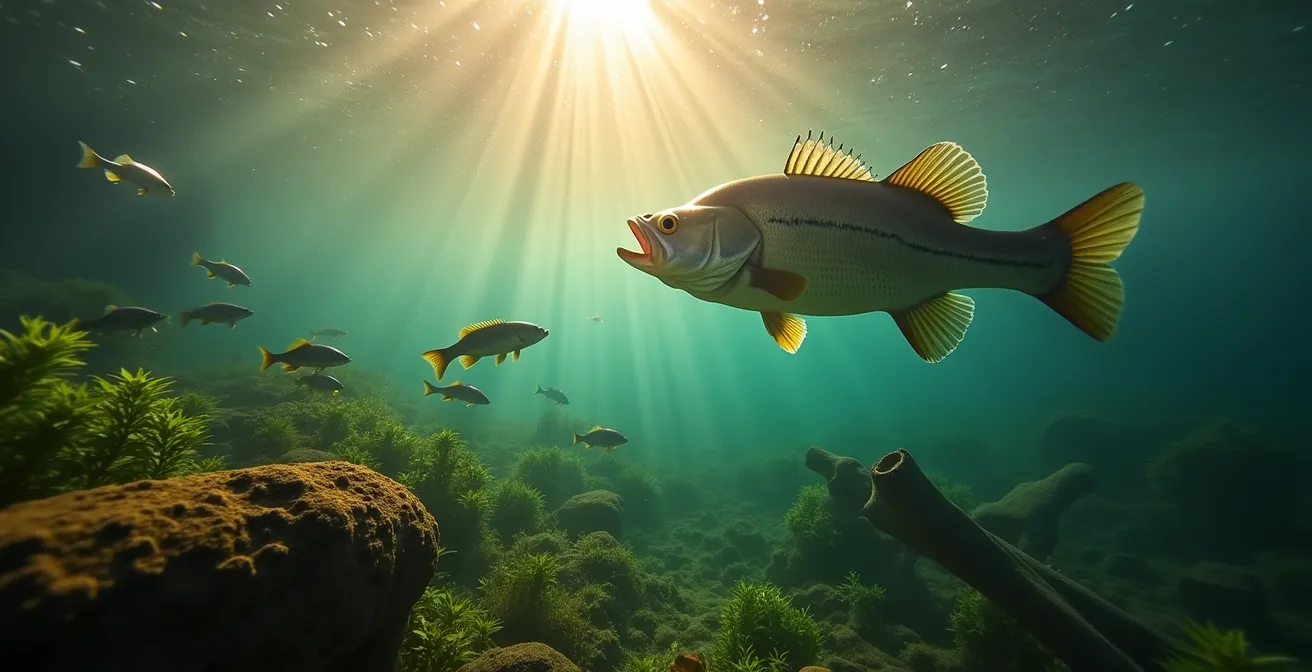
The counterintuitive truth of trophy management is that actively removing smaller predators is often the most critical factor in growing larger fish.
- Overabundant small predators, like stunted bluegill, create an “ecological bottleneck” that consumes the food base without becoming viable prey for trophy-class fish.
- Removing these mesopredators frees up resources, corrects the food pyramid, and allows apex predators like largemouth bass to reach their maximum genetic potential.
Recommendation: Shift your mindset from preservation to active intervention. Implement a strategic harvest of small, overpopulated predators to engineer the specific results you want in your fishery.
For landowners and club members dedicated to cultivating a trophy fishery, the instinct is often to protect every fish. The common wisdom suggests that a larger population equals more opportunities for growth. However, this approach frequently leads to the opposite result: a pond full of small, underfed fish and a frustrating lack of trophy-class specimens. The conventional advice to simply stock more forage fish or stop harvesting bass often overlooks the complex, brutal arithmetic of a closed aquatic ecosystem.
The problem isn’t a lack of fish; it’s a structural imbalance in the food web. This imbalance is governed by powerful ecological principles like trophic cascades and carrying capacity. When mid-level predators—often called mesopredators—become too numerous, they decimate the food base intended for juvenile game fish while being too large themselves to be efficiently preyed upon by the trophies you seek to grow. This creates a permanent bottleneck, stunting the entire population.
But what if the key wasn’t simply adding more, but strategically taking away? This guide abandons simplistic recipes and dives into the science of predator-prey dynamics. We will treat your pond not as a static pool, but as a dynamic system you can actively engineer. By understanding and manipulating the roles of apex predators, mesopredators, and the very foundation of the food chain, you can break through growth plateaus and produce the exact class of fish you desire.
This article will explore the critical management actions that turn a stunted fishery into a trophy factory. We will dissect how to identify population imbalances, the ethics of removing certain species, the importance of biosecurity, and how your own data collection can become a powerful management tool.
For those who prefer a condensed visual summary, the following video outlines key principles for managing a pond to produce trophy bass, complementing the detailed strategies discussed below.
To navigate these advanced concepts, this article is structured to build your expertise from the ground up. The following summary outlines the key ecological levers you’ll learn to pull to take control of your fishery’s destiny.
Summary: Mastering Predator Dynamics for a Trophy Fishery
- How to Identify a “Stunted” Bluegill Population Before It Crashes?
- Kill on Sight: Why Releasing Snakeheads Is Illegal and Unethical?
- Why Releasing the Largest Pike Maintains the Food Chain Balance?
- The Stocking Mistake That Introduces Disease to Your Private Pond
- When to Fertilize a Pond to Boost Plankton Without Causing Algae Blooms?
- How to Determine the Carrying Capacity of a Fenced Reserve?
- The Hull Inspection Step That Prevents Zebra Mussel Transfer
- Citizen Science: How Your Catch Data Helps Restore Native Populations?
How to Identify a “Stunted” Bluegill Population Before It Crashes?
A “stunted” bluegill population is the classic sign of a fishery in distress. The primary indicator is the average size of your catch. If nearly every bluegill you catch is 3-5 inches long and possesses a disproportionately large head and eyes for its thin body, you have a problem. These are not young fish; they are sexually mature adults trapped in an ecological bottleneck. They are too large for most predator bass to eat efficiently, yet too small to be of interest to anglers. This creates a protected class of hyper-abundant mesopredators that dominate the ecosystem.
The underlying driver of this issue is their immense biotic potential. According to Michigan State University research, a single stunted bluegill can produce 20,000 to 40,000 eggs annually, with hundreds of offspring surviving from each female. This explosive reproduction, without sufficient predation pressure, leads to intense competition for resources. As documented by Keystone Hatcheries, this density-dependent growth means that fish in an overcrowded environment grow significantly slower. In their study, 10,000 bluegill in a one-acre pond grew approximately 10 times slower than 1,000 bluegill in the same space. This is the feedback loop: too many fish lead to slow growth, which keeps them in the “stunted” size class, leading to more reproduction and even more competition.
To confirm stunting, conduct a simple catch survey. Use a small hook and bait to sample the bluegill population. If over 80% of your catch falls into that 3-5 inch range and few larger specimens are found, it’s time for aggressive intervention. Your goal is not to preserve this population, but to drastically reduce its numbers to restore balance and re-allocate food resources toward growing larger, more desirable fish.
Kill on Sight: Why Releasing Snakeheads Is Illegal and Unethical?
The introduction of an invasive species like the northern snakehead represents a catastrophic failure in fishery management. Unlike a native predator, which has co-evolved with its prey, an invasive apex predator enters an ecosystem with no natural checks and balances. Releasing a snakehead is not just a poor decision; in most jurisdictions, it is illegal and constitutes a profound ethical breach against the environment. These fish are highly aggressive, reproduce rapidly, and can tolerate a wide range of water conditions, allowing them to outcompete and displace native species with terrifying efficiency.
A snakehead’s impact is a textbook example of negative trophic cascade. They are voracious predators of fish, frogs, and crustaceans, effectively wiping out the forage base that native predators like largemouth bass depend on. This doesn’t just impact the bass; it destabilizes the entire food web. By eliminating the smaller fish and invertebrates, they create an ecological desert where only they can thrive. This is the essence of what biologists call “mesopredator release,” where the introduction of a new, unchecked predator causes a complete collapse of prey populations below it.
The visual contrast between a balanced ecosystem and one dominated by an invasive species is stark. The goal of responsible management is to prevent this type of collapse at all costs.
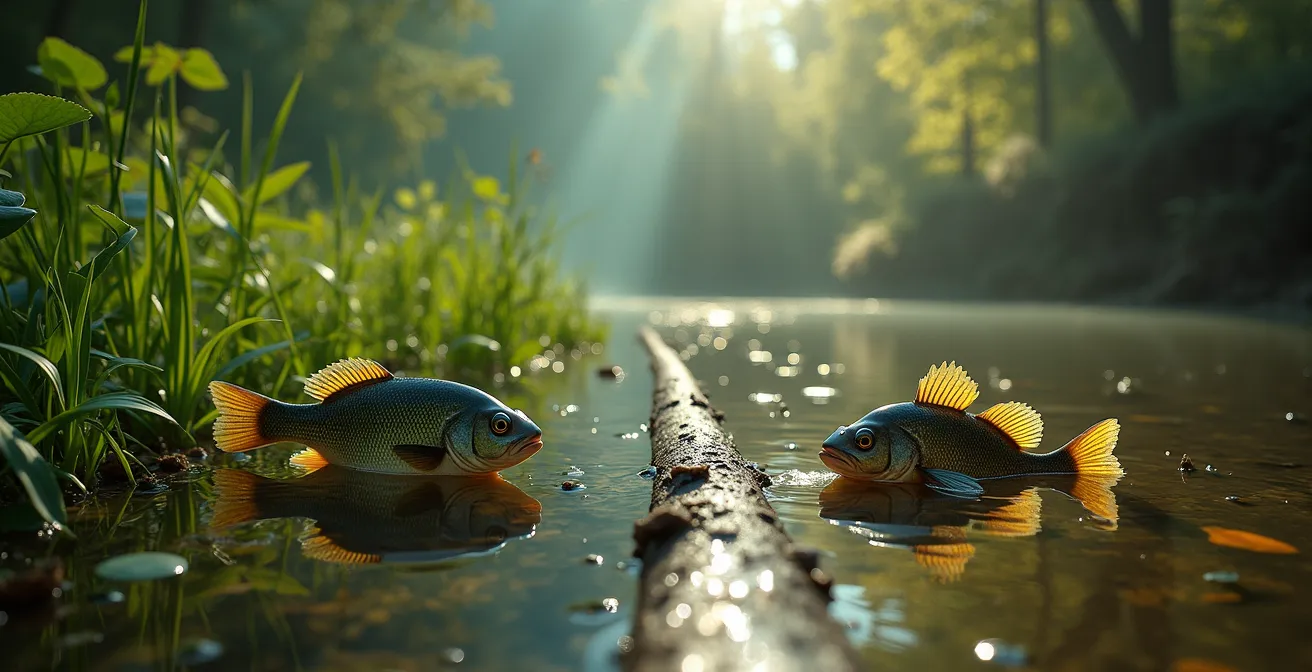
As the illustration above suggests, the result is a murky, simplified, and unproductive system. Because of their devastating impact, the rule for snakeheads is universal: kill on sight. Do not return them to the water under any circumstances. Report the catch to your state’s fish and wildlife agency, as they track the spread of these invasive species. Your action is a critical defense of the native ecosystem you are working so hard to manage.
Why Releasing the Largest Pike Maintains the Food Chain Balance?
In many fisheries, particularly in northern climates, the Northern Pike serves as the true apex predator. The instinct of many anglers is to harvest the largest “gator” pike as a trophy. This is a critical management mistake. These large, mature pike are not just big fish; they are the primary regulators of the entire ecosystem. Releasing them is one of the most important conservation actions a manager can take to maintain a healthy and balanced food chain.
Large pike (typically over 30 inches) fulfill a role that smaller predators cannot. Their primary diet consists of medium-sized fish, including smaller pike, suckers, and perch. By preying on these, they prevent the overpopulation of mesopredators, which in turn protects the smaller forage fish that species like walleye and bass depend on. When you remove the largest pike, you trigger a classic “mesopredator release.” The population of 15-25 inch pike explodes, and they begin to compete directly with other game fish for smaller prey, ultimately stunting the growth of all species.
This isn’t just theory; it’s a documented ecological pattern. Research highlights a direct link between the decline of apex predators and the explosion of smaller ones. As shown by a comprehensive review from Oregon State University, in North America, 60% of mesopredator ranges have expanded as apex predator ranges have contracted. By selectively harvesting smaller, more abundant pike for consumption and releasing the large, old females, you are actively managing this dynamic. You are preserving the “enforcers” of the food web, ensuring that the system remains balanced and capable of producing trophy-class fish of all species, not just pike.
The Stocking Mistake That Introduces Disease to Your Private Pond
While predator management is crucial, it can all be undone by one common mistake: improper fish stocking. Introducing new fish into a closed system without strict biosecurity protocols is like playing Russian roulette with the health of your entire fishery. It’s a leading vector for introducing parasites and diseases like Largemouth Bass Virus (LMBV) or viral hemorrhagic septicemia (VHS), which can be more devastating than a predator imbalance.
Disease can mimic the effects of poor predator management. As documented by SOLitude Lake Management, an outbreak can reduce forage fish populations by up to 50%, effectively starving your trophy fish and halting their growth. They noted a case in a 10-acre Texas pond where a viral infection in the bluegill population prevented bass from reaching trophy size for six years, despite otherwise perfect habitat and harvest strategies. The source of the outbreak was traced back to an uncertified wild fish transfer. This highlights a critical point: the source of your stocked fish matters more than almost any other factor.
A disciplined manager must evaluate the risk associated with every potential source. Wild-caught fish or those from a local bait shop carry an extremely high risk of introducing pathogens that your pond’s ecosystem has no defense against. A certified hatchery that follows rigorous testing and quarantine procedures is always the safest bet.
The following table, based on data from fisheries experts, provides a clear risk assessment framework. It demonstrates why cutting corners on stocking is a gamble you cannot afford to take, as biosecurity is fundamental to success.
| Source Type | Disease Risk | Quarantine Needed | Success Rate |
|---|---|---|---|
| Certified Hatchery | Low (5-10%) | 2 weeks | 90%+ |
| Wild Caught | High (40-60%) | 4-6 weeks | 60-70% |
| Private Pond Transfer | Medium (20-30%) | 3 weeks | 75-85% |
| Bait Shop Stock | Very High (60-80%) | Not Recommended | <50% |
Even with fish from a certified hatchery, a quarantine period of at least two weeks in an isolated tank is a non-negotiable best practice. This allows you to observe for any signs of illness before introducing them into your main population, protecting your long-term investment in the fishery.
When to Fertilize a Pond to Boost Plankton Without Causing Algae Blooms?
Fertilizing a pond is about kick-starting the entire food chain from the bottom up. The goal is not to “feed the fish,” but to feed the microscopic life that feeds the fish. Proper fertilization stimulates a bloom of phytoplankton (microscopic plants), which in turn feeds zooplankton (microscopic animals). This zooplankton is the primary food source for fry and small forage fish like bluegill. By boosting this foundational layer, you create a surplus of food that ripples all the way up to your trophy bass. In fact, according to Pond King biologists, a well-executed fertilization program can increase a pond’s total fish production by up to 400% per acre.
However, timing is everything. Fertilizing at the wrong time or in the wrong amount will not create a healthy plankton bloom, but rather a noxious, stringy, filamentous algae bloom. This type of algae has no food value, can deplete oxygen levels, and can ruin the aesthetics and health of your pond. The key to getting it right is measuring water clarity, which is a direct proxy for plankton density. The standard tool for this is a Secchi disk—a simple, black-and-white disk attached to a measuring line.
The principle is simple: if the water is too clear, the food web is not productive enough. If it’s too murky, you risk an oxygen crash. The ideal “bloom” is a greenish tint to the water with a visibility of 18-24 inches. Fertilization should only begin when visibility is greater than 24 inches and should cease once it drops below 18 inches. This ensures you are stimulating a productive bloom without overshooting the mark and causing a harmful algae takeover.
Your Action Plan: Secchi Disk Fertilization Protocol
- Establish Baseline: Measure water clarity weekly with a Secchi disk at the same pond location and time of day to track trends.
- Identify the Trigger: Begin fertilization only when water visibility consistently exceeds 24 inches, indicating a need for more nutrients.
- Apply Correctly: Use a high-phosphate liquid fertilizer (e.g., 10-52-0) at a rate of 5-8 pounds per surface acre, avoiding application before heavy rain.
- Monitor and Cease: Stop all fertilization as soon as visibility drops below 18 inches. This signals the bloom is at its optimal density.
- Check Preconditions: Never fertilize if the water temperature is below 60°F, as the plankton will not be able to utilize the nutrients effectively.
By following this data-driven protocol, you move from guessing to managing. You are precisely controlling the primary productivity of your ecosystem, ensuring that every pound of forage fish has the maximum amount of food to grow and, in turn, feed your target trophy species.
How to Determine the Carrying Capacity of a Fenced Reserve?
In ecology, “carrying capacity” (often denoted as K) is the maximum population size of a species that the environment can sustain indefinitely. For a pond manager, understanding this concept is fundamental to setting realistic goals. Your pond, much like a fenced land reserve, is a closed system with finite resources. No matter how perfect your management, there is a hard biological limit to the total weight of fish it can support.
As a general rule, Michigan State Extension research shows that most lakes can support between 200-400 pounds of fish per surface acre. This is the “total biomass.” This weight can be composed of 400 one-pound fish or 40 ten-pound fish. Your job as a manager is to decide how that biomass is allocated. If you have a stunted bluegill population, they might constitute 300 pounds of that capacity, leaving only 100 pounds for all other species, including your desired trophy bass. This is why culling small predators is so effective: it reallocates biomass from undesirable fish to desirable ones.
However, the traditional model of carrying capacity being limited only by food and space is being refined. A fascinating study on dingo removal in fenced reserves in Australia revealed that even with apex predators completely removed, mesopredator populations (in that case, foxes and cats) did not explode as expected. Their numbers remained stable or declined due to internal competition for resources. This shows that in a truly closed system without migration, resource availability can be an even stronger limiting factor than predation. This has direct implications for a private pond. If you don’t provide enough food (through fertilization and a healthy forage base), your predator populations will self-regulate through starvation and stunting, regardless of how many you stock.
To determine your pond’s specific carrying capacity, you must combine general guidelines with direct observation. Conduct regular catch surveys and record the weight and species of fish. Over time, you will see a plateau in the total biomass. This is your effective carrying capacity. Your management strategy—harvesting, stocking, fertilizing—is then a matter of manipulating the species composition within that fixed weight limit.
The Hull Inspection Step That Prevents Zebra Mussel Transfer
While managing the predators and prey within your pond is a full-time job, the greatest threats often come from the outside. The transfer of aquatic invasive species (AIS) like zebra mussels, spiny waterflea, or Eurasian milfoil can cause an ecosystem collapse far faster than a predator imbalance. A single boat trailer, livewell, or anchor rope can carry microscopic veligers (larval mussels) or plant fragments from an infested waterbody into your pristine private pond, with irreversible consequences.
The introduction of an invasive species acts like a biological bomb. Zebra mussels, for example, are filter feeders that strip the water of plankton with extreme efficiency. This starves the base of the food web, crashing zooplankton populations and, by extension, the forage fish that depend on them. They alter water chemistry, clog intake pipes, and cover all hard surfaces with razor-sharp shells. As noted in research on trophic cascades published by Prugh et al. in *BioScience*, the negative effects of a major ecosystem disruption can occur with shocking speed, often “within a single season.” Preventing the initial introduction is the only viable management strategy.
This requires a zero-tolerance biosecurity protocol for any boat, trailer, or piece of equipment that has been in another body of water. A simple visual inspection is not enough. A thorough “Clean, Drain, Dry” procedure is mandatory. This involves a detailed hull inspection, focusing on crevices and hidden areas. Key steps include flushing engine cooling systems with high-temperature water (140°F), completely draining and drying livewells and bilge areas for a minimum of five days, and pressure washing trailer bunks where veligers can hide. This level of diligence is not optional; it is the most critical step in protecting your investment and the health of your aquatic ecosystem from outside contamination.
Key Takeaways
- Trophy fish growth is limited by biomass allocation; removing overabundant small predators frees up resources for larger fish.
- Protecting apex predators (like large pike) and eliminating invasive predators (like snakeheads) are both critical for maintaining food web stability.
- Biosecurity is paramount. The risk of introducing disease or invasive species from uncertified stocking or contaminated equipment can negate all other management efforts.
Citizen Science: How Your Catch Data Helps Restore Native Populations?
The most effective fishery managers are also the most diligent data collectors. Every fish you catch, measure, and record is a vital data point that tells the story of your pond’s health. This practice, often called “citizen science,” transforms you from a passive angler into an active participant in the restoration and management of your aquatic ecosystem. Your logbook is your most powerful tool for making informed, strategic decisions rather than relying on guesswork.
Consistent data collection allows you to track trends over time. Are the average weights of your bass increasing? Is the size structure of your bluegill population shifting away from the “stunted” class? Is your catch-per-unit-effort (CPUE) for a target species going up or down? Answering these questions with data allows you to precisely measure the impact of your management interventions, such as a selective harvest or a fertilization program. You can see, season over season, if your actions are producing the desired results. If not, you have the information needed to adjust your strategy.
This data is invaluable not only for your own pond but can also contribute to broader scientific understanding when shared with state agencies or university researchers. Your detailed observations on growth rates, population structures, and the effects of management changes provide real-world evidence that helps refine ecological models. As research has shown, ecological systems can respond rapidly to management. Changes in predator-prey dynamics can be observed within a single growing season. Your data provides the high-resolution feedback needed to steer your ecosystem toward your goal of a balanced, productive, trophy fishery.
By embracing the role of an ecosystem engineer and using data to guide your actions, you can systematically build the trophy fishery you’ve always envisioned. The next logical step is to formalize your data collection process and begin implementing a selective harvest plan based on the principles discussed.
Frequently Asked Questions on Why Removing Small Predators Can Actually Produce Bigger Trophies?
What specific measurements should citizen scientists record?
Essential data includes: total length, weight, relative weight (Wr) calculations, sex identification during spawning season, stomach content observations, and GPS coordinates. Photo documentation with measuring boards provides verification for unusual specimens or record fish.
How quickly can selective harvest change population structure?
Research shows measurable changes within one growing season. For instance, northern goshawk populations showed territory shifts within 1.5km of apex predator reestablishment in just one year, demonstrating rapid ecological responses to predator management interventions in terrestrial systems, a principle that also applies to aquatic environments.