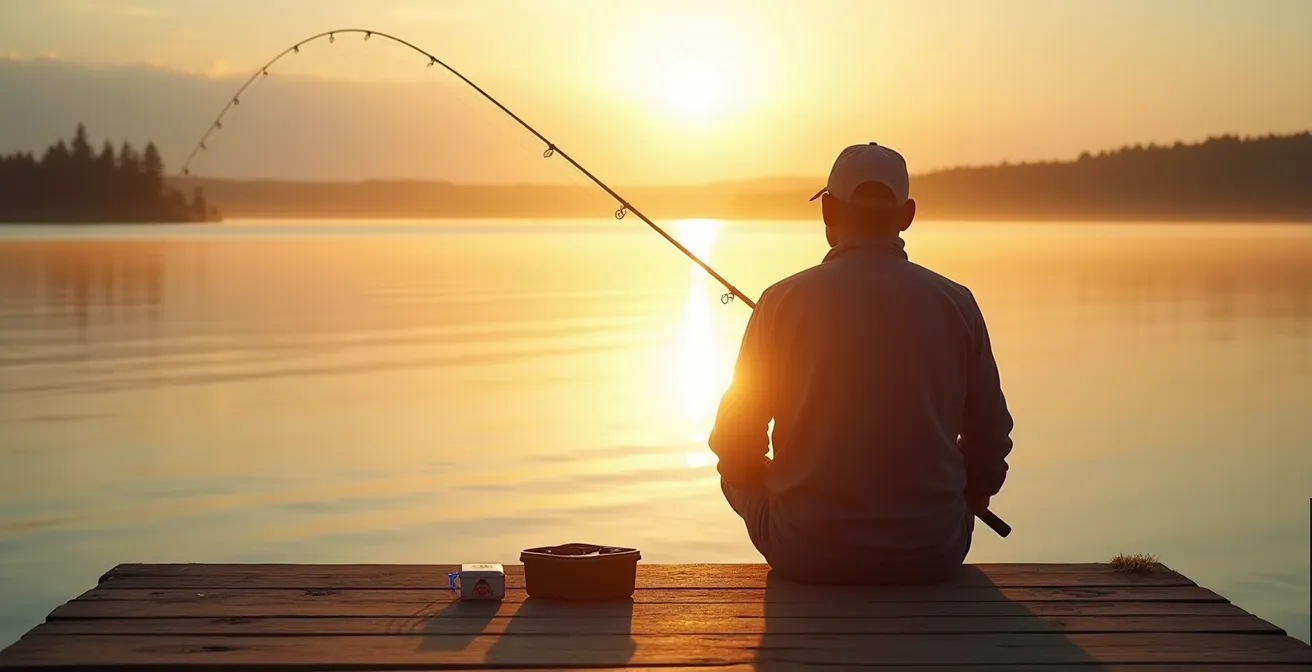
Contrary to modern hype, monofilament’s supposed “flaws” like stretch and memory are actually its greatest strategic assets for live bait fishing.
- The inherent stretch acts as a shock absorber, preventing pulled hooks and allowing fish to fully commit to the bait.
- Its near-neutral buoyancy allows for the most natural, lifelike drift presentation that braided lines can’t replicate.
Recommendation: Instead of fighting mono’s properties, learn to leverage its physics to master bait presentation and dramatically increase your hook-up rates.
Every time I walk through the fishing aisle, it’s a dizzying wall of new technology. Super-thin braids, invisible fluorocarbons, space-age copolymers—all promising to catch you more fish. And they’re fine lines, don’t get me wrong. But folks get so caught up in the marketing hype that they forget the old workhorse hanging right there next to them: simple, reliable monofilament. They see its stretch and thickness as weaknesses, relics of a bygone era. I see them as its greatest strengths, especially when you’re dealing with the delicate art of live bait fishing.
The new-fangled lines are all about sensitivity, about feeling every single bump and tick from the bottom. That’s great for artificial lures. But live bait isn’t about bumps and ticks; it’s about life. It’s about presenting a minnow, a worm, or a leech so it behaves exactly as it would if it weren’t tethered to your rod. This is where the so-called “disadvantages” of mono become powerful tools. The secret isn’t finding a line that eliminates all variables; it’s about choosing a line whose variables you can control and turn into a tactical advantage. Mastering this isn’t just about catching more fish—it’s about understanding the fundamental physics of the water.
This guide isn’t about convincing you to throw away your other lines. It’s about taking a step back and rediscovering the foundational principles that make monofilament a master of bait presentation. We’ll break down how to leverage its unique properties—from knot strength and weighting to bite detection and hook choice—to put more fish in the net. Forget the noise; it’s time to get back to what works.
This article provides a comprehensive look into the practical science of using monofilament for live bait. Below, you will find a summary of the key areas we will explore to help you master this timeless technique.
Summary: Mastering Monofilament for Live Bait
- The Palomar vs. Clinch: Which Knot Retains 95% of Line Strength?
- How to Weight Your Line so Bait Drifts Naturally in Current?
- Float vs. Tight Line: Which Method Detects Micro-Bites in Cold Water?
- Circle Hook or J-Hook: Which Ensuring Higher Hook-Up Rates for Live Bait?
- When to Use Fluorocarbon Leaders to Fool Line-Shy Fish?
- How Many Years Does It Take for Fluorocarbon to Break Down?
- Why Knotless Mesh Saves You 10 Minutes of Untangling per Fish?
- How to Read River Seams to Locate Feeding Fish Instantly?
The Palomar vs. Clinch: Which Knot Retains 95% of Line Strength?
Let’s get one thing straight: the strongest line in the world is only as good as its weakest link, and that’s almost always the knot. Folks spend a fortune on high-tech line but tie a sloppy knot and wonder why they lose fish. Monofilament has what I call “knot forgiveness.” Its soft, round profile seats down on itself perfectly, creating optimal compression and friction. Unlike wiry fluorocarbons or slick braids that demand very specific knots, mono plays nice with the classics. The Palomar and the Improved Clinch are the gold standards for a reason.
The key isn’t just picking one, but tying it perfectly. A well-tied Palomar knot is a masterpiece of simple physics, a double-run through the hook eye that distributes stress evenly. Studies have shown the Palomar knot preserves up to 95% of your line’s strength when tied correctly, which is a staggering level of efficiency. The Clinch is nearly as good, but can be prone to slipping with very light lines if you don’t add that extra tuck to make it “Improved.” The real secret to mono knot strength isn’t a fancy knot; it’s flawless execution of a simple one. That means moistening the line to reduce friction burn and cinching it down slow and steady.
Action Plan: Achieving Maximum Knot Strength
- Always wet the monofilament line with water or saliva before tightening – this reduces friction heat that weakens the line.
- Use 5 wraps for lines under 20lb test, but you can reduce it to 3 wraps for heavy 40lb+ mono to avoid a bulky knot.
- Pull slowly and steadily when cinching the knot. Quick jerks create friction and can microscopically damage the line structure.
- Check the knot visually. A good knot should look neat and symmetrical, with coils lying parallel and not crossing over each other.
- Test with steady pressure before your first cast. This seats the knot properly and ensures it won’t slip under the shock of a strike.
This foundational skill separates the anglers who land big fish from those who tell stories about the one that got away.
How to Weight Your Line so Bait Drifts Naturally in Current?
Braided line sinks fast. Fluorocarbon sinks even faster. Monofilament, with its near-neutral buoyancy, sinks slowly and gracefully. This isn’t a bug; it’s a feature. When you’re fishing live bait in a current, you don’t want your bait to plummet to the bottom. You want it to drift along at the same speed as the natural food sources—a concept I call “bait physics.” This is where mono truly outshines other lines. Your job is to add just enough weight to get the bait into the strike zone, and then let the line’s natural properties do the rest.
The key is distributing small split-shot weights along the line instead of clumping one large sinker near the hook. By spacing out smaller weights, you create a more natural, subtle curve in the line. This allows the bait to move freely and follow the micro-currents, appearing far more lifelike to a wary fish. A heavy sinker anchors the bait, creating an unnatural pivot point that fish can easily detect. A series of small weights simply guides the bait into the current’s flow. It’s the difference between dragging a dog on a leash and letting it sniff its way down the sidewalk.
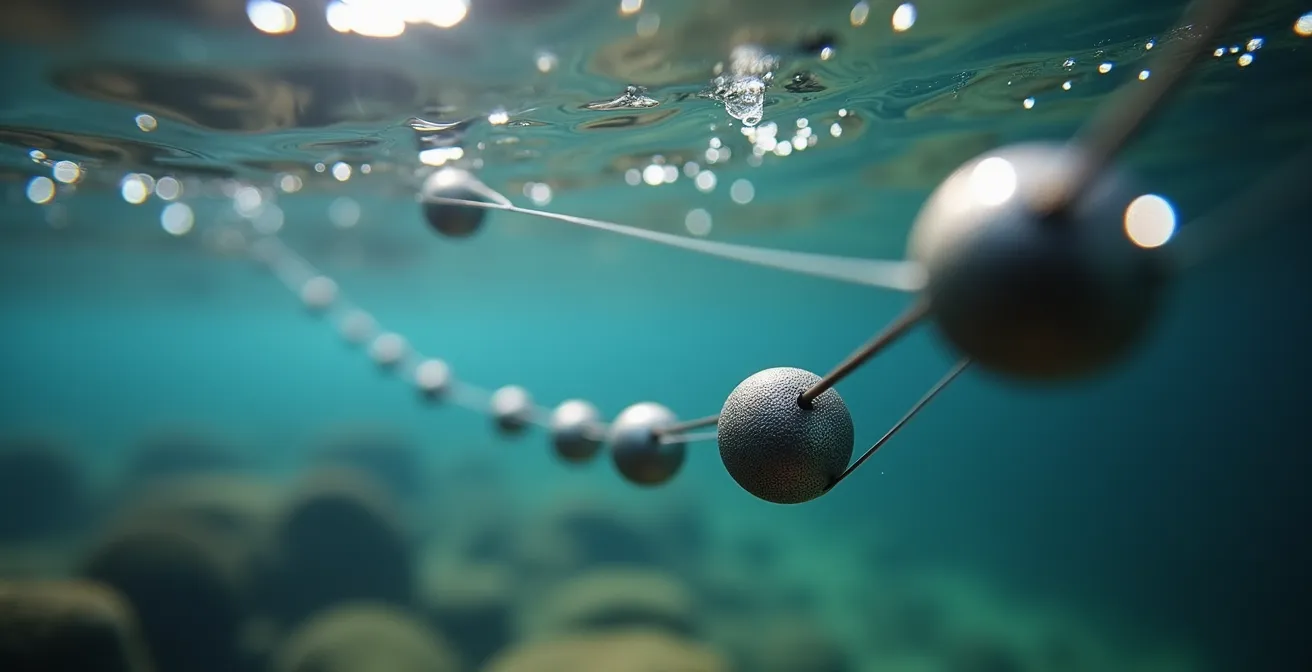
As you can see, this distribution allows the entire rig to flow with the water. One of the most effective applications of this principle is the Carolina rig, a classic setup for presenting baits just off the bottom.
Case Study: The Carolina Rig’s Natural Presentation
The Carolina rig is a perfect example of using weight to your advantage without sacrificing natural movement. The setup involves an egg sinker sliding freely on the main line, followed by a bead to protect the knot, and then a swivel. A leader of 12-14 inches is tied from the swivel to the hook. As a fish takes the bait, the line can slide through the sinker without the fish feeling the weight, giving you precious seconds to detect the bite. The bead also creates a subtle “clicking” sound in the current, which can attract curious fish. This rig perfectly leverages monofilament’s properties to create a deadly, natural presentation.
By thinking like a fish and understanding the flow of water, you can make your bait irresistible.
Float vs. Tight Line: Which Method Detects Micro-Bites in Cold Water?
Here’s where we talk about mono’s most misunderstood feature: its stretch. Anglers obsessed with braid call it a lack of sensitivity. I call it a “shock absorber” and a bite-detection tool, if you know how to use it. It’s true that monofilament can stretch up to 25%, which cushions strikes but reduces sensitivity compared to a no-stretch braided line. In cold water, when fish bites can be incredibly subtle “micro-bites,” this presents a challenge. The answer lies in choosing the right method for the conditions: a float system or tight-lining.
Using a float (or bobber) with mono is a classic combination. The line’s natural buoyancy helps support the float, making it highly sensitive to the slightest pull from below. The float gives you a clear visual indicator, bypassing the need to “feel” the bite through the line’s stretch. For still water or light winds, this is an incredibly effective way to detect those timid, cold-water takes. On the other hand, tight-lining—keeping a direct connection from rod tip to bait—relies on feeling the bite. With mono, you won’t feel a sharp “tick” like you would with braid. Instead, you’ll feel a spongy weight or a “mushy” feeling as the line begins to stretch. This requires more concentration, but the stretch gives the fish an extra moment to get the bait fully in its mouth before it feels resistance.
Some old-timers even take this a step further by “line watching,” using high-visibility fluorescent mono. They don’t watch the float or feel for a bite; they watch the line itself where it enters the water. The slightest twitch, pause, or sideways movement of that bright yellow or green line signals a bite long before you’d ever feel it.
As this comparative analysis from Berkley Fishing shows, the best method depends entirely on the situation.
| Method | Bite Detection | Mono Advantages | Best Conditions |
|---|---|---|---|
| Float System | Visual indicator | Line buoyancy helps float sensitivity | Still water, light winds |
| Tight Line | Feel through rod | Stretch acts as shock absorber | Moving water, active fish |
| High-Vis Mono | Line watching | Fluorescent colors show subtle movements | Clear water, wary fish |
There is no single “best” method; the expert angler adapts their technique to the line’s properties and the fish’s behavior.
Circle Hook or J-Hook: Which Ensuring Higher Hook-Up Rates for Live Bait?
The hook you choose is directly related to the stretch in your line. Using the wrong hook with monofilament is a recipe for frustration and missed fish. The debate between Circle hooks and traditional J-hooks is a perfect example. With a low-stretch line like braid, a hard, sharp hook-set is necessary to drive a J-hook home. If you try that same aggressive hook-set with mono, the 25% stretch will absorb most of the force, resulting in a poor hook-up. You’ll feel the fish, pull back hard, and come up with nothing but a stolen bait.
This is where you must leverage the “strategic stretch” of mono. With a J-hook, you can’t just react. You must wait a beat after feeling the bite, letting the fish turn with the bait. Then, instead of a short, sharp jerk, you use a long, sweeping motion of the rod. This “reeling into the fish” technique uses the full length of the rod to take up the line’s stretch and steadily drive the hook home. It’s a more deliberate and, frankly, more graceful way of fishing.
Circle hooks, on the other hand, were practically designed for monofilament. Their unique shape is made to slide to the corner of the fish’s mouth and hook it automatically as the line tightens. The key is to *not* set the hook. When you feel a bite, you simply start reeling steadily. The stretch of the mono provides the perfect, gentle delay, giving the fish time to turn and the hook time to do its job. A violent hook-set with a circle hook will actually pull it right out of the fish’s mouth. By letting the line’s stretch and the hook’s design work together, you achieve a nearly perfect hook-up rate, almost always in the corner of the jaw, which is better for the fish and easier for you.
- For Circle Hooks: Let the monofilament’s stretch act as a natural delay. Simply start reeling when you feel the weight of the fish; let the rod and line do the work for you.
- For J-Hooks: Compensate for the stretch. After the bite, pause for a second, then use a long, sweeping hook-set to drive the point home.
- Hook Placement: When using mono, nose-hooking live bait is often best, as it keeps the hook point exposed and ready, even if the line stretch causes a slight delay.
- Drag Setting: Set your drag a little lighter with mono (around 20-25% of the line’s breaking strength) to allow the stretch to work as a shock absorber without pulling the hook.
By matching your hook and your hook-set to your line’s properties, you turn a potential weakness into a powerful advantage.
When to Use Fluorocarbon Leaders to Fool Line-Shy Fish?
Even a die-hard mono fan like me knows there are times when you need a little extra stealth. In gin-clear water, when fish have a lot of time to inspect your offering, even the thin diameter of modern monofilament can be a deal-breaker. This is the one scenario where I’ll concede that another material has a distinct advantage. This is precisely when a fluorocarbon leader becomes an essential tool in your arsenal, not a replacement for your main line, but a specialized extension of it.
The science is simple. The primary advantage of fluorocarbon is its refractive index, which is very close to that of water. This property is what makes it nearly invisible underwater. As the experts at Wikipedia note in their article on fishing lines, Fluorocarbon lines or ‘fluoro lines’ are valued for their similar refractive index to that of water, making it less visible to fish. So, you get the best of both worlds: the trusted performance, stretch, and knot-friendliness of your monofilament main line, connected via a small swivel or a line-to-line knot to a 2-3 foot section of “invisible” fluorocarbon leader. This leader presents the bait with maximum stealth in the final, critical feet where the fish makes its decision.
You don’t need to spool your whole reel with expensive, hard-to-manage fluorocarbon. Using it as a leader is a targeted, cost-effective strategy. It combines the cushioning stretch of mono on the main line (preventing break-offs from a powerful run) with the invisibility of fluoro at the business end. This is a perfect example of hybrid thinking, using the right material for the right job to create a system that is greater than the sum of its parts. It’s the smart way to tackle line-shy fish without giving up the core benefits of your mono main line.
It’s not about being a purist for one line type; it’s about building the most effective system for the conditions at hand.
How Many Years Does It Take for Fluorocarbon to Break Down?
Now for the part of the conversation that makes every responsible angler uncomfortable. We love our sport, but we have to be honest about its impact. The very properties that make monofilament and fluorocarbon so effective—their strength and durability—also make them an environmental hazard when left behind. These are not materials that simply go away. They are plastics, and they persist in the environment for an alarmingly long time. Discarded or broken fishing line is a major source of plastic pollution in our lakes and rivers, entangling wildlife and cluttering ecosystems.
It’s important to understand the scale of the problem. While both are bad, there’s a significant difference in their longevity. According to environmental impact studies, monofilament lines can take 10 to 600 years to break down, while fluorocarbon lines can last upward of 1,000 years in the environment. That’s a staggering timeframe. The fluorocarbon leader you used today could outlast the oldest cathedrals in Europe. This isn’t a reason to stop fishing, but it’s a powerful reason to be meticulous about our habits.
This durability means we have a profound responsibility. Every angler must make it a personal mission to leave no trace. This means collecting every snippet of trimmed line from tying knots. It means making a real effort to retrieve snagged lines instead of just snapping them off. Many tackle shops and boat ramps have recycling bins specifically for fishing line. Use them. The convenience and performance of these lines come with a heavy environmental price tag, and it’s our duty to minimize that cost as much as humanly possible for the generations of anglers who will come after us.
Being a good angler is inseparable from being a good steward of the environment.
Why Knotless Mesh Saves You 10 Minutes of Untangling per Fish?
You’ve done everything right. You chose the right line, tied the perfect knot, presented the bait naturally, and fought the fish with skill. Now it’s at the side of the boat, and you reach for the net. This is where a great day can turn into a tangled nightmare. Traditional nylon nets with their knotted mesh are like magnets for monofilament and, even worse, for hooks. The line wraps around the knots, the hook buries itself deep in the mesh, and you end up spending more time performing surgery on your net than admiring your catch.
This is why the invention of the rubber or silicone knotless mesh net was such a game-changer for mono anglers. The smooth, non-porous material doesn’t have any knots for the line to snag on. Hooks can’t easily penetrate the rubber, and they often pop right out with a simple shake. This simple change in equipment can save you an incredible amount of time and frustration over the course of a day. Instead of a 10-minute untangling session, you can land the fish, unhook it, and have your line back in the water in under a minute.
Furthermore, these nets are far better for the fish, especially if you practice catch-and-release. The smooth rubber mesh doesn’t scrape off the fish’s protective slime coat like a coarse nylon net can. This slime is crucial for protecting the fish from infections. By using a knotless net, you not only save yourself a headache but also significantly increase the fish’s chances of survival after being released. It’s a true win-win situation, a piece of modern gear that perfectly complements the use of a classic line like monofilament.
- Choose the Right Mesh: Opt for nets made of rubber or silicone knotless mesh. They are specifically designed to prevent hook and line tangles.
- Keep it Wet: Always wet the net before landing a fish. A wet net reduces friction and is gentler on the fish’s slime coat.
- Consider Hand-Landing: For smaller, non-toothy fish, learning to hand-land them can eliminate net tangles entirely and is often quicker.
- Proper Storage: Store your net away from loose tackle. A hook that finds its way into the mesh in your garage is just as frustrating as one that gets tangled on the water.
Investing in the right landing net is one of the smartest things a monofilament angler can do.
Key takeaways
- Monofilament’s stretch is a strategic tool, acting as a shock absorber that prevents pulled hooks and allows for better hook-sets with the right technique.
- The near-neutral buoyancy of mono is its superpower, enabling the most natural and lifelike drift presentation for live bait in currents.
- Mastering classic knots and using the right hook (Circle vs. J-hook) in conjunction with mono’s properties is more important than chasing the latest line technology.
How to Read River Seams to Locate Feeding Fish Instantly?
Now, let’s put it all together on the water. Reading a river is like reading a story, and your fishing line is the pen you use to trace its plot. Fish are lazy; they want to expend the least amount of energy for the biggest possible meal. They won’t sit in the fastest part of the current. Instead, they’ll hold in the slack water right next to it, waiting for the current to deliver food to them. These transition zones are called seams, and they are goldmines for anglers. The challenge is presenting your bait naturally along that seam.
This is where monofilament’s “controlled buoyancy” shines. As we’ve established, its mono’s near-neutral buoyancy makes it sink slowly, ideal for mending line across different current speeds. Mending is the act of lifting and repositioning your line on the water’s surface to counteract the drag from different current speeds between you and your bait. A line that sinks too fast, like braid, makes mending nearly impossible; it gets pulled under immediately. A line that floats too much creates a huge belly on the surface that drags the bait unnaturally. Mono sits perfectly in the middle, allowing you to make those crucial adjustments to achieve a perfect, drag-free drift right along the seam where a hungry fish is waiting.
Using a high-visibility monofilament makes this even easier. You can visually track your line’s path on the water, seeing exactly when it starts to drag and when a mend is needed. Many experienced anglers find they can detect strikes just by watching their hi-vis line. As one angler put it when describing the switch, “I can see my line twitch when a bass is taking it.” It’s a visual, intuitive way of fishing that connects you directly to the river’s flow and the fish’s behavior. It’s the art of fishing, not just the mechanics.
Stop fighting your line’s natural tendencies and start using them to your advantage. By understanding the physics of monofilament—its stretch, its buoyancy, its forgiveness—you can transform this “old-school” line into your most effective tool for presenting live bait and connect with fish in a more fundamental way.