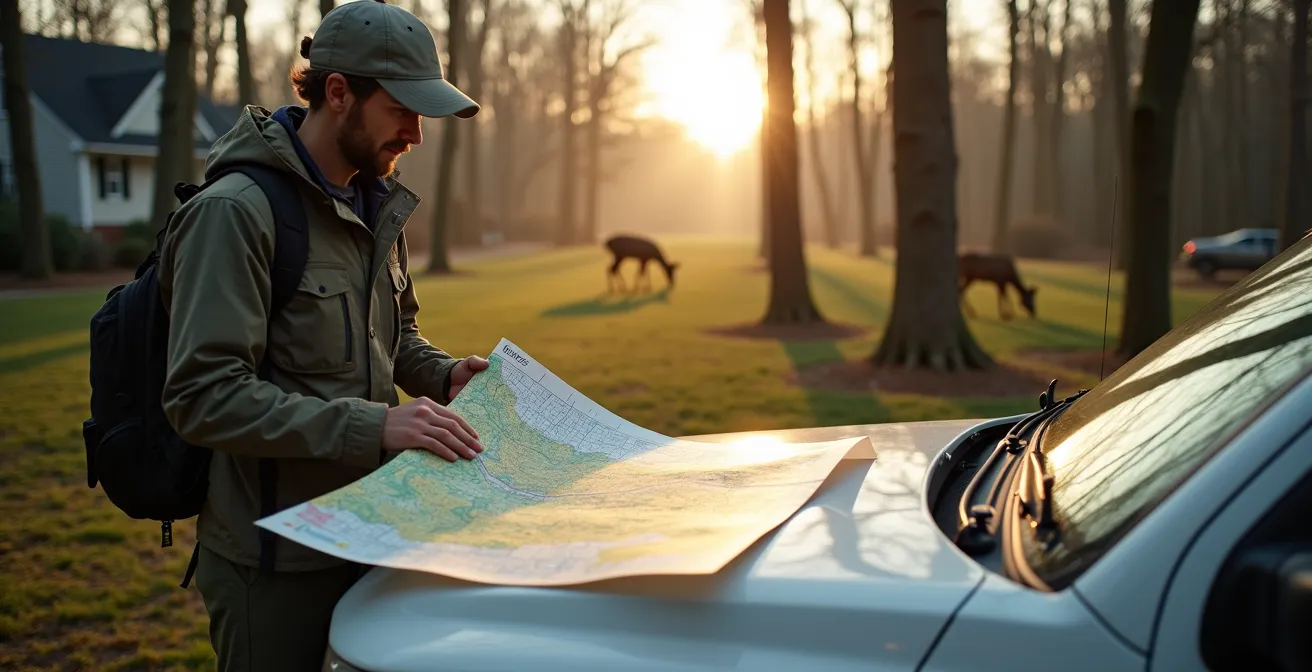
Effective suburban wildlife management isn’t about culling; it’s about implementing a surgical, data-driven system to ensure community safety and ecological health.
- Managed hunts directly reduce vehicle collisions by altering both population density and animal behavior.
- Archery is a statistically safe and precise tool for targeted removals in populated zones.
Recommendation: View controlled hunting as a necessary municipal service, governed by strict protocols and scientific carrying capacity assessments.
As a municipal wildlife manager, I’m on the front lines of a growing conflict that unfolds not in the remote wilderness, but in our backyards, parks, and along our commuter routes. The sight of deer grazing peacefully in a suburban green space is often seen as a welcome touch of nature. However, when populations become unchecked, this idyllic picture quickly turns into a complex management problem involving property damage, ecological degradation, and most critically, threats to public safety. The common discourse often gravitates towards passive solutions or overlooks the issue entirely until a crisis, like a spike in vehicle collisions, forces a reaction.
Many communities believe the only options are to either do nothing or to implement costly, often ineffective, non-lethal methods. But what if the most responsible and effective approach has been misunderstood? The key to resolving human-wildlife conflict in developed areas isn’t simply about reducing animal numbers; it’s about implementing a highly regulated, data-driven management system. This system views controlled hunting not as a recreational activity, but as a precise, surgical intervention designed to restore ecological balance and protect residents.
This is not a call for open season in our neighborhoods. Instead, it is a proposal to adopt a framework of ecological calibration. We must move beyond the emotional debate and analyze the data, safety protocols, and strategic applications that make controlled hunting an indispensable tool for modern wildlife conservation in human-dominated landscapes. This article will deconstruct the process, from understanding its direct impact on public safety to the specific protocols that ensure it is executed with surgical precision.
To provide a clear and structured overview, this guide breaks down the essential components of a modern, managed hunting program. Explore the following sections to understand the data, strategies, and safety measures that underpin this necessary conservation tool.
Summary: A Manager’s Framework for Controlled Hunting Programs
- Why Vehicle Collisions Drop Significantly After Managed Hunts?
- How to Apply for Controlled Hunt Draws in High-Demand Zones?
- Public Land vs. Private Leases: Where Is Controlled Hunting Most Effective?
- The Safety Myth That Stops Communities from Approving Urban Archery
- How to Determine the Carrying Capacity of a Fenced Reserve?
- How to Calculate Your Personal Harvest Impact on Local Herds?
- Why Sourcing Your Own Meat Is the Ultimate Act of Rebellion?
- How to Coordinate a Group Hunt Without Compromising Individual Safety?
Why Vehicle Collisions Drop Significantly After Managed Hunts?
The most immediate and quantifiable benefit of a controlled deer management program is the dramatic reduction in deer-vehicle collisions. From a municipal management perspective, these incidents represent a significant cost in terms of property damage, insurance claims, human injury, and even fatalities. The effectiveness of managed hunts goes beyond simple population reduction. In Meridian Township, Michigan, a long-term deer management program led to a remarkable 49% reduction in car-deer collisions over 14 years. This demonstrates a direct correlation between active management and increased public safety on our roads.
However, the underlying mechanism is more complex than just having fewer deer. Controlled hunting creates what biologists call a “landscape of fear.” This doesn’t mean the animals are perpetually terrified, but rather that they adapt their behavior to avoid perceived threats. They become more cautious, spend less time in open areas near roads, and are more active during nocturnal hours when traffic is lighter. This behavioral shift is a powerful, secondary benefit of managed hunting. A Connecticut study further reinforces the impact, showing that controlled hunts reduced the local deer herd by 50 percent in the first year alone, leading to a corresponding drop in landscape damage complaints.
This behavioral modification is crucial for an effective program. It means that even with a stable deer population, the risk to motorists can be significantly mitigated by re-establishing a natural caution in the herd. The illustration below visualizes this concept, showing how deer movement patterns shift to avoid high-risk corridors like roadways once a human presence is reintroduced through regulated hunting.

Ultimately, a managed hunt acts as a powerful ecological signal. It teaches deer to associate human-dominated areas with risk, compelling them to use the landscape more carefully. This combination of population control and behavioral science is why managed hunts are a cornerstone of any serious effort to reduce vehicle collisions in suburban and protected areas.
How to Apply for Controlled Hunt Draws in High-Demand Zones?
Access to controlled hunts, especially in high-demand suburban or protected zones, is not a free-for-all. It’s a highly structured process designed to be fair, transparent, and aligned with specific management objectives. As a manager, my goal is to ensure that the right number of qualified individuals are deployed to the right areas. This is typically achieved through a lottery or “draw” system. Understanding this process is the first step for any resident or hunter looking to participate in these critical conservation efforts. The system is intentionally methodical to prevent overcrowding and ensure safety.
The application process itself is a data-driven protocol. Prospective participants must first meet baseline requirements, such as holding a valid hunting license. Applicants then submit their choices for specific hunt zones and dates during a designated period. The system is designed to prioritize those who select a hunt as their first choice, ensuring that the most committed applicants have a higher probability of success. For group applications, a party leader typically applies first, linking the applications to ensure the group can hunt together if drawn, which is crucial for coordinating efforts on specific properties.
The selection mechanism is based on randomization to ensure fairness, not on a first-come, first-served basis. As the Oregon Department of Fish and Wildlife outlines for its reservation hunts, the process is purely mathematical and unbiased:
Each controlled hunt application is assigned a unique seven-digit random number. A seven-digit seed number is drawn for each hunt series. Permits are awarded beginning with the applicant whose number matches or is closest to and above the start number.
– Oregon Department of Fish and Wildlife, 2025 Wildlife Area Reservation Hunt Regulations
After the main draw, any remaining or “leftover” permits are often made available, providing a second opportunity for those who were not initially selected. This systematic and auditable process ensures that permit allocation is both equitable and precisely aligned with the harvest goals set for each specific management zone. It transforms the hunt into a predictable and controlled management action.
Public Land vs. Private Leases: Where Is Controlled Hunting Most Effective?
A successful wildlife management strategy requires selecting the right tool for the right location. When it comes to controlled hunting, the operational context—whether it’s a large state park or a patchwork of suburban backyards—dictates the most effective approach. The two primary models are government-run hunts on public land and coordinated hunts on private land leases. Each has a distinct structure and is best suited for different management objectives. They are not mutually exclusive; in fact, a comprehensive regional plan often utilizes both in tandem.
Public land hunts, typically held in state forests, parks, or Wildlife Management Areas (WMAs), are designed for large-scale population management. They are governed by state or federal agencies, with access usually granted through a public lottery system. The rules are standardized and the objective is broad: to maintain the health of the ecosystem and keep the herd within the biological carrying capacity of that large area. This approach is effective for managing populations across a wide, contiguous landscape.
In contrast, private land hunts offer the surgical precision needed for fragmented suburban environments. In places like corporate campuses, golf courses, or residential neighborhoods with large lots, a public-access hunt is unfeasible and unsafe. Here, a private lease model, often coordinated by a single “hunt captain” or a private organization, is superior. These operations require written permission from every participating landowner and are tailored to the specific property. They allow for the precise removal of deer from sensitive areas where they pose the most direct conflict with human activity.
The following table, based on common management structures, highlights the key differences and best applications for each model, as detailed in a recent comparative analysis of urban management strategies.
| Aspect | Public Land Hunts | Private Lease Hunts |
|---|---|---|
| Management Structure | Government-run with broad objectives | Single hunt captain with specific mission |
| Access Requirements | Lottery/permit system, public access | Written landowner permission required |
| Best Application | Large-scale population management | Precision removal in fragmented landscapes |
| Typical Locations | Wildlife Management Areas, National Forests | Suburban properties, golf courses, corporate campuses |
| Flexibility | Rigid regulations, standardized approach | Adaptable to specific property needs |
The Safety Myth That Stops Communities from Approving Urban Archery
The single greatest barrier to implementing effective suburban deer management programs is the public perception of safety. The image of hunting often conjures firearms and long-range projectiles, which are understandably concerning in populated areas. This is where the “safety myth” takes root, preventing many communities from considering the most effective tool available: urban archery. As a manager, my primary responsibility is public safety, and the data unequivocally shows that controlled archery programs are extraordinarily safe. The Connecticut study, for example, reported zero incidents involving non-participants over its multi-year duration.
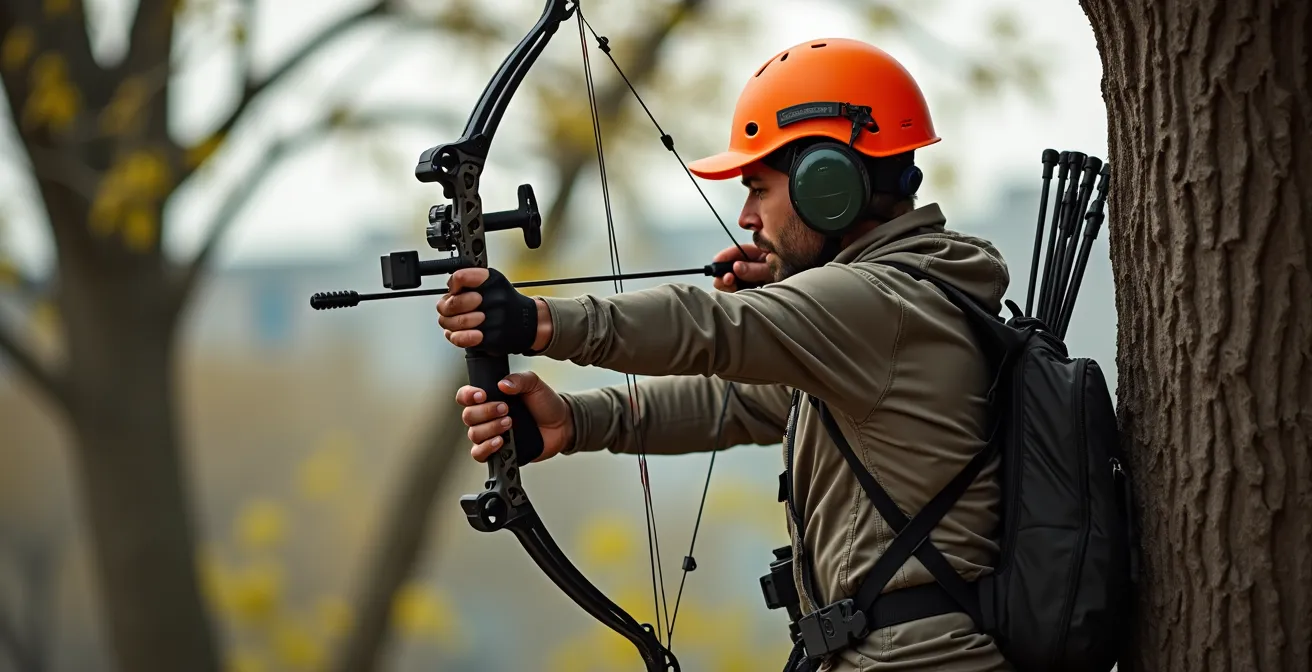
The safety of archery in suburban settings is not a matter of luck; it is a matter of physics and strict regulation. Unlike a firearm, an arrow has a very limited range and loses energy quickly. Furthermore, urban archery programs universally require hunters to shoot from an elevated position, such as a tree stand. This creates a steep, downward angle of fire. As the illustration below demonstrates, a shot from an elevated stand ensures that the arrow’s trajectory is directed into the ground within a very short distance, typically 15-20 yards. There is no risk of a projectile traveling horizontally for hundreds of yards.
This method provides the precision that is simply not possible with other tools in confined spaces. It allows for the selective and safe removal of deer from specific problem areas. As Dan Forster, Vice President of the Archery Trade Association, explains, this is the core value of urban archery:
Archery offers more management options in urban and suburban settings… Those areas desperately need deer removed, and bows let you surgically remove them in confined places. Many urban areas aren’t trying to manage deer to long-range population goals. They just want to reduce complaints and car-deer collisions.
– Dan Forster, Archery Trade Association Vice President
The term “surgically remove” is key. It reframes the action from a blunt culling to a targeted, precise management activity. By understanding the physics and reviewing the flawless safety records of established programs, communities can move past the myth and embrace urban archery as the responsible, effective solution it is.
How to Determine the Carrying Capacity of a Fenced Reserve?
The foundation of any defensible wildlife management plan is data, and the most critical metric is carrying capacity. This term refers to the maximum number of a species that a given habitat can support indefinitely without causing degradation to that environment. In a fenced reserve or a geographically isolated suburban area, exceeding this capacity has rapid and severe consequences. The vegetation is stripped, other wildlife species suffer, and the deer themselves become stressed and susceptible to disease. Determining this threshold is not guesswork; it is a scientific assessment based on direct field observation.
Managers use several key indicators to “read” the health of the habitat. A classic sign of overpopulation is a “browse line”—a distinct horizontal line on trees and shrubs where deer have eaten all the vegetation within their reach. We also monitor specific “indicator plants,” which are highly palatable species that are the first to disappear when the population gets too high. The physical condition of the animals themselves is another crucial clue; deer in poor body condition with low fat reserves are a clear sign that the habitat can no longer support them. These observations allow us to build a data-based picture of the ecosystem’s health.
Your Field Checklist: Assessing Habitat Carrying Capacity
- Observe browse lines on trees: Look for a visible horizontal line where deer can no longer reach vegetation. Is it becoming more pronounced?
- Monitor indicator plant species: Inventory highly palatable plants like certain wildflowers or saplings. Are they disappearing or showing heavy browse damage?
- Assess body condition of animals: If possible through observation or harvest data, check for poor body condition (e.g., visible ribs), which indicates nutritional stress.
- Evaluate understory vegetation: Is the forest floor becoming bare? Severe thinning of the understory indicates overpopulation and impacts ground-nesting birds.
- Document ecological changes: Note the loss of other flora and its impact on other wildlife species, such as insects and birds that depend on it.
Case Study: Chronic Wasting Disease (CWD) Prevention
The importance of staying below carrying capacity is starkly illustrated by disease prevention. Overcrowding creates ideal conditions for the spread of pathogens. In Meridian Township, the deer management program plays a critical role in preventing the return of Chronic Wasting Disease (CWD), which affected the deer herd in 2015. Since management efforts were enhanced and the population was brought into balance with the habitat, no cases of CWD have been reported since 2016. This suggests that maintaining a healthy, unstressed population is a powerful defense against disease outbreaks.
By regularly conducting these field assessments, we can make proactive, data-driven decisions about harvest quotas. It’s not about eliminating deer; it’s about maintaining a healthy, balanced number that the land can sustainably support, ensuring the long-term health of the entire ecosystem.
How to Calculate Your Personal Harvest Impact on Local Herds?
For a hunter participating in a controlled hunt, it’s easy to focus on the individual act of filling a tag. However, within a management framework, every harvest is a data point that contributes to a larger ecological goal. Understanding your personal impact requires shifting your perspective from “harvesting a deer” to “removing a specific demographic unit” from the population. The most significant misconception among the public, and even some hunters, is that harvesting bucks is the key to population control.
The science is clear: buck harvest has a negligible effect on overall population growth. The true engine of population dynamics is the number of does and their reproductive success. As a wildlife manager, my focus is almost entirely on the antlerless harvest. Each doe removed from the population also removes her potential future offspring, making it the most efficient lever for population control. Dax Mangus, a Big Game Coordinator for the Utah DWR, explains this critical distinction:
It should be noted that harvesting buck deer does not drive deer populations. That is a common misconception. The most important factors that drive deer population numbers are the survival rates of doe deer (since bucks don’t have babies), fawn production and fawn survival after the winter.
– Dax Mangus, Utah DWR Big Game Coordinator
Therefore, calculating your personal impact starts with the sex of the animal. Harvesting a doe in an overpopulated suburban zone is a direct and significant contribution to the management goals of reducing human-wildlife conflicts and preventing habitat degradation. In contrast, harvesting a buck in the same area primarily affects the age structure and genetics of the male population, not the overall numbers. This is why management programs in overpopulated areas issue a high number of antlerless tags. For example, Utah’s Cooperative Wildlife Management Unit (CWMU) program is structured around this principle, with the allocation of 1,251 public antlerless permits in a recent season to achieve specific population objectives.
Your personal impact is therefore magnified exponentially when you align your harvest with the specific goals of the management unit. By prioritizing the doe harvest in designated areas, you are no longer just a hunter; you are an active and effective agent of ecological restoration.
Why Sourcing Your Own Meat Is the Ultimate Act of Rebellion?
In an age of industrial food systems and disconnected supply chains, participating in a controlled hunt and sourcing your own protein is a profound statement. It is a “rebellion” not in a destructive sense, but in a constructive one—a rebellion against passivity and a deliberate act of taking personal responsibility for one’s food and one’s local environment. When conducted within the framework of a municipal management program, this act transcends a personal quest for organic meat. It becomes an act of civic ecology.
Every deer harvested from an overpopulated suburban area accomplishes multiple goals simultaneously. It directly contributes to reducing vehicle collisions, protects native vegetation, and mitigates property damage. But the story doesn’t end there. The venison itself is a high-quality, organic, and locally sourced protein. By choosing to source this meat, an individual opts out of a complex industrial system and participates directly in their local food web. This fosters a powerful connection to the landscape and a deeper understanding of the real costs and benefits of wildlife management.
Furthermore, this act of personal provision can be scaled into a powerful tool for community support. Many controlled hunt programs have integrated donation requirements, formalizing the link between wildlife management and food security.
Case Study: The Venison Project
Nonprofits like The Venison Project exemplify this connection. By organizing hunts and processing donations, they address food insecurity through the sustainable management of local deer populations. In 2025 alone, their events in Georgia, Alabama, and Tennessee resulted in 250 deer being donated to shelters and food banks, providing approximately 23,500 meals to people in need. This transforms a management “problem” (overpopulation) into a community “solution” (food provision).
This model is increasingly being codified into state-run programs. For instance, the Arkansas Game and Fish Commission requires that every first deer harvested in its urban hunts must be donated to an approved food bank. This policy explicitly frames the hunt not as a recreational privilege, but as a community service with tangible benefits for the most vulnerable. Sourcing your own meat through these programs is the ultimate expression of active, responsible citizenship.
Key Takeaways
- Controlled hunting is a data-driven, surgical tool for ecological management, not a blunt instrument for culling.
- The safety of urban archery is proven by physics (downward trajectory) and years of zero-incident data from established programs.
- Effective management is based on scientific assessments of a habitat’s carrying capacity, not arbitrary population targets.
- Harvesting does, not bucks, is the primary mechanism for controlling deer population growth and achieving management goals.
How to Coordinate a Group Hunt Without Compromising Individual Safety?
While the strategic “why” of controlled hunting is based on ecological data, the operational “how” is grounded in an unwavering commitment to safety. In any group hunting scenario, especially in or near populated areas, individual enthusiasm must be subordinate to a rigid, system-wide safety protocol. As the manager overseeing these operations, my role is to ensure that every participant understands and adheres to a plan that eliminates ambiguity and minimizes risk. A successful group hunt is not measured by the harvest, but by its flawless safety record.
Coordination begins long before the hunt. It involves detailed mapping, clear communication channels, and contingency planning. Each hunter must be assigned a specific zone or stand location with clearly defined sectors of fire. These are not suggestions; they are strict boundaries established with compass bearings to ensure no projectile can possibly travel in the direction of another hunter or an unauthorized area. The U.S. Fish and Wildlife Service, in its regulations for hunts on National Wildlife Refuges, codifies many of these best practices.
The core elements of a safe group hunt protocol are universal and non-negotiable. They form a system of overlapping safeguards that protect both participants and the public. These protocols are the bedrock of any professionally managed group hunt.
- Establish clear sectors of fire: Use compass bearings or highly visible landmarks to define a safe shooting lane for each hunter. No shot should ever be taken outside this lane.
- Implement three-way communication: All critical messages (e.g., “hunt starting,” “hunter moving,” “animal down”) must be transmitted, received, and confirmed by a central coordinator and all relevant parties.
- Conduct pre-hunt contingency drills: Before the hunt begins, walk through emergency scenarios, including accidental injury, encounters with non-participants, or lost hunters.
- Require youth supervision: A strict and critical rule in federal guidelines is that all hunters age 15 or younger must remain in the immediate presence of a supervising adult at all times.
- Map no-shoot zones: Before anyone enters the field, all roads, trails, buildings, and property lines must be mapped as absolute “no-shoot” azimuths.
By treating the group hunt as a professional, protocol-driven operation rather than a casual outing, we can execute these necessary management actions with the highest degree of safety. This disciplined approach is what earns public trust and ensures the long-term viability of controlled hunting as a community-sanctioned activity.
Ultimately, integrating controlled hunting into a municipal management plan is an act of responsible governance. It requires setting aside outdated perceptions and embracing a data-driven, safety-first framework to protect our communities and preserve the health of our local ecosystems. To begin implementing these strategies in your community, the first step is to initiate a data-based conversation with local officials and wildlife agencies.