
Conquering tournament stress isn’t about having more mental toughness; it’s about deploying proven, pre-built mental systems when the pressure hits.
- Objective data from a detailed logbook builds unshakable, evidence-based confidence that emotion cannot erode.
- Specific, physical “tactical resets” are essential for breaking negative thought loops and regaining analytical focus during a slump.
Recommendation: Stop hoping for a positive mindset on tournament day and start building a structured arsenal of mental processes you can execute under pressure.
The silence is deafening. Hours have passed since the last bite, and the only thing growing is the pit in your stomach. Every cast feels heavier, every empty retrieve a confirmation of failure. You start second-guessing your spot, your lure, your entire strategy. This is the moment a tournament is lost, not because the fish aren’t there, but because the angler’s mental game has collapsed. The common advice to “stay positive” or “just focus” is useless here. It’s like telling a quarterback to “throw better” while the defensive line is steamrolling him.
The truth the pros know is that managing stress isn’t about feeling good; it’s about having a playbook. It’s about building and drilling bulletproof mental systems that you can execute automatically when your emotional brain tries to take over. Confidence isn’t a feeling you hope for; it’s a result you build through process. Your gear, your electronics, and your daily habits are not just tools for catching fish—they are instruments for controlling your mind. The difference between cashing a check and going home empty-handed often comes down to who can execute their mental system when the bite dies.
This is not a guide about positive thinking. This is a breakdown of the tactical, process-oriented mental systems that allow elite anglers to stay in the game, make sharp decisions, and find fish when everyone else is spiraling. We will deconstruct how to build confidence from data, use physical actions to reset your brain, and turn your equipment into tools for maintaining peak mental performance under duress.
In the following sections, we will explore the specific, actionable strategies that separate the consistently successful from the occasionally lucky. This guide provides a detailed roadmap for building your own mental playbook, transforming how you handle pressure on the water.
Summary: Tournament Fishing: How the Pros Conquer Mental Stress When the Bite Dies
- How Keeping a Detailed Logbook Can Double Your Catch Rate Next Year?
- The Leader Length Violation That Can Disqualify a World Record Catch
- Musky vs. Pike: How to adjust your Figure-8 technique for the species?
- Instructional Guide vs. Meat Trip: How to Ask for the Right Experience?
- Baitcasting vs. Spinning: Why Pros Use Baitcasters for Accuracy?
- Graphite vs. Fiberglass: Why Carbon Rods Detect Strikes You Are Missing?
- How to Distinguish Between Bait Balls and Predator Arches on 2D Sonar?
- Daily Limit vs. Possession Limit: What Is the Legal Difference?
How Keeping a Detailed Logbook Can Double Your Catch Rate Next Year?
Confidence on tournament day isn’t born from hope; it’s forged from data. When the bite goes cold, your mind will feed you doubts. The only way to fight back is with cold, hard evidence. A detailed fishing logbook is your single most powerful weapon against the mental downward spiral. It’s not a diary of your feelings; it’s a database of your successes. When you’re facing a tough decision, you don’t have to guess. You can consult a record of what worked in similar conditions—water temp, clarity, wind direction, time of day.
Top-tier professionals and guides are now instrumental in developing specialized fishing journal apps that automatically pull in environmental data. This isn’t for nostalgia; it’s for performance analysis. By tracking your confidence level and mental state alongside catch data, you begin to see patterns not just in fish behavior, but in your own. You learn to recognize the specific triggers that lead to bad decisions. Your logbook becomes an objective third-party coach, reminding you that you’ve solved this exact problem before.
The goal is to build a library of proven tactical shifts. Instead of panicking and running all over the lake, you can consult your log and execute a data-driven Plan B. Documenting your decision-making processes during slow periods is crucial. It allows you to analyze your stress responses after the fact and refine your approach. This system transforms you from a reactive, emotional angler into a proactive, analytical problem-solver. Your logbook proves you have the answers, silencing the internal voice of doubt.
The Leader Length Violation That Can Disqualify a World Record Catch
Under pressure, your mind is your biggest liability. Performance psychology research confirms that even a little stress in competition can interfere with the capacity to think clearly, analyze information, and make good decisions. This is when catastrophic, unforced errors happen—like using a leader that’s a quarter-inch too long, a simple mistake that can get a winning bag or even a world record disqualified. Stress doesn’t just make you feel bad; it makes you sloppy.
You cannot simply will yourself to be calm. You must deploy a pre-rehearsed, physical routine to interrupt the mental chaos. This is what we call a “Tactical Reset.” It’s a 60-second sequence of simple, controllable actions that forces your brain out of its emotional spiral and back into a process-oriented state. When you feel that mental slippage begin—the frustration, the panic, the urge to make a rash move—you initiate the reset. It’s a non-negotiable protocol.
The routine itself is less important than its consistent execution. It could be something as simple as reeling in, sitting down, taking a drink of water, and then re-tying your lure with absolute, undivided attention on the knot. The act of performing a precise, physical task short-circuits the brain’s panic response. It’s a way of telling your nervous system, “I am still in control of my actions.” This small victory builds momentum, allowing you to re-engage with your strategy from a position of control, not chaos.
Your High-Stress Systems Check Routine
- When feeling mental slippage, initiate a 60-second physical routine.
- Re-tie your lure with full attention to knot quality.
- Physically measure your leader length against tournament specifications.
- Check and adjust your drag setting to optimal resistance.
- Use this routine as a mental reset button to refocus attention.
Musky vs. Pike: How to adjust your Figure-8 technique for the species?
The Figure-8 is more than a last-ditch effort at the boat; it’s a masterclass in process-oriented focus. While the technique differs slightly for musky (wider, deeper turns) versus pike (sharper, faster turns), the underlying mental benefit is the same: it forces your brain to concentrate on a precise physical execution, shutting out the noise of a slow day. When you’re locked into carving perfect turns and watching your lure’s every move, you aren’t thinking about the clock, the competition, or the lack of bites. You are fully engaged in a controllable process.
Elite anglers understand this principle. During long tournament days, when changing conditions can rattle your nerves, a return to pure technique is a powerful anchor. You can’t control the weather or the mood of the fish, but you can control the sweep of your rod, the speed of your reel handle, and the geometry of your Figure-8. This is a form of active mindfulness. By focusing intently on the “how” of a technique, you stop obsessing over the “what if” of the outcome.
This shift in focus is a potent antidote to stress. Instead of your day being defined by uncontrollable results (or lack thereof), it’s defined by your ability to execute. A perfectly executed Figure-8 that doesn’t draw a strike is still a win for your mental game. It reinforces your discipline and control. Use these technical moments, whether it’s a Figure-8, a specific pitching motion, or a retrieve cadence, as mental training. They are opportunities to prove to yourself that your performance is measured by your execution, not just the fish in the livewell.
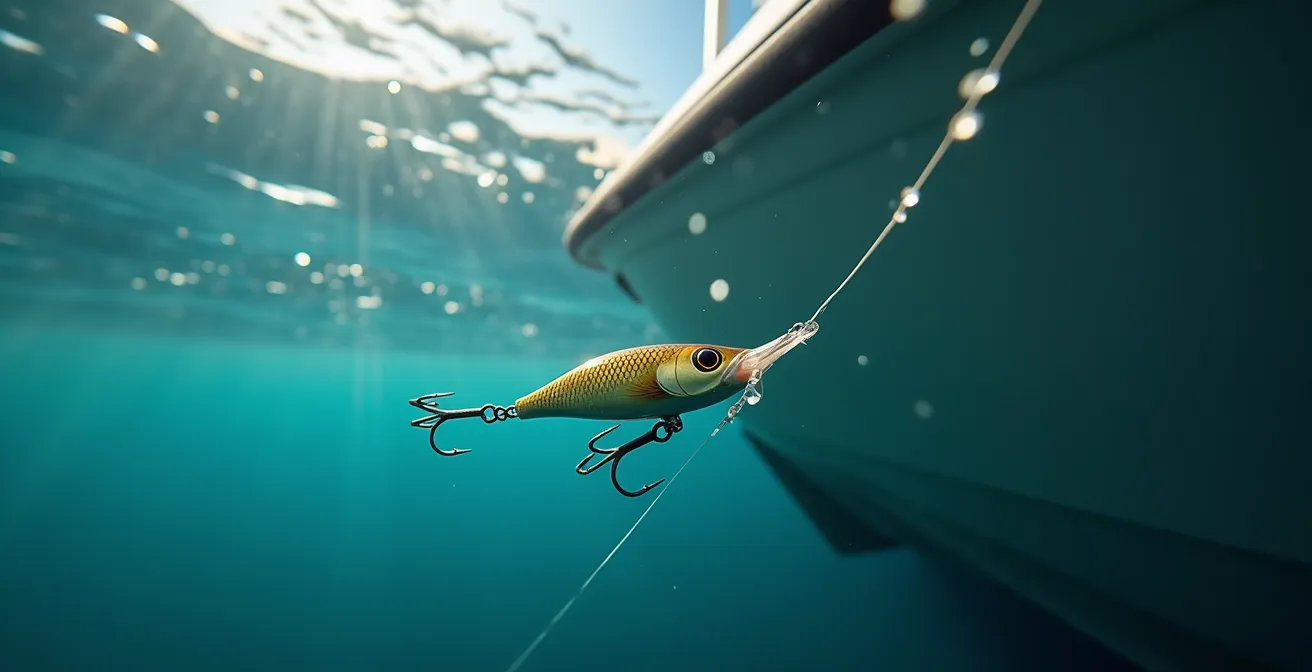
The visual of a lure tracing that perfect path is a reminder that control is in your hands. This is the essence of staying mentally sharp: dedicating your full attention to the task at hand, knowing that flawless execution is what ultimately creates opportunity.
Instructional Guide vs. Meat Trip: How to Ask for the Right Experience?
Hiring a guide is one of the fastest ways to improve, but most anglers get it wrong. They book a “meat trip,” focused solely on catching fish. A competitive angler should book an “instructional trip,” focused on downloading the guide’s brain. Your objective isn’t a full cooler; it’s to extract the decision-making processes, mental models, and crisis-response strategies of an expert who is on the water 200 days a year.
Before you even step on the boat, you need to set the right expectations. Tell the guide you’re preparing for tournaments and you want to learn *how they think*. Ask them to walk you through their “why” for every decision. As performance psychologist Jay T. McNamara notes, “It is a great mental exercise to alertly observe someone else and experience the world from his perspective.” This is active modeling. You are there to learn their system.
Come prepared with a list of strategic questions. Don’t ask “Where are the fish?” Ask, “How would you break down this lake if your primary pattern died?” Don’t ask “What lure is this?” Ask, “What specific conditions or triggers would make you switch from this lure to another?” The goal is to simulate a tournament shutdown and see how a top-level expert works through it. You are paying for a masterclass in mental process. This turns a day on the water into an intense mental training session, giving you new frameworks and tactics to add to your own arsenal when you’re alone and the pressure is on.
Baitcasting vs. Spinning: Why Pros Use Baitcasters for Accuracy?
Your choice of equipment is a statement about your mental approach. While a spinning reel is forgiving, a baitcaster demands constant engagement. For a competitive angler, this isn’t a drawback; it’s a strategic advantage. A baitcaster forces you into a state of process-oriented focus. Your thumb is in constant, direct contact with the spool, feathering the line to control distance and prevent backlash. This constant physical feedback loop keeps your mind tethered to the present moment and the task of making a perfect cast.
This forced engagement is a powerful tool for managing stress. When your mind starts to wander or spiral into negativity, the technical demands of casting a baitcaster pull it back to the present. Studies show that proper thumbing techniques can deliver a 30% increase in casting accuracy. This accuracy isn’t just about lure placement; it’s about building confidence through repeatable, precise execution. Every perfect cast that lays a jig silently next to a piling is a small victory that reinforces your sense of control.
A baitcaster is fundamentally less forgiving of mental lapses. If your focus wavers, the reel will let you know with a backlash. This immediate, tangible consequence trains your brain to maintain a higher level of concentration. It’s a built-in accountability partner for your mental game. For a pro, the baitcaster isn’t just for accuracy; it’s a discipline tool that keeps their mind sharp, focused, and engaged in the process, cast after cast.
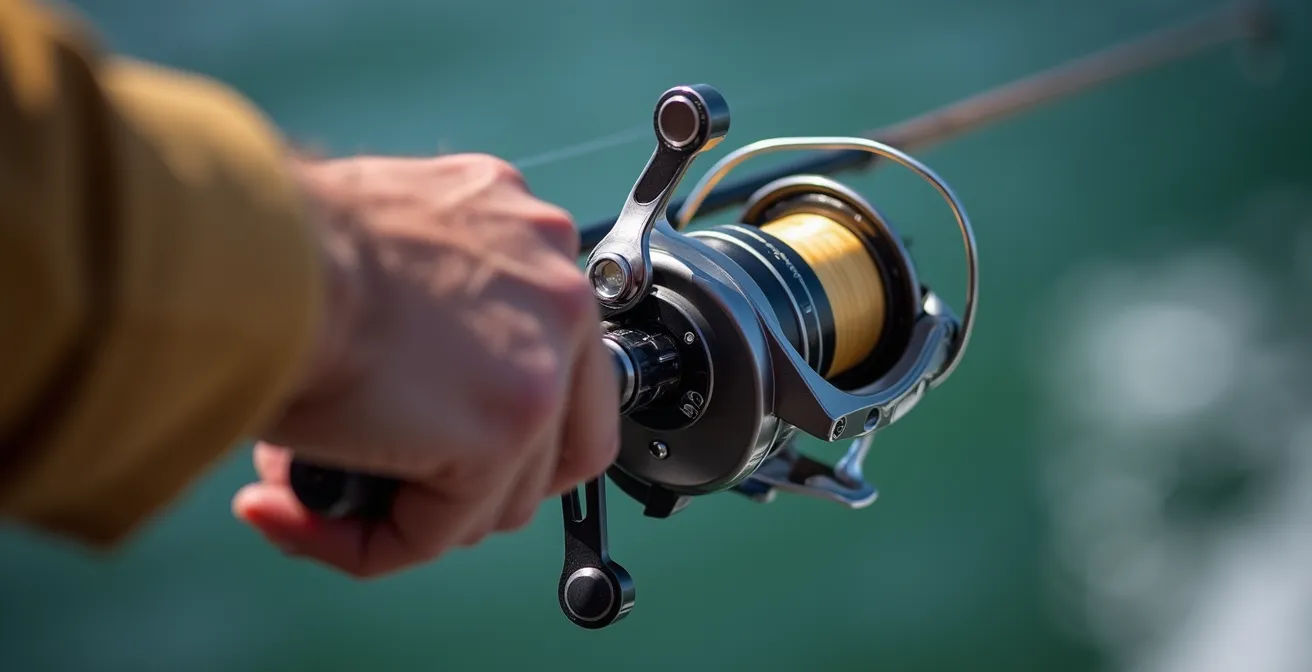
The mental benefits become clear when you compare the two systems directly. While a spinning reel has its place, the baitcaster’s demands align perfectly with the needs of a competitive mindset under stress.
| Mental Aspect | Baitcaster Benefits | Spinning Reel Benefits |
|---|---|---|
| Accuracy Control | Better line control for precise casts | Easier learning curve |
| Feedback Sensitivity | Direct contact detects subtle changes | Less overwhelming for beginners |
| Mental Engagement | Constant spool control keeps focus sharp | Allows more relaxed approach |
| Stress Response | Process-oriented casting builds confidence | Fewer backlash worries |
Graphite vs. Fiberglass: Why Carbon Rods Detect Strikes You Are Missing?
The debate between graphite and fiberglass isn’t just about technology; it’s about eliminating doubt. A modern, high-modulus carbon fiber (graphite) rod is a tool for mental clarity. Its incredible sensitivity doesn’t just help you feel subtle bites—it silences the nagging voice in your head that asks, “Did I just miss one?” When you can feel every pebble on the bottom and every blade of grass your crankbait ticks, you have absolute confidence in the feedback you’re getting. You know, without a doubt, that if a fish breathes on your lure, you will feel it.
This elimination of uncertainty is a massive advantage in a high-stress tournament. Doubt is a cancer in the mental game. It leads to second-guessing, loss of focus, and tentative hook sets. A less sensitive rod creates ambiguity, and ambiguity is where stress thrives. With a top-tier carbon rod, the feedback is binary: it was either a bite or it wasn’t. There is no in-between. This allows you to fish faster, more aggressively, and with unwavering commitment to every cast.
This is the essence of what separates the best from the rest. It’s not just about having better gear; it’s about understanding how that gear impacts your mental state. As the legendary Kevin VanDam puts it:
If you’re not able to maximize the tough days — to find some way to turn them into average days and to learn from them — you’re not going to be as successful as you should be, and you’ll find yourself chasing the guys who possess that kind of mental toughness.
– Kevin VanDam, Fishing Tips for a Tournament Win
That mental toughness is built on a foundation of confidence, and confidence is built by eliminating variables. Your rod is one of the most critical variables. Choosing a rod that gives you definitive, unambiguous feedback is choosing to eliminate a major source of mental stress.
How to Distinguish Between Bait Balls and Predator Arches on 2D Sonar?
When the bite dies, your sonar screen is not just a tool for finding fish; it’s a gym for your brain. A dead period is the most dangerous time for a tournament angler’s mental state. Idleness breeds negativity. The pro’s defense against this is to shift from a “hunting” mindset to an “analytical” mindset. Instead of aimlessly casting, you engage in a focused, intellectual exercise: sonar interpretation.
The goal is to keep your analytical brain firing and your emotional brain quiet. Challenge yourself. Turn it into a game. How cleanly can you distinguish a tight bait ball from a school of non-predatory fish? How quickly can you identify the distinct, thicker arches of predators holding near that bait? Set strict rules for yourself, like requiring a distinct separation and a specific arch shape before you even think about stopping to fish. This isn’t just about finding fish; it’s about maintaining mental discipline and preventing the emotional spiral that comes from “just casting.”
This analytical process serves multiple purposes. First, it keeps you productive. You are actively gathering information, documenting bait types, and noting bottom transitions for future reference. Second, it prevents the emotional fatigue of hundreds of empty casts. Your focus is on the screen and the data, not on the lack of bites. You’re a scientist gathering data, not a desperate angler praying for a strike. This mental reframing is critical. It allows you to weather long, slow periods and arrive at the next spot mentally fresh and sharp, rather than defeated and frustrated.
Key Takeaways
- Build concrete mental systems and pre-planned routines; do not rely on fleeting emotions like “positivity.”
- Use specific, rehearsed physical actions—like re-tying a lure or checking gear—as “tactical resets” to break negative thought patterns.
- Leverage your equipment to enforce discipline. Use sensitive rods to eliminate doubt and baitcasters to maintain moment-to-moment focus.
Daily Limit vs. Possession Limit: What Is the Legal Difference?
While understanding the legal difference between a daily limit (what you can keep in one day) and a possession limit (the total you can have, including at home) is critical for compliance, the real mental challenge in a tournament is the “culling” process. The stress of managing your livewell, deciding which fish to keep and which to release to upgrade your total weight, is immense. But the most important limit to manage is the one on your mental energy over a multi-day event.
Elite tournaments are marathons, not sprints. You cannot let a bad Day 1 destroy your mental capital for Day 2 and 3. Winning anglers understand that a tournament is a game of averages and adjustments. You can often weather a terrible first day if you can mentally regroup, execute a systems check, and treat Day 2 as a clean slate. A single bad day doesn’t define the tournament, but letting that bad day bleed into the next one absolutely will. This requires a macro-level mental strategy focused on preservation and recovery.
This is the final piece of the puzzle: recognizing that mental fortitude isn’t about being a rock; it’s about being resilient. It’s about having the systems in place to diagnose a bad day, flush the negativity, and show up on the ramp the next morning with the same sharp, analytical mindset you started with. The anglers who can do this consistently are the ones who are in contention year after year. As the National Professional Fishing League states, “The anglers who win the mental game are the ones you see hoisting trophies.”
Stop waiting for the bite to turn on and start building the mental systems that guarantee you stay in the game. Begin today by creating a simple tactical reset routine and committing to a data log for your next five trips. Your future tournament success depends on it.