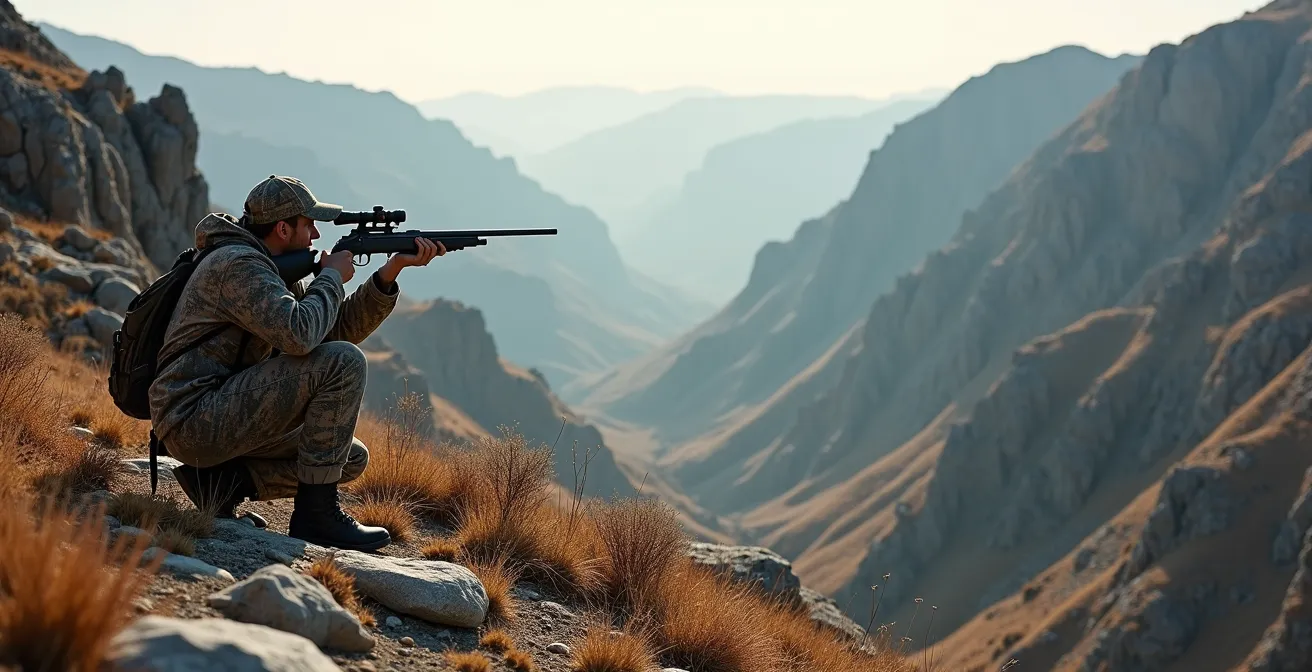
True hunting safety transcends memorizing rules; it requires understanding the physics that govern a bullet’s flight path long after it leaves the barrel.
- A bullet’s interaction with the environment is dictated by its velocity, mass, construction (e.g., copper vs. lead), and the angle of impact.
- Natural backstops are not equal; their geology, density, and uniformity determine whether they safely stop a projectile or dangerously redirect it.
Recommendation: Shift your mindset from simply “seeing a safe backstop” to “visualizing the entire potential trajectory,” accounting for unseen deflection and ricochet risks.
Every hunter knows the four cardinal rules of firearm safety, with “Know your target and what lies beyond” being paramount. We’re trained to identify a clear backstop—a solid hill, a dense berm of earth—that can reliably stop a bullet. But this foundational rule, while essential, only tells half the story. It focuses on the intended final destination of the projectile, often overlooking the complex, chaotic journey it can take to get there, or more alarmingly, where it goes after passing through the target.
The common advice is to avoid hard surfaces and water, but what constitutes a “hard” surface in a forest? A moss-covered rock? Frozen soil? What specific angle turns a calm pond into a high-risk ricochet surface? The standard safety curriculum provides the “what,” but for the technical-minded hunter, the “why” and “how” are what truly build expertise and prevent accidents. The real danger often lies not in the obvious hazards, but in the unseen variables of physics and the environment.
This is where a deeper understanding becomes a hunter’s most critical tool. This article moves beyond the basic tenets of safety to explore the applied physics of terminal ballistics in the field. We’ll deconstruct the hidden factors that influence a bullet’s path, from its initial stability leaving the muzzle to its final interaction with terrain. The goal is not to replace the core safety rules, but to augment them with a layer of predictive knowledge. By learning to think like a field ballistics expert, you can transform your ability to assess risk and ensure that every shot you take is not just aimed well, but lands safely.
To help you master these concepts, this guide will break down the critical physical principles and their real-world applications in the field. You will learn to evaluate terrain, understand bullet behavior, and make safer decisions in split-second scenarios.
Summary: The Unseen Path: A Hunter’s Guide to Bullet Trajectory and Ricochet
- Why a Clean Pass-Through Can Be Dangerous in Rocky Terrain?
- How to Evaluate a Natural Backstop in Split-Second Scenarios?
- High Velocity vs. Heavy Mass: Which Is Safer for Brush Hunting?
- The Angle Error That Causes Waterfowl Shot to Skip Across Ponds
- How to Zero Your Rifle to Minimize Unpredictable Deviations?
- Why Copper Bullets Require More Velocity to Expand Reliably?
- Zone of Fire vs. Target Fixation: What Is the Difference?
- Rifle, Bow, or Shotgun: Which Weapon Fits Your Local Terrain Best?
Why a Clean Pass-Through Can Be Dangerous in Rocky Terrain?
A clean pass-through shot is often considered the ethical ideal, as it typically creates a better blood trail and a quicker, more humane harvest. However, in certain environments, this ideal scenario introduces a significant and often underestimated danger: the post-target trajectory. When a bullet exits an animal, it still carries a tremendous amount of kinetic energy. In a dense forest with a soft soil backstop, this energy is quickly and safely absorbed. But in rocky terrain, that same exiting bullet becomes an unguided, high-velocity projectile looking for a hard surface to ricochet from.
The danger is not hypothetical. While seemingly rare, data shows that ricochet bullets account for approximately 4% of all hunting injuries. This statistic underscores the reality that a hunter’s responsibility does not end at the target. The composition of the terrain *behind* the target is just as critical as the target itself. A bullet that has passed through soft tissue is often destabilized, causing it to tumble. A tumbling projectile striking a hard surface will ricochet in a far more erratic and unpredictable manner than a stable one.
Understanding the geology of your hunting area is crucial. Different types of rock present different levels of risk:
- Hard Granite: Acts much like a steel plate, creating a high risk of ricochet with somewhat predictable angles of deflection.
- Soft Shale or Sandstone: These may absorb some of the bullet’s energy or cause it to fragment, but they can still produce dangerous, unpredictable deflections.
- Volcanic Basalt: An extremely hard surface that poses a maximum ricochet risk, requiring extreme caution for any shot with pass-through potential.
- Hidden Hazards: Perhaps the most dangerous scenario involves rocks buried just beneath the topsoil or leaf litter, creating an unseen ricochet surface where you expect a safe, earthen backstop.
This is why a hunter must think in three dimensions, considering the entire flight path of the bullet, including its potential path after a successful pass-through. A shot that is perfectly ethical in one environment can become reckless in another simply due to the ground composition 100 yards behind the animal. The “clean pass-through” is only truly clean if its journey ends safely in the earth, not caroming off a hidden slab of granite.
How to Evaluate a Natural Backstop in Split-Second Scenarios?
The textbook definition of a safe backstop is a substantial earthen bank, hill, or other feature that is guaranteed to stop a bullet. In the real world, hunters rarely have such a perfect setup. Instead, we must evaluate a mosaic of trees, rocks, and uneven ground in the fleeting moments before a shot. This process needs to be as ingrained and automatic as flicking off the safety. It’s not just about seeing “a hill,” but about understanding the properties of that hill.
To make this evaluation effective under pressure, you must visualize a three-dimensional safety zone, not just a two-dimensional backstop. This “cone of safety” extends out from your position and must encompass any potential deviation of your shot and any possible ricochet path beyond the target. The illustration below helps conceptualize this 3D space, where the true danger zone is much wider and taller than the simple line of sight to the target.

As the visual demonstrates, a safe shot requires a backstop that contains this entire cone. A small mound of dirt directly behind a deer might stop a perfect shot, but it does nothing to contain a shot that deviates slightly left or a ricochet that skips off the ground in front of the target. A mental checklist can help you make this complex evaluation rapidly and reliably.
Your S.U.R.E. Checklist for Backstop Evaluation
- Solid? – Verify the backstop’s density and material. Is it a dense earth berm, or is it a loose, rocky outcrop that could promote ricochet?
- Uniform? – Scan for gaps, hollows, or porous areas. A seemingly solid wall of trees can have gaps that allow a bullet to travel for miles.
- Room for Error? – Ensure the backstop extends well beyond your target in all directions, accounting for potential rifle cant, wind drift, or shooter error.
- End of Path Visible? – Can you confirm with certainty where the bullet will ultimately come to rest? If the bullet passes over a crest, you have lost control of it.
Committing this S.U.R.E. checklist to memory allows a hunter to move beyond a simple visual check and perform a rapid, robust risk assessment. It transforms the vague concept of “know what’s beyond your target” into a concrete, repeatable process that ensures a safe conclusion for every projectile, even in the most dynamic hunting situations.
High Velocity vs. Heavy Mass: Which Is Safer for Brush Hunting?
The age-old debate in deer camps revolves around the best “brush-busting” caliber. The common wisdom often suggests that a heavy, slow-moving bullet is superior because its mass allows it to “plow through” small branches and twigs without significant deflection. Conversely, others argue a high-velocity, lightweight bullet will fragment or deflect so violently that it’s less of a ricochet risk. The truth, as is often the case in ballistics, is far more nuanced and depends on the concepts of sectional density (SD) and projectile construction.
Sectional density is a bullet’s weight in pounds divided by its diameter in inches squared. A higher SD indicates that the bullet has more weight concentrated behind its frontal area, giving it greater momentum and a better ability to resist deflection and maintain its course upon impact. Therefore, a heavy-for-caliber bullet (e.g., a 180-grain .308) will inherently have a higher SD and better deflection resistance than a light-for-caliber bullet (e.g., a 150-grain .308), regardless of velocity.
However, velocity adds another layer of complexity. Extremely high velocities, like those from a varmint cartridge, can cause a lightly constructed bullet to virtually explode upon contact with even a small twig, sending fragments in every direction. While this might prevent a classic ricochet, it creates a “shotgun effect” of multiple secondary projectiles that are completely unpredictable. The following table illustrates this trade-off.
This comparative data shows a clear trend: bullets with a higher sectional density, which are typically heavier for their caliber, pose a lower risk of both deflection and dangerous fragmentation in brushy conditions.
| Bullet Type | Velocity | Sectional Density | Brush Deflection Risk | Secondary Projectile Risk |
|---|---|---|---|---|
| Light Varmint (55gr .223) | 3200+ fps | 0.157 | Very High | Extreme (fragmentation) |
| Standard Hunting (150gr .308) | 2800 fps | 0.226 | Moderate | Moderate |
| Heavy for Caliber (180gr .308) | 2500 fps | 0.271 | Lower | Low |
| Dangerous Game (300gr .375) | 2400 fps | 0.305 | Lowest | Very Low |
Case Study: The Newfoundland Deflection
The real-world impact of this phenomenon is stark. As documented by Outdoor Life, a hunter in Newfoundland fired at a moose from 65 yards. The bullet struck a small, unseen limb just a few yards in front of the animal. This minor impact was enough to alter the bullet’s path by approximately 15 inches, turning a lethal shot into a non-fatal injury. This case perfectly demonstrates that no bullet is immune to deflection, but choosing a projectile with a higher sectional density can help mitigate, though not eliminate, this risk.
The Angle Error That Causes Waterfowl Shot to Skip Across Ponds
For waterfowl hunters, the “backstop” is often the water itself, a surface that seems inherently safe. However, water is one of the most efficient surfaces for producing ricochets. The phenomenon of a skipping stone is a perfect analogy; a projectile hitting water at a low angle of incidence will not penetrate but will instead be redirected, often multiple times, losing very little velocity with each skip. For a pattern of shotgun pellets, this creates a wide, low-flying hazard that can travel for hundreds of yards.
The critical factor is the angle of incidence—the angle at which the shot strikes the water’s surface. While many variables are at play, a fundamental principle of ballistics is that shots fired at water surfaces at angles less than 30 degrees have a very high probability of ricocheting. When ducks are flying low over decoys, or a hunter is shooting from a low-profile blind, it’s easy to fall into this low-angle danger zone without realizing it.
A calm, glassy surface is the most predictable for ricochet, but choppy water created by wind can be even more dangerous. Each wave presents a small, angled ramp that can send pellets in completely unpredictable directions. This is why experienced waterfowlers adopt a “rule of sky,” ensuring they only take shots where there is a clear patch of sky visible behind the bird. This simple discipline naturally forces a higher, safer shooting angle where the pellets will lose their energy in the air and fall harmlessly into the water rather than skipping across it.
To mitigate this specific risk, hunters should adhere to a strict safety protocol when shooting over water:
- Verify Sky: Always ensure clear sky is visible behind the target bird before pulling the trigger. This is the most important rule.
- Avoid Low Skimmers: Never shoot at birds that are skimming just feet above the water’s surface. Wait for them to gain altitude or flare up.
- Maintain High Angles: Whenever possible, maintain a shooting angle of at least 45 degrees to the water’s surface. This provides a significant margin of safety.
- Position Blinds Strategically: Set up your blind or hunting position on higher ground, like a bank or knoll, to create naturally high-angle shooting opportunities.
By understanding the physics of the angle of incidence and internalizing these rules, a waterfowl hunter can effectively eliminate the risk of a dangerous ricochet across the water, protecting themselves, their partners, and anyone else who might be unseen downrange.
How to Zero Your Rifle to Minimize Unpredictable Deviations?
A properly zeroed rifle is the foundation of every ethical shot. However, many hunters mistakenly believe that zeroing is a one-and-done process performed at a local range. In reality, a “perfect zero” is a fragile state, highly susceptible to subtle errors and environmental changes that can introduce significant, unpredictable deviations at hunting distances. Mastering the zeroing process means accounting for these hidden variables.
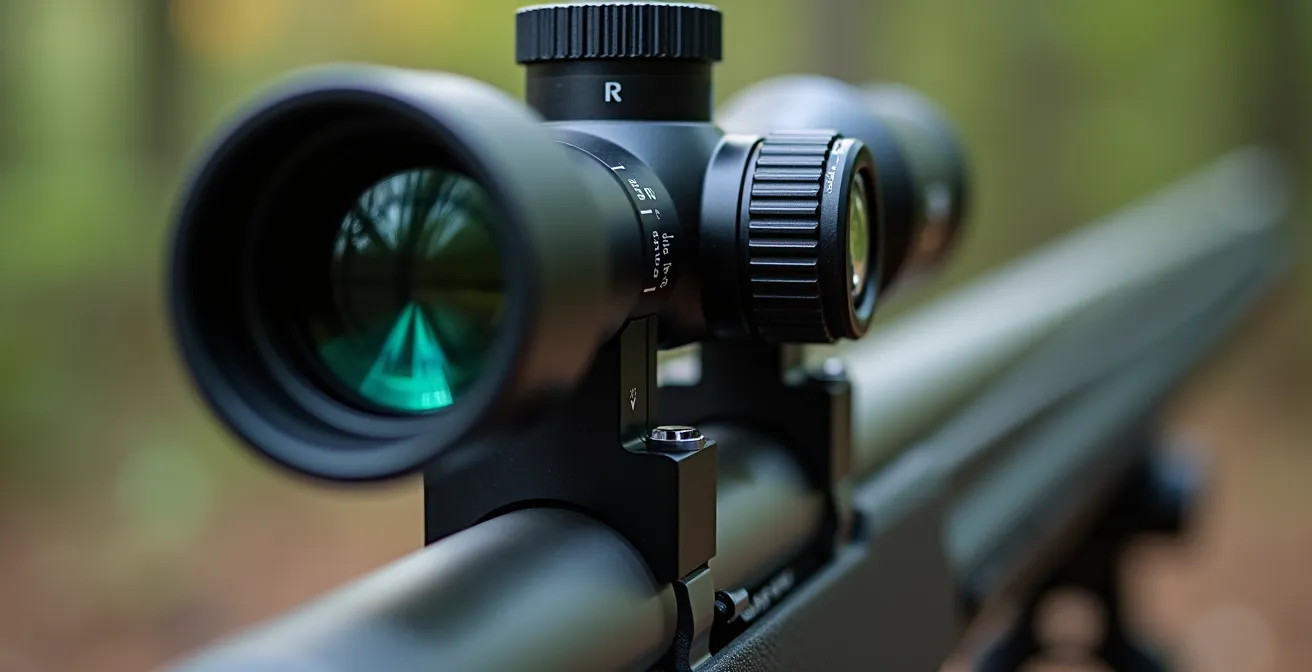
One of the most common and insidious errors is rifle cant. This is a slight, often unnoticed, tilting of the rifle to the left or right. Even a few degrees of cant can cause the bullet to drift significantly in the direction of the tilt, with the effect magnifying over distance. A scope that is not perfectly leveled in its rings or a shooter who unconsciously tilts the rifle under pressure can easily introduce several inches of error at 200 yards. The macro image below shows a bubble level integrated into a scope, a tool precision shooters use to eliminate this exact error.
Beyond mechanical errors like cant, the environment itself can invalidate a perfect zero. This is known as environmental zero shift. A rifle zeroed at sea level on a hot, humid day will not have the same point of impact when fired at high altitude in cold, dry air. Changes in air pressure, temperature, and humidity alter air density, which in turn changes the drag on the bullet and its trajectory over distance. For long-range hunters, these shifts can mean the difference between a clean kill and a complete miss or, worse, a wounded animal.
Case Study: The Impact of Environmental Zero Shift
The ballistic experts at Hornady provide a compelling example of this effect. In their testing, they demonstrated how a .338 caliber rifle required significant adjustments between different environments. The same ammunition that was perfectly zeroed in the warm, humid, sea-level conditions of Mobile, Alabama, showed a dramatically different point of impact when fired in the cold, thin air of the British Columbia mountains. At typical hunting ranges, this shift could easily be several inches, demonstrating that a hunter must be prepared to verify or adjust their zero in the field.
Minimizing these deviations requires meticulousness. It means using a level to mount your scope, practicing a consistent cheek weld to avoid cant, and using a ballistic calculator to understand how environmental changes will affect your bullet’s path. A truly reliable zero isn’t just a point on a paper target; it’s a system that accounts for the physics of both the rifle and the world around it.
Why Copper Bullets Require More Velocity to Expand Reliably?
With the increasing prevalence of lead-free hunting zones and a growing environmental consciousness, monolithic copper bullets have become a popular choice. However, these projectiles behave very differently from traditional lead-core bullets, and failing to understand their unique performance envelope can lead to poor terminal performance and unethical outcomes. The key difference lies in their material properties: copper is simply harder and less malleable than lead.
A traditional lead-core bullet with a soft point begins to expand or “mushroom” upon impact almost instantly, even at lower velocities. This is because the soft lead deforms easily. A solid copper bullet, by contrast, relies on a combination of a hollow point and hydraulic pressure to initiate expansion. The cavity at the tip must be forced open by tissue and fluid, which then peels back the bullet’s petals. This process requires a significant amount of energy, which translates directly to a minimum impact velocity.
If a copper bullet strikes its target below this velocity threshold, it will not expand at all. It will behave like a full metal jacket (FMJ) “target” round, punching a small-caliber hole straight through the animal without transferring sufficient energy or creating a large wound channel. This often results in a lost or unrecovered animal. For this reason, manufacturers specify a minimum impact velocity for reliable expansion, which is a critical piece of data for any hunter. According to experts in the field, most copper bullets require a minimum impact velocity of 2000 feet per second (fps) to perform as designed, though some polymer-tipped designs can expand at slightly lower velocities.
Actionable Plan for Copper Bullet Performance
- Calculate Your Maximum Range: Use a ballistic calculator to determine the exact distance at which your chosen copper bullet drops below its minimum expansion velocity (e.g., 2000 fps). This is your absolute maximum effective range.
- Verify Velocity Before the Shot: For any long-range shot, use a rangefinder and your ballistic data to confirm your bullet will still be above the velocity threshold upon impact.
- Choose Smart Designs: For hunting scenarios where shots might be at extended ranges, select copper bullets with large polymer tips or deep, pre-cut stress lines, as these are engineered to initiate expansion at lower velocities.
- Match Bullet to Cartridge: Ensure your cartridge has enough case capacity to push the copper bullet fast enough to be effective at your intended hunting distances.
- Never Exceed the Envelope: Discipline is key. Never take a shot beyond the range where your bullet is guaranteed to have enough velocity to expand reliably.
Switching to copper bullets is a responsible choice, but it comes with the responsibility of understanding their physics. By respecting the velocity requirements of these projectiles, a hunter can ensure they perform effectively and ethically in the field.
Zone of Fire vs. Target Fixation: What Is the Difference?
In hunter education, two concepts that are crucial for preventing tragic accidents are “zone of fire” and “target fixation.” While they may sound similar, they represent two distinct aspects of situational awareness. Understanding the difference is key to developing the mental discipline required for safe hunting, especially when in a group.
A zone of fire is a pre-determined, physical area of responsibility assigned to each hunter in a group. It’s an agreed-upon lane or sector that a hunter can safely shoot into. For example, when three hunters are walking abreast, the person on the left can only shoot to the left and forward, the person in the middle can only shoot straight ahead, and the person on the right can only shoot to the right and forward. It is a proactive safety agreement that ensures no one inadvertently points their firearm toward a partner.
Target fixation, on the other hand, is a reactive psychological phenomenon. It’s a form of tunnel vision where a hunter becomes so intensely focused on a target animal that they lose all peripheral awareness. Their brain effectively filters out everything else in the environment, including their hunting partners who may have moved into the line of fire, the quality of their backstop, or other unseen hazards. It is one of the leading causes of hunting accidents involving multiple people.
Case Study: A Tragic Intersection of Concepts
A 2024 incident report from the New York State Department of Environmental Conservation highlights how these two concepts can tragically intersect. In November 2023, a hunter in Chautauqua County shot at a deer, but the bullet first struck a tree. The deflected bullet then hit their hunting partner. This incident is a textbook example: the shooter likely experienced target fixation, failing to notice their partner had moved. At the same time, the partner had moved out of their own zone of fire and into the shooter’s. The deflected bullet, even after losing energy, was still capable of causing injury, demonstrating how a failure to manage both zone of fire and target fixation creates a recipe for disaster.
The primary way to combat target fixation is through conscious, disciplined practice. By training your brain to break its focus, you can maintain situational awareness even in the most exciting moments. The “Scan-Aim-Scan” protocol is an effective technique:
- SCAN: Before even raising the rifle, visually sweep your entire 180-degree field of view to establish a baseline of your surroundings and the location of your partners.
- AIM: Acquire your target through the scope, but consciously maintain your peripheral awareness. Keep your non-shooting eye open if possible.
- SCAN: Just before pressing the trigger, force yourself to lower the scope for a fraction of a second and re-verify the background and the area around the target.
Key Takeaways
- A bullet’s potential for ricochet is determined by its velocity, mass, and construction, not just the hardness of the surface it strikes.
- The angle of incidence is the single most important factor for ricochet on water; shots below 30 degrees are extremely high-risk.
- A rifle’s zero is not static; it is affected by mechanical errors like cant and environmental factors like temperature, altitude, and humidity.
Rifle, Bow, or Shotgun: Which Weapon Fits Your Local Terrain Best?
The ultimate application of understanding ballistics and ricochet is choosing the right tool for the job. The effectiveness and, more importantly, the safety of a rifle, shotgun, or bow are not inherent to the weapon itself but are instead defined by the terrain in which it is used. Each weapon system has a different “danger zone footprint”—the total area it can affect through its maximum range and potential for ricochet or deflection. Matching this footprint to your local environment is a hunter’s highest-level safety responsibility.
In dense, eastern hardwood forests, a high-powered rifle might be a poor choice. The risk of a bullet deflecting off an unseen tree and traveling for miles is significant. Here, a shotgun with slugs, which has a much shorter maximum range, or a bow, which has almost no ricochet potential, are often far safer and more practical choices. Conversely, in the wide-open plains of the West, a bow’s limited range can be a handicap, and a flat-shooting rifle becomes the appropriate tool, provided the hunter is acutely aware of the vast overshot distances.
Wetlands present their own unique challenges, where a rifle bullet can skip across the water for over a mile. A shotgun with birdshot, whose pellets lose energy quickly, is the universally accepted tool for this environment. The choice is about containing the weapon’s potential energy within the landscape. The following table breaks down the comparative risks of each weapon type in different terrains.
This analysis demonstrates that weapon selection is a critical component of risk management. The safest choice is the one with the minimum effective power and range for the terrain and game being hunted.
| Weapon Type | Maximum Range | Ricochet Range | Dense Forest Risk | Open Plains Risk | Wetlands Risk |
|---|---|---|---|---|---|
| Compound Bow | 400 yards | 100 yards | Lost arrow | Limited range | Minimal |
| 12ga Shotgun Slug | 1 mile | 0.5 mile | Overpenetration | Drop at range | Water skip |
| .30-06 Rifle | 3+ miles | 1.5 miles | Deflection | Overshot | Long skip |
Ultimately, a responsible hunter doesn’t just ask, “Can I make this shot?” They ask, “Is this the right weapon for this shot, in this place?” This mindset shift, from a focus on capability to a focus on appropriateness, is the hallmark of a true expert. It acknowledges that every landscape has its own set of rules, and our job is to choose the equipment that respects them.
By embracing the physics of ballistics and applying that knowledge to your equipment and environment, you elevate your practice of hunting from a simple pursuit to a technical skill. This deeper understanding is what transforms a good hunter into a safe and ethical one, ensuring that the only impact you leave on the landscape is the one you intend.