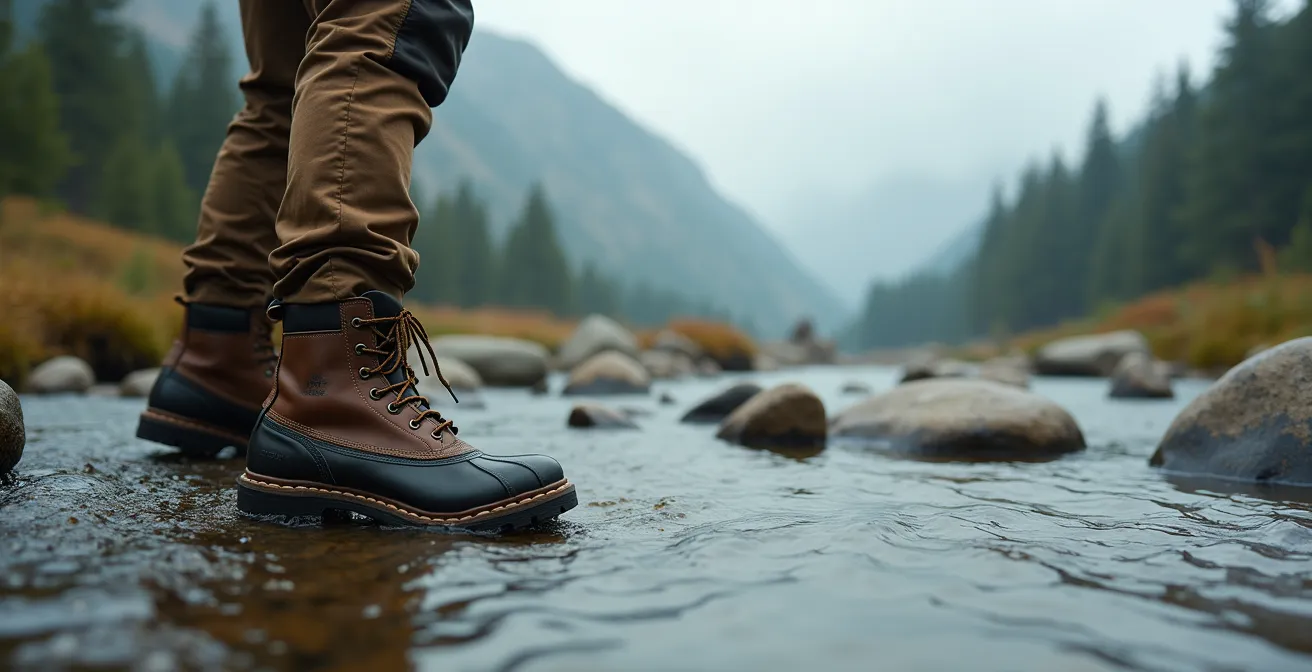
In summary:
- Treat your feet as a system: Your boots, socks, and feet must work together to manage moisture and friction.
- Waterproof is not enough; breathability and active moisture management are what truly keep feet dry and healthy.
- Insulation choice depends more on your activity level than the temperature outside.
- Mastering simple, terrain-specific lacing adjustments is the single most effective way to prevent blisters.
- A structured, multi-week break-in period is non-negotiable for ensuring your boots are ready for the hunt.
For any hunter who covers serious ground, the hunt doesn’t end because of a missed shot or a change in weather. It ends when your feet fail. A single, well-placed blister can sabotage weeks of planning and turn a dream hunt into an agonizing ordeal. The common advice—”break them in” or “buy good socks”—is dangerously simplistic. It treats the boot as a simple piece of equipment, when in reality, it’s the housing for a complex, delicate ecosystem. As a footwear specialist, I see hunters make the same critical mistakes season after season, focusing on brand names or insulation ratings while ignoring the fundamental physics of what causes foot failure: friction, pressure, and moisture.
Most guides will tell you to look for a waterproof membrane or a certain amount of insulation. While not wrong, this advice misses the crucial point. The real enemy isn’t just the river you cross; it’s the sweat your own body produces inside the boot. The key to blister-free, functional feet from the first mile to the last isn’t finding a mythical “perfect boot.” It’s about understanding and mastering the foot-sock-boot system as a whole. It’s about learning to dynamically manage the microclimate inside your footwear, adjusting to your activity level and the terrain underfoot.
This guide moves beyond the marketing claims. We will deconstruct the components of this system, from the material science of waterproofing and insulation to the biomechanics of lacing techniques. You will learn not just what to buy, but how to think like a pedorthist—proactively managing pressure points, controlling moisture, and turning your boots into a true extension of your body, ready for any challenge the wilderness presents.
To navigate this complex topic, we will break down the essential elements you must master. This guide covers everything from material choices and insulation science to the practical skills of lacing and pre-season preparation, ensuring your feet are the last thing on your mind when you’re in the field.
Summary: The Ultimate Guide to Blister-Free Hunting Boots
- Gore-Tex vs. Rubber: Which Keeps Feet Drier in High Activity?
- How to Select Grams of Insulation Based on Activity Level, Not Just Temperature?
- Heel Lock vs. Toe Relief: Which Lacing Method Stops Downhill Bruising?
- The Campfire Error That Delaminates Your Expensive Boots
- When to Buy Your Boots to Ensure They Are Ready for Opening Day?
- Why Cotton Is the Enemy of the Late-Season Hunter?
- Why Merino Wool Outperforms Synthetics in Variable Mountain Climates?
- Desert, Mountain, or Swamp: How to Adapt Your Tactics to the Biome?
Gore-Tex vs. Rubber: Which Keeps Feet Drier in High Activity?
The promise of a waterproof/breathable membrane like Gore-Tex is seductive: it keeps external water out while letting internal sweat vapor escape. However, its effectiveness is critically misunderstood. A membrane’s ability to “breathe” depends on a pressure and humidity differential between the inside and outside of the boot. On a long, strenuous hike, your foot is a biological engine producing heat and moisture. In fact, research shows a foot can sweat as much as 15 ml per hour during high-exertion activity. This creates a high-humidity microclimate inside the boot.
The problem is, this system breaks down completely under two common hunting conditions. First, when the boot’s outer fabric (leather or synthetic) becomes saturated with water from rain, dew, or a creek crossing, it effectively chokes the membrane, dropping its breathability to near zero. As documented by the Appalachian Mountain Club, in sustained wet conditions, hikers essentially trap all foot sweat inside their boots. Second, in high-humidity environments like a swamp or a warm, rainy day, there is no significant humidity gradient to drive moisture out. In both cases, your “breathable” boot becomes a rubber boot, trapping sweat against your skin.
So, which is better? For high-activity hunting with a risk of saturation, a full-rubber boot paired with an active moisture management strategy is often superior. This means accepting that your feet will get damp from sweat and planning for it. This involves a disciplined sock-swapping schedule, changing to a dry pair every few hours and attaching the damp pair to your pack to dry. For Gore-Tex, the strategy is to meticulously maintain the exterior Durable Water Repellency (DWR) so water beads off, preserving breathability for as long as possible.
How to Select Grams of Insulation Based on Activity Level, Not Just Temperature?
One of the most common and costly mistakes hunters make is choosing boot insulation based solely on the forecasted temperature. The belief that “more is better” for cold weather leads to sweaty, cold, and blister-prone feet. The purpose of insulation is not to generate heat, but to trap the heat your body produces. However, if you are highly active—stalking an animal, climbing a steep ridge—your body generates an enormous amount of heat. Excessive insulation in this scenario traps too much heat, leading to profuse sweating. That sweat saturates your socks and the insulation itself, compromising its thermal properties and creating the perfect environment for friction blisters.
A far more effective approach is to select insulation based on your anticipated activity level. A hunter sitting stationary in a tree stand for hours requires significantly more insulation (800g-1000g) than a hunter actively covering miles of mountainous terrain (200g-400g), even at the same ambient temperature. The active hunter’s primary challenge is managing heat and sweat, not retaining it. Furthermore, the effectiveness of insulation is dramatically reduced when it’s compressed. Intense lacing over the instep can compress insulation by 50% or more, creating a cold spot and a pressure point simultaneously.
The illustration below shows a macro view of what happens inside your boot. The fluffy, uncompressed fibers trap air effectively, providing warmth. But where laces create pressure, those fibers are crushed, eliminating the air pockets and creating a direct path for heat to escape, paradoxically making your foot colder and more susceptible to pressure sores.

This is why thinking in terms of activity level is critical. For hunts involving mixed activity, like walking to a stand and then sitting, a layered sock system can be more effective than a heavily insulated boot. You wear a lighter sock for the walk in and add a thicker, dry sock once you’re stationary. The following table provides a more nuanced framework for making this choice, as this detailed insulation selection matrix shows.
| Activity Level | Temperature Range | Recommended Insulation | Use Case |
|---|---|---|---|
| High Activity | 32°F to 50°F | 200g | Active stalking, continuous hiking |
| Moderate Activity | 10°F to 32°F | 400g-600g | Mixed walking and short stops |
| Low Activity | -10°F to 10°F | 800g-1000g | Tree stand hunting, long glassing sessions |
| Stationary | Below -10°F | 1200g+ | Ice fishing, extended observation |
Heel Lock vs. Toe Relief: Which Lacing Method Stops Downhill Bruising?
Blisters and bruised toes are rarely a sign of a poorly fitting boot; they are a sign of poorly managed internal foot movement. The two most destructive forces are heel lift during ascents (causing friction blisters on the heel) and forward foot slide during descents (causing bruised toenails and toe blisters). Many hunters try to solve both problems by simply cranking their laces as tight as possible from top to bottom. This is a critical error. It creates uniform pressure, cutting off circulation and creating new pressure points without solving the core mechanical issues.
The solution is not uniform tension, but zonal lacing. This technique treats the boot’s lacing system as two independent sections: the instep (over the top of your foot) and the ankle/cuff. By mastering this, you can achieve a secure heel lock while simultaneously giving your toes room to breathe and splay naturally. The key is a simple but transformative knot: the surgeon’s knot. By tying a surgeon’s knot (an extra twist through the loop) at the eyelets just before your ankle begins to flex, you create a “lock” in the system. This physically separates the tension below from the tension above.
This allows you to implement two distinct strategies. For steep ascents, you can keep the instep section snug to prevent your heel from lifting, while leaving the upper cuff slightly looser for ankle flexion. For brutal descents, you can dramatically tighten the ankle section to create a powerful heel lock that anchors your foot in the back of the boot, preventing it from sliding forward into the toe box. At the same time, the instep lacing can be kept comfortably snug, not crushingly tight. As military rucking specialists have documented, this ability to independently control tension is a game-changer for preventing both heel slip and toe jam, dramatically reducing blister formation on long, varied-terrain treks.
The Campfire Error That Delaminates Your Expensive Boots
After a long, wet day, the temptation to place your waterlogged boots near the campfire to dry is immense. This is arguably the fastest way to destroy a high-end pair of hunting boots. Modern boots are not simple constructions of leather and rubber; they are complex, multi-layered systems bonded together with sophisticated, heat-sensitive adhesives. The intense, radiant heat from a fire, even from what feels like a “safe” distance, is far more than these adhesives are designed to withstand.
When exposed to this direct heat, two destructive processes occur. First, the adhesives soften and fail, causing delamination. This is where the rubber rand (the protective strip around the lower part of the boot) peels away from the leather, or the outsole begins to separate from the midsole. This damage is often irreparable and completely compromises the boot’s structural integrity and waterproofing. Second, the heat can cause the leather itself to shrink, dry out, and crack, permanently altering the boot’s fit and creating new, aggressive hot spots.
Footwear experts are unanimous on this point: boots must be dried at moderate temperatures only, away from direct heat sources. The correct, albeit slower, method for drying boots in the field is to first remove the insoles and loosen the laces completely to open them up. Stuff them loosely with newspaper, paper towels, or even dry, spare clothing to draw moisture out from the inside. Place them in a dry, well-ventilated area, like inside your tent, but never next to a fire or a portable heater. It may take all night, but this patient approach preserves the hundreds of dollars you invested in your footwear. The campfire is for warming your hands and your spirits, not for destroying your most critical piece of gear.
When to Buy Your Boots to Ensure They Are Ready for Opening Day?
The concept of “breaking in” boots is widely known but poorly executed. Many hunters buy boots a week or two before the season, wear them around the house, and assume they’re ready. This is a recipe for disaster. A proper break-in isn’t just about softening leather; it’s a systematic process of molding the boot to your foot, testing the entire foot-sock-boot system under load, and identifying potential hot spots before they become debilitating blisters in the field. This process requires time. A lot of it.
The ideal time to purchase your new boots is a minimum of 90 days before your first hunt. This generous timeline serves two purposes. First, it gives you ample time to return the boots if you discover a fundamental fit issue that no amount of break-in can solve. Second, it allows for a phased, escalating break-in protocol. Field tests by publications like Western Hunter have shown that hunters following a structured 90-day schedule can achieve virtually zero blisters on opening day. This isn’t about wearing them to the office; it’s about simulating the stresses of the hunt.
This process involves gradually increasing the duration and intensity of wear, always with the exact socks you plan to hunt in. You start indoors, move to short walks on pavement, then graduate to uneven terrain with a weighted pack. This is your chance to practice the zonal lacing techniques for hills, test for side-hill stability, and feel for the slightest friction points. Each walk is a diagnostic test. Taking this time to prepare your gear is as important as sighting in your rifle. It’s a deliberate ritual that builds confidence in your equipment, ensuring your boots are a reliable partner, not a liability.
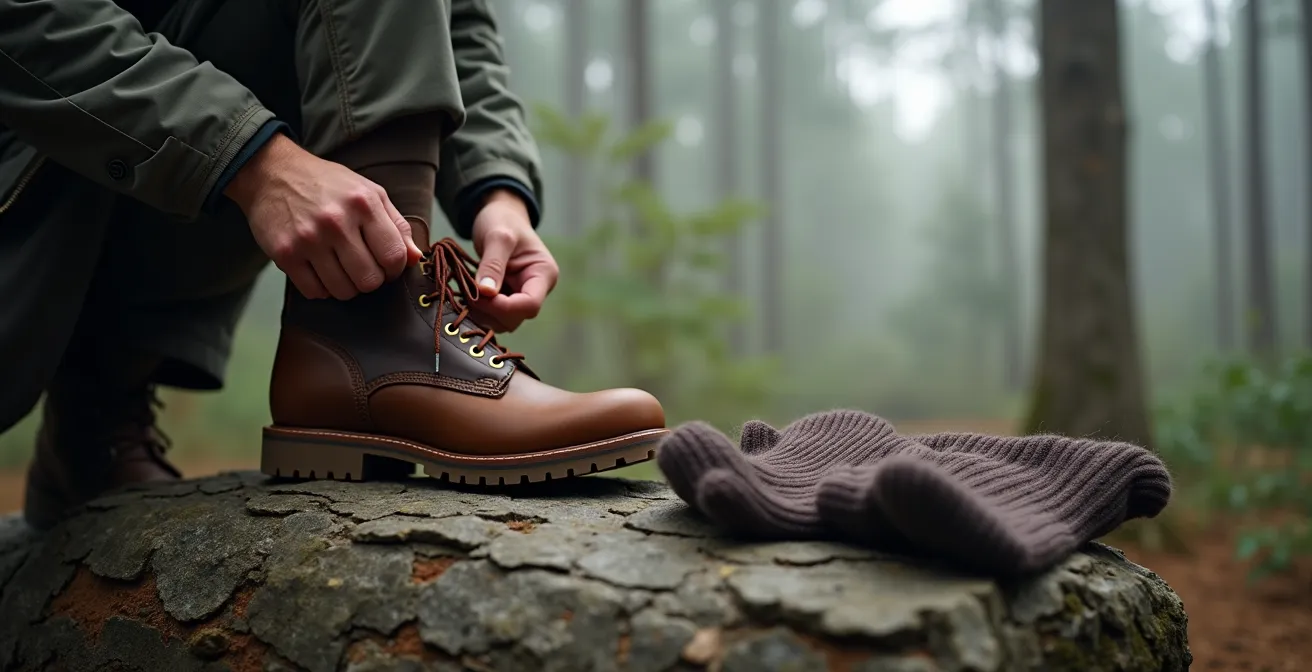
Your 90-Day Boot Readiness Plan
- Months 3-2 (90-60 days out): Purchase boots. Wear them around the house for 2-3 hours daily. Focus on identifying any immediate, obvious pressure points or fit issues while the return window is still open.
- Month 2 (60-30 days out): Begin short (1-3 mile) walks on varied terrain. Wear your planned hunting socks and carry a pack with 15-20 lbs of weight. Pay close attention to heel lift and toe pressure.
- Month 1 (30-7 days out): Escalate to longer hikes on terrain that mimics your hunting area. Carry your full pack weight. This is the time to practice and master your terrain-specific lacing adjustments for ascents and descents.
- Final Week (7 days out): Conduct at least one full “dress rehearsal” hike. Test for side-hill stability and ensure no new friction points have developed. This is also the time to apply a fresh DWR treatment if the boot’s exterior is absorbing water.
- Day Before Hunt: Do a final fit check with your chosen hunting socks. Ensure your sleeping socks are separate and kept dry, guaranteeing a warm, comfortable start to your hunt.
Why Cotton Is the Enemy of the Late-Season Hunter?
The old adage “cotton kills” is not an exaggeration, especially when it comes to your feet. While a cotton t-shirt might be uncomfortable when wet, a cotton sock is an active agent of destruction inside your boot. Its danger lies in its fundamental physical properties: cotton is hydrophilic, meaning it loves water. In fact, studies have demonstrated that cotton can absorb up to 27 times its own weight in water. Inside a boot, that water comes from sweat, and cotton acts like a sponge, pulling it from your skin and holding it there.
This creates a cascade of problems. First, wet skin loses its structural integrity. It becomes soft, pliable, and incredibly fragile—a condition often called maceration. Field studies on blister mechanics show that this water-logged skin has a significantly higher coefficient of friction. In simple terms, it becomes “grippier” and far more likely to tear under the shear forces generated by your foot moving inside the boot. Hikers wearing cotton socks consistently show blister formation rates up to three times higher than those wearing proper moisture-wicking materials.
Second, in a late-season or cold-weather context, this trapped moisture becomes a massive liability for thermoregulation. Water conducts heat away from the body 25 times faster than air. A wet cotton sock is a direct conduit, constantly pulling precious warmth from your foot, leading to cold, numb feet even in moderately insulated boots. This combination of being cold, wet, and highly susceptible to skin tearing makes cotton socks the single worst material choice for any serious hunter. It’s not just a matter of comfort; it’s a fundamental issue of safety and performance.
Why Merino Wool Outperforms Synthetics in Variable Mountain Climates?
While synthetics (like polyester or nylon) are excellent at wicking liquid sweat away from the skin, Merino wool has a unique and superior property that makes it ideal for the variable conditions of a mountain hunt. The difference lies in how it manages moisture at a microscopic level. Synthetics are hydrophobic; they don’t absorb water, so they push liquid sweat to the outside of the fabric to evaporate. This works well during high activity but can cause a dangerous “flash-off” cooling effect the moment you stop moving.
Merino wool, on the other hand, is hygroscopic. Its fibers can absorb a significant amount of moisture—up to 30% of their own weight—in a vapor state. This is a critical distinction. As research from boot manufacturer HANWAG shows, Merino begins to absorb your sweat *before* it even condenses into a liquid on your skin. This process keeps the microclimate immediately next to your skin drier and more stable. It effectively buffers changes in your exertion level, preventing the rapid cooling cycle that plagues synthetic users when they stop to glass after a hard climb.
Furthermore, Merino retains its insulating properties even when damp, a feat synthetics cannot match. For multi-day hunts, its natural antimicrobial properties are a massive advantage. While synthetic socks can become stiff and abrasive with dried salt and bacteria after just one day’s use, a pair of Merino socks can remain comfortable and odor-free for multiple days. This means you can carry fewer pairs, saving weight and space. The sock selection strategy for mountain hunting should be built around Merino wool as the foundation:
- Use a midweight Merino blend for the best balance of cushioning and moisture management.
- For those who sweat excessively, a thin synthetic liner sock can be worn under the Merino sock to quickly move liquid sweat into the absorbent wool layer.
- Always carry at least two spare pairs, and make a habit of swapping to a dry pair mid-day, strapping the wet ones to your pack to dry in the open air.
Key Takeaways
- Blister prevention is not a feature you buy, but a system you manage, consisting of your feet, socks, and boots.
- Active moisture management—through sock choice, DWR maintenance, and sock swapping—is more important than a “waterproof” label.
- Boot insulation must be matched to your activity level, not just the temperature, to avoid overheating and sweat saturation.
Desert, Mountain, or Swamp: How to Adapt Your Tactics to the Biome?
The perfect foot-sock-boot system is not universal; it must be adapted to the specific challenges of the environment you’re hunting in. The demands of a hot, sandy desert are diametrically opposed to those of a humid swamp or a vertically-challenging mountain range. A hunter who fails to adapt their system to the biome is setting themselves up for failure. Each environment presents a primary enemy: sand and heat in the desert, gravity and temperature swings in the mountains, and near-total saturation in the swamp.
In the mountains, the system prioritizes support and thermoregulation. This means a stiffer boot to protect the foot on uneven ground and a Merino wool sock system to manage sweat and temperature during massive exertion swings. The key tactic here is mastering zonal lacing to prevent foot movement during steep ascents and descents. In the desert, breathability is king. A heavy, waterproof boot is a sweat-filled torture chamber. The ideal system is a lightweight, non-membrane boot that breathes easily, paired with a light synthetic or Merino sock. The key tactic is physical barrier protection: tall, snug gaiters are essential to keep sand and grit out of the boot, as a single grain of sand can become an instrument of torture over many miles.
Swamp hunting presents the most difficult challenge: 100% external humidity and high internal sweat. As field tests in these environments show, even the best waterproof/breathable membranes are rendered useless. The winning strategy is to abandon the idea of staying dry from the outside. Instead, you build a system designed for perpetual dampness: knee-high rubber boots to provide a physical barrier, combined with an aggressive sock-swapping protocol. A thin synthetic liner to wick moisture into a thicker wool outer sock, which is then swapped out for a dry one mid-day, is the only way to keep feet functional. This biome-specific system, adapted from expert field analysis, is crucial for success.
| Biome | Boot Type | Sock System | Key Tactic |
|---|---|---|---|
| Mountain | Stiff-shanked with membrane | Merino wool for thermoregulation | Master zonal lacing for elevation changes |
| Swamp | Rubber or knee-high waterproof | Thin synthetic liner + wool outer | Mid-day sock swap strategy |
| Desert | Lightweight non-membrane | Light synthetic or Merino | Tall gaiters for sand/grit prevention |
By shifting your perspective from simply buying a product to actively managing a system, you take control of your own comfort and effectiveness in the field. Understanding these principles of moisture, friction, and pressure is the ultimate guarantee that your feet will carry you through your hunt and back, no matter the distance or terrain. Evaluate your gear, practice these techniques, and make foot failure a thing of the past.