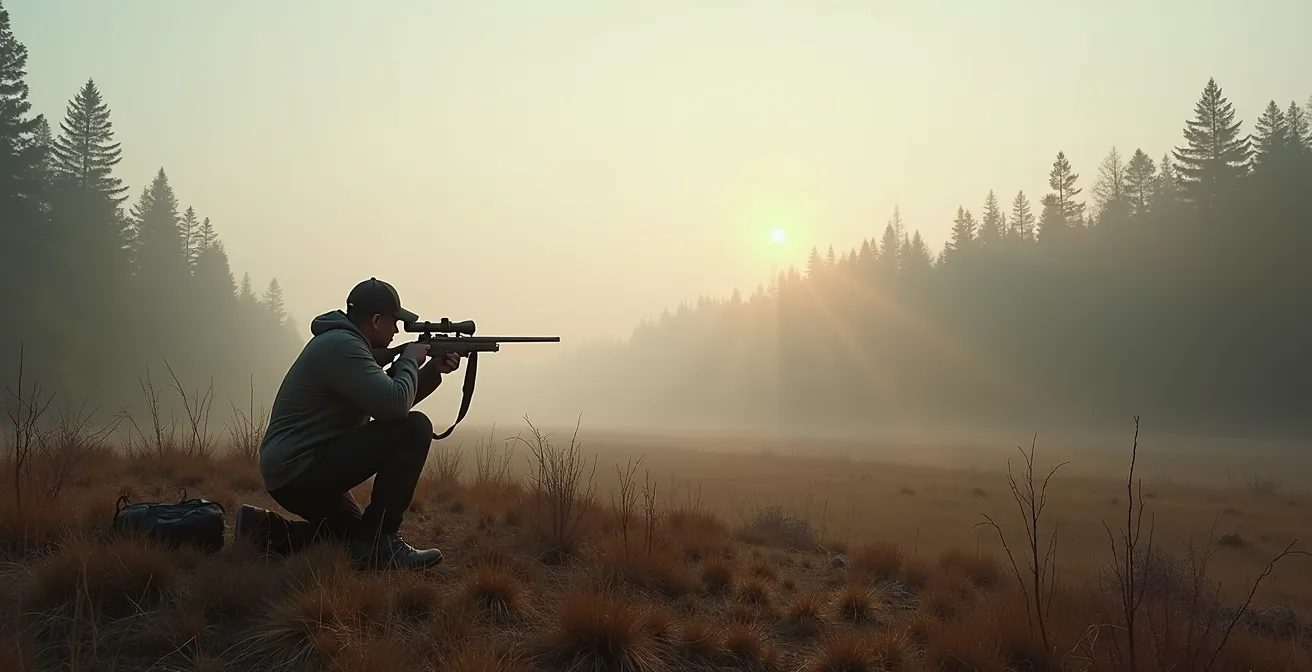
The common belief that a perfect “behind the shoulder” shot is the sole measure of an ethical hunter is a profound and dangerous oversimplification.
- True hunting ethics are defined by a continuous cycle of situational judgment, respectful recovery, and a deep sense of stewardship.
- The moral obligation extends far beyond the moment of the shot, encompassing how you track, handle the harvest, and even mentally process a loss.
Recommendation: Adopt a mindset of conscious stewardship, where every decision—from passing on a marginal shot to fully utilizing the harvest—honors the animal’s life and secures the future of hunting.
The moment is etched in the mind of every conscientious hunter: the breath held, the crosshairs steady, the world narrowing to a single point of focus. In that instant, the deepest hope is for a clean, quick, and humane kill. The greatest fear—a fear that speaks to the very core of our ethics—is the alternative: a wounded animal that escapes, destined to suffer. This is the moral weight we carry into the field. It is a burden of responsibility that separates a true hunter from a mere shooter.
For too long, the conversation around ethical kills has been confined to the mechanics of ballistics and the oft-repeated mantra to “aim behind the shoulder.” While essential, this advice only scratches the surface. It fails to address the complex, dynamic realities of the hunt: the shifting winds, the animal’s angle, the adrenaline coursing through your veins, and the profound duties that begin the second after the trigger is pulled. True ethical hunting is not a single action but a holistic philosophy—a pact made with nature, the animal, and oneself.
This guide moves beyond the simplistic answers. It delves into the decision-making process that defines a steward, not just an extractor. We will deconstruct long-held assumptions about shot placement, provide systematic methods for recovery under difficult conditions, and explore the mental fortitude required to learn from failure. This is about forging a deeper connection to the hunt, one founded on reverence, responsibility, and an unwavering commitment to minimizing suffering at every stage of the process.
To navigate this complex ethical terrain, we will explore the critical components of the modern hunter’s pact. This article breaks down the journey from pre-shot assessment to post-harvest respect, offering a comprehensive framework for honoring the animal and the tradition of the hunt.
Summary: A Guide to the Ethical Hunter’s Pact
- Why the “Behind the Shoulder” Shot Is Not Always the Ethical Choice?
- How to Read Blood Trails to Recover Game in Difficult Conditions?
- Range vs. Skill: What Defines Your Personal Ethical Maximum Distance?
- The Photo Mistake That Disrespects the Harvest on Social Media
- How to Mentally Recover After Losing a Wounded Animal?
- Stewardship vs. Extraction: What Defines a Regenerative Hunter?
- Trophy vs. Meat: Which Selection Criteria Benefits the Herd More?
- How to Process an Entire Animal in the Field Without Spoilage?
Why the “Behind the Shoulder” Shot Is Not Always the Ethical Choice?
The “behind the shoulder” shot, targeting the heart-lung area, is taught as the gold standard for good reason. It offers a large vital zone and is highly effective on a broadside animal. However, treating this as a universal rule without considering the animal’s orientation is a critical ethical error. The hunt is a dynamic event, and a static rule cannot apply to a moving, three-dimensional target. An ethical hunter understands that the angle of the shot completely changes the path to the vitals and, therefore, the definition of an ethical target.
The choice is often between targeting the circulatory system (heart and lungs) and the Central Nervous System (CNS). While a CNS shot can cause an instantaneous collapse, the target is minuscule and the risk of a horrific, non-lethal wound to the jaw or spine is immense. In contrast, according to the Australian Deer Association’s humane hunting guidelines, chest shots damage four essential life systems with over double the room for error compared to a CNS shot. This makes the thoracic cavity the most reliable and forgiving target. However, access to this area is paramount.
Understanding the animal’s position is non-negotiable. A responsible hunter must be able to assess the following shot angles and act accordingly:
- Broadside: The optimal position. It presents the largest vital area with a clear path for both firearms and bows.
- Quartering-Away: A highly ethical shot. It offers a clear path to the vitals, often exposing them even more than a broadside angle. The aiming point should be adjusted to exit through the opposite front shoulder.
- Quartering-Toward: A high-risk shot. The shoulder blade and heavy bone structure protect the vital organs. For firearm hunters, it requires careful consideration of angle and caliber; for bowhunters, it should almost always be passed up.
- Frontal and Rear Shots: These are almost universally unethical. A frontal shot presents an extremely small target, while a rear-facing shot offers no path to the vitals and must always be refused.
The core principle is not to simply aim “behind the shoulder,” but to visualize the bullet’s or arrow’s path through the animal to ensure it will transect the vital organs from the current angle. If that path is obstructed or uncertain, the ethical choice is always to wait for a better opportunity.
How to Read Blood Trails to Recover Game in Difficult Conditions?
The ethical pact with the animal does not end when the shot is fired. It intensifies. The moments following the shot are a test of patience, skill, and resolve. A hunter’s primary duty is the swift and relentless pursuit of the animal to confirm the kill and prevent any prolonged suffering. Assuming an animal is “down for good” without confirmation is a grave mistake. The art and science of reading a blood trail are fundamental skills that every ethical hunter must master.
The first step is to wait. Adrenaline can push a mortally wounded animal for miles if it feels pursued. For a confirmed heart or lung shot, a 30-60 minute wait is standard. For a suspected gut or liver shot, patience is even more critical. A gut-shot deer will often lie down and expire in its first bed if left undisturbed, but will run relentlessly if pushed. This is where patience becomes the most potent tracking tool.

Once you begin tracking, every drop of blood, every scuff on the ground, and every broken twig is a clue. Look for the type of blood: bright, frothy blood indicates a lung shot and a likely short trail. Dark, thick blood suggests a liver shot, requiring a longer wait and a more deliberate track. Greenish or watery material with little blood is the sign of a gut shot, demanding the longest wait time—often 12 hours or more—to ensure a successful recovery.
When the trail goes cold, resist the urge to wander aimlessly. A systematic approach is your best ally in the dense woods or fading light. This is when a pre-planned protocol for a grid search becomes invaluable, turning panic into a productive, methodical process.
Your Action Plan: Systematic Grid Search Protocol
- Mark the last sign of blood with biodegradable paper; this is your new starting point.
- When the trail disappears, divide the area into a grid pattern radiating from the last known point.
- Walk each line of the grid methodically, scanning the ground and checking under every bush and brush pile where a wounded animal might seek cover.
- Align multiple markers to re-establish the animal’s direction of travel if you find a new sign.
- Expand the search grid in widening circles if the initial sweep is unsuccessful, maintaining your systematic coverage.
Range vs. Skill: What Defines Your Personal Ethical Maximum Distance?
Modern rifle and scope technology can give hunters a false sense of capability. The ability of a rifle to hit a target at 500 yards is a matter of physics; the ability of a hunter to make a clean, ethical kill at that distance is a matter of immense skill, practice, and brutal self-honesty. Your ethical maximum distance is not a fixed number determined by your equipment. It is a dynamic variable that shrinks based on environmental conditions and your own physical and mental state.
A truly ethical hunter knows their absolute maximum range in perfect conditions—a number established through consistent practice from field positions, not a comfortable bench rest. More importantly, they know how to apply “multipliers” to that number the moment conditions become less than ideal. The ego must be removed from the equation; the only thing that matters is the certainty of a humane kill.
This table, based on concepts from hunting experts, illustrates how quickly your maximum ethical range can diminish. A hunter who can reliably make a 400-yard shot on a calm day must recognize that their ethical range is significantly less in real-world hunting scenarios. As a MeatEater analysis shows, unstable rests or high winds drastically reduce ethical certainty.
| Environmental Factor | Range Multiplier | Example Impact |
|---|---|---|
| Wind over 10mph | x 0.75 | 500yd capability becomes 375yd |
| Unstable shooting rest | x 0.80 | 400yd capability becomes 320yd |
| Low light conditions | x 0.70 | 300yd capability becomes 210yd |
| Cold/numb fingers | x 0.85 | 400yd capability becomes 340yd |
| Buck fever/elevated heart rate | x 0.60 | 300yd capability becomes 180yd |
Calculating this personal, situational limit is the essence of long-range ethics. It requires you to assess the wind, your stability, the light, and your own adrenaline level, and then have the discipline to accept the reduced range. A 500-yard rifle in the hands of a hunter experiencing buck fever with a hasty rest is, ethically speaking, a 200-yard rifle at best. The challenge is not making the shot; it’s having the integrity to know when *not* to.
The Photo Mistake That Disrespects the Harvest on Social Media
In the age of social media, the hunt doesn’t end with the recovery of the animal. It extends to how we present that experience to the world. A poorly composed, disrespectful “trophy photo” does more damage to the future of hunting than most hunters realize. The battle for hunting’s survival is not waged against anti-hunting extremists; it is fought for the hearts and minds of the non-hunting majority. A single image can shape their perception, either validating hunting as a respectful, natural act or condemning it as a blood sport.
The mistake is treating the post-hunt photo as a moment of conquest rather than one of reverence. Photos that display the animal in an undignified manner—with excessive blood, a hanging tongue, or the hunter grinning triumphantly over the carcass—broadcast a message of disrespect. They fail to communicate the solemnity of the moment and the gratitude that should be felt for the life that was taken to provide sustenance. Ethical hunters understand that this is a moment for quiet contemplation, not chest-thumping.
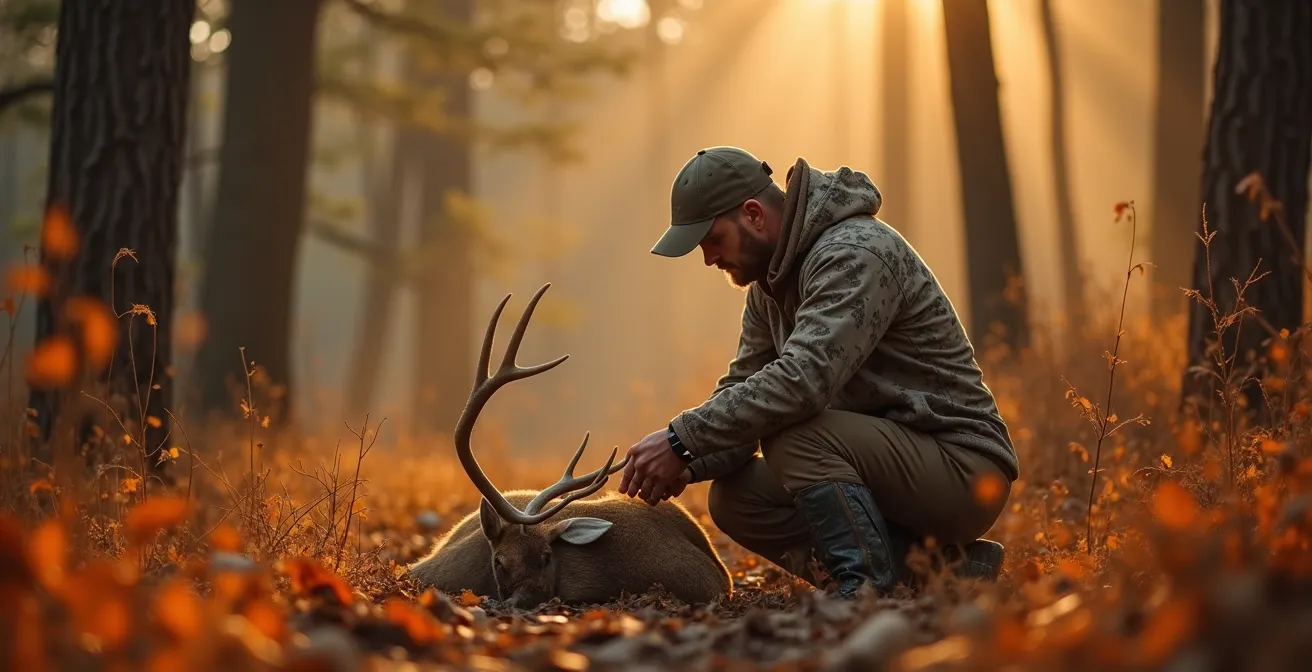
Composing a respectful harvest photo is an essential part of our ethical duty. It is the final act of honoring the animal. The goal is to create an image that reflects the beauty of the animal and the natural environment in which it lived. This involves a few simple but profound steps:
- Clean the animal: Wipe away any excess blood from the mouth and wound area. A little water and a cloth go a long way.
- Position it naturally: Tuck the legs underneath the body as if it were bedded down. Close its eyes and place its tongue back in its mouth.
- Choose a clean background: Move the animal away from a gut pile or a bloody area. Place it against a backdrop of natural foliage, rocks, or trees.
- Show reverence in your own posture: Kneel or sit respectfully beside the animal. The focus should be on the animal, not the hunter. The emotion conveyed should be gratitude, not ego.
By taking the time to compose a thoughtful and respectful photo, we tell a more truthful story about what it means to be a hunter. We show the non-hunting public that we are stewards who value the lives we take, ensuring that our tradition can continue for generations to come.
How to Mentally Recover After Losing a Wounded Animal?
There is no heavier feeling in hunting than the slow, dawning realization that you are not going to recover a wounded animal. After hours of tracking, after every grid has been searched and every ounce of effort expended, the moment of acceptance is crushing. It brings with it a wave of guilt, disappointment, and a profound sense of failure. This experience is a crucible, and how a hunter processes it is a true measure of their character.
The first step is to allow yourself to feel those emotions. The guilt and sadness are not weaknesses; they are proof of your ethical foundation. They are a stark reminder of the gravity of taking a life. As the team at Zero to Hunt puts it, these feelings are a sign that you have respect for the animal and the process.
When a shot doesn’t go as expected and you’re looking at a blood trail with no known end, it’s devastating. Disappointment, guilt, and uncertainty are there, but then resolve kicks in. You will do everything possible to find that animal. Feel those emotions momentarily – they remind you that you DO have ethics and respect.
– Zero to Hunt, Tracking Wounded Deer – 5 Steps for Success
The key is not to dwell in the guilt, but to transform it into a catalyst for growth. A lost animal is a harsh but powerful teacher. It forces a hunter to conduct a ruthless self-assessment of what went wrong. Was the shot rushed? Was the range misjudged? Was there a flaw in the tracking strategy? This post-mortem is not about self-flagellation but about identifying concrete areas for improvement. Every detail of the shot and the subsequent tracking effort should be documented and analyzed.
Sharing the experience with a trusted mentor or fellow hunter is also a crucial part of recovery. This is not for confession, but for learning. An experienced peer can offer perspective, identify potential errors you may have missed, and reinforce the hard-won lessons. Finally, creating a personal ritual to acknowledge the loss—returning to the last known spot, saying a few words of respect—can provide closure and reaffirm your commitment to doing better next time. The goal is to emerge from the experience not as a defeated hunter, but as a more skilled, more humble, and more conscientious one.
Stewardship vs. Extraction: What Defines a Regenerative Hunter?
At its core, hunting presents a fundamental choice in mindset: is the hunter an extractor, taking resources from the environment, or a steward, participating in and contributing to its health? The ethical hunter unequivocally chooses stewardship. This philosophy, sometimes called regenerative hunting, views the hunter as an integral part of the ecosystem, with a responsibility not just to follow laws, but to actively enhance the wild places and wildlife populations they cherish.
This mindset extends beyond the hunt itself. It’s about how we conduct ourselves in the wild at all times. The principles of Leave No Trace are not just for hikers; they are fundamental to ethical hunting. A steward does not build permanent blinds from natural materials but uses portable ones. They never use trees, signs, or rocks for target practice. They pack out everything they pack in, including spent shell casings, and leave the landscape as pristine—or more pristine—than they found it.
This commitment to stewardship is vital for the future of hunting because our actions are constantly under a microscope. As conservation officers often emphasize, while only a small fraction of the population hunts, the vast majority holds an opinion on it. These opinions, often formed by the behavior they witness, translate into votes and policies that will dictate hunting’s future. For instance, data highlights that while around 10% of the U.S. population hunts, 80% do not, and this non-hunting majority ultimately holds the power to protect or dismantle our heritage based on their perception of us.
A regenerative hunter also contributes actively to conservation. This means more than just buying a license. It means volunteering for habitat improvement projects, participating in wildlife surveys, donating to conservation organizations, and mentoring new hunters in the principles of ethical stewardship. It’s an understanding that our privilege to hunt is earned through our contribution to the resource. The harvest is not the culmination of the hunt; it is one part of a continuous cycle of giving back to the wild that has given us so much.
Trophy vs. Meat: Which Selection Criteria Benefits the Herd More?
The debate between hunting for trophies and hunting for meat often creates a false dichotomy. For the ethical steward, these are not mutually exclusive goals but are both secondary to a more important criterion: the health and balance of the herd. The decision of which animal to harvest should be guided by principles of conservation and sound wildlife management, not by the size of the antlers or the sheer quantity of meat.
Focusing solely on the largest, most impressive “trophy” males can, in some populations, negatively impact the gene pool and social structure. These mature animals play a crucial role in the breeding cycle. Conversely, indiscriminately harvesting any animal without regard for age or sex can also be detrimental. The most beneficial approach is a selective one, where the hunter acts as a thinking predator, making choices that mimic natural selection and promote a healthy, resilient population.
This often means targeting mature animals, but not necessarily the top-tier breeders. It can mean prioritizing the removal of an older doe past her prime breeding years or a younger male that is clearly not of superior genetic quality. It requires the ability to field-judge animals and understand the specific management goals for the area you are hunting. The guiding principles for an ethical harvest selection should include:
- Patience for a clean opportunity: Never shoot into a group of animals. Wait until the target animal is isolated with a safe backstop.
- Prioritizing maturity: Harvesting mature animals generally helps maintain a natural herd structure.
- Understanding local management goals: Know whether the local wildlife agency recommends harvesting more does to balance the buck-to-doe ratio or focusing on specific age classes.
- Committing to the shot: The decision to harvest a specific animal is a commitment to seeing it through with a quick, humane kill and full utilization of the meat.
Ultimately, the “trophy” is not the animal itself but the experience of participating in a well-managed ecosystem. The greatest reward is knowing that your actions have contributed to the long-term health of the herd. The meat in the freezer and the antlers on the wall are simply tangible reminders of that profound connection and responsibility.
Key Takeaways
- An ethical shot is defined by the animal’s angle and your situational skill, not just aiming “behind the shoulder.”
- Your ethical maximum range is not fixed; it shrinks dramatically with factors like wind, an unstable rest, or adrenaline.
- The moral responsibility of a hunter intensifies after the shot, demanding a relentless and systematic effort to recover the animal.
How to Process an Entire Animal in the Field Without Spoilage?
The final, and perhaps most significant, act of reverence for a harvested animal is the complete and respectful utilization of its body. To let meat spoil due to poor handling is the ultimate ethical failure, negating the purpose and sanctity of the hunt. The clock starts ticking the moment the animal is down, and the hunter’s knowledge of field processing is what stands between a freezer full of clean, healthy protein and a tragic waste. The goal is simple: get the animal cooled down as quickly as possible.
The two primary enemies of meat are heat and bacteria. Your field processing method should be designed to combat both. In warmer weather, this is an urgent task. The first step is to remove the internal organs (field dressing), which are a major source of heat and bacteria. This should be done cleanly and carefully to avoid rupturing the stomach or intestines, which can contaminate the meat. A common mistake cited by tracking experts is the failure to recognize the urgency based on the hit; for instance, stomach wounds, while always fatal, account for the highest percentage of unrecovered deer and also necessitate the fastest possible field care upon recovery to prevent spoilage.
Once field-dressed, the goal is to promote air circulation around the entire carcass. Prop the chest cavity open with a stick and, if possible, hang the animal in a shady, breezy location. If the animal needs to be transported, placing it on top of a vehicle where it is exposed to engine heat is a recipe for disaster. If you must quarter the animal in the field, use clean knives and place the meat in high-quality, breathable game bags—never in plastic, which traps heat and moisture. Skinning the animal as soon as possible will also dramatically accelerate the cooling process.
True stewardship means using as much of the animal as possible. This goes beyond the prime cuts. The neck makes for an incredible roast, the shanks are perfect for braising, and the trim should be ground for burger or sausage. Organs like the heart and liver are nutrient-dense delicacies. Even the bones can be used to make a rich, flavorful stock. If you have more meat than you can use, sharing the harvest with friends, family, or local food banks is a time-honored tradition that completes the cycle of the hunt. It transforms a personal success into a communal benefit, embodying the spirit of a true, regenerative hunter.
To fully embrace this philosophy, the next step is to consciously apply this cycle of preparation, judgment, and reverence to every future hunt. This is how we honor the animal, the tradition, and our own conscience.