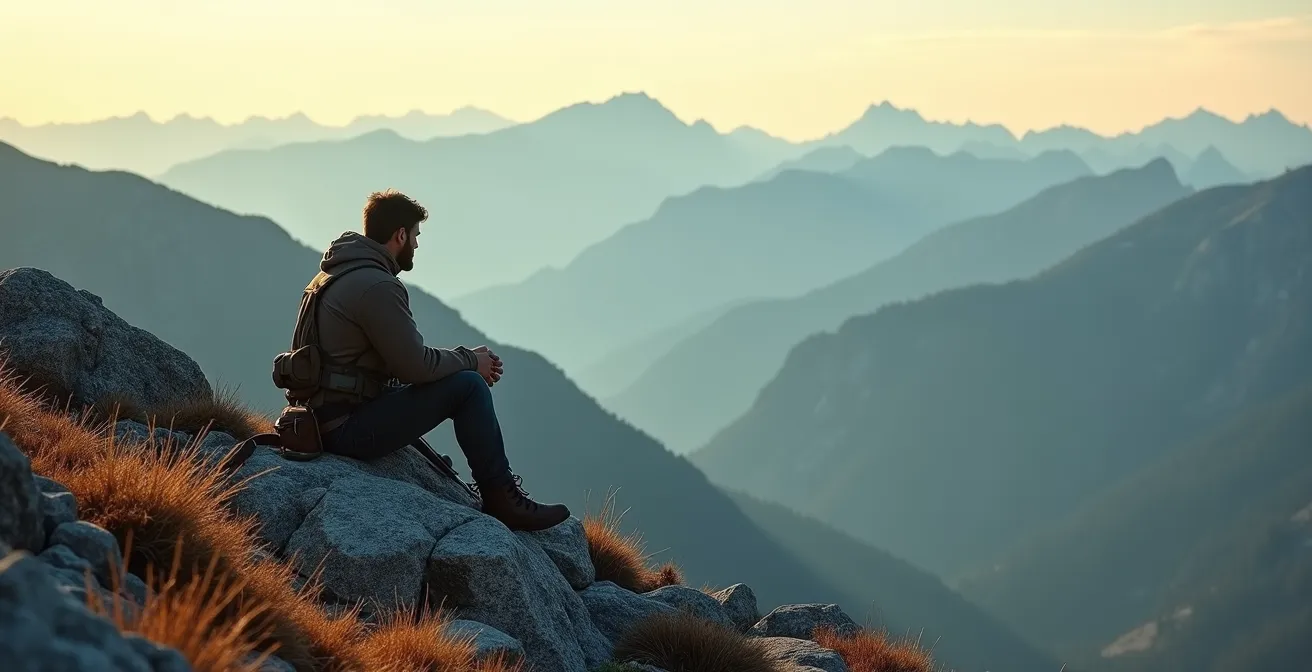
Success in a solo wilderness hunt hinges less on gear and more on mastering your internal landscape.
- Every practical choice, from camp setup to waste management, is a profound ethical decision that shapes your psychological resilience.
- True preparedness involves ‘cognitive inoculation’—training your mind to function calmly and automatically under extreme stress.
Recommendation: Shift your focus from simply enduring solitude to actively practicing self-awareness and environmental stewardship as the foundation of a safe and meaningful hunt.
The silence of a high-country basin, broken only by the wind, is the trophy many solo hunters seek. It is a profound state of isolation, a stark contrast to the noise of modern life. In this space, you are completely self-reliant, a state that is both deeply rewarding and psychologically demanding. The weight of every decision rests solely on your shoulders, and the line between solitude and vulnerability can feel terrifyingly thin. For many, the mental game of being alone is the most formidable quarry of all.
Most guides to backcountry hunting focus on gear lists, physical fitness, and the tactical skills of tracking and navigating. They advise you to “be prepared” and “have mental grit.” While essential, these are merely the tools. They do not address the engine that drives them: the human mind under the immense pressure of isolation. This approach treats the psychological challenge as an obstacle to be overcome, rather than what it truly is—the very heart of the experience.
What if the key to a successful and safe solo hunt isn’t just about enduring the solitude, but about transforming your relationship with it? The central thesis of this guide is that true wilderness preparedness is a practice of deep self-awareness. It posits that every logistical choice—from how you pitch your tent to the noise your jacket makes—is an ethical act that directly impacts your psychological state and your connection to the wild. This is not about managing fear, but about cultivating a regenerative mindset.
This article will deconstruct the psychological weight of isolation by examining the practical, on-the-ground decisions you make. We will explore how choices in stewardship, camp setup, noise discipline, and navigation are not just about survival, but are opportunities to build mental resilience, deepen your ethical footprint, and ultimately, redefine what it means to be a hunter alone in the wilderness.
This comprehensive guide delves into the core principles of wilderness psychology and ethics for the solo hunter. The following sections break down critical decisions that define your experience, turning abstract concepts into concrete actions.
Summary: Solitude vs. Safety: How to Manage the Psychological Weight of Isolation?
- Stewardship vs. Extraction: What Defines a Regenerative Hunter?
- Tent vs. Trailer: Which Base Camp Setup Minimizes Soil Compaction?
- Ridge or Valley: Where to Pitch a Tent to Avoid Widow-Makers?
- Cathole or Pack-Out: What Is Required in Alpine Zones?
- The Velcro Mistake That Ruins the Silence of a Wilderness Basin
- How to Read a Topo Map When Electronics Fail in the Middle of Nowhere?
- What to Do If You Find Native Artifacts While Scouting?
- How to Plan a Backcountry Hunt That Doesn’t End in Logistics Failure?
Stewardship vs. Extraction: What Defines a Regenerative Hunter?
The psychological journey of the solo hunter begins long before the first track is cut. It starts with a fundamental mindset shift: from an extractor of resources to a steward of the ecosystem. An extractive mindset views the wilderness as a commodity, a place from which to take game. A regenerative mindset, however, sees the hunter as a temporary, responsible participant in a complex web of life. This isn’t just semantics; it fundamentally alters your perception and decision-making, reducing psychological load by providing a clear ethical framework. When you see yourself as a caretaker, your actions gain purpose beyond the hunt itself.
This stewardship is an active, conscious practice. It means packing out not just your own trash, but any you find. It means being obsessively careful with fire, as the stakes are immense; research attributes nearly 87% of wildfires in surveyed areas to human causes, a stark reminder of our potential for unintended destruction. A regenerative hunter understands that their presence is an intrusion, and their goal is to make that intrusion as traceless and beneficial as possible. This philosophy transforms the hunt from a personal pursuit into a service to the land itself.

As the image powerfully illustrates, stewardship can be a quiet, intimate act. Removing old, rusted wire is not a glorious task, but it is a profound one. It is a tangible act of healing the land, of leaving it better than you found it. This is the essence of the regenerative mindset. It’s a commitment to giving back more than you take, ensuring the wild remains wild for generations to come. This perspective provides a powerful psychological anchor, grounding you in a sense of purpose that transcends the success or failure of the hunt.
Tent vs. Trailer: Which Base Camp Setup Minimizes Soil Compaction?
The choice of base camp is one of the first and most significant decisions that reflects your underlying mindset. It’s a choice between immersion and insulation, and it has profound effects on both the environment and your own psychology. A hard-sided trailer creates a definitive, comfortable barrier against the wilderness. It’s a home away from home, but this very comfort can sever the subtle, critical connection to the environment. It keeps the wild at arm’s length, reducing your ability to perceive its nuances—the shift in wind, the distant snap of a twig, the changing light.
A tent, by contrast, is a permeable membrane. It forces a more intimate and immediate relationship with the land. You feel the temperature drop, hear every sound, and exist within the ecosystem rather than beside it. This heightened awareness is a key component of a successful solo hunt. From an environmental standpoint, the differences are equally stark. A trailer, parked in one spot for days, creates significant soil compaction and vegetation damage that can take seasons to recover.
The following table, based on Leave No Trace principles and impact studies, highlights the trade-offs. As a comparative analysis shows, the physical footprint is directly tied to the psychological experience.
| Factor | Tent Camp | Trailer Camp |
|---|---|---|
| Soil Compaction | Minimal if moved regularly | Significant in single location |
| Psychological Boundary | Permeable membrane with nature | Hard boundary from wilderness |
| Recovery Time | 2-4 weeks for vegetation | 1-2 seasons for deep compaction |
| Mental Immersion | High – constant nature connection | Low – comfort zone isolation |
| Fair Chase Ethics | Equal environmental challenges | Potential technological advantage |
Choosing a tent camp isn’t about masochism; it’s about a commitment to full immersion. This choice actively manages your psychological state by forcing you to be present and adaptable. The discomfort is a tool for focus. By minimizing your physical and psychological boundary with the wilderness, you are not just reducing your impact; you are sharpening the very senses and instincts that define a hunter.
Ridge or Valley: Where to Pitch a Tent to Avoid Widow-Makers?
Once you’ve chosen your type of shelter, the specific placement of your tent becomes a critical exercise in risk management and psychological balance. The choice between a high, exposed ridge and a low, sheltered valley is rarely straightforward. It’s a classic trade-off between perspective and protection. The ridge offers a commanding view, a strategic advantage for glassing game and surveying your surroundings. This sense of control can be a powerful psychological balm, reducing feelings of being trapped or unaware. However, this exposure comes at a cost: vulnerability to high winds, lightning, and a greater visibility to the very animals you are pursuing.
Conversely, a valley or a dense stand of timber offers protection from the elements. It’s a place of refuge, conserving warmth and hiding you from view. The primary danger here is the “widow-maker”—a dead tree or large limb that could fall in high winds or under the weight of snow. Choosing a site in a valley requires a meticulous, 360-degree assessment of the canopy above you, a task that demands calm, focused attention. This choice represents a different kind of psychological load: you trade the anxiety of exposure for the diligence of risk assessment.
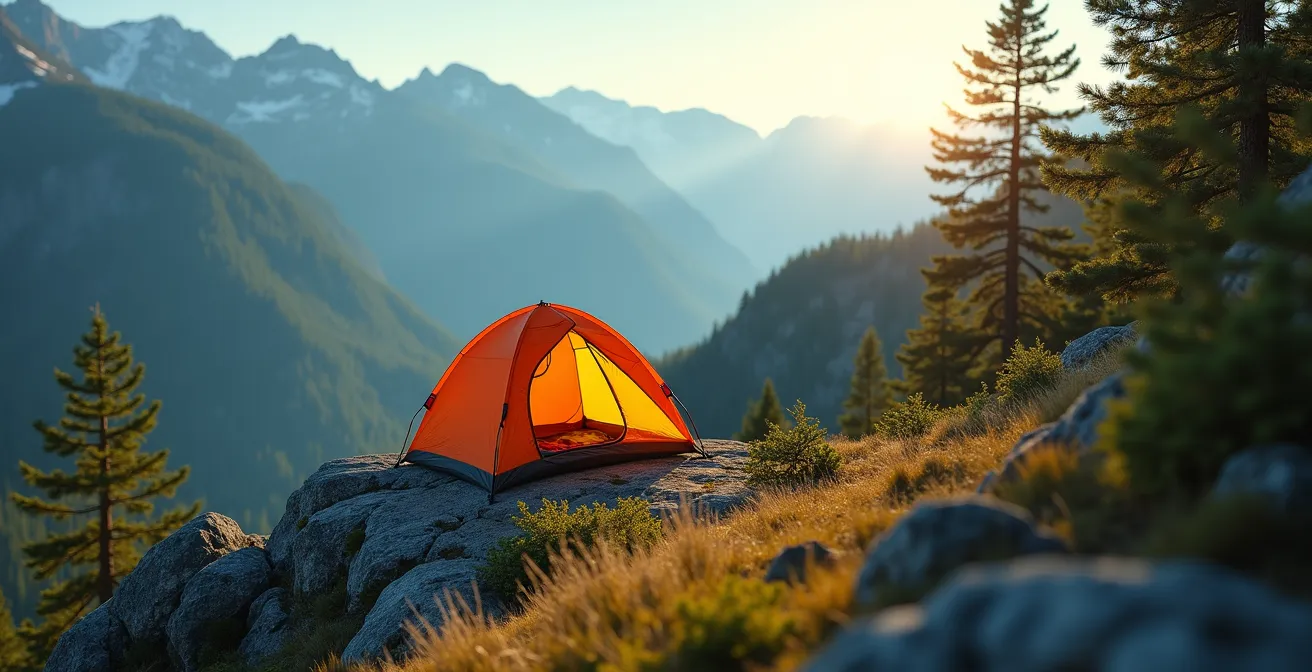
This image perfectly captures the duality of the decision. The ridge camp is a position of prospect, offering knowledge and a sense of dominance over the landscape. The valley camp is a position of refuge, offering safety and concealment. Neither is inherently “correct.” The right choice depends on the weather, the terrain, and your own mental state. Are you feeling the need for control and perspective, or for security and rest? Acknowledging this internal driver is key to making a sound decision that balances physical safety with psychological comfort.
Cathole or Pack-Out: What Is Required in Alpine Zones?
Nowhere is the principle of stewardship more critical than in fragile alpine environments. These high-elevation zones, characterized by thin soil and slow-growing, specialized vegetation, are exceptionally vulnerable to human impact. The air is thin, the growing season is short, and decomposition happens at a glacial pace. What might disappear in a few weeks in a lush forest can persist for years above the treeline. This makes waste management not just a courtesy, but an absolute ethical and ecological imperative.
The scale of these ecosystems is often deceptively small. For example, Vermont’s remaining alpine zone comprises only 125 acres, a tiny, irreplaceable island of arctic-like habitat. In such places, the standard “cathole” method for human waste is often insufficient. The cold, sterile soil lacks the microbial activity to break down waste effectively. Therefore, in many designated alpine or high-use areas, the requirement is to pack out all solid human waste using approved WAG (Waste Alleviation and Gelling) bags. This is the highest standard of Leave No Trace, and it is a non-negotiable aspect of your ethical footprint.
The principle of packing it out extends to everything you bring. As the Leave No Trace Organization states in their guidelines, the rule is uncompromising. This is a direct reflection of a stewardship mindset in action.
Pack out everything you bring in — including food wrappers, spent shells, and brass. When nature calls, dig a cathole 6–8 inches deep and at least 200 feet from water, then cover it well.
– Leave No Trace Organization, Leave No Trace Hunting Ethics Guide
Adhering to these rules is a discipline. It requires forethought, the right equipment, and a willingness to accept a degree of inconvenience for the sake of the environment. For the solo hunter, this discipline is also a psychological tool. It reinforces your role as a protector, creating a sense of righteous purpose that strengthens your resolve and connection to the wild. You are not just following a rule; you are actively participating in the preservation of a sacred space.
The Velcro Mistake That Ruins the Silence of a Wilderness Basin
The impact of a hunter is not limited to what is seen or left behind; it extends to what is heard. In the profound quiet of a remote wilderness basin, sound travels with startling clarity. The metallic clank of a trekking pole against a rock or the synthetic rip of a Velcro pocket can echo for miles, a jarring intrusion into the natural soundscape. This is more than just an issue of spooking game; it’s a violation of the sanctity of the place. For the solo hunter, silence is not emptiness; it is a rich, immersive medium for connection and self-reflection.
This concept of silence as a vital component of the wilderness experience is backed by psychological research. It is in the absence of artificial noise that the mind can truly expand and engage with the environment on a deeper level. As one study notes, the value is profound.
Studies emphasize the significance of the wilderness, far from daily demands, and devoid of technological stimuli allowing the silence, time and space for self-reflection and contemplation on the sacredness and meaning of life.
– Frontiers in Psychology, The Wilderness Solo Experience: A Unique Practice of Silence and Solitude
Protecting this silence is a practice of acoustic stewardship. It begins with gear selection. Choosing packs with silent magnetic closures or button snaps over Velcro, using soft-shell fabrics that don’t rustle, and wrapping metal items in cloth are all conscious decisions that contribute to a quieter presence. It’s also about movement—practicing slow, deliberate motions when accessing gear, stepping carefully to avoid dislodging rocks. This discipline of quietness forces a state of heightened awareness, making you a more effective hunter and a more respectful visitor.
Action Plan: Implementing Acoustic Stewardship
- Replace velcro closures on high-use pockets with silent magnetic or button alternatives.
- Opt for cord pulls or silent zipper designs instead of standard metal zippers for access during hunting hours.
- Wrap metal items like trekking poles, bipods, or stove components in cloth or athletic tape to prevent clanking.
- Choose soft-shell or natural-fiber (wool) outer layers over noisy hard-shell or synthetic materials whenever conditions permit.
- Practice ‘slow-motion’ movements when reaching into your pack or handling gear to build muscle memory for quietness.
How to Read a Topo Map When Electronics Fail in the Middle of Nowhere?
In the backcountry, technology is a fragile ally. Batteries die, screens crack, and satellite signals disappear. When your GPS fails miles from any road, your ability to navigate with a map and compass is not just a skill—it is your lifeline. However, the real challenge is not the mechanics of taking a bearing, but the psychological state required to do so under immense stress. Panic is the true enemy. It induces tunnel vision, impairs rational thought, and turns a solvable problem into a life-threatening crisis. True preparedness, therefore, is about training your mind as much as your hands.
This is the principle of cognitive inoculation. It’s the process of exposing yourself to stress in controlled, repetitive scenarios so that the correct response becomes automatic. It’s why firefighters run drills and pilots use simulators. For the solo hunter, this means practicing navigation skills not just on a sunny afternoon, but when you are tired, cold, and disoriented. It means intentionally leaving the GPS off and forcing yourself to rely on the map. Research confirms the efficacy of this approach; studies have demonstrated a 34% improvement in performance for individuals who have engaged in mental preparation through simulated survival scenarios.
Case Study: Stress Inoculation and Limbic Learning
Survival psychology experts emphasize that quality training under progressively stressful conditions provides ‘stress inoculation.’ This isn’t about memorizing facts; it’s about conditioning the brain’s limbic system, the seat of our instinctual responses. Through repetitive practice, complex actions like triangulating a position or reading contour lines become automatic, like muscle memory. This “limbic learning” bypasses the panicked, over-analytical conscious mind, allowing for efficient, intuitive decision-making when it matters most. The goal is to make the correct response feel like the easiest and most natural one, even when fear is screaming for attention.
The ability to read a topo map is a function of interpreting abstract symbols—the tight brown lines of a steep slope, the blue vein of a creek, the green shading of timber. Under stress, this interpretation can feel impossible. But with cognitive inoculation, you don’t just see lines; you see the land. You’ve built a mental model that allows you to feel the terrain through the paper. This is the pinnacle of navigational skill, a seamless integration of knowledge and instinct, and your greatest defense against the psychological weight of being lost.
What to Do If You Find Native Artifacts While Scouting?
There are moments in the wilderness that transcend the hunt. You might be still-hunting through a timbered draw or glassing a rocky outcrop when your eye catches an unnatural shape: the chipped edge of a projectile point, a shard of pottery, or a ring of fire-cracked rocks. In that instant, you have crossed a threshold from the present into the deep past. You are standing on ground that is not just wild, but hallowed. How you act in this moment is the ultimate test of the regenerative mindset and your ethical core.
The immediate, almost childlike impulse can be to pick it up, to possess this tangible piece of history. This impulse must be resisted. These artifacts are not souvenirs. They are part of a fragile, in-situ historical record. To move one is to erase a word from a sentence, forever altering the story of the land. The ethical mandate is clear, as articulated by the Leave No Trace Center for Outdoor Ethics: leave them exactly as you found them. Your role is that of a witness, not a collector.
Never use rocks, signs, or trees for target practice, and leave cultural or historic artifacts undisturbed. When you take only your game and memories home, you help preserve the story of the land for others.
– Leave No Trace Center for Outdoor Ethics, Hunting Ethics Guidelines
This act of restraint is a profound form of respect. It acknowledges that you are a visitor in a place with a history far deeper than your own. The most powerful response is to take a moment of quiet contemplation. Acknowledge the person who made or used this tool, who lived and hunted on this same land centuries ago. Consider abandoning your hunt in that specific drainage for the day, treating the area as a place of reverence rather than a resource to be exploited. This act of cultural stewardship connects you to the human lineage of the landscape, enriching your experience far more than possessing any physical object ever could.
Key Takeaways
- Your success and safety as a solo hunter are determined more by your psychological framework and ethical mindset than by your gear.
- Every practical decision, from camp placement to waste disposal, is an opportunity to practice stewardship and strengthen your mental resilience.
- Proactive mental preparation, including ‘cognitive inoculation’ for stress and a clear plan for managing solitude, is the foundation of a regenerative hunt.
How to Plan a Backcountry Hunt That Doesn’t End in Logistics Failure?
A backcountry hunt that fails is rarely due to a single catastrophic event. More often, it is a slow unraveling, a death by a thousand small cuts caused by a failure in mental, not just physical, logistics. Planning extends beyond maps and gear lists; it must encompass a robust framework for managing your own psychology. The physical challenges of the wilderness are predictable; the internal challenges of solitude are far more insidious and require a dedicated strategy.
As experts in the field note, the mental aspect is often the most overlooked component of preparation. The constant companionship of hunting partners provides an external source of motivation and validation that disappears in solo hunting. When you are alone, all of that must come from within.
One thing that often goes overlooked when a person first starts solo hunting is the mental side of it. Beyond the potential for fear, you may not realize how much your hunting buddies keep you going when things get tough. On long glassing days with no sightings, it’s now just you and your thoughts trying to keep you motivated.
– Argali Outdoors, Beginner’s Guide to Solo Backcountry Hunting
The solution is to create a psychological logistics plan. This involves establishing pre-defined structures and rituals that provide stability when motivation wanes. This includes setting non-negotiable daily routines: a time to wake, a ritual for making a hot drink, scheduled times for glassing, and a process for camp chores. It also means creating ‘mental bailout points’ or reset rituals—pre-planned actions to take when you feel your resolve slipping, such as reading a specific passage from a book or writing in a journal to externalize your thoughts and regain focus. Crucially, it includes a clear communication plan with a contact back home, not just for safety, but to serve as a psychological lifeline, a reminder that your solitude is a choice, not a permanent state.
Your next hunt begins not with a map, but with a plan for your own mind. Start building your psychological framework today to transform your relationship with the wilderness and ensure every journey is a regenerative one.
Frequently Asked Questions on Solitude vs. Safety: How to Manage the Psychological Weight of Isolation?
Should I GPS mark the location of artifacts I find?
Consider the risk of location data being leaked or sites being looted. Prioritize site sanctity over data collection unless reporting to official archaeological authorities.
Is it ethical to continue hunting in an area where artifacts are found?
Consider abandoning your hunt in that specific drainage for the day as a sign of respect, treating the area as hallowed ground rather than just a resource.
What’s the legal requirement for artifact discoveries?
Federal law prohibits disturbing archaeological sites on public lands. Report significant finds to land management agencies without disturbing the artifacts.