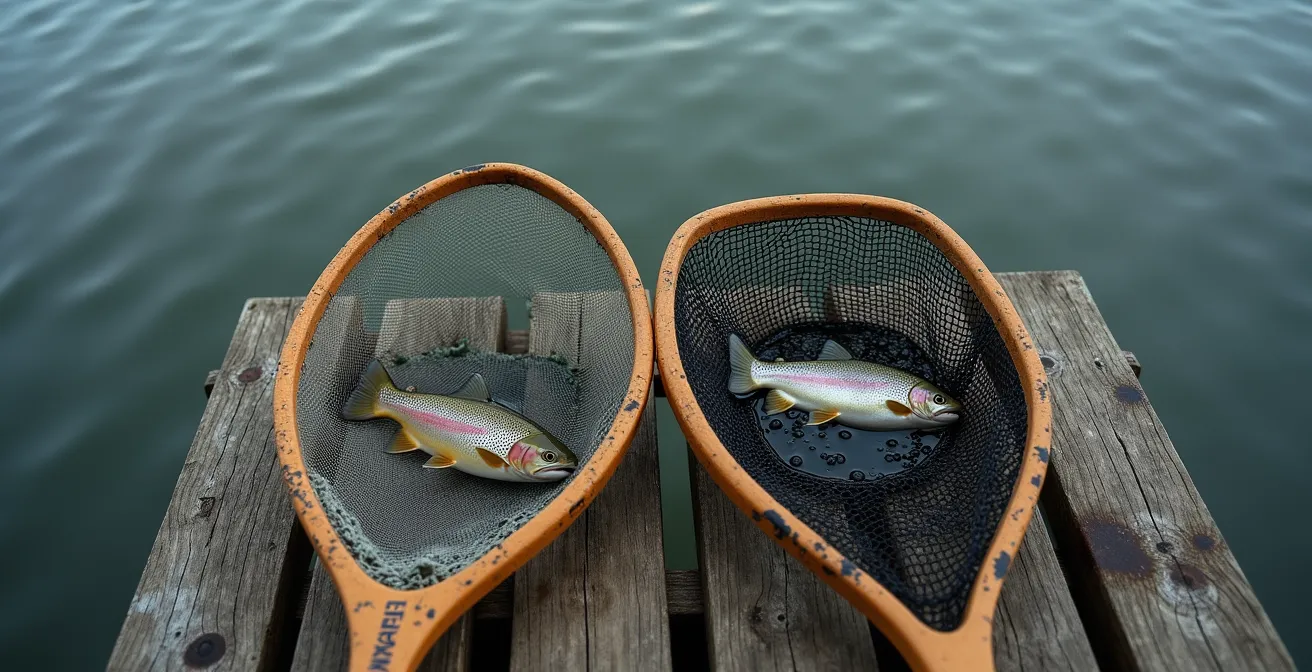
The choice between a rubber and nylon net is more than a preference; it’s a decision that directly impacts a fish’s immune system and its long-term survival.
- Smooth rubber mesh minimizes the removal of the critical slime coat, which acts as the fish’s primary defense against parasites and disease.
- Proper net depth and a ‘head-first’ netting technique prevent physical injury and reduce the stress that leads to delayed mortality.
Recommendation: Always choose a deep, knotless rubber or rubber-coated net and handle every fish with wet hands for the briefest time possible to ensure its health.
For the conscientious catch-and-release angler, the moment of landing a fish is a mix of triumph and responsibility. We strive to return our catch to the water unharmed, ready to thrive and be caught another day. We’ve all heard the standard advice: use knotless nets, handle fish with wet hands, and be quick. But true stewardship goes deeper than just following rules. It involves understanding the delicate biology of the fish and the profound impact our equipment choices have on its chances of survival.
The debate between rubber and nylon nets is not merely about preventing hook tangles; it’s about preserving a fish’s life-support system. This guide moves beyond the surface-level tips to explore the ‘why’ behind the best practices. We will delve into the physiological reasons a fish’s slime coat is its suit of armor, how net depth can mean the difference between a secure landing and a lost fish, and why a few seconds of air exposure can trigger a cascade of stress responses leading to delayed mortality. It’s not about what you’re told to do, but understanding why you’re doing it.
By dissecting the mechanics of netting and the biological consequences of handling, you will gain a specialist’s perspective. This knowledge transforms the act of choosing a net from a simple gear purchase into a critical decision for fish conservation. This article will walk you through the precise techniques and gear choices that protect the fish at every stage of the landing process, ensuring you are not just a successful angler, but a true guardian of the resource.
To help you navigate these crucial concepts, this guide is structured to cover everything from the mechanics of your net to the biology of the fish, culminating in the proper revival techniques.
Summary: A Comprehensive Guide to Fish-Safe Netting and Handling
- Why Knotless Mesh Saves You 10 Minutes of Untangling per Fish?
- The Net Depth Mistake That Causes Large Pike to Jump Out
- Head First or Tail First: Which Netting Angle Prevents Lost Fish?
- When to Use a Dip Net Instead of a Full Landing Net?
- How to Stop Your Net from Snagging Every Bush on the Trail?
- Why Dry Hands Remove the Immune System of a Fish?
- Why Air Exposure Exceeding 10 Seconds Drastically Lowers Survival?
- How to Revive a Deeply Exhausted Trout in Fast Current?
Why Knotless Mesh Saves You 10 Minutes of Untangling per Fish?
The frustration of a treble hook hopelessly embedded in a net is a familiar pain for many anglers. This single issue not only costs valuable fishing time but also prolongs the stress on the landed fish. While the title’s “10 minutes” might be an exaggeration for some, the underlying principle is sound: the material and construction of your net’s mesh are the primary factors in preventing tangles. The solution lies in understanding the interaction between a hook point and the net’s surface. Traditional knotted nylon nets are a hook’s worst enemy, with countless fibers and knots for a point to penetrate and grab.
In contrast, modern rubber or rubber-coated nets are designed with a smooth, non-porous surface. A hook point that comes into contact with this material has nowhere to dig in. Instead of piercing fibers, it simply slides off. This is especially critical when fishing with lures that have multiple treble hooks, as one thrash from the fish can turn a simple landing into a web of chaos. A knotless design is the first step, but the material itself is what provides the ultimate anti-tangle benefit.
Beyond the material, your technique during the landing process can further reduce snags. By keeping tension on the line with a high rod tip, you limit the fish’s ability to thrash wildly in the net. This prevents the lure from flailing and creating secondary tangles with the leader or the line itself. The goal is a smooth, controlled entry into a net that is inherently resistant to hook penetration, protecting both your gear and the fish from unnecessary damage and stress.
Action Plan: The 3-Step Process to Prevent Hook Tangles
- Choose rubber or rubber-coated netting specifically designed for treble hooks; the smooth surface allows hooks to slide off without penetrating the mesh fibers.
- When netting a fish, keep the rod tip high to maintain tension, preventing the fish from thrashing and creating secondary tangles with line and leaders.
- After landing, lift the net vertically and allow gravity to help separate the hooks from the rubber surface, rather than pulling horizontally which can worsen tangles.
Ultimately, a tangle-free net is a fish-safe net. It allows for a quicker hook removal and a faster release, minimizing the out-of-water time that is so detrimental to the fish’s health.
The Net Depth Mistake That Causes Large Pike to Jump Out
You’ve fought a trophy pike to the boat, its powerful form glistening just below the surface. You slide the net underneath, and for a second, victory is yours. Then, in a flash of green and white, the fish launches itself straight out of the net and back into the water, throwing the hook. This heartbreaking scenario is often caused by a fundamental mismatch between the net’s depth and the fish’s size, a problem exacerbated by the material properties of some nets.
A net’s bag should be deep enough to comfortably contain the entire length of the target fish, ideally with a depth at least 1.2 times the length of the fish. When a large, powerful fish like a pike or musky is placed in a shallow net, its body is not fully enveloped. If the fish gives a powerful tail kick, it can use the bottom of the shallow net bag as a launchpad. This is particularly problematic with rubber nets. As some experienced anglers have noted, the elastic properties of rubber can create a “trampoline effect,” actively bouncing a large fish out of the net if the depth is insufficient. Nylon nets, being less elastic, are more forgiving in this regard but come with their own significant downsides for fish health.
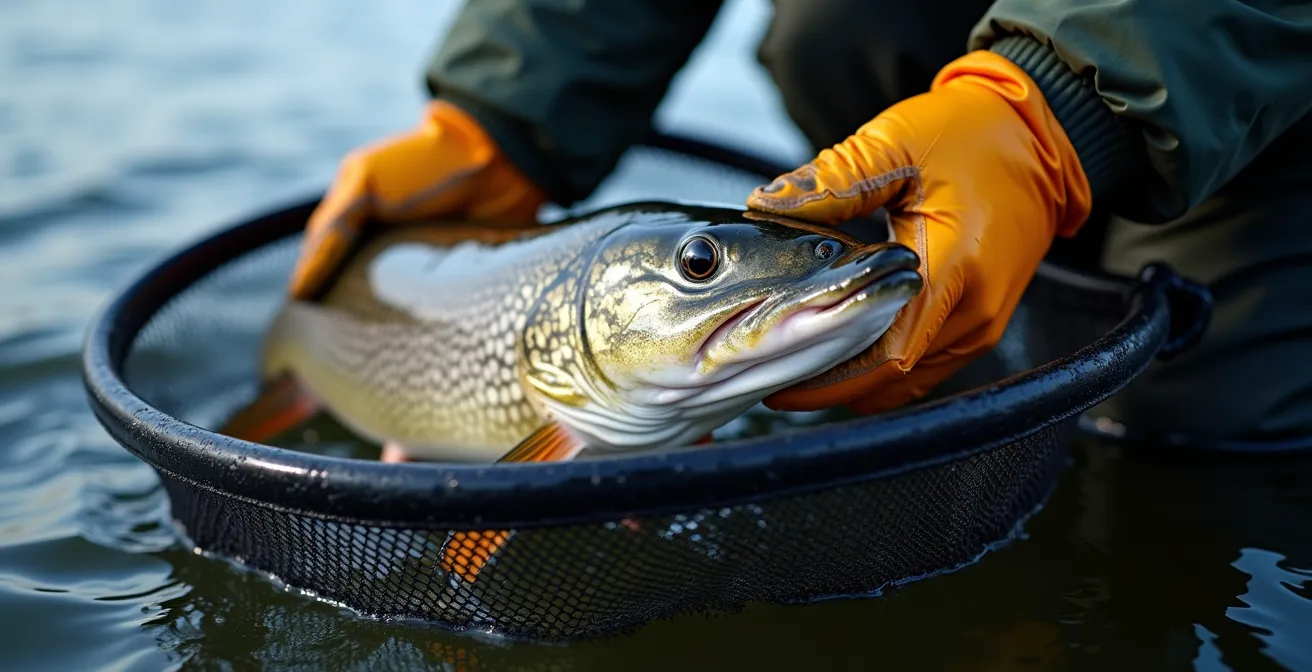
As this image demonstrates, a deep net bag allows the angler to secure the fish properly. Once the fish is head-first in the net, a quick lift of the hoop and a turn of the handle folds the mesh over the fish, effectively trapping it. This simple maneuver is impossible with a shallow net. The fish remains cradled and calm, preventing the thrashing that can cause injury or lead to an escape. When selecting a net, don’t just consider the hoop size; pay critical attention to the bag’s depth, ensuring it’s built to handle the trophy you’re hoping to land.
This isn’t just about successfully landing your catch; it’s about doing so with control and safety, minimizing stress for both the angler and the fish.
Head First or Tail First: Which Netting Angle Prevents Lost Fish?
The final moments of the fight, as the fish approaches the net, are fraught with risk. A wrong move can lead to a lost fish, a broken line, or unnecessary injury. The most common debate among anglers is whether to net a fish head-first or tail-first. From a fish health and control perspective, the answer is unequivocally head-first. A fish’s engine is its tail; attempting to net it from behind is like trying to grab a moving car by its bumper. The fish can engage its full forward propulsion and easily dart away or around the net.
By guiding the fish head-first into the net, you neutralize its primary means of escape. Once its head and pectoral fins are inside the hoop, it cannot effectively swim forward or turn. As one experienced angler wisely advises, “Lift the head before putting the net under the fish because they have a tendency of flopping on the surface enough to throw the hook.” This act of lifting the rod tip brings the fish’s head up and guides it directly into the waiting net in one smooth motion. This method ensures you maintain constant line tension, which is critical for preventing a thrown hook at the last second. A tail-first approach often creates dangerous slack in the line as the angler repositions.
The best technique is a proactive, single-motion sweep. Don’t chase the fish with the net. Instead, lead the fish with your rod and position the net as its destination. When the fish is in range, a decisive scoop from head to tail secures the catch efficiently and safely.
This comparative data, based on analysis from fishing communities and experts, clearly shows the superior outcomes of a head-first approach. As detailed in a comprehensive guide to catch-and-release principles, mastering this technique is fundamental.
| Netting Method | Success Rate | Fish Control | Line Tension |
|---|---|---|---|
| Head-First | High | Excellent – neutralizes forward propulsion | Maintained throughout |
| Tail-First | Low | Poor – fish can engage full thrust | Creates dangerous slack |
| One-Motion Sweep | Highest | Optimal – proactive control | Consistent tension |
This isn’t just about technique; it’s about understanding the fish’s hydrodynamics and using them to your advantage for a safe and successful landing.
When to Use a Dip Net Instead of a Full Landing Net?
The terminology can be confusing, but the distinction between a “dip net” and a “landing net” is critically important for fish welfare. A traditional dip net, often characterized by a shallow, coarse mesh bag and a simple frame, has a very limited and specific purpose in the world of angling. Its primary role is for tasks that do not involve handling game fish you intend to release. A dip net is a tool for collecting bait like minnows or shrimp from a baitwell, or for scooping debris out of the water. It should never be considered an appropriate tool for landing a game fish of any size.
The abrasive, often knotted mesh of a cheap dip net is extremely damaging to a fish’s scales, fins, and protective slime coat. Furthermore, their typically shallow bags provide no support for the fish’s body and increase the risk of the fish falling or jumping out, leading to impact injuries. For any catch-and-release fishing, a proper landing net with fish-safe mesh is non-negotiable. This means a deep, soft, knotless mesh, preferably rubber or rubber-coated, designed to cradle the fish securely and minimize harm.
There are situations, such as fishing from a high pier or a steep bank, where a long handle is necessary. However, this does not justify using a damaging dip net. In these cases, anglers should seek out specialized long-handled landing nets that incorporate fish-safe features. Likewise, for wade fishing, specific wading nets with shorter handles and rubberized mesh offer the best combination of control and fish safety. The rule is simple: if you intend to release the fish, a dip net is the wrong tool for the job, without exception.
- Use dip nets ONLY for: Collecting bait (minnows, shrimp), removing debris from water, or in emergency situations from high piers/banks where standard nets cannot reach.
- Never use dip nets for: Game fish of any size, catch-and-release fishing, or any fish you intend to handle carefully.
- For elevated positions: Choose long-handled landing nets with fish-safe rubber mesh.
- For wade fishing: Opt for specialized wading nets with rubberized coating and shorter handles for better control.
Choosing the right tool is the first step in respecting the fish you pursue, and in this context, a landing net and a dip net are two entirely different tools.
How to Stop Your Net from Snagging Every Bush on the Trail?
For anglers who hike, wade, or kayak to access remote fishing spots, a landing net can feel like a magnet for every branch, bush, and thorn along the trail. A loose, dangling net bag not only causes constant frustration but can also be damaged before you even reach the water. Securing your net for transport is essential for both convenience and gear longevity. The goal is to keep the net compact, out of the way, and readily accessible for when you need it.
A number of ingenious solutions have been developed by anglers to solve this problem. The most effective methods involve using clips, straps, or magnets to attach the net securely to a pack, vest, or wader belt. For nets with collapsible or sliding handles, the first step is always to retract the handle to its shortest length. Then, the mesh bag itself needs to be controlled. A simple and highly effective technique is to use a small bungee cord or a purpose-built net strap to wrap the mesh tightly against the handle.
Case Study: The Kayak Angler’s Magnetic Holder Solution
Kayak anglers, who operate in a confined space and need instant access to their gear, have perfected the art of net management. Many successfully use a combination of a bungee cord clip attached to the net’s handle and a strong magnetic net holder. The magnet is attached to their life vest or kayak seat, and the net simply ‘clicks’ into place. The bungee acts as a safety tether, preventing the net from being lost if it’s accidentally knocked free or dropped in the current. This system keeps the net secure during travel and paddling but allows it to be deployed with a single, quick pull when a fish is on the line.

This image showcases the ideal way to prepare a net for the trail. The rubber mesh is neatly folded and cinched tight against the wooden handle with a bungee cord. This simple step prevents the frustrating snags that can turn a pleasant hike into a struggle. Whether you choose a magnetic release, a simple carabiner, or a specialized holster, the principle remains the same: a secured net is an efficient tool, while a dangling net is a liability.
By taking a moment to properly stow your gear, you ensure it’s ready and undamaged when that perfect fish finally comes to the line.
Why Dry Hands Remove the Immune System of a Fish?
Even as a child, I was taught not to handle my goldfish because I might remove their mucus and hurt them.
– Linda Crampton, Owlcation – Fish Mucus Composition
This childhood lesson holds a profound scientific truth that is paramount for catch-and-release angling. The “slime coat” on a fish is far more than just a slippery layer; it is a complex and vital part of the fish’s immune system. To understand why dry hands, abrasive nets, or contact with any dry surface is so damaging, we must think of this mucous layer as the fish’s skin, armor, and external immune defense all rolled into one. Touching a fish with dry hands is the equivalent of stripping away this protection through mechanical abrasion.
The fish’s mucous layer serves three essential functions that are critical for its survival. First, it is a physical barrier, making the fish slippery to predators and, more importantly, preventing parasites, fungi, and bacteria from attaching to its skin. Second, it is a chemical barrier. This slime is packed with antimicrobial peptides, lysozymes, and antibodies that actively kill pathogens on contact. When we remove this layer, we are effectively disabling its frontline immune defense. Third, it plays a crucial role in osmoregulation—the process by which a fish maintains the delicate balance of salt and water in its body. A compromised slime coat can lead to osmotic stress, draining the fish of vital energy as it struggles to maintain this balance.
According to biological research, the fish’s mucous layer has these critical functions, making its preservation a top priority. A dry hand, a coarse nylon net, or laying a fish on a hot rock can wipe away a significant portion of this protective layer. The damage may not be immediately visible, but it leaves the fish highly vulnerable to infections that can lead to delayed mortality days or even weeks after it swims away. Therefore, always wetting your hands before handling a fish is not just a polite suggestion; it is a fundamental act of preserving its immune system.
By treating the slime coat with respect, you give the fish the best possible chance to survive and recover fully from the encounter.
Why Air Exposure Exceeding 10 Seconds Drastically Lowers Survival?
The “hero shot”—holding a magnificent fish out of the water for a photo—is a cherished part of angling culture. However, from a fish health perspective, every second a fish spends in the air is a second it is suffocating. Fish gills are incredibly delicate structures designed to extract dissolved oxygen from water. When exposed to air, these fine filaments collapse, unable to function. This initiates a rapid cascade of physiological stress responses, starting with a spike in cortisol and a buildup of lactic acid in the muscles.
The often-cited “10-second rule” is a good guideline, but the reality is that any air exposure is damaging. The goal should always be to keep the fish in the water as much as possible. This is where a good quality, deep rubber net becomes an indispensable tool. It allows the angler to keep the fish safely contained in the water while unhooking it. A study by Keep Fish Wet highlighted the damage caused by different handling methods, finding that knotless nylon nets, while better than knotted ones, still caused significant fin fraying. In contrast, large rubber mesh nets were found to cause the lowest amount of scale and mucus loss, confirming them as the least harmful option for fish health.
The longer the air exposure, the greater the stress and physiological damage, and the lower the likelihood of survival. The concept of delayed mortality is particularly relevant here; a fish might swim away with vigor after 30 or 60 seconds of air exposure, but the internal damage and energy depletion from lactic acid buildup can prove fatal hours later.
The following table, based on data from fisheries science and conservation groups like those promoting best practices, illustrates the escalating danger of air exposure. It serves as a stark reminder that time is of the essence.
| Air Exposure Duration | Impact Level | Recovery Likelihood | Physiological Effects |
|---|---|---|---|
| <10 seconds | Minimal | Excellent | Minor stress response |
| 30 seconds | Significant | Impaired | Cortisol spike, lactic acid buildup |
| 60+ seconds | Severe | Poor | High probability of delayed mortality |
If a photo is necessary, prepare everything in advance and make it the last thing you do, lifting the fish for the briefest possible moment before returning it to the water for revival.
Key Takeaways
- A fish’s slime coat is its primary immune system; using rubber nets and wet hands is essential to preserve it.
- Proper net depth is crucial, especially for large fish, to prevent them from “bouncing” out and to ensure a secure, controlled landing.
- Always net a fish head-first to neutralize its propulsion and maintain line tension, dramatically increasing landing success and safety.
How to Revive a Deeply Exhausted Trout in Fast Current?
After a long fight, a fish is often completely exhausted, its muscles burning with lactic acid. The final act of a responsible angler is to ensure the fish is fully revived before release. A common mistake is to hold the fish in the fastest part of the current, believing the high flow of water will help it “breathe” better. In reality, this can be counterproductive, forcing the exhausted fish to fight the current and expending what little energy it has left. It’s like asking a marathon runner to immediately start sprinting.
The correct approach is to find a seam of slower, “neutral” water, often found near the bank or behind a rock, adjacent to the main current. This provides the fish with highly oxygenated water without the physical force. A rubber net is an excellent tool for this process, as it can be used to cradle the fish in the water without the need for hand contact, further protecting its slime coat. Studies have repeatedly shown that smooth rubber nets remove significantly less protective slime compared to knotted or nylon nets, reducing stress and increasing post-release survival chances.
While supporting the fish, it’s vital to watch for specific signs of recovery. Don’t simply release it when it gives a kick. A truly recovered fish will exhibit several signs: its dorsal fin will stand erect, its gill movements will become regular and rhythmic (not frantic gasps), and it will be able to maintain an upright position without your support. Only when the fish can hold its position in the slow current on its own for at least 10 seconds is it ready to be released.
Checklist: Trout Revival Protocol in Current
- Find a seam of slower ‘neutral’ water adjacent to the main current; avoid placing an exhausted fish directly in fast water.
- Hold the fish gently facing upstream in the slower water, supporting its body weight with a rubber net if possible.
- Watch for specific recovery signs: dorsal fin standing erect, regular (not frantic) gill movement, and the ability to maintain an upright position without support.
- Only release when the fish shows all three recovery signs and can hold its position independently for at least 10 seconds.
By taking these patient and informed steps, you are completing the ethical contract of catch-and-release, ensuring the health of the fish and the future of the fishery.