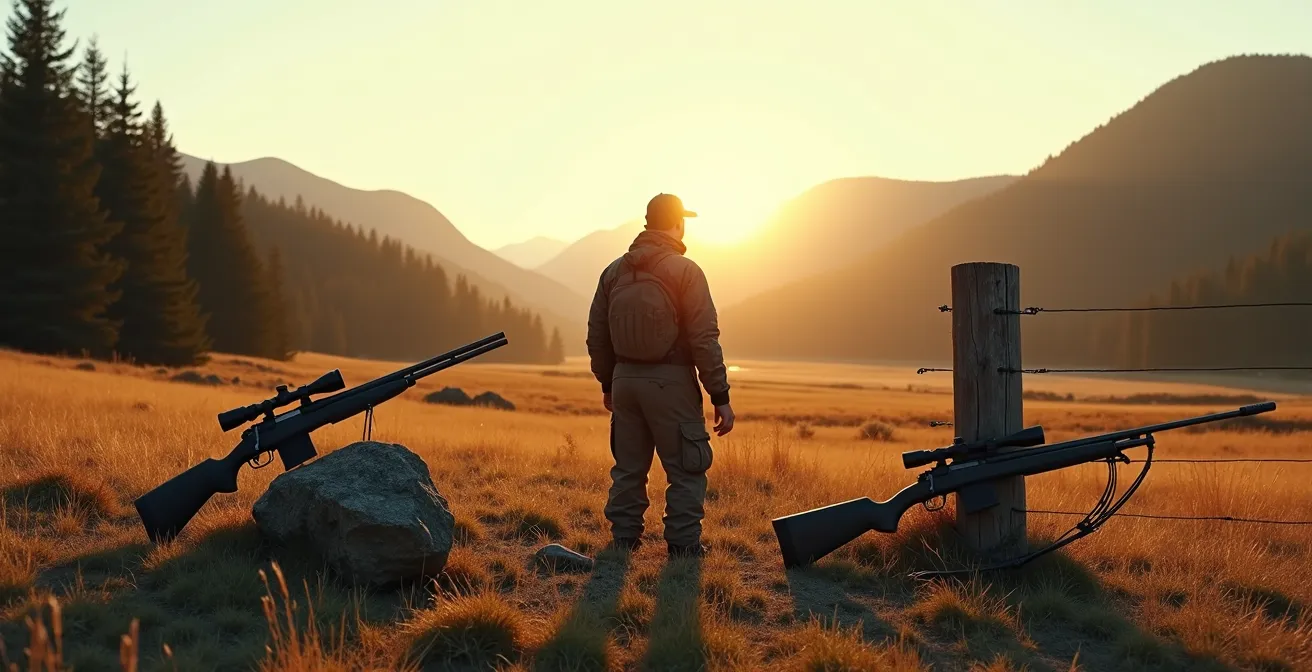
Choosing your first hunting weapon is overwhelming, but the right choice is dictated by an objective analysis of your terrain, not by popular opinion or brand loyalty.
- Dense cover demands absolute reliability and quick handling, favoring certain rifle actions or shotguns, while open country requires the flat-shooting accuracy of a specialized rifle and scope combination.
- A weapon’s mechanical action, safety features, and ammunition type are more critical for field effectiveness than a specific caliber alone.
Recommendation: Before investing, first analyze the environmental constraints and typical engagement distances of your primary hunting area. Then, match the weapon system’s inherent strengths to that specific context.
Stepping into a gun shop for the first time with the intent to buy a hunting weapon can be daunting. The walls are lined with rifles, shotguns, and bows, each with a passionate following. You’ll hear plenty of advice, often conflicting: “Get a .30-06, it works for everything,” or “A 12-gauge shotgun is the only tool you’ll ever need.” While well-intentioned, this advice often overlooks the single most important factor in your decision: the physical environment where you will be hunting.
The choice is not about finding a single “best” gun, but about selecting the optimal tool for a specific job. The dense, rain-soaked forests of the Pacific Northwest present a completely different set of challenges than the wide-open prairies of Wyoming or the thick brush of a Southern swamp. These environmental constraints impose non-negotiable demands on your equipment, from its resistance to moisture and debris to its ballistic performance in and around cover.
But what if the key wasn’t the caliber, but the action’s reliability in freezing rain? What if the real deciding factor wasn’t brand, but a barrel’s hidden wear or a bullet’s performance after striking a twig? This guide moves beyond generic recommendations. As a technical specialist, my goal is to provide an unbiased framework for your decision. We will deconstruct the critical components of rifles, bows, and shotguns, analyzing how each performs under the pressures of a specific terrain.
By understanding the “why” behind each technical choice—from action type and scope magnification to bullet construction—you can make a strategic investment. This article will walk you through a series of key technical questions, all viewed through the lens of your hunting environment, enabling you to select a weapon system that won’t just work, but will excel where you need it most.
To navigate this technical landscape, we will explore a series of critical decisions that every new hunter faces. The following sections break down these complex topics into a clear, logical framework, helping you build a complete picture of what weapon system is truly right for you.
Summary: A Terrain-First Guide to Choosing Your Hunting Weapon
- Bolt Action vs. Semi-Auto: Which Offers Better Reliability for Follow-Up Shots?
- How to Tune Your Rest so Your Broadheads Fly Like Field Points?
- Pump vs. Break Action: Which Is Safer for Beginner Upland Hunters?
- The Barrel Wear Sign That Means You Should Walk Away from a Used Rifle
- How to Match Your Scope Magnification to Your Effective Range?
- High Velocity vs. Heavy Mass: Which Is Safer for Brush Hunting?
- Why Rust in the Bore Is More Dangerous Than External Scratches?
- Do Non-Lead Bullets Really Perform Worse Than Traditional Lead Core?
Bolt Action vs. Semi-Auto: Which Offers Better Reliability for Follow-Up Shots?
The debate between bolt-action and semi-automatic rifles often centers on the speed of follow-up shots. A semi-auto is undeniably faster. However, for a new hunter making a primary investment, the more critical question is about reliability within your specific hunting environment. Reliability isn’t a single metric; it’s a measure of performance under stress, whether from dirt, moisture, or extreme temperatures. Here, the simplicity of the bolt-action rifle provides a distinct mechanical advantage.
A bolt-action has fewer moving parts. The manual operation of the bolt provides immense mechanical force to chamber a round or extract a spent casing, overcoming dirt or ice that might jam a gas-operated semi-automatic system. In fact, bolt-actions tend to be more reliable in freezing temperatures due to this robust, simple design. A semi-auto’s gas system, with its small ports and moving components, is inherently more vulnerable to fouling and environmental interference.
This paragraph introduces the environmental reliability of different rifle actions. The table below breaks down their performance in common challenging hunting conditions.
| Environment | Bolt Action Performance | Semi-Auto Performance |
|---|---|---|
| Fine Dust (Prairie) | Excellent – sealed action | Good – requires maintenance |
| Freezing Rain | Excellent – minimal parts | Moderate – gas system vulnerable |
| Mud/Snow | Very Good – simple mechanism | Moderate – multiple failure points |
As the data shows, while a semi-auto can be kept reliable with diligent maintenance, its design presents more potential failure points when exposed to harsh elements. The bolt-action’s closed system and simple, powerful mechanics offer a higher baseline of environmental reliability, a crucial factor when a single shot opportunity is on the line. For a hunter who will face mud, snow, or freezing rain, the bolt-action’s dependability often outweighs the semi-auto’s speed.
How to Tune Your Rest so Your Broadheads Fly Like Field Points?
For the bowhunter, accuracy is not just about a steady hand; it’s a product of a perfectly tuned system. The most common frustration for new archers is the experience of seeing their field points (practice tips) fly true, only to have their broadheads (hunting tips) veer off course. This isn’t a flaw in the broadhead; it’s a sign that your bow is not perfectly tuned. The blades of a broadhead act like wings on an arrow, and any slight imperfection in the arrow’s flight will be dramatically exaggerated.
The solution is a process called “broadhead tuning” or “walk-back tuning.” The goal is to adjust the arrow rest—the small component that holds the arrow before it’s fired—so that the arrow leaves the bow in a perfectly straight line, with no wobble or fishtailing. This ensures the fletching has full control and the broadhead’s blades don’t “steer” the arrow. The process involves making micro-adjustments to the rest’s horizontal and vertical position based on where the broadheads impact relative to the field points.
A common method is to shoot a field point at a target, then shoot a broadhead-tipped arrow at the same aiming point. If the broadhead hits left, you move the rest to the right in tiny increments (and vice versa). If it hits low, you may need to adjust the rest or nocking point up. This process is repeated until both types of points hit the same spot. This tuning is what determines your ethical effective range. An untuned bow might be lethal at 20 yards, but a perfectly tuned bow can extend that ethical range significantly. According to extensive testing by publications like Field & Stream, a distance of 60 yards is the gold standard for verifying your tune, as any remaining flaws become evident at that range.
Pump vs. Break Action: Which Is Safer for Beginner Upland Hunters?
When selecting a first shotgun, particularly for upland hunting where hunters often move in groups and navigate obstacles like fences and thickets, safety is the paramount concern. Both pump-action and break-action shotguns are reliable, but the break-action offers an unparalleled and unambiguous level of “systemic safety” that is ideal for a novice.
The primary advantage is its status as a visibly safe firearm. When a break-action is “broken open,” the chamber is physically exposed and disconnected from the firing mechanism. Anyone, from a hunting partner to a landowner, can see at a glance that the weapon is completely inert and cannot fire. This is not just a feature; it’s a critical communication tool in the field. Pump-actions, by contrast, have an internal magazine and a closed chamber, making their loaded/unloaded status impossible to verify without physically manipulating the action.
Case Study: The Break-Action’s Visual Safety Advantage
Hunter education courses consistently emphasize that break-action shotguns provide immediate, undeniable visual confirmation of an unloaded state. This is crucial when hunters are crossing fences, helping a dog, or simply taking a break. The universally recognized “open” action prevents tragic misunderstandings within a hunting party, reducing the cognitive load on a new hunter who is already focused on muzzle discipline and footwork.
This inherent simplicity is a powerful asset for a beginner. As a leading hunter safety program notes, this design reduces the mental burden on a novice.
For a true beginner, the break-action’s simplicity reduces mental overhead, allowing the novice to focus on critical safety elements: muzzle discipline, footwork in rough terrain, and awareness of hunting dogs and partners.
– Hunter Safety Education Program, National Shooting Sports Foundation Guidelines
While some beginners worry about gauge, the action type is a more significant safety factor. A 20-gauge may have less recoil than a 12-gauge, boosting confidence, but the break-action’s simple, verifiable safety status is a more fundamental benefit for someone learning the ropes of safe group hunting.
The Barrel Wear Sign That Means You Should Walk Away from a Used Rifle
Purchasing a used rifle can be an excellent way for a new hunter to acquire a high-quality firearm at a reduced cost. However, the external appearance can be deceiving. A rifle with a beautifully finished stock and a pristine blueing might be hiding critical, performance-killing damage inside its barrel. The single most important area to inspect is the bore, as internal wear is far more significant than any external scratch.
The most dangerous and often hidden sign of a worn-out barrel is throat erosion. This is the wear that occurs in the section of the barrel immediately in front of the chamber, where the rifling begins. Each shot burns hot gases that slowly eat away at this steel. As the throat erodes, the bullet has to “jump” a longer, unguided distance before it engages the rifling, which severely degrades accuracy. This is not something you can easily see with the naked eye.
Another critical issue is pitting from bore rust. As one experienced hunter shared, this can be cleverly hidden by a dishonest seller.
I once nearly bought a rifle with a pristine stock and action, but the cotton swab trick revealed severe bore pitting. The seller had clearly ‘prettied up’ the exterior while hiding internal damage that would have destroyed accuracy.
– Hunter’s Experience
To avoid a bad investment, a methodical inspection is necessary. While a borescope is the best tool, several field-expedient checks can reveal major problems. If you see any signs of significant wear or damage, it’s best to walk away, no matter how good the price seems.
Your Action Plan: Critical Barrel Inspection Checklist
- Throat Inspection: If possible, use a borescope to look for “fire-cracking” or worn-down rifling just ahead of the chamber. This is the primary sign of a high-round-count barrel.
- Muzzle Crown Check: Carefully inspect the very end of the muzzle. Any nicks, dings, or uneven wear from improper cleaning rods can ruin accuracy as it’s the last thing the bullet touches.
- Exterior vs. Interior Mismatch: Be wary if the rifle’s exterior looks brand new but the bore shows signs of wear. It could indicate a “cosmetic flip” hiding internal problems.
- The Cotton Swab Test: Run a tight-fitting, dry cotton patch or swab down the bore. If it snags or comes out with frayed fibers, it’s a clear indicator of rust pitting or other damage.
- Fouling Buildup: Look for heavy copper or carbon fouling that resists simple cleaning. It can indicate a neglected barrel where rust may have already started under the fouling.
How to Match Your Scope Magnification to Your Effective Range?
For a rifle hunter, the scope is not an accessory; it is an integral part of the weapon system. Choosing the right magnification is a direct function of your terrain. It’s a common mistake for new hunters to buy the most powerful scope they can afford, only to find it’s a liability in their hunting environment. An overly magnified scope in dense woods will have a tiny field of view, making it nearly impossible to find a moving target at close range.
The key is to match the scope’s magnification range to your anticipated engagement distances. This is a more critical decision than choosing an “all-around” caliber. The versatility of a modern variable-power scope, when chosen correctly, allows a single rifle to be effective across multiple scenarios. A hunter in thick timber needs a low bottom-end magnification (like 2x or 3x) for a wide field of view, while a prairie hunter needs a high top-end (12x, 16x, or more) to make precise shots at several hundred yards.
This table provides a general guideline for matching magnification to terrain, which directly dictates your likely shooting distances.
| Terrain Type | Typical Range | Recommended Magnification | Key Consideration |
|---|---|---|---|
| Dense Woods | 50-150 yards | 2-7x or 3-9x | Wide field of view priority |
| Open Prairie | 200-400 yards | 4-16x | Mirage management crucial |
| Mountain/Hills | 100-300 yards | 3-12x | Versatility for varied shots |
Case Study: First vs. Second Focal Plane Scopes
Beyond just magnification, the scope’s focal plane design is critical for hunting at unknown ranges. First Focal Plane (FFP) scopes are generally superior for hunting because their reticle subtensions (hash marks for holdover) are accurate at any magnification. With a Second Focal Plane (SFP) scope, the reticle is only accurate at one specific (usually maximum) magnification. For a hunter, who may need to make a quick shot at an unexpected distance without time to dial the turret to max power, the FFP design provides a decisive advantage in speed and accuracy.
Ultimately, selecting a scope requires an honest assessment of your hunting reality. Prioritizing a wide field of view for close encounters or high magnification for long shots is a choice your terrain makes for you.
High Velocity vs. Heavy Mass: Which Is Safer for Brush Hunting?
One of the most persistent and dangerous myths in hunting is the concept of a “brush-busting” bullet. The idea is that a high-velocity, lightweight bullet can power through small branches and twigs on its way to the target. This is fundamentally untrue and has led to countless missed or wounded animals. The reality is that any bullet can and will be deflected by even the smallest obstacle.
In fact, modern ballistics testing confirms that no bullet reliably penetrates brush without significant, unpredictable deflection. High-velocity, pointed “spitzer” style bullets are particularly susceptible. Upon striking a twig, they tend to yaw violently and veer dramatically off course. In dense cover, where clear shooting lanes are rare, the safer and more effective strategy is not to try and shoot *through* brush, but to use a projectile less prone to deflection in the first place.
This is where heavy, slower-moving projectiles with a large frontal area, or meplat, have an advantage. They are not immune to deflection, but their greater momentum and less aerodynamic shape make them more likely to maintain a straighter path after minor contact. This is why certain weapon systems are traditionally favored for dense environments.
Case Study: The Shotgun Slug as a Dense Cover Solution
In regions where hunting occurs in thick woods or swamps, the rifled shotgun slug has long been the tool of choice. A 12-gauge or 20-gauge slug is a massive, heavy, and relatively slow projectile. Its large frontal area and substantial mass make it significantly less prone to being deflected by light brush compared to a much smaller, faster rifle bullet. While it lacks the long-range capability of a rifle, the slug delivers tremendous terminal performance at typical brush-hunting distances (under 100 yards) and minimizes the risk of a wild ricochet, making it a safer and more ethical choice for that specific environment.
The takeaway for the new hunter is clear: there is no substitute for a clear shooting lane. When hunting in dense cover, choose a weapon system and projectile (like a heavy, round-nosed bullet in a lever-action rifle or a shotgun slug) that is inherently more stable, and always wait for an unobstructed shot.
Why Rust in the Bore Is More Dangerous Than External Scratches?
A hunter can be forgiven for focusing on the external condition of a firearm. Scratches on the stock or worn blueing on the barrel are cosmetic flaws that speak to a life of use in the field. However, rust inside the barrel—in the bore—is a far more insidious and dangerous problem. It is not a cosmetic issue; it is a direct threat to the firearm’s safety and integrity.
The danger lies in how rust damages the steel. It creates pits and rough patches along the bore’s surface. These imperfections have two immediate negative effects. First, they will scrape and damage the surface of the bullet as it travels down the barrel, ruining its aerodynamic stability and destroying any hope of consistent accuracy. Second, these rough spots will grab and hold fouling (copper and powder residue) at an accelerated rate, making the barrel progressively harder to clean and accelerating further damage.
But the most critical danger is the risk of a catastrophic pressure spike. The bore of a rifle is a precision-engineered pressure vessel. Rust pits create constrictions, or tight spots, in that vessel. When a bullet is forced through these tight spots at immense speed, the pressure behind it can increase dramatically and instantaneously.
Rust pits create tight spots in the bore. When a bullet passes, these spots can cause a dangerous spike in chamber pressure that, in extreme cases, could lead to catastrophic firearm failure.
– Firearms Safety Expert, Gun Digest Technical Manual
This pressure spike can, at a minimum, cause a stuck case or damage the rifle’s action. In a worst-case scenario, it can cause the barrel to rupture, resulting in a catastrophic failure that can severely injure or kill the shooter or bystanders. For this reason, any visible rust or pitting inside the bore of a firearm should be considered a major red flag. It destroys the rifle’s value, compromises its accuracy, and most importantly, makes it a potential safety liability.
Key Takeaways
- Weapon choice should be driven by an objective analysis of your primary hunting terrain, not popular opinion.
- Mechanical simplicity often equals greater reliability in harsh environmental conditions like rain, snow, and dust.
- An unambiguous, visually verifiable safe status (like a break-action shotgun) is a critical advantage for beginner hunters, especially in groups.
Do Non-Lead Bullets Really Perform Worse Than Traditional Lead Core?
The conversation around non-lead ammunition is often clouded by outdated information and resistance to change. Many jurisdictions now mandate non-lead projectiles (typically made of copper or a copper alloy) for hunting to protect wildlife from lead poisoning. A common concern among hunters is that these monolithic bullets don’t perform as well as traditional lead-core bullets. From a technical standpoint, this is largely a myth. Modern non-lead bullets do not perform worse; they simply perform *differently*, and understanding those differences is key to using them effectively.
Traditional lead-core bullets work by fragmenting upon impact. The soft lead core expands and often sheds a significant portion of its weight inside the animal, creating multiple wound channels. By contrast, a monolithic copper bullet is designed to expand into sharp “petals” while retaining nearly all of its original weight. In fact, ballistics testing shows that modern monolithic copper bullets can achieve 95% or more weight retention. This deep, straight-line penetration can be a significant advantage, especially on tough, large-boned animals or on quartering shots.
The key to getting excellent terminal performance from a monolithic bullet is velocity. Copper is less dense than lead, so to achieve reliable expansion, these bullets need to be driven fast. This has led to a highly effective new strategy in ammunition selection.
Case Study: The Light-for-Caliber Monolithic Strategy
Instead of using the traditional bullet weight for a given caliber (e.g., a 150-grain bullet in a .308 Winchester), experienced hunters using monolithic projectiles often drop down in weight (e.g., to a 130-grain bullet). This lighter bullet can be driven at a much higher muzzle velocity. This increased velocity not only ensures dramatic and reliable expansion upon impact, even at longer ranges, but it also results in a flatter trajectory. In many cases, a lighter, faster monolithic bullet can outperform a heavier, traditional lead-core bullet in both terminal ballistics and flight path.
The modern non-lead bullet is not a compromise; it is a highly engineered piece of terminal tackle. When matched with the right velocity, it offers deep penetration, massive tissue damage, and near-perfect weight retention, making it an exceptionally effective and environmentally responsible choice for any hunter.
Now that you have a framework for analyzing the technical aspects of your future hunting weapon, the next logical step is to apply this knowledge. Begin by honestly assessing the terrain, cover, and typical engagement distances of the places you plan to hunt most often, and use that analysis to build a profile of the ideal tool for the job.