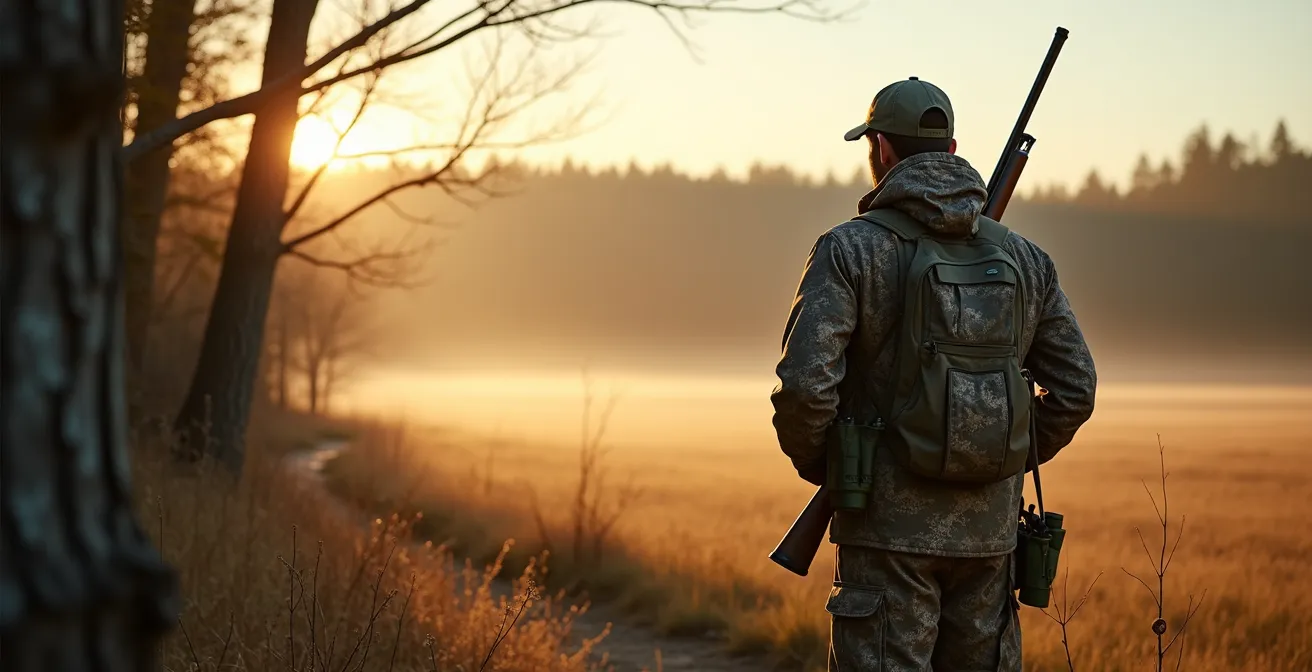
Successful mixed-bag hunting isn’t about carrying more gear; it’s about mastering the rapid mental shift between hunting predator and prey.
- Learn to recalibrate your senses from spotting large game to detecting subtle small game signs.
- Turn a “failed” deer hunt into a successful coyote set by switching from stealth to psychological warfare.
Recommendation: Start thinking of every hunt not as a single-target mission, but as a landscape of layered opportunities waiting to be unlocked.
For the versatile hunter, a day in the field is a canvas of overlapping opportunities. The primary goal might be an elk or a deer, but the landscape is teeming with possibilities—grouse flushing underfoot, a coyote slinking through the sagebrush, or quail erupting from a draw. Many hunters prepare by packing multiple firearms and knowing the regulations, but they miss the most critical tool: the ability to mentally pivot. The true art of the mixed-bag hunt lies not in your pack, but in your mind.
The common approach is logistical. Hunters ask, “Do I have the right gun? The right ammo?” This is the first layer, but it’s superficial. The deeper challenge is cognitive. Hunting a wary herbivore like an elk requires a mindset of stealth, patience, and scent elimination. Hunting an intelligent predator like a coyote demands the opposite: aggressive calling, psychological manipulation, and leveraging your presence as a challenge. These are two fundamentally different tactical approaches.
This guide abandons the simplistic gear-focused advice. Instead, we will deconstruct the mental and sensory recalibration required to become a truly opportunistic hunter. It’s about developing the cognitive flexibility to switch from a passive predator-avoidance mindset to an active predator-engagement strategy in a matter of minutes. We will explore how to see a “failed” hunt as a tactical transition, how to read the unique behaviors of different species, and how to make your presence in the woods an asset rather than a liability. By mastering this mental switch, you transform from a single-target hunter into an efficient harvester who maximizes every second of valuable field time.
This article provides a strategic framework for developing that crucial cognitive flexibility. We’ll break down specific scenarios, from big game to small game and predators, to help you capitalize on every opportunity the wild presents.
Summary: Mixed Bag Hunting: A Guide to Cognitive Flexibility in the Field
- Why You Should Pack a .22 Pistol on Your Elk Hunt?
- How to Turn a Failed Deer Stand into a Successful Coyote Set?
- Pheasant vs. Quail: How to Identify Birds on the Flush?
- Bear and Deer: How to Scent Control for Two Different Noses?
- Freeze or Flee: How Different Species React to Human Presence?
- Why Wildlife Agencies Rely on Hunter Data to Monitor Herd Health?
- How to Utilize Bones and Hides to Minimize Field Waste?
- Why Modern Hunting Is Attracting a New Demographic of Urban Dwellers?
Why You Should Pack a .22 Pistol on Your Elk Hunt?
The elk hunt is a game of patience, often involving long periods of sitting and glassing. Your senses are tuned to the macro level: the distant bugle, the flicker of an ear in the aspens, the massive shape moving through timber. This intense focus, however, can lead to sensory fatigue and missed opportunities. Carrying a lightweight .22 pistol is not just about bagging a camp meal; it’s a tool for cognitive recalibration. It forces you to switch your focus from the grand scale of elk hunting to the micro-scale of your immediate surroundings.
When you are stationary, waiting for elk to move at dawn or dusk, the woods are still alive. A grouse might drum on a log 30 yards away, or a squirrel might chatter in a nearby pine. Engaging with these small game targets provides a vital mental break and hones your situational awareness. It’s an exercise in switching your sensory filtering—training your ears to distinguish the soft flutter of grouse wings from the rustle of leaves, and your eyes to catch the subtle movement of a small mammal against the forest floor.
This practice has direct benefits for your primary hunt. It keeps your mind sharp and engaged, preventing the mental lull that can cause you to miss the faint snap of a twig that signals an approaching bull. It is the first, simplest step in developing the opportunistic mindset. A successful hunter doesn’t just wait for opportunity; they actively seek it on every level. The .22 pistol is the key to unlocking these layered opportunities, turning downtime into productive, skill-sharpening action and securing high-protein meals with minimal noise and energy expenditure.
How to Turn a Failed Deer Stand into a Successful Coyote Set?
An empty deer stand at the end of a sit is often seen as a failure. The efficient hunter sees it as a tactical shift. The absence of deer could mean many things, but one strong possibility is the presence of predators. This moment is not the end of the hunt; it’s the beginning of a new one that requires a complete 180-degree mental pivot. You must transition from the passive, stealthy mindset of a prey animal mimic to the aggressive, confrontational mindset of a territorial challenger.
Your deer hunt was about being invisible. You minimized scent, stayed silent, and moved like a shadow. Now, you will do the opposite. The lingering human scent you worked so hard to conceal can become a curiosity factor for an intelligent predator like a coyote. Your mission changes from stealth to psychological warfare. Instead of hiding, you are now issuing a challenge. This is where predator calls—distress cries of prey or coyote pup sounds—come into play. You are no longer trying to blend in; you are trying to trigger a territorial or predatory response.
This is the essence of opportunistic hunting. You leverage the conditions of your previous hunt to create a new one. Here’s how you make the switch:
- Analyze the absence: The lack of deer isn’t just bad luck; it’s data. Use it as an indicator of potential coyote activity in the area.
- Repurpose your scent: Don’t worry about the scent you’ve left. A curious coyote may circle downwind to investigate the source of the calls, using your lingering scent as a confirmation point.
- Change your posture: Shift from a tense, still deer-hunting posture to a ready, active predator-hunting posture. You are now the aggressor in this scenario.
- Use remaining attractants: Any deer scents or lures used earlier can now act as bait to hold a responding coyote’s attention.
An empty stand isn’t a wasted morning; it’s a perfectly prepared stage for a predator set.
Pheasant vs. Quail: How to Identify Birds on the Flush?
The cognitive shift required for mixed-bag hunting is most intense when dealing with upland birds. The explosion of a covey of quail and the cackling launch of a rooster pheasant demand instantaneous identification and reaction. There is no time for conscious thought; the decision to shoot or hold must be deeply ingrained. Misidentifying the bird can lead to a missed opportunity or, worse, a violation if one species is out of season. This is where pre-hunt study translates into instinctual field performance.
The two species present entirely different challenges. A pheasant launch is a singular, vertical event. It’s loud, rattling, and often involves a cackling rooster that then flies low and straight, offering a more predictable flight path. A quail covey, by contrast, is a “covey bomb”—a multi-directional explosion of smaller birds with a lower-pitched, whirring buzz. Your brain must process not one target, but a dozen, and pick one to focus on, all while your heart is pounding.
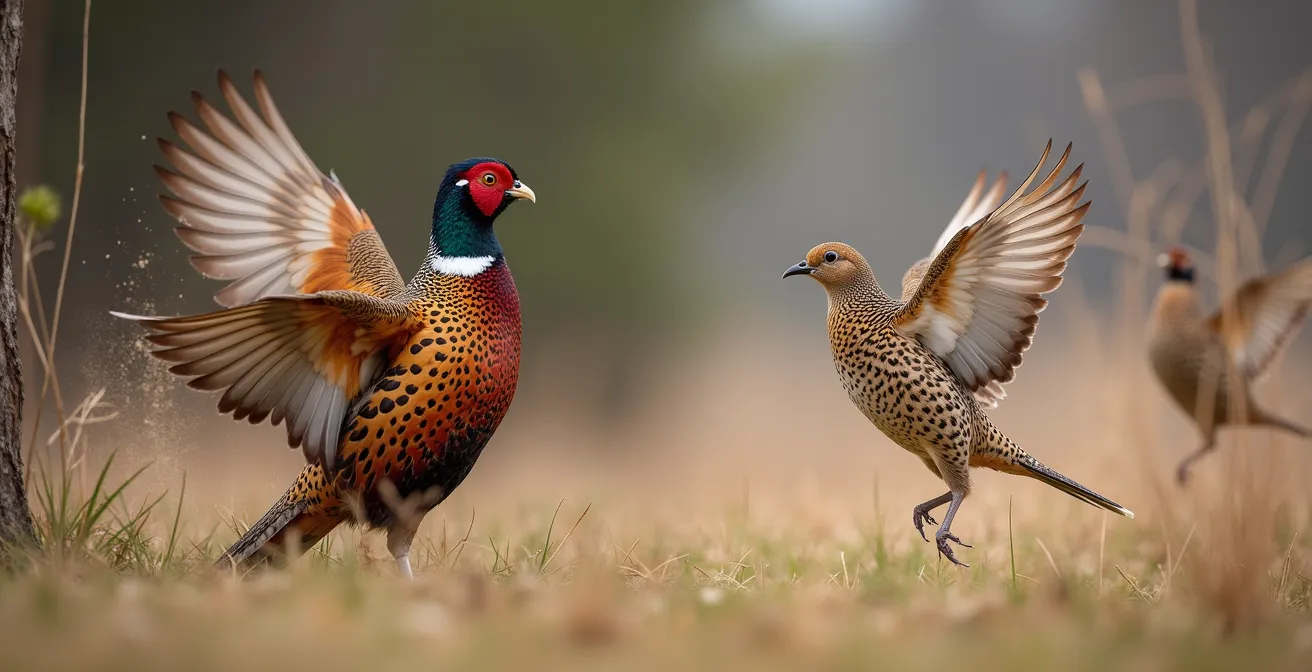
To master this, you must train your brain to recognize the key signatures of each bird. This goes beyond visual ID and incorporates sound and behavior. The following matrix breaks down the crucial differences that your mind must process in a fraction of a second. Mastering this data before the hunt allows your subconscious to take over when the action happens.
| Feature | Pheasant | Quail |
|---|---|---|
| Acoustic Signature | Cackling, rattling explosion | Lower-pitched whirring buzz |
| Flight Pattern | Vertical launch, then low and straight | Explode in multiple directions (covey bomb) |
| Post-flush Behavior | Often runs after landing | Seeks nearest thick cover |
| Habitat Preference | Open grasslands, ag fields, cattail marshes | Brushy draws, overgrown fencerows, woodland edges |
Bear and Deer: How to Scent Control for Two Different Noses?
Hunting both deer and bear on the same trip presents one of the most complex scent control puzzles an opportunistic hunter can face. You are dealing with two animals that perceive and react to scent in fundamentally different ways. A whitetail deer possesses a hyper-sensitive nose geared for one primary purpose: detecting predators from a great distance. Any foreign odor, especially human scent, triggers an immediate flight response. For deer, your scent control must be absolute and uncompromising.
A black bear, however, operates on a different sensory level. While its sense of smell is legendary—often cited as being many times more powerful than a bloodhound’s—it is driven primarily by its stomach. A bear’s nose is a tool for finding food. Consequently, it can be both incredibly wary of human scent and intensely drawn to food-related smells. This creates a paradox for the mixed-bag hunter. The bacon you cooked for breakfast could be a liability for your deer hunt but an attractant for a bear. Your scent strategy must therefore be dynamic.
The scale of this challenge is significant; in the U.S. alone, almost 40 million hunting licenses, tags, permits, and stamps were issued in 2024, showing how many hunters could potentially manage such multi-species encounters. The key is to prioritize. If deer are your primary target, absolute scent elimination is the rule. This means scent-free soaps, sprays, and clothing storage. When you decide to pivot to bear, you can then strategically introduce scent—not human scent, but potent bait scents like anise oil or commercial lures—at a dedicated bait site located a safe distance from your deer stand. You are essentially creating two different scent environments: a sterile zone for deer and a “hot” zone for bear.
Freeze or Flee: How Different Species React to Human Presence?
The most advanced form of cognitive recalibration is learning to read and react to an animal’s response to your presence. Every species has an evolved strategy for dealing with a perceived threat, and it’s rarely random. Understanding whether an animal is predisposed to freeze or flee allows you to adapt your own body language and tactics in real time. This isn’t just hunting; it’s a non-verbal dialogue with the animal.
Species that rely on camouflage, like rabbits or grouse, are more likely to freeze, trusting their coloration to hide them. Species that rely on speed, like deer or coyotes, are more likely to flee. Your approach must change accordingly. When you spot a freeze-prone animal, the key is to slow down, avoid direct eye contact, and use a “grazing walk” pattern—a slow, meandering movement that mimics a non-threatening herbivore. This can allow you to close the distance without triggering the flight response.
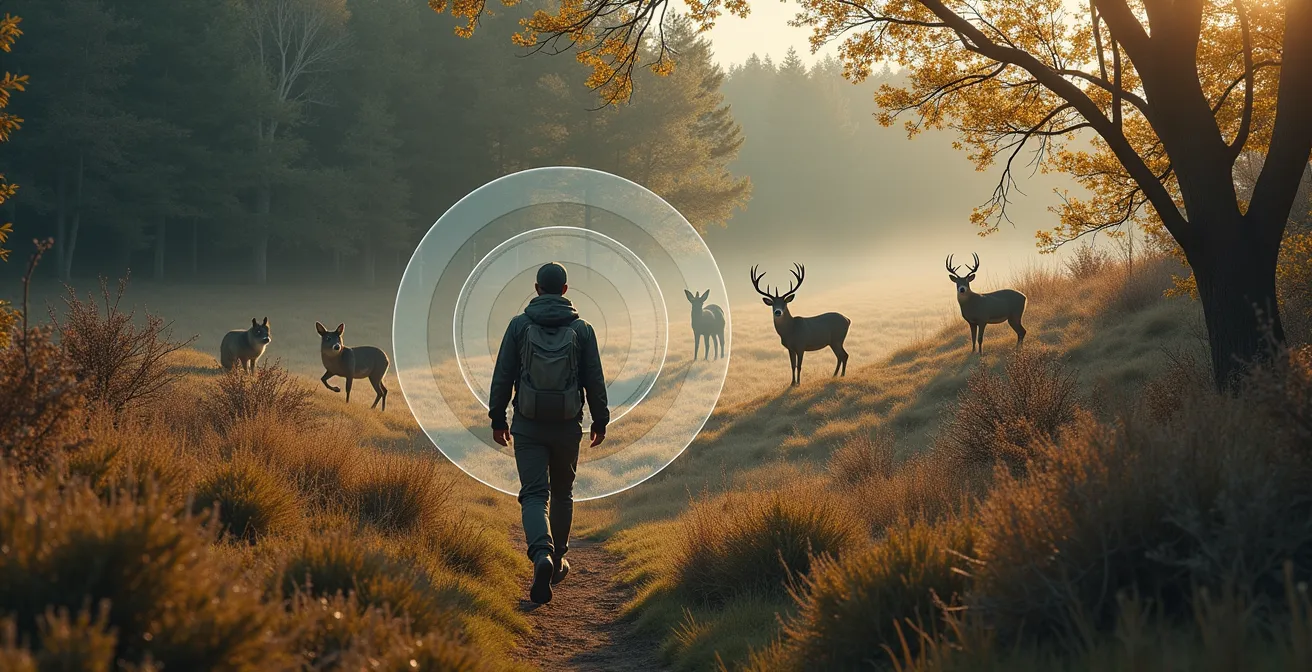
Every animal also operates within a series of invisible pressure bubbles or zones. There’s a wide awareness zone, a closer alert zone, and finally, the critical flight zone. The size of these bubbles varies dramatically. A squirrel might have a flight zone of only a few feet, while a wary coyote’s can be hundreds of yards. The expert hunter visualizes these zones and navigates their edges, applying just enough pressure to get a shot without causing a full-blown panic. This requires projecting the right energy—indifference for a predator, calm non-threat for prey. Mastering this is the pinnacle of opportunistic fieldcraft.
Action Plan: Species-Specific Response Protocol
- Identify evolutionary response patterns: catalogue which local species rely on camouflage (freeze) versus speed (flee).
- Practice body language adjustment: learn to slow your movement, avert your gaze, and use a non-threatening “grazing walk” when approaching prey.
- Project confidence for predators: adopt a deliberate, steady posture to signal indifference or challenge to species like coyotes.
- Map invisible pressure bubbles: mentally visualize the awareness, alert, and flight zones for each target species before an encounter.
- Calibrate your navigation: consciously adjust your path and speed to stay outside the flight zone, which can range from a squirrel’s tiny bubble to a coyote’s extensive range.
Why Wildlife Agencies Rely on Hunter Data to Monitor Herd Health?
The opportunistic hunter, with their broad focus and diverse encounters, is one of the most valuable assets for modern wildlife management. State and federal agencies don’t have the resources to be everywhere at once. They rely on the vast network of hunters in the field to act as their eyes and ears. Every animal harvested, every observation logged, and every tag reported provides a crucial data point that helps biologists monitor herd health, track population dynamics, and set sustainable harvest quotas for the following seasons.
When you report harvesting a deer, you’re providing data on age structure and health. When you report seeing fewer quail in an area known for them, you’re flagging a potential habitat issue. This citizen-science aspect of hunting is the financial and operational backbone of the North American Model of Wildlife Conservation. This model is a user-pays, public-benefits system where hunters and anglers, through license fees and excise taxes on gear, provide the primary funding for conservation. The impact is staggering; according to a USFWS survey, Americans injected $394.8 billion into the economy through wildlife-related activities, directly funding the agencies that manage these resources for everyone.
Your role as a mixed-bag hunter magnifies this effect. By pursuing multiple species, you gather a wider, more diverse dataset from a single trip. You might provide information on elk in the high country, grouse in the mid-elevation forests, and coyotes in the valley floor. As Greg Sheehan, former U.S. Fish and Wildlife Service Principal Deputy Director, stated:
Hunters and anglers form the foundation of wildlife conservation in the United States, consistently generating more funding for habitat and wildlife management than any other source.
– Greg Sheehan, U.S. Fish and Wildlife Service
This reality adds a profound layer of purpose to your hunt. Being an efficient, observant, and ethical mixed-bag hunter is not just about filling your freezer; it’s an active participation in the stewardship of the wildlife you cherish.
How to Utilize Bones and Hides to Minimize Field Waste?
The philosophy of the opportunistic hunter extends beyond the kill. It culminates in a deep-seated respect for the animal, which manifests as a commitment to minimizing waste. In a mixed-bag scenario, this principle becomes even more powerful, as the byproducts of one animal can become tools for hunting another. The concept of “waste” is transformed into “resource.” Every part of the harvested animal—from the meat and organs to the hide, bones, and sinew—has a purpose.
This “nose-to-tail” approach is the ultimate expression of hunting efficiency and ethics. For the mixed-bag hunter, it creates a sustainable, self-supporting ecosystem within your hunting practice. The fat (tallow) from a harvested deer isn’t discarded; it’s rendered down and used as a long-lasting, high-energy bait for predators like coyotes and bears. A deer hide isn’t left in the field; scraps can be used to create scent drags for predator hunting. The bones themselves are a treasure trove of utility.
Embracing this full-utilization mindset not only honors the animal but also makes you a more effective and self-reliant hunter. It reconnects you with ancient skills and a deeper understanding of the natural world. Consider these cross-species utilization strategies:
- Predator Bait: Create potent bait stations using deer tallow and hide scraps.
- Scent Attractants: Boil deer skulls to produce a natural bone-broth scent that can attract coyotes.
- Tools and Calls: Craft turkey wingbone calls for predator hunting, or fashion durable knife handles from antlers and large bones.
- Camp Resources: Produce tallow candles for reliable lighting in hunt camp.
- Mementos: Design jewelry or keepsakes from teeth and claws, creating a tangible connection to the hunt.
This practice closes the loop, ensuring that the end of one hunt is the beginning of another, and that nothing is ever truly wasted.
Key Takeaways
- True mixed-bag success is a mental skill, not a gear checklist. It’s about cognitive flexibility.
- A “failed” hunt for one species is often the perfect setup for another if you can pivot your tactics and mindset.
- Every action in the field, from harvest reports to waste utilization, connects you to the broader mission of wildlife conservation.
Why Modern Hunting Is Attracting a New Demographic of Urban Dwellers?
The image of the hunter is changing. While the traditional rural base remains strong, a new and growing demographic is emerging from urban and suburban centers. These new hunters are often drawn to the sport not by family tradition, but by a powerful desire for self-sufficiency, a connection to their food source, and an authentic experience in the natural world. This “field-to-fork” movement is a significant driver, but the appeal of hunting for this new generation runs deeper.
The principles of the modern, opportunistic hunter—efficiency, adaptability, ethical utilization, and a direct role in conservation—resonate strongly with this group. They are not interested in just collecting trophies; they are seeking a holistic and meaningful engagement with the ecosystem. The idea of a mixed-bag hunt, where one trip can yield a variety of experiences and food sources, is particularly appealing. It represents the ultimate in efficiency and sustainability, values that are highly prized by a demographic accustomed to optimizing time and resources.
This shift is reflected in the data. New entrants into hunting are increasingly diverse. For example, a recent report highlights that females represent 33 percent of new hunting entrants while comprising only 17 percent of all active hunters, indicating a significant change in participation. These new hunters are tech-savvy, using digital mapping tools and online resources to learn, but they are seeking an analog escape. Hunting provides a tangible, challenging, and deeply rewarding counterbalance to a screen-based life. The mental and physical demands, the ethical considerations, and the direct contribution to conservation create a powerful, multi-faceted appeal that is redefining what it means to be a hunter in the 21st century.
By mastering the cognitive shifts detailed here, you not only become a more successful hunter but also a more engaged and effective steward of the wild. The next step is to consciously apply these mental exercises on your next trip, turning every moment in the field into a potential opportunity.