In summary:
- Survival is not a checklist; it’s a series of decisions made before a situation becomes catastrophic.
- Your first priority is recognizing the “decision threshold”—the moment you must abandon the hunt and shift to survival mode.
- Staying dry is more critical than staying warm. Wet clothing, especially cotton, is a death sentence.
- Mastering how to build an improvised shelter and a fire in wet conditions are non-negotiable skills.
- A trained, “Safety-First” mindset that overrides panic and buck fever is your single most important piece of gear.
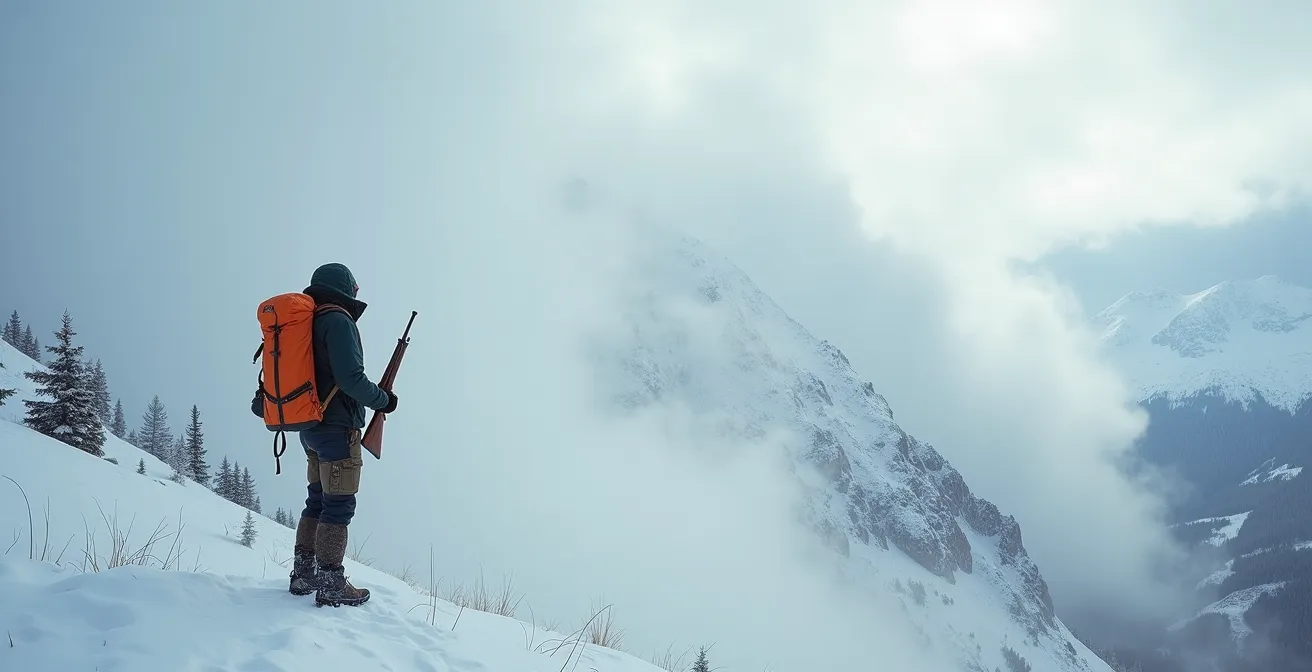
The wind whips the snow into a whiteout, erasing the trail you followed just an hour ago. The temperature plummets. Your truck is miles away, across terrain that is now actively hostile. This is the scenario every backcountry hunter dreads, where the thrill of the chase is replaced by the cold, hard reality of survival. Many guides will give you a simple checklist: layer your clothes, carry a fire starter, tell someone your plan. While correct, this advice fails to address the most critical element: the mindset and decision-making process under extreme pressure.
This isn’t about having the fanciest gear. It’s about understanding the cascading failures that turn a bad situation into a fatal one. It’s a thermodynamic battle against the cold, and a psychological battle against your own instincts. The key isn’t just knowing *what* to do, but recognizing the precise moment *when* to do it. The difference between a harrowing story and a tragic headline is often a single decision made—or not made—at a critical threshold.
This guide goes beyond the basics. We will dissect the subtle environmental and physiological cues that signal imminent danger. We will explore the physics of heat loss, the mechanics of building life-saving shelter from nothing, and the mental conditioning required to make calm, rational choices when your life depends on it. This is the knowledge that allows you to override panic and engage the problem with the cold, calculated focus of a survivor.
This article will break down the essential strategies for surviving an unexpected blizzard. We’ll cover everything from reading the weather to mastering your own psychology, providing a clear framework for getting home alive.
Summary: How to Survive an Unexpected Blizzard While Miles from the Truck?
- Why a Barometric Pressure Drop Should Change Your Hunt Plan Immediately?
- How to Build a Debris Hut If You Lose Your Tent?
- Shivering vs. Confusion: Which Symptom Means You Are About to Die?
- The Waterproofing Failure That Soaks You to the Bone in an Hour
- How to Start a Fire When Every Stick in the Woods Is Soaked?
- Bivy Sack vs. 4-Season Tent: Which Is Better for Solo Alpine Hunting?
- Why Cotton Is the Enemy of the Late-Season Hunter?
- How to Cultivate a “Safety-First” Mindset That Overrides Buck Fever?
Why a Barometric Pressure Drop Should Change Your Hunt Plan Immediately?
The most important survival decisions are made before the crisis hits. For a hunter, the first and most crucial environmental cue is a rapid drop in barometric pressure. This isn’t just an indicator that a storm is coming; it’s a non-negotiable signal to change your plan. While a falling barometer might mean deer start feeding aggressively, for the hunter, it means your window for a safe return is closing fast. Ignoring this sign is the first step in a cascading failure.
The speed of the drop is the critical factor. A slow, steady decline over a day is normal. A rapid plunge, however, signifies an intense, fast-moving system. Expert meteorologists recognize that a barometric pressure drop of 3 mb per hour is a clear indicator of an approaching storm front. At this rate, you must immediately shift from “hunting mode” to “survival mode.” Your new objective is not bagging a buck; it’s getting back to the truck or to a pre-planned shelter location safely.
This is your first decision threshold. Crossing it means you stop moving away from safety and start moving towards it. You must calculate your return time based on the increasingly difficult terrain and set a hard turnaround time. This isn’t weakness; it’s the professional discipline that separates seasoned outdoorsmen from statistics.
Your Action Plan for a Pressure Drop
- Monitor hourly pressure readings with a watch or GPS. A drop of 1-2 mb/hour is a warning.
- At a 3+ mb/hour drop rate, immediately calculate your distance and travel time to your vehicle, accounting for worsening conditions.
- Set a hard, non-negotiable turnaround time, especially if the pressure falls below 29.90 inches of mercury (Hg).
- Switch from hunting to survival mode: as you begin your retreat, actively scan for and collect dry tinder.
- Mark potential natural shelter locations (rock overhangs, dense thickets) on your GPS as you head back.
Treating the barometer as your primary safety gauge transforms it from a piece of data into your most important field advisor. Listening to it is the first step in ensuring you can hunt another day.
How to Build a Debris Hut If You Lose Your Tent?
Imagine the scenario: the blizzard hits, your tent is ripped away by the wind, or you’re simply too far from camp to make it back. Your gear has failed. Now, you must create shelter from the raw materials around you. This is where the debris hut—a primitive but incredibly effective shelter—becomes your lifeline. Its primary function is not to be a fortress against the wind, but to trap your own body heat by creating a cocoon of insulated, dead air space.
The principle is simple: insulation. You need a thick, uncompressed barrier between you and the cold ground/air. The structure starts with a sturdy ridgepole, about 9 feet long, propped against a tree or stump at one end and resting on the ground at the other. This forms the spine of your shelter. Next, you lean smaller branches against the ridgepole, creating a rib cage. The key is to then pile debris—leaves, pine needles, ferns, moss—onto this frame. Don’t be shy; you need at least two to three feet of thick, fluffy debris covering the entire structure to be effective.

Inside, you must create an equally thick bed of the same material to insulate you from the frozen ground. You crawl into the small opening (feet first) and pull the remaining debris in behind you to plug the entrance. It will be tight, even claustrophobic, but this small space is what allows your body heat to warm the interior. This is the thermodynamic battle in its most basic form: trapping still air to prevent convective heat loss.
Case Study: Improvised Winter Shelter Success
In a documented test, a survivalist built an emergency shelter during the coldest weekend of the year in the Ozark Mountains. Instead of a traditional debris hut, he used a raised bed frame made of logs, which he filled with a thick layer of leaves and insulated with deer hides. By hanging an emergency blanket under the frame to reflect heat and covering the exterior with plastic sheeting, he successfully maintained a survivable temperature through a sub-freezing night, aided by small, strategically placed fires near the entrance. This demonstrates that the principles of insulation and improvisation are more important than a specific design.
Building a debris hut is exhausting work, especially in a storm. Practice this skill in a low-stakes environment. Knowing you can create life-saving shelter with your bare hands and the materials of the forest is a powerful psychological advantage.
Shivering vs. Confusion: Which Symptom Means You Are About to Die?
In a blizzard, your body is in a constant fight to maintain its core temperature. When that temperature begins to drop, your body sends out a series of increasingly desperate signals. Understanding these signals is the difference between self-rescue and succumbing to hypothermia. Officially, hypothermia occurs when core body temperature drops below 95°F (35°C), but the signs start much earlier.
The first stage is shivering. This is a good sign. It’s your body’s automatic defense mechanism, burning energy to generate heat. While uncomfortable, shivering means your system is still fighting. The real danger begins when the shivering stops. This is the physiological tipping point. It means your body is running out of energy and is starting to shut down. This is when severe hypothermia sets in, and mental functions are the first to go.
Survival experts have a memorable acronym for the subtle signs of moderate hypothermia: the “Umbles.” They are the precursor to the life-threatening stage. As Dr. Campbell McLaren, an expert on winter weather survival, notes:
When someone stays out too long in really cold weather, blood vessels begin contracting and there is less blood flow peripherally. We start to fumble. And tumble. And stumble.
– Dr. Campbell McLaren, NPR Interview on Winter Weather Survival
These symptoms are red flags that you or your partner are past the point of simple cold and are entering a medical emergency:
- Grumbles: An uncharacteristic negative attitude or irritability.
- Fumbles: Clumsy hands, difficulty with simple tasks like zippers.
- Mumbles: Slurred or incoherent speech.
- Stumbles: Poor coordination, tripping over nothing.
- Tumbles: A complete loss of balance.
Confusion, disorientation, and paradoxical undressing (feeling hot and removing clothes) are signs of severe, late-stage hypothermia. At this point, the person is not thinking rationally and is close to death. Shivering is a call to action; confusion is a five-alarm fire.
If you see these signs, immediate action is required: get the person into shelter, remove wet clothing, and begin passive rewarming with dry layers and body-to-body contact if necessary. Their life depends on your swift and correct response.
The Waterproofing Failure That Soaks You to the Bone in an Hour
In a blizzard, “waterproof” is a relative term. Under driving snow and wind, even the best gear can fail at seams or zippers. Sweat from exertion can soak you from the inside out. Once you are wet, the thermodynamic battle intensifies exponentially. Water is a brutally efficient conductor of heat, pulling warmth away from your body at a catastrophic rate. This is a gear failure that rapidly becomes a physiological crisis.
The material of your clothing determines how quickly this crisis unfolds. Some fabrics become liabilities the moment they get damp, while others retain a significant portion of their insulating properties. Understanding this difference is fundamental to cold-weather survival. Cotton, often found in jeans, t-shirts, and even socks, is the absolute worst offender. When wet, it loses all insulating value and actively leeches heat from your body.
This isn’t an exaggeration; it’s physics. The data clearly shows the dramatic difference in how various materials perform when they are compromised by moisture. Wool and high-quality synthetics are designed to manage moisture and retain warmth, giving you a crucial buffer to get dry. Cotton offers no such forgiveness.
The following table, based on data from outdoor survival experts, illustrates the stark reality of how different materials handle moisture. The comparison makes it clear why your clothing choice is a life-or-death decision. As an analysis from Outside Online’s survival guides shows, the difference in heat loss is staggering.
| Material | Heat Loss Rate When Wet | Insulation Retention | Drying Time |
|---|---|---|---|
| Cotton | 25x faster than dry | 0% when saturated | 8-12 hours |
| Wool | Minimal increase | 80% when wet | 4-6 hours |
| Synthetic (Polyester) | Moderate increase | 50-60% when wet | 2-3 hours |
Your layering system is your primary defense. If it fails due to a poor material choice or getting soaked through, your survival timeline shrinks from hours to minutes. Always prioritize wool or synthetic layers, and aggressively manage moisture, venting as you exert yourself to prevent sweat from becoming your worst enemy.
How to Start a Fire When Every Stick in the Woods Is Soaked?
You’ve built your shelter, but the shivering is setting in. You need fire. Not just for warmth, but for the immense psychological boost it provides. The problem? The blizzard has soaked everything. Every piece of wood is dripping wet. Trying to start a fire with conventional methods is a recipe for frustration and failure. This is where skill and preparation triumph over a hostile environment.
First, you need a reliable ignition source that works in the worst conditions. This is the principle of weaponized redundancy. Don’t rely on a single cheap lighter. Your fire kit must include:
- Waterproof matches in a sealed, robust container.
- A high-quality windproof lighter.
- A thick (1/2 inch diameter) ferrocerium rod and a steel striker. A ferro rod works when wet and throws a shower of 5,000°F sparks.
Store these three items in separate, waterproof containers in different parts of your kit. If you lose one, you have two more.
Next, you need to find or create dry tinder and kindling. Look for tinder in protected places: under thick pine boughs, inside the bark of dead-standing trees, or in the pocket of your own jacket (e.g., dryer lint, cotton balls soaked in wax). To get dry kindling, find a fallen branch (never from the ground). Use your knife to shave off the wet outer bark and wood. The heartwood in the center will be dry. Create a pile of fine shavings (“feather sticks”) from this dry core. This is your fuel.
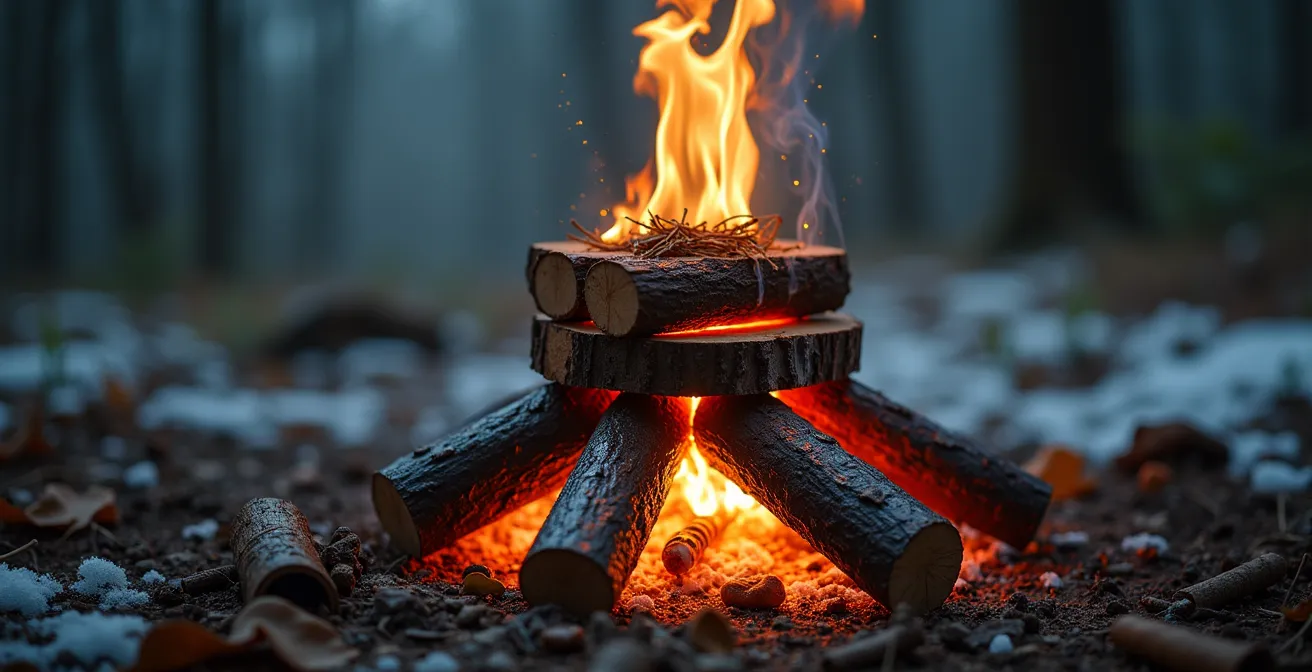
Finally, use the upside-down fire lay. This counter-intuitive method is superior in wet conditions. Place your largest, wettest logs on the bottom as a platform. Add progressively smaller layers of wood on top, finishing with your dry kindling and tinder nest at the very peak. Light the tinder at the top. As the fire burns downwards, it dries out the larger, wetter logs below, creating a self-sustaining fire that requires less maintenance.
A successful fire in a blizzard is a monumental victory. It pushes back the cold, dries your gear, and restores your will to fight. It’s a skill you must have before you need it.
Bivy Sack vs. 4-Season Tent: Which Is Better for Solo Alpine Hunting?
Your choice of shelter is a pre-trip decision that has massive implications for both your mobility as a hunter and your survivability in a storm. For the solo alpine hunter, the two main contenders are the minimalist bivy sack and the robust 4-season tent. There is no single “best” answer; the right choice depends on your strategy, risk tolerance, and the specific conditions you anticipate. It’s a classic trade-off between weight and security.
A bivy sack (or bivy) is essentially a waterproof, breathable cocoon for your sleeping bag. Its advantages are its incredibly low weight (1-2 lbs) and lightning-fast setup time. This makes it ideal for “spike camps”—quick, temporary camps you set up far from a basecamp to hunt an area aggressively. It allows a “fast and light” approach. However, its protection is minimal. It offers little defense against heavy snowfall and has notoriously poor condensation management, which can lead to your sleeping bag getting wet from your own breath, a critical failure in freezing temperatures. The psychological aspect is also a factor; many find bivies claustrophobic and morale-sapping in a storm.
A 4-season tent, by contrast, is a fortress. It is engineered to withstand high winds and heavy snow loads. It offers excellent ventilation to manage condensation and provides livable space to wait out a storm, cook, and manage your gear. This psychological comfort is a significant survival asset. The trade-off is weight and bulk (4-8 lbs or more) and a longer setup time. It’s the superior choice for a fixed basecamp or for trips where severe weather is a high probability.
The decision between these two systems is a critical part of your hunt plan. A bivy favors mobility, while a tent favors security. A common strategy is to use a 4-season tent as a basecamp and carry a lighter emergency bivy for unexpected nights out. The following comparison breaks down the key features.
This data, compiled from sources like expert survival guides, helps clarify the trade-offs you are making with your shelter choice.
| Feature | Bivy Sack | 4-Season Tent |
|---|---|---|
| Weight | 1-2 lbs | 4-8 lbs |
| Setup Time | < 2 minutes | 5-15 minutes |
| Condensation Management | Poor – freezes inside | Good – ventilation options |
| Storm Protection | Minimal | Excellent |
| Psychological Comfort | Claustrophobic | Livable space |
| Best For | Spike camps, fast & light | Base camps, extended stays |
Ultimately, the best shelter is the one you have with you and know how to use. But choosing the right one from the start can prevent a cascading failure before you even leave the truck.
Why Cotton Is the Enemy of the Late-Season Hunter?
There is one rule in cold-weather survival that is absolute and non-negotiable: cotton kills. This isn’t hyperbole; it’s a statement of fact based on the physics of heat transfer. For the late-season hunter, who faces both external moisture from snow and internal moisture from sweat, wearing cotton is one of the most dangerous mistakes you can make. It is the weak link that can compromise your entire layering system and dramatically shorten your survival time in a blizzard.
The problem is how cotton handles moisture. Unlike wool or synthetics which wick moisture away from the skin and retain much of their insulating value when damp, cotton acts like a sponge. It absorbs and holds water against your body. This water then becomes a thermal conductor. According to survival experts, water robs body heat 25 times faster than air. Wearing a wet cotton t-shirt is like wrapping yourself in a refrigerated blanket, actively pulling your precious core heat away.
The danger is insidious because cotton is everywhere. You may have diligently chosen wool or synthetic base layers, only to be betrayed by a hidden piece of cotton gear. This is a classic example of a small oversight leading to a catastrophic failure.
Case Study: The Hidden Cotton Hazards in Your Gear
A wilderness first aid instructor in Seattle documented the many overlooked places cotton lurks in a typical hunter’s loadout. The investigation revealed several critical failure points: cotton boot laces that wick water directly into insulated boots, compromising them from the outside; cotton-padded pack straps and hip belts that absorb sweat and hold cold moisture against the torso; the soft cotton lining of a favorite hat that becomes useless when damp; and even the cotton rifle sling that transfers the biting cold directly to your shoulder and back. This shows that even a small amount of cotton in a critical location can undermine an otherwise excellent gear system.
Before your next late-season hunt, conduct a full audit of your gear. Read the labels on your shirts, socks, underwear, and even your accessories. Replace every single cotton item with a wool or synthetic equivalent. Your life may very well depend on it.
Key Takeaways
- Survival is a mindset of proactive decision-making, not a reactive checklist.
- Your body and your gear have critical failure points; your job is to recognize the warning signs and act before they are breached.
- Staying dry is paramount. Eliminate all cotton and master moisture management to win the thermodynamic battle against the cold.
How to Cultivate a “Safety-First” Mindset That Overrides Buck Fever?
All the gear and skills in the world are useless if your mind fails you under pressure. In a survival situation, your greatest asset—or your most dangerous liability—is your own judgment. For hunters, one of the biggest psychological hurdles is “buck fever,” an adrenaline-fueled state of excitement that can cloud decision-making. In a blizzard, this same adrenaline can manifest as panic, leading to fatal mistakes like running blindly or failing to recognize the early signs of hypothermia. The ultimate survival skill is cultivating a “Safety-First” mindset that is so deeply ingrained it overrides these primal responses.
This mindset is not something you’re born with; it’s forged through discipline and ritual. One of the most powerful techniques is the “pre-mortem safety ritual,” performed before every single hunt. It’s a mental exercise where you anticipate failure in order to prevent it. By forcing yourself to answer hard questions before you start, you are pre-loading your brain with a rational plan.
This process of stress inoculation is a core principle in elite military training. As a former Navy SEAL and security expert for Global Rescue, Harding Bush emphasizes that the most dangerous decision during a blizzard is often the choice to leave shelter. SEAL training protocols build resilience by forcing recruits to practice critical skills under duress: starting a fire with one hand in freezing water, navigating by compass in total darkness, and making shelter decisions against a ticking clock. This conditioning ensures that when a real crisis hits, the trained, logical response overrides the emotional, panic-driven one.
The goal is to make safety protocols as automatic as shouldering your rifle. It’s about building mental muscle memory. This includes simple but powerful actions:
- Verbally state your plan and turnaround time to a partner or a recording device.
- Physically touch each piece of your survival kit (fire starter, shelter, beacon) and state its purpose aloud.
- Set hard alarms on your phone or watch for your check-in and turnaround times.
Ultimately, surviving an unexpected blizzard isn’t about being tougher than the storm. It’s about being smarter. It’s about having the humility to respect the power of nature and the discipline to make the right call, even when it means walking away from the hunt of a lifetime. That disciplined mindset is what will truly get you home alive.