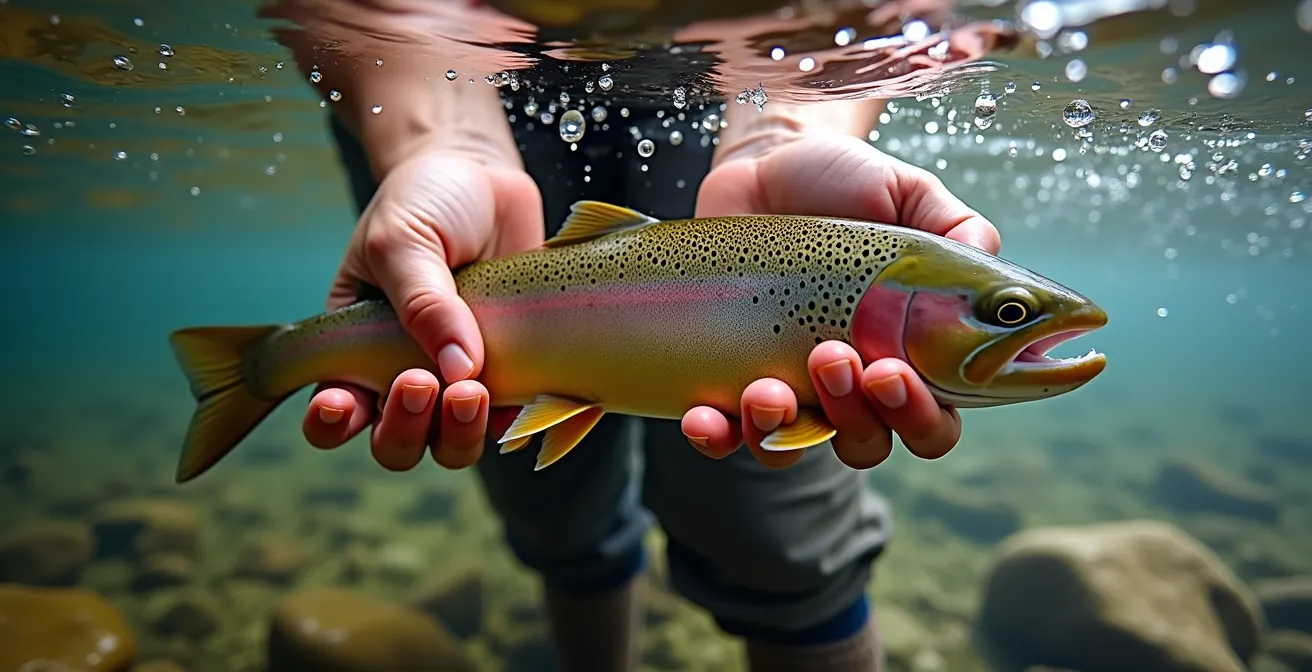
The sinking feeling of watching a released trout struggle or go belly-up downstream is a deep concern for any ethical angler. The solution isn’t a magic revival technique, but a holistic approach that minimizes physiological stress at every stage. This guide moves beyond common myths to explain the science behind fish survival, empowering you to reduce the cumulative stress and ensure the fish you release have the best possible chance to thrive.
The moment of release is the culmination of our angling ethic. We watch, holding our breath, as a magnificent trout returns to the current. But sometimes, despite our best intentions, the fish struggles, disoriented and exhausted. It’s a moment that raises a critical question for every catch-and-release angler: did I do enough? The common advice often focuses on that final revival, but this view is incomplete. It overlooks the concept of cumulative stress, a physiological debt the fish accrues from the moment of the hookset.
The real art of fish rehabilitation isn’t found in a frantic, last-minute effort to pump water through its gills. True stewardship lies in a deeper understanding of fish biology. It’s about recognizing that the fight itself, the time spent out of water, the way the fish is handled, and even the water temperature all contribute to its chances of survival. Many conventional practices, passed down through generations, are now being re-evaluated through a scientific lens. The key to revival isn’t just about what you do in the last 30 seconds; it’s about what you did in the preceding five minutes.
This guide will deconstruct the process, moving from gear and handling to the specific environmental factors that impact a fish’s recovery. By understanding the ‘why’ behind each best practice, you can transition from simply letting a fish go to actively facilitating its survival. We will explore the science of gill efficiency, the critical role of a fish’s immune system, and how to mitigate the invisible damage that can lead to delayed mortality long after the fish has swum out of sight.
text
To navigate this comprehensive approach, here is a summary of the key principles we will cover, each designed to minimize the fish’s physiological debt and maximize its chances of a full recovery.
Summary: A Scientific Approach to Maximizing Fish Survival
- Through the Gills or Forceps: Which Method Saves Gut-Hooked Fish?
- Why You Should Stop Fishing for Trout When Water Hits 68°F?
- How to Hold a Pike Vertically Without Damaging Its Internal Organs?
- Why Dry Hands Remove the Immune System of a Fish?
- When to Use a Descending Device for Reef Fish with Barotrauma?
- Why Knotless Mesh Saves You 10 Minutes of Untangling per Fish?
- Why Air Exposure Exceeding 10 Seconds Drastically Lowers Survival?
- Barbless Hooks: Do They Really Reduce Mortality Rates in Released Fish?
Through the Gills or Forceps: Which Method Saves Gut-Hooked Fish?
A deeply hooked fish presents one of the most challenging ethical dilemmas. The instinct is to perform “surgery” with forceps to retrieve the hook, but this well-intentioned act is often the most damaging. The throat and gill area of a fish are incredibly delicate, rich with blood vessels and vital to respiration. Attempting to extract a hook from this area frequently causes severe bleeding and tissue damage that the fish cannot survive.
The science on this is increasingly clear: cutting the line is the superior option. While leaving a hook seems counterintuitive, most modern hooks will either be dissolved by the fish’s stomach acids or worked free over time. The alternative—internal hemorrhaging from a pair of forceps—is far more lethal. In fact, research shows a staggering 74% mortality rate when a deep hook is forcibly removed from a trout, compared to a 47% rate when the leader is simply cut and the hook is left in place. This demonstrates that the trauma of removal is the primary driver of mortality.
A compelling study on snook further solidifies this principle. Researchers from the Fish and Wildlife Research Institute observed deep-hooked snook where half had the hook removed and the other half had the line cut. As documented in their catch-and-release research, four of the twelve snook died after hook removal, while none of the fish where the leader was simply cut succumbed. The evidence points to a simple, gentle rule: for a gut-hooked fish, the most humane tool is a pair of nippers applied to the line, not forceps applied to the hook.
Why You Should Stop Fishing for Trout When Water Hits 68°F?
Water temperature is an invisible but potent factor in fish survival. Trout are cold-water species, and their entire physiology is optimized for high oxygen levels found in cool water. As temperatures rise, the amount of dissolved oxygen in the water plummets. Forcing a trout to fight in warm, oxygen-deprived water is like asking a human to sprint at high altitude—it creates an immense physiological debt that can be impossible to repay.
When water temperatures approach 68°F (20°C), trout begin to experience significant thermal stress. Their metabolism speeds up, demanding more oxygen just as less becomes available. A prolonged fight in these conditions causes a severe buildup of lactic acid in their muscles. Even if a fish swims away, this acidosis can lead to delayed mortality hours or even days later. A general guideline is that brown trout prefer temperatures below 59°F (15°C), struggle at 68°F (20°C), and face lethal conditions at 77°F (25°C).
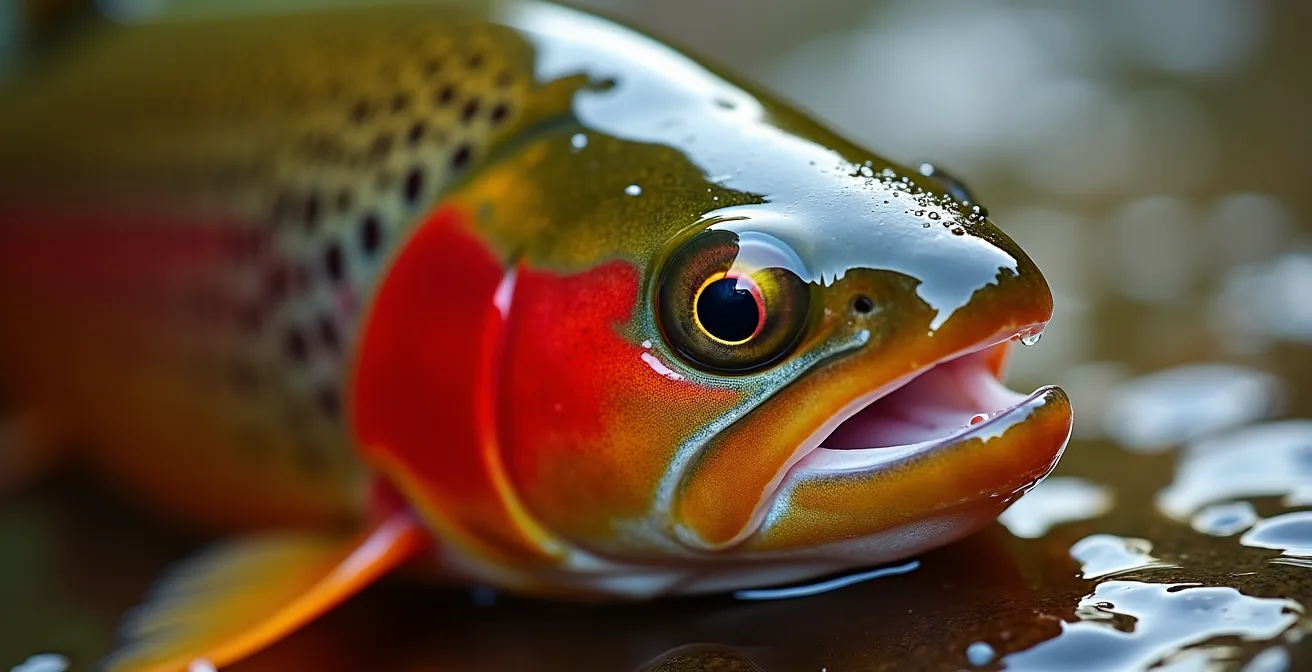
As the image of these delicate gill filaments suggests, respiration is a fragile process. In warm water, the fish cannot extract enough oxygen to recover from the exhaustion of being caught. This is why responsible angling requires a thermometer. Air temperature is a poor indicator; direct measurement of the water is essential. When the water is warm, the most ethical decision is to stop fishing for trout altogether and target warm-water species or wait for cooler conditions, such as early mornings or after a cold rain.
How to Hold a Pike Vertically Without Damaging Its Internal Organs?
The question itself contains a dangerous premise. The simple, science-backed answer is: you don’t. Holding a large fish like a pike or musky vertically by its jaw or gill plate is a practice that should be eliminated from angling. Fish have evolved to be supported by the buoyancy of water. Their internal organs are not secured in the same way a mammal’s are. When a large fish is held vertically, its own weight causes its organs to compress and shift, leading to internal tearing, displacement, and potentially fatal injuries.
The “jaw-hang” or “lip-grip” for a hero shot inflicts immense pressure on the mandibular joint and surrounding tissues. This can dislocate the jaw, preventing the fish from feeding effectively if it survives. The most protective method for handling any large fish is to support its body horizontally. This distributes its weight evenly and mimics the support it receives in its natural environment. The best practice is a two-handed “C-grip” cradle: one hand supporting the fish just behind the pectoral fins and the other supporting the body near the tail.
This comparative table of handling methods illustrates the stark difference in risk, showing why a horizontal hold is always the superior choice for the fish’s welfare.
| Handling Method | Risk Level | Recommended For | Key Consideration |
|---|---|---|---|
| Horizontal C-Grip | Low | All large fish | Support behind pectorals and tail |
| Vertical Hold | High | Never recommended | Causes organ compression |
| Net Support | Lowest | All sizes | Fish remains in water |
| Gill Plate Grip | Very High | Never | Damages vital breathing organs |
Ultimately, the best place to handle a fish is in the water, using a net for control while you remove the hook. Minimizing both air exposure and physical handling is paramount. The desire for a photograph should never outweigh the life of the fish.
Why Dry Hands Remove the Immune System of a Fish?
A fish’s “slime coat” is far more than just slime; it is a sophisticated and essential part of its integumentary system, functioning much like our own skin. This layer of mucus is the fish’s primary defense against a hostile, microbe-filled aquatic world. It contains a complex cocktail of enzymes, antibodies, and proteins like lysozyme that actively fight off bacteria, fungi, and parasites. It also helps with osmoregulation (balancing salts) and makes the fish slippery to evade predators.
When you touch a fish with dry hands, you are effectively stripping away this protective barrier. The abrasive texture of dry skin acts like sandpaper, removing the delicate mucus layer and even the underlying scales. This leaves the fish vulnerable to a host of infections. A patch of missing slime is like an open wound, an invitation for pathogens in the water to attack. Research confirms that this slime coat protects fish from harmful microorganisms by both trapping and sloughing off microbes and containing its own antimicrobial properties.
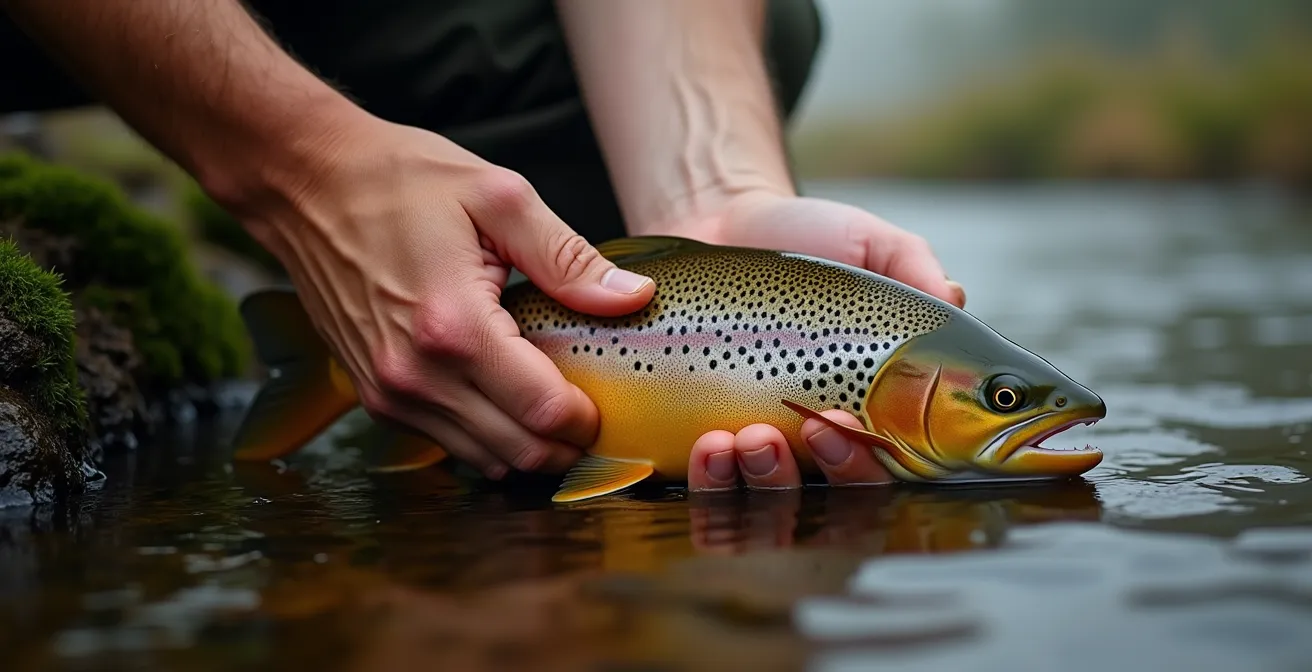
This is why the mantra “keep ’em wet” extends to your hands. Before you ever touch a fish, you must thoroughly wet your hands with water from the stream or lake. This simple act dramatically reduces the friction and helps preserve the fish’s vital slime coat. Using soft, rubberized nets instead of knotted nylon also serves the same purpose. Protecting this immune barrier is one of the most significant and easiest things an angler can do to increase post-release survival.
When to Use a Descending Device for Reef Fish with Barotrauma?
Barotrauma is a condition that affects fish pulled rapidly from deep water. The swift change in pressure causes the gasses in their swim bladder to expand, which can lead to visible signs like a bloated abdomen, bulging eyes, or their stomach being pushed out of their mouth. This is most common in deep-water ocean species like snapper and grouper, but can also occur in lake trout. While some studies found 32% of Lake Superior trout showed barotrauma, they also noted that survival was not necessarily lower for these fish, suggesting the issue is complex.
The traditional, and harmful, response was to “fizz” the fish by puncturing the swim bladder with a sharp object. This practice is now strongly discouraged as it often causes more harm than good, creating a pathway for infection. The modern, science-approved solution is a descending device. These tools, which can be as simple as a weighted, inverted hook or a specialized jaw clamp, allow the angler to safely return the fish to the depth at which it was caught.
As the fish is lowered, the increasing water pressure naturally recompresses the gasses in the swim bladder, reversing the effects of barotrauma. The fish can then be released at depth, where it can re-acclimate and swim away in a healthy state. A descending device should be considered essential equipment for any angler fishing in depths greater than 30-50 feet, where barotrauma becomes a significant risk. Using one is a direct and effective intervention that dramatically increases survival for deep-water species that would otherwise perish on the surface.
Why Knotless Mesh Saves You 10 Minutes of Untangling per Fish?
The choice of a landing net is often an afterthought, but it has profound implications for both fish welfare and angler frustration. The “10 minutes of untangling” is a slight exaggeration, but it highlights a real problem: old, knotted nylon nets are incredibly damaging and inefficient. Knots are abrasive, scraping off the fish’s protective slime coat and damaging delicate fins and eyes. Furthermore, hooks, especially on multi-lure rigs, become hopelessly embedded in the knotted mesh, leading to prolonged handling time as you struggle to free both the fish and your lure.
This extended time out of the water adds significant stress to the fish. A knotless, rubberized mesh net solves all these problems. The smooth material is gentle on the fish’s skin, fins, and eyes, preserving its vital slime coat. Hooks do not penetrate the rubber, making removal instantaneous. This allows the angler to keep the fish in the water within the net while unhooking it, which is the gold standard for minimizing air exposure and handling stress.
A good net isn’t just a tool for landing a fish; it’s a recovery cradle. It allows you to control the fish safely with minimal contact, reducing panic and physical harm. Choosing the right net is a simple gear change that pays massive dividends in fish survival and a more pleasant, efficient angling experience.
Action Plan: Choosing and Using the Right Net
- Assess your gear: Select a net with a soft, rubberized, or knotless mesh to protect the fish’s eyes, fins, and slime coat.
- Size appropriately: Ensure the net’s basket is large enough to comfortably contain the largest fish you expect to catch without folding it.
- Practice in-net release: Keep the fish secured and in the water within the net while you remove the hook whenever possible.
- Handle with care: Use the net to lift the fish from the water for a brief moment only if necessary, minimizing its time in the air.
- Consider handle length: For boat or high-bank fishing, a longer handle reduces the need to lift the fish high, minimizing stress and the risk of dropping it.
Why Air Exposure Exceeding 10 Seconds Drastically Lowers Survival?
For a fish, air is a vacuum. Its gills, designed to extract dissolved oxygen from water, collapse in air. This means any time a fish is out of water, it is effectively suffocating. The “10-second rule” has become a popular guideline for a reason: scientific research has shown a dramatic and direct correlation between air exposure time and mortality. The longer the fish is held out of water, the lower its chance of survival.
The numbers are sobering. One landmark study revealed the stark reality of air exposure: fish released with minimal air exposure had a 12% mortality rate. Just 30 seconds out of water caused this rate to jump to 38%. A full minute of air exposure, the time it might take to fumble with a camera for a “hero shot,” resulted in a staggering 72% death rate. The fish might swim away, but the physiological damage and oxygen debt incurred are often insurmountable.
A powerful case study on tarpon further illustrates this point. Researchers tagged 27 tarpon after they were caught and released. Twenty-six of them survived the ordeal. The single fish that died was the only one that had been lifted from the water for a photograph. This single variable—a brief moment of air exposure for a picture—was the difference between life and death. This is why the best practice is to “keep ’em wet.” Your photograph is never more important than the fish’s life. If you must take a picture, be prepared, do it in seconds, and keep the fish as low to the water as possible.
Key Takeaways
- The goal of catch and release is not just to let the fish go, but to minimize the cumulative physiological stress from fight to release.
- Handling practices are paramount: always use wet hands, support fish horizontally, and use a rubberized, knotless net.
- Environmental factors are critical: monitor water temperatures and avoid fishing for cold-water species like trout when water exceeds 68°F (20°C).
Barbless Hooks: Do They Really Reduce Mortality Rates in Released Fish?
The debate over barbed versus barbless hooks is a classic one in angling circles, and the science reveals a nuanced picture. On one hand, the evidence broadly supports the use of barbless hooks for reducing mortality. A comprehensive meta-analysis of 18 different studies concluded that, overall, fish caught on barbed hooks had significantly higher mortality rates than those caught on barbless hooks. The primary reason is simple: barbless hooks are much quicker and easier to remove, drastically reducing handling time and air exposure—two of the biggest contributors to post-release mortality.
However, the issue is not entirely black and white. Some experts argue that in specific situations, a barbed hook may cause less damage. This counter-intuitive idea is known as the “stiletto effect.”
There is no definitive answer to the barbed vs barbless debate. Studies have shown that the ‘stiletto effect’ makes large barbless hooks more damaging than barbed counterparts, which holds the hook better in one position
– Domenick Swentosky, Troutbitten
The theory is that a barbless hook can move around more during the fight, potentially cutting a wider wound, whereas a barbed hook stays put. Furthermore, a study of wild stream trout caught on spinners found that while barbless hooks were quicker to remove, the overall mortality was already very low (less than 4%), and the hook type did not create a statistically significant difference in survival. For the vast majority of situations, however, the benefits of quick, clean removal make barbless hooks—or hooks with pinched-down barbs—the superior choice for conservation-minded anglers.
By integrating these science-based principles into your routine, you transform every release into a conscious act of conservation, ensuring the magnificent fish we pursue today are there for others to enjoy tomorrow.
Frequently Asked Questions on How to Revive a Deeply Exhausted Trout in Fast Current?
Should I revive a trout by moving it back and forth in the water?
No, this is an outdated and harmful myth. A fish’s gills are designed for a one-way flow of water. Moving a fish backward forces water against the natural direction, damaging the delicate gill filaments and being less effective at oxygenating the fish. The correct method is to hold the fish upright in the current, facing upstream, allowing the water to flow naturally through its mouth and over its gills. If in still water, a slow forward “figure-eight” motion is preferred.
Do revival techniques actually help fish recover?
This is a point of scientific debate. Some studies suggest that prolonged handling during revival can add more stress, counteracting any potential benefits, and that the best approach is to release the fish as quickly as possible once it’s unhooked. The theory is that the fish’s own instincts in its natural environment are its best path to recovery, free from the stress of human contact.
When might revival be necessary despite the research?
While quick release is often best, active revival is necessary if the fish is clearly disoriented and unable to maintain its upright position in the current. In such cases, gently holding it facing the current until it regains equilibrium and swims away under its own power is crucial. This is also important in areas with high predator populations (like birds or larger fish), where giving the fish a few extra moments to recover can be the difference between escape and predation.