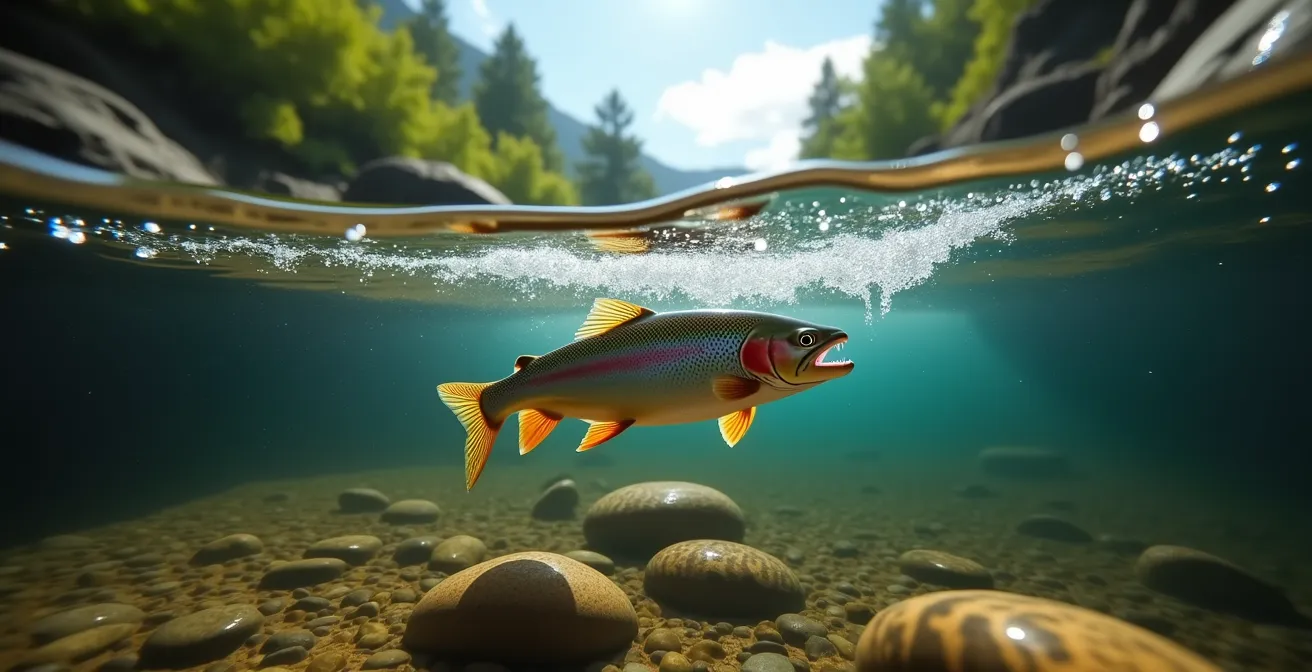
For anglers accustomed to still water, a river’s current can feel like random chaos. The key isn’t to fight it, but to understand its predictable physics. This guide decodes the hydraulic events—flow, structure, and pressure—that create a clear map of fish behavior. By learning to read this map, you can stop guessing and start predicting where fish will be, turning the river from an obstacle into your greatest advantage.
Transitioning from the placid surfaces of lakes to the dynamic, moving water of a river is a challenge that confounds many skilled anglers. The still-water angler’s brain is wired to look for structure—weed beds, drop-offs, points. In a river, the structure is the current itself. Most anglers are told to “fish the seams,” a platitude that is both true and utterly unhelpful. It’s like telling a chef to “use heat.” The real expertise lies in understanding the different *types* of heat and how to apply them. The same is true for river currents.
The common advice to “look for the bubble line” only scratches the surface. It fails to explain why that bubble line exists, how deep it is, or what kind of feeding behavior it encourages. But what if the secret wasn’t just spotting visual cues, but in understanding the underlying physics? The river is not a chaotic mess; it is a system of predictable hydraulic events. Every rock, bend, and change in gradient creates a “flow topography” that dictates where fish must position themselves to survive and feed. This guide is built on that principle. We will move beyond spotting seams and learn to interpret the river’s energy calculus, allowing you to build a mental map of where fish are holding before you even make a cast.
This article will deconstruct the river’s language, section by section. We’ll explore the specific hydraulic features that create prime feeding and holding zones, ensuring you can approach any new piece of water with a strategic, analytical eye. The following summary outlines the key areas we will cover.
Summary: Decoding the River’s Hydraulic Map
- Why Fish Congregate at the Tailout of Rapids in Summer?
- The Wading Belt Mistake That Can Drown You in Waist-Deep Water
- Upstream or Downstream: Which Presentation Controls Drag Better?
- How to Identify Undercut Banks That Hold Trophy Brown Trout?
- When to Target River Mouths for Spawning Runs?
- The Water Filtration Mistake That Ends Expeditions Early
- How to Walk Along Riverbanks Without Causing Massive Erosion?
- Dry Fly or Nymph: Which Technique Catches More Trout Under Pressure?
Why Fish Congregate at the Tailout of Rapids in Summer?
The tailout—the area where a fast, turbulent rapid begins to slow and deepen into a pool—is a magnet for fish, especially during the warm months. This is not a coincidence; it’s a direct consequence of two fundamental physical principles: oxygenation and energy conservation. As water tumbles over rocks, it becomes highly aerated. In summer, when warmer water holds less dissolved oxygen, this super-oxygenated flow is a refuge. In fact, in these turbulent zones, it’s possible to find over 100% oxygen saturation levels, a critical factor for trout metabolism.
Beyond oxygen, the tailout acts as a perfect food delivery system. The fast current of the rapid dislodges nymphs and other food items, carrying them downstream. Fish can position themselves at the head of the tailout, just where the current begins to slow, and intercept this “conveyor belt” of food with minimal effort. They get the dual benefit of high oxygen and low-energy feeding. The key is to identify the primary feeding lanes within the tailout, often marked by bubble lines on the surface. These lines trace the path of the most concentrated food drift, representing the highest-probability targets for a cast.
Reading a tailout involves observing the transition from choppy water to a glassy surface. A sharp, abrupt transition often indicates a sudden drop in depth and a more aggressive feeding zone. A gradual, tapering transition suggests a slower change in depth, where fish may be more cautious and spread out. Understanding this hydraulic shift from turbulent to laminar flow is the first step in decoding the river’s map.
The Wading Belt Mistake That Can Drown You in Waist-Deep Water
Before we delve deeper into reading water, we must address a critical element of interacting with it: safety. The single most dangerous misconception among river anglers is that a wading belt’s primary purpose is to keep them dry. Its true function is to prevent your waders from instantly filling with hundreds of pounds of water if you fall. In waist-deep water, the force of the current is immense, and an unbelted pair of waders acts like an anchor, making self-rescue nearly impossible. This isn’t opinion; the danger is well-documented, and wearing a belt is a non-negotiable rule of river safety.
The mistake is not just forgetting the belt, but wearing it improperly. It must be cinched tightly around your waist, over your waders, creating a seal. A loose belt is almost as useless as no belt at all. While no belt is perfectly waterproof, scientific studies on wading safety confirm that a properly worn belt drastically slows the ingress of water, giving you precious seconds to regain your footing or begin self-rescue maneuvers. It transforms a potentially fatal situation into a manageable, albeit cold, one.
Beyond its physical function, a good wading belt serves a psychological purpose. As river guide and expert Mike McClelland notes, it acts as a mental checkpoint. As he stated in the Wired2Fish River Safety Guide:
The wading belt isn’t just to keep water out; it’s a mental checkpoint to force the angler to re-evaluate the river’s power before taking the next step.
– Mike McClelland, Wired2Fish River Safety Guide
Every time you clip that buckle, it should be a conscious reminder to respect the hydraulic forces at play. Before taking another step into a stronger current, pause and assess the risk. Acknowledging the river’s power is the foundation of becoming a true river expert, not just a visitor.
Upstream or Downstream: Which Presentation Controls Drag Better?
Once you’ve identified a promising seam, the next question is how to present your fly. The direction of your cast—upstream, downstream, or across—is not a matter of preference but a tactical decision dictated by the specific hydraulics of the seam. The ultimate goal is to achieve a drag-free drift, making your fly behave exactly like a natural insect. Different current speeds and depths require different presentation angles to counteract drag.
An upstream presentation, often combined with a “reach mend,” is ideal for hard seams with a sharp difference in current speed. Casting upstream allows the fly to sink into the target zone before the line crosses the fast current, which would otherwise rip the fly unnaturally across the surface. This gives you a few precious moments of a perfect, natural drift as the fly enters the fish’s window. Conversely, a downstream presentation or “swing” is highly effective for covering wide, soft seams or targeting fish on the far bank. The tension of the line in the current allows you to control the depth and speed of the fly as it swings through the likely holding water.
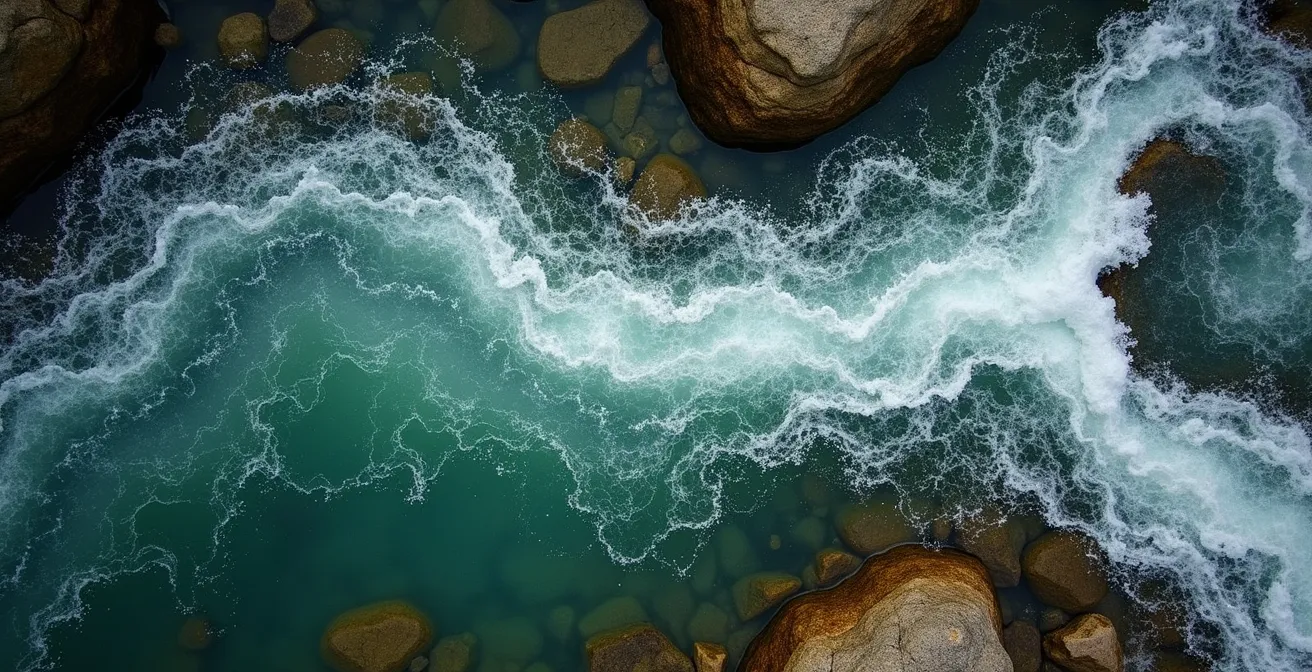
The choice is a function of the seam’s character. Pocket water behind boulders demands a quick, upstream “tuck cast” to sink the fly immediately into the small strike zone. A long, uniform seam along an outside bend may be best fished with a cross-current cast and multiple mends to manage the line. There is no single “best” way; there is only the most effective presentation for the specific flow topography you are facing. The expert angler analyzes the seam and selects the angle that provides the most control over drag.
The following matrix breaks down these decisions, linking the type of seam to the optimal presentation strategy. Mastering this allows you to move beyond simply casting *at* the seam to presenting your fly *within* it.
| Seam Type | Best Presentation | Depth Control | Drag Management |
|---|---|---|---|
| Hard Seam (sharp speed difference) | Upstream with reach mend | Allows sinking before crossing | Natural drift achieved |
| Soft/Wide Seam | Downstream or cross-current | Keeps fly higher in column | Covers larger target zone |
| Pocket Water Behind Boulders | Upstream tuck cast | Quick sink into strike zone | Minimal line on water |
| Far Bank Seams | Downstream swing | Controlled depth through swing | Line tension maintains control |
How to Identify Undercut Banks That Hold Trophy Brown Trout?
While visible seams in the middle of the river are obvious targets, some of the most productive—and most overlooked—holding water is found along the banks. An undercut bank is a classic example of a high-potential habitat, especially for large, wary brown trout that prize overhead cover. These are sections where the current has scoured out the earth beneath the bank, creating a hidden ledge. The challenge is that the best undercuts are often invisible from the surface. Identifying them requires you to read secondary indicators on the bank itself.
The most reliable indicator is the type of bankside vegetation. An unstable, collapsing dirt or sand bank is unlikely to have a significant undercut. However, a bank stabilized by the dense root systems of trees like alders and willows often signals a deep, stable undercut that provides excellent, long-term cover for trophy fish. These roots act as natural rebar, maintaining the structural integrity of the bank against the current’s force. This observation is a core part of reading the river’s deeper secrets.
Case Study: Vegetation as an Indicator of Prime Undercuts
An analysis of successful trophy trout catches consistently reveals a strong correlation between bankside vegetation and the quality of the holding water. Anglers who successfully target large fish from undercuts report that the presence of a dark ‘shadow line’ right against the bank is a primary visual cue. This indicates depth. Furthermore, they observe how the main current seems to “disappear” or tuck under the bank rather than deflecting off it. This combination of deep-rooted trees, a shadow line, and current behavior is the trifecta for identifying a prime, fish-holding undercut bank.
To systematically locate these hidden lairs, you need a process of evaluation. It’s not enough to randomly cast at every bank. You must quickly assess the potential of each section. The following checklist provides a framework for identifying high-probability undercut banks.
Action Plan: 5-Point Undercut Bank Assessment
- Check for outside bend position: The most powerful currents and deepest undercuts typically form on the outside of river bends. Prioritize these areas.
- Assess bankside vegetation: Look for mature, deep-rooted trees (alders, willows) which signal a stable, well-formed undercut. Avoid bare, crumbling banks.
- Look for the shadow line: A dark line of water pressed tightly against the bank is a strong visual indicator of depth and overhead cover.
- Observe current behavior: The river’s main current should appear to slide smoothly under the bank, not boil or deflect away from it. This confirms a hollow space.
- Note surface texture: The water directly against a deep undercut is often smoother and slower than the main current, indicating a protective pocket of calm water.
When to Target River Mouths for Spawning Runs?
Expanding our view from micro-features to macro-locations, river mouths—where a tributary enters a larger river or a river enters a lake—are strategic choke points in the aquatic ecosystem. During specific times of the year, they become hotspots of activity. The key is understanding the temporal triggers that concentrate fish in these transitional zones. The most significant trigger is a spawning run, when species like salmon, steelhead, or even suckers and walleye move from the main body of water into the river to reproduce.
Timing is everything. These runs are often initiated by environmental cues. A significant drop in barometric pressure preceding a storm or a sustained change in water temperature can signal to entire populations of fish that it’s time to move. Anglers who monitor weather patterns can often predict the start of a run with surprising accuracy. During these periods, the seam created by the confluence of the two bodies of water becomes a crucial staging area where fish acclimate before continuing their journey upstream.
However, an even more advanced strategy involves thinking like a predator. Spawning runs attract not only the target species but also the resident predators that feed on them. This creates a “predator’s advantage” opportunity. Large, resident brown trout, pike, or bass will position themselves along the transitional seam at the river mouth to ambush smaller, vulnerable fish moving upstream. This presents a dual opportunity: you can target the (often numerous) spawning fish, or you can switch to larger lures and different tactics to target the trophy predators that are there to feast on them. It requires a shift in mindset from just following the run to understanding the entire food web event that is taking place.
The Water Filtration Mistake That Ends Expeditions Early
The ability to read a river’s flow extends beyond finding fish; it is also a critical survival skill. A common and dangerous mistake on any fishing expedition is assuming that all moving water is safe to drink. The clarity of the water is not an indicator of its purity. Microorganisms like Giardia and Cryptosporidium are invisible and can be present even in the most pristine-looking mountain streams, leading to severe gastrointestinal illness that can abruptly end a trip. Proper water filtration or purification is essential.
The mistake many make is in their source selection. While a filter is your final line of defense, your first line is choosing the safest possible water source based on your understanding of river hydraulics. The fastest, most turbulent water in the main channel is generally the safest bet. The high velocity and oxygenation create a hostile environment for many pathogens and keep sediment suspended and diluted. In contrast, calm, stagnant water near the banks or in back-eddies is the most dangerous. This is where runoff from the surrounding land concentrates and pathogens can thrive in the warmer, slower-moving water.
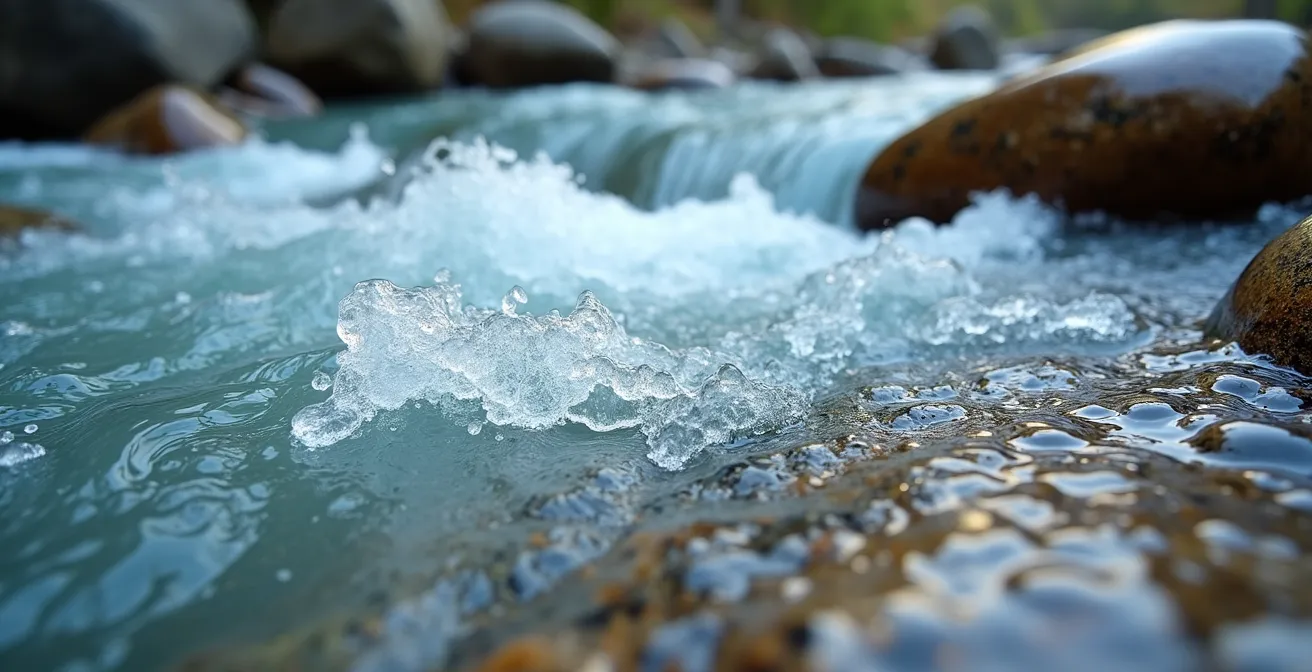
Your ability to read the river’s flow topography directly translates to a risk assessment for water collection. You can actively reduce the load on your filter and minimize your risk by choosing your source wisely. Here is a simple hierarchy of risk based on river features:
- Safest: The main channel with a fast, deep current. The volume and speed provide maximum dilution.
- Moderate Risk: Side channels with visible flow. The water is moving, but may have higher concentrations of runoff.
- High Risk: Calm water near the banks. Convenient, but this is where contaminants from the immediate shoreline accumulate.
- Highest Risk: Stagnant, warm, shallow back-eddies. These are breeding grounds for bacteria and should be avoided at all costs.
Finally, always pre-filter water through a bandana or cloth if it contains visible sediment. This removes larger particles that can clog and ruin your primary filter, ensuring it functions correctly when you need it most.
How to Walk Along Riverbanks Without Causing Massive Erosion?
An expert river angler understands that they are a part of the river’s ecosystem, not just a visitor. The way you move along the river has a direct and lasting impact on its health and, consequently, on the quality of the fishing. The most fragile part of the river system is often the bank itself. Walking carelessly along the edge of a steep or vegetated bank can cause it to collapse, initiating a cycle of erosion that can degrade the habitat for years.
This isn’t just an abstract conservation issue; it directly affects the hydraulic features you seek. As one conservation biologist from the Troutbitten Conservation Series explains, the damage is self-inflicted:
You’re destroying your own seams. Collapsing a bank widens the river channel, which makes the flow shallower, slower, and warmer. This directly degrades the quality of the seams, pools, and riffles that hold fish.
– Conservation biologist, Troutbitten Conservation Series
Every time a piece of an undercut bank—a prime trout lie—is trampled and collapses, that piece of habitat is gone. The sediment released clouds the water and can smother the insects trout feed on. The responsible angler adopts a low-impact approach to movement, consciously choosing a path that preserves the structural integrity of the riverbank. This means thinking about your route before you take your first step.
Developing an ethic of low-impact movement involves a clear hierarchy of choices. The goal is always to minimize contact with fragile soil and vegetation at the water’s edge. This not only protects the river but also prevents you from spooking fish that may be holding close to the bank.
- Priority 1: Use established trails located well away from the immediate bank whenever they exist.
- Priority 2: When no trail is present, prioritize walking on durable surfaces like exposed rock, gravel bars, or boulders.
- Priority 3: If travel over soil is unavoidable, maintain the maximum possible distance from the fragile, unsupported edge of the bank.
- Priority 4: Actively identify and avoid sensitive zones: steep sandy banks, visibly undercut areas, and wet, mossy sections that are easily disturbed.
- Priority 5: Plan your route in advance. Look ahead 50 yards and map out a path that connects durable surfaces, rather than simply following the water’s edge.
Key Takeaways
- A fish’s location is a constant energy calculation: they must position themselves where they can get the most food for the least amount of effort. Seams and current breaks are the solution to this equation.
- River safety is non-negotiable and starts with knowledge. A wading belt is not an accessory; it is a life-saving tool for risk assessment and emergency preparedness.
- True expertise involves a conservation ethic. Low-impact movement along riverbanks is not just “good for the environment”—it directly preserves the very hydraulic structures that create productive fishing spots.
Dry Fly or Nymph: Which Technique Catches More Trout Under Pressure?
After learning to read the river’s structure, safety, and ethics, the final piece of the puzzle is tactical choice under pressure. On heavily fished waters, trout become incredibly discerning. They may ignore a perfectly drifted dry fly or a well-placed nymph if it doesn’t match their precise feeding behavior at that moment. The choice between fishing on the surface (dry fly) or subsurface (nymph) is often determined by the subtle characteristics of the seam and the fish’s energy calculus.
The general rule is that nymphs will catch more fish because trout conduct the vast majority of their feeding subsurface. However, for pressured fish, the equation changes. These fish are often hyper-aware of any unnatural drift, the flash of a split shot, or the shadow of a strike indicator. Detailed observation of pressured trout shows that they often move into the thinnest, slowest water at the very edge of a seam to feed on emerging or adult insects, as it’s a safer, less committed feeding position. In these specific situations, a well-presented dry fly can be far more effective than a nymph.
The decision hinges on your analysis of the seam’s specific character. A deep, fast seam with a prominent bubble line is a prime candidate for a weighted nymph rig, as this is a high-volume food conveyor belt. In contrast, a soft, slow seam in shallow water, especially during a hatch, is a classic dry fly scenario. Pressured fish also become experts at feeding in micro-seams—tiny current variations just a few inches wide. For these fish, an emerger pattern fished just below the surface can be the key, splitting the difference between a high-riding dry and a deep-sunk nymph.
This table offers a tactical framework for making that final decision, linking your observation of the seam to the most effective technique for the conditions.
| Seam Position | Water Speed | Best Technique | Success Rate |
|---|---|---|---|
| Seam edge (thin water) | Slow | Dry fly | Higher for spooky fish |
| Deep seam line | Fast | Weighted nymph | 3x more strikes than dry |
| Micro-seam within seam | Variable | Emerger pattern | Best during hatches |
| Foam line concentration | Moderate | Either (match the hatch) | Context dependent |
By combining your knowledge of hydraulics with a careful observation of fish behavior, you can move beyond generic rules and make informed, effective tactical decisions on any river. Your next step is to take this analytical framework to the water and begin consciously applying it to every seam you encounter.