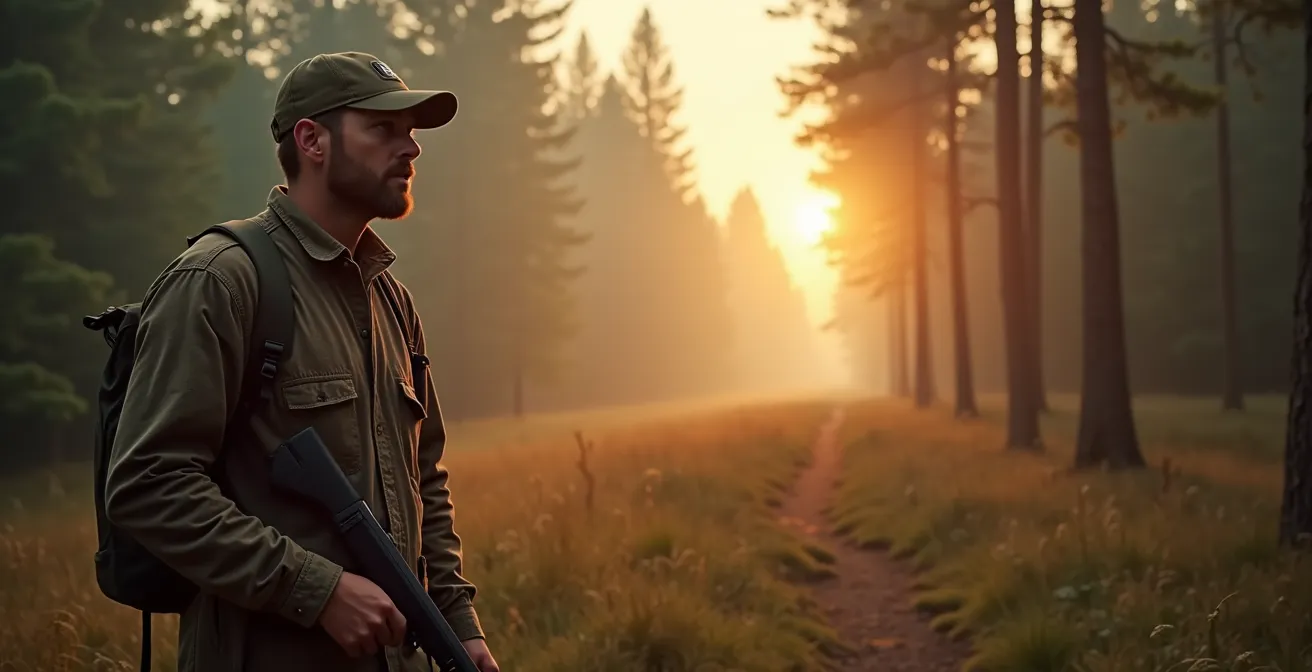
Most hunters believe experience and memorized rules are enough to ensure safety. This is a fatal misconception. True field safety is not a passive checklist; it is an active, pre-drilled psychological system designed to override the cognitive failures caused by adrenaline and exhaustion. This guide details how to build that non-negotiable mindset, transforming safety from something you remember into something you do automatically.
Every hunter can recite the fundamental rules of firearm safety. We treat every firearm as loaded, we control the muzzle, we keep our finger off the trigger, and we are sure of our target and what lies beyond. These rules are the bedrock of our sport, yet accidents happen every season. The critical failure isn’t a lack of knowledge; it’s a breakdown in application under pressure. The pulse-pounding surge of “buck fever,” the subtle creep of exhaustion on a multi-day hunt, or a moment of overconfidence can create a catastrophic gap between knowing the rule and executing it.
The common advice to “stay calm” or “just remember the rules” is profoundly inadequate. It fails to address the physiological hijacking that occurs when the primal brain takes over. Your heart races, your vision narrows, and your prefrontal cortex—the part of your brain responsible for rational decision-making—goes offline. In that moment, you don’t rise to the occasion; you fall back on your training. If that training is merely passive memorization, you are unprepared for the moment of truth.
This is not about being a better shot. It is about building a superior safety system. This guide moves beyond simple recitation. We will deconstruct the cognitive traps that lead to failure and provide a framework for building a series of unbreakable safety rituals. You will learn to hardwire these protocols into your muscle memory, creating a “cognitive override” that functions flawlessly when you need it most. This system-based approach is what separates the consistently safe hunter from the hunter who is one moment of weakness away from tragedy.
This article provides a structured path to forging that mindset. We will examine why experience can be a liability, how to build checklists that become automatic, and how to drill for the specific failure points you will face in the field. This is the blueprint for a lifetime of safe and responsible hunting.
Summary: How to Cultivate a “Safety-First” Mindset That Overrides Buck Fever
- Why Experienced Hunters Are Just as Prone to Accidents as Beginners?
- How to Build a Pre-Hunt Checklist That Impossible to Forget?
- Zone of Fire vs. Target Fixation: What Is the Difference?
- The Exhaustion Danger That Compromises Safety on Multi-Day Hunts
- How to Drill Safety Scenarios Before the Season Opens?
- When to Replace Your Firing Pin Spring Before It Fails?
- Why “Sound Shooting” Is the Most Dangerous Habit in Hunting?
- What Every Hunter Must Understand About Bullet Trajectory and Ricochet?
Why Experienced Hunters Are Just as Prone to Accidents as Beginners?
There is a dangerous myth in the hunting community: that experience grants immunity to accidents. The opposite is often true. Complacency is a subtle poison, and the veteran hunter can become its most vulnerable victim. After decades of successful hunts, the rigid adherence to safety protocols can soften. The routine becomes automatic, but not in a mindful way. It becomes thoughtless. This mental relaxation is the precursor to disaster. The belief that “it won’t happen to me” is a cognitive trap that has led to countless tragedies in the field.
Data consistently refutes the idea that only novices are a danger. In fact, over 40% of hunting accidents involve experienced hunters who have been in the field for years, even decades. Their vast experience does not prevent a momentary lapse in judgment. For example, a 2024 analysis of hunting incidents in New York detailed cases involving a 75-year-old with 50 years of experience in a self-inflicted accident and a 27-year-old with 15 years of experience striking a hunting partner. These are not rookie mistakes; they are failures of a system under pressure.
An experienced hunter’s brain has developed countless shortcuts for efficiency. While this is beneficial for tracking or reading terrain, it can be lethal when applied to firearm handling. The “automaticity” that makes a seasoned hunter so effective can also lead them to skip a mental or physical safety check that a nervous beginner might perform three times. The beginner is often hyper-vigilant, while the veteran is at risk of becoming hypo-vigilant—dangerously comfortable. This is why a safety mindset must be a conscious, actively maintained system, not a passive assumption based on one’s resume.
How to Build a Pre-Hunt Checklist That Impossible to Forget?
A checklist on a piece of paper is useless if it’s not ingrained in your behavior. The goal is to transform a list into a physical, kinesthetic safety ritual that becomes as automatic as tying your boots. It must be a sequence of actions you perform every single time you handle your firearm, so that its absence feels deeply wrong. The most effective systems are simple and memorable. A prime example is the ACTT protocol, which provides a framework for this ritual.
This protocol translates the core safety rules into a series of non-negotiable actions:
- A – Always treat every firearm as if it were loaded. This is the foundational mindset. Your physical ritual must reflect this: never allow the muzzle to cover anything you are not willing to destroy.
- C – Control the muzzle direction at all times. This is an active, not passive, task. As you move, your body must be conditioned to constantly adjust your firearm’s position to maintain a safe direction.
- T – Trigger finger stays outside the guard until ready to shoot. Your finger should have a “home.” A physical resting place along the frame or receiver that it returns to instinctively after every action.
- T – Target must be positively identified with a safe backstop. This is the final cognitive check before the physical act of shooting. It is the culmination of the entire safety system.
To make this ritual impossible to forget, you must practice it physically until it becomes muscle memory. This isn’t about thinking; it’s about doing. Before you leave the truck, before you cross a fence, after you reach your stand—the ritual is performed.
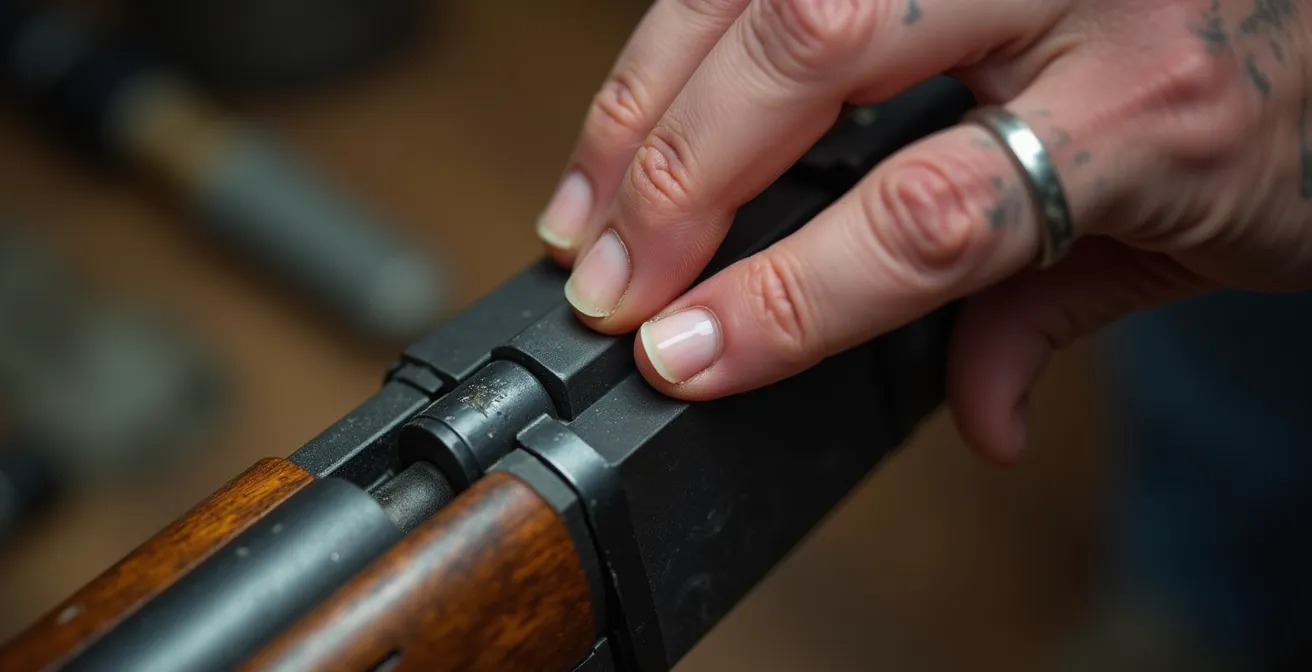
As the image above illustrates, this is a tactile process. It involves your hands and your body going through the motions. You physically check the chamber. You physically place your finger in its “home” position. You physically orient your body to control the muzzle. This kinesthetic reinforcement is what builds a protocol that holds up under the adrenal stress of buck fever. It is a system that works when your conscious brain is compromised.
Zone of Fire vs. Target Fixation: What Is the Difference?
The moment before the shot is a battle for cognitive control. Two opposing mental states are at war: maintaining a safe “Zone of Fire” versus succumbing to “Target Fixation.” Understanding the difference is a matter of life and death. A safe zone of fire is a conscious, 45-degree wedge of space where you have pre-determined it is safe to shoot. It requires your executive brain to be in full control, actively processing the entire environment, including potential backstops and the location of your partners. Target fixation, however, is a primal brain takeover. It’s the “buck fever” phenomenon where your entire world narrows to the target. Your peripheral vision collapses, and your auditory senses may even dull. This is why a hunter can fail to see a partner standing just a few feet from their target.
This failure in target identification is a leading cause of hunting accidents. The consequences are stark and unforgiving. For instance, IHEA data shows that in a single year, 29 hunting fatalities were the direct result of a hunter’s failure to positively identify their target. These tragedies occur when the primal brain’s impulse to “get the target” overrides the executive brain’s safety protocols. The hunter doesn’t see a person, a vehicle, or a house behind the animal because their brain has literally filtered it out. They are looking, but they are not seeing.
Building the discipline to resist target fixation requires active practice. It means forcing yourself, in the moment of highest excitement, to break focus from the target and deliberately scan your entire zone of fire one last time. It’s a cognitive override—a practiced mental action that keeps your rational brain in charge.
The following table breaks down the critical differences between these two mental states. Your job is to train yourself to live in the left-hand column.
| Aspect | Safe Zone of Fire | Target Fixation |
|---|---|---|
| Mental State | Conscious awareness of entire field | Tunnel vision on single point |
| Field of View | 45-degree safe zone maintained | Peripheral vision lost |
| Decision Making | Systematic safety checks | Impulsive reactions |
| Risk Level | Controlled and predictable | High accident potential |
| Brain Function | Executive brain (prefrontal cortex) in control | Primal brain (amygdala) overrides safety |
The Exhaustion Danger That Compromises Safety on Multi-Day Hunts
On long, strenuous hunts, your greatest enemy may not be the terrain or the weather, but the slow, insidious creep of physical and mental exhaustion. Fatigue is a major contributing factor to hunting accidents, yet it is often underestimated. It doesn’t just make your muscles sore; it impairs judgment, slows reaction time, and degrades fine motor skills. A hunter who is sleep-deprived and physically drained is far more likely to make a critical error—forgetting to engage the safety, mishandling their firearm while crossing an obstacle, or taking a risky shot they would normally pass on.
The most dangerous periods are often at the very beginning and very end of the day. Hunting in low-light conditions at dawn or dusk, when game is most active, also coincides with the times our bodies are naturally less alert. This combination is a well-documented recipe for disaster, particularly in activities requiring balance and coordination, such as using a tree stand.
Case Study: The Mayo Clinic’s Findings on Hunter Fatigue
A Mayo Clinic analysis of their trauma database over a 14-year period provides a chilling look at this reality. The study revealed that 55% of tree stand injuries involved spinal damage, with accidents most commonly occurring at dawn or dusk when hunters are fatigued. Investigators found a pattern of hunters climbing stands up to 30 feet high while wearing wet, muddy boots in low light—a combination that dramatically increases accident risk when cognitive function is already compromised by exhaustion. This demonstrates how environmental factors and physical state create a perfect storm for a life-altering mistake.

The only effective countermeasure is a proactive, disciplined approach to rest and energy management. This is not a sign of weakness; it is a mark of a professional. It means building mandatory rest breaks into your hunt plan, just as you would plan your route. It means staying hydrated, managing your calorie intake, and recognizing the signs of fatigue before your judgment is impaired. Pushing through exhaustion is not “toughness”; it is recklessness. A safe hunter knows their physical limits and respects them as much as they respect their firearm.
How to Drill Safety Scenarios Before the Season Opens?
A safety mindset is not born from reading; it is forged through repetition. Just as a professional athlete drills plays until they are second nature, a safe hunter must drill safety protocols until they are instinctual. Pre-season practice should go far beyond simply zeroing your rifle. It must involve simulating the specific moments of a hunt where safety is most likely to break down. This is your failure point analysis: identify the risks, and then drill the correct response until it is unbreakable.
This means getting out of the static shooting bench environment. Put on your full hunting gear—your pack, your bulky jacket, your gloves—and run through realistic scenarios. The goal is to create “muscle memory” for safety procedures so that you don’t have to think about them in the heat of the moment. Your body will simply know what to do. The effectiveness of this approach is undeniable, as proven by programs across the country. For example, the effectiveness of safety training is shown by Texas, which achieved a record low of just 10 non-fatal hunting accidents in 2023, a staggering reduction from 30 fatal accidents in 1972 before modern hunter education was implemented.
Your pre-season training must be active, physical, and scenario-based. You are not just practicing shooting; you are practicing safety under simulated stress. This builds the cognitive override that will keep you, and everyone around you, safe when it counts.
Your Pre-Season Safety Drill Protocol:
- Obstacle Crossing: Create a “fence” or “creek” in your practice area. Drill the process of safely unloading your firearm before crossing and reloading only after you are stable on the other side.
- Verbal Corrections: Practice with a partner. Rehearse using clear, firm, and non-confrontational language to correct an unsafe action, such as, “Could you please point your muzzle in a safe direction?”
- Failure Simulation: Using snap caps or dummy rounds, practice clearing jams and responding to simulated misfires. This prevents panic and ensures a safe response if it happens on a live animal.
- Gear-Up Timed Drills: Run drills in full gear to see how fatigue and equipment encumbrance affect your ability to handle your firearm safely. Identify and fix issues before the season starts.
- Shooting Position Practice: Practice getting into and out of various shooting positions—sitting, kneeling, standing—while maintaining 100% muzzle control and trigger discipline.
- Low-Light Simulation: Conduct drills at dawn or dusk (in a safe, legal shooting area) to acclimate yourself to the challenges of target identification in marginal light.
When to Replace Your Firing Pin Spring Before It Fails?
A comprehensive safety mindset extends beyond human factors to the mechanical reliability of your equipment. A firearm is a machine, and machines wear out. One of the most critical yet often-overlooked components is the firing pin spring. A weak or failed spring doesn’t just cause frustrating misfires; it can create a serious safety hazard. A light primer strike might tempt a hunter to immediately open the action on what could be a hang fire—a delayed detonation that can occur outside the chamber. Proactive maintenance is not optional; it is a core tenet of responsible firearm ownership.
You cannot wait for a failure to occur in the field. You must have a system of preventative maintenance. For most modern firearms, a good rule of thumb is to replace critical springs like the firing pin spring every 5,000 rounds or every 10 seasons, whichever comes first. This is a general guideline; your manufacturer’s recommendation should always take precedence. Keeping a detailed maintenance log for each firearm, documenting round count and service history, is the mark of a truly serious and safe hunter.
Beyond round count, you must learn to recognize the subtle signs of a failing spring. These are early warnings that your equipment’s reliability is compromised. Ignoring them is a gamble you cannot afford to take. The “Pencil Test” is a simple diagnostic you can perform at home: place a pencil, eraser-first, down the barrel of an unloaded firearm, point it upward, and dry fire. A healthy spring should launch the pencil several inches. A weak ejection is a red flag.
This table outlines key indicators that can help you diagnose the health of your firing pin spring before it leads to a critical failure.
| Indicator | Healthy Spring | Failing Spring |
|---|---|---|
| Primer Strikes | Deep, centered indentations | Light or off-center marks |
| Trigger Pull | Consistent weight and break | Variable or mushy feeling |
| Pencil Test Distance | 6-8 inches ejection | Less than 4 inches |
| Cycling Reliability | 100% ignition rate | Occasional misfires |
Why “Sound Shooting” Is the Most Dangerous Habit in Hunting?
Of all the potential failures in judgment, “sound shooting”—firing at a sound, a flash of color, or an indistinct movement—is arguably the most unforgivable. It represents a complete abdication of a hunter’s primary responsibility: positive target identification. This is not a mistake; it is a conscious decision to gamble with a lethal weapon. The rustle in the bushes or the flicker of brown in the brush could be your game animal, but it could also be another hunter, a hiker, a farmer on their own land, or a child’s lost pet. There is no excuse for pulling the trigger without 100% certainty of your target’s identity.
This dangerous habit is born from a combination of impatience, over-eagerness, and a profound lapse in discipline. It is the ultimate expression of target fixation overriding all rational thought. The hunter wants something to be their target so badly that their brain fills in the gaps, transforming an ambiguous stimulus into what they hope to see. This is a cognitive failure of the highest order, and it is responsible for some of the most horrific and preventable tragedies in the history of hunting.
The authorities on hunting safety are unequivocal on this point. There are no shades of gray. As the experts at the Idaho Fish and Game department state with chilling clarity:
A safe hunter makes certain that movement or sound is a game animal that is in season before pointing a muzzle. Mistaking a person for game is one of the most common causes of hunting accidents, which can be serious or fatal.
– Idaho Fish and Game, 10 Tips for Firearm Handling Safety
Agencies like Texas Parks & Wildlife have documented numerous cases where hunters shot at sounds or movements in the low light of dawn and dusk. Their analysis led directly to the implementation of the hard-and-fast rule: “Never shoot at a sound or movement.” This is not a suggestion. It is a command. Waiting for better light or a clearer shot is not a missed opportunity; it is a demonstration of professional discipline.
Key Takeaways
- Experience does not equal safety; it can breed a dangerous complacency that leads to accidents.
- True safety comes from building physical, kinesthetic rituals (like the ACTT protocol) that become unbreakable muscle memory.
- Hunter safety is a mental battle: you must actively train to maintain a “zone of fire” awareness and fight the “target fixation” that causes cognitive failure.
What Every Hunter Must Understand About Bullet Trajectory and Ricochet?
A hunter’s responsibility does not end at the target. It extends to the entire potential path of the bullet, both before and, crucially, after impact. Every trigger pull is the release of a projectile with an astonishing amount of energy and a potential range that far exceeds our visual horizon. Understanding bullet trajectory and the unpredictable nature of ricochet is a fundamental, non-negotiable aspect of a “safety-first” mindset. The rule “be sure of your target and what’s beyond it” is not just about the 50 yards behind the animal; it is about the miles beyond.
A high-powered rifle bullet can travel for thousands of meters and still retain lethal energy. For example, military ballistics data confirms that surface danger zones for a standard 7.62x51mm round extend to 4,100 meters—over 2.5 miles—from the firing point. This is a staggering distance that is almost impossible to comprehend from a tree stand. A shot fired at a deer on a ridgeline could, if it misses, travel far enough to cross highways, enter residential areas, or endanger people who are completely unaware of your presence.
The danger is compounded by the phenomenon of ricochet. A bullet striking a hard surface will not simply stop; it will deflect at an unpredictable angle, often with minimal loss of velocity. The risk varies dramatically depending on the surface. Surfaces with a high probability of causing a ricochet include:
- Water: Often mistaken as a safe backstop, water can cause a bullet to skip just like a stone, sending it in a completely new and unpredictable direction.
- Frozen Ground, Rock, or Concrete: These very hard surfaces are extremely likely to cause a ricochet and can even cause the bullet to fragment, creating multiple projectiles.
- Trees: A bullet can deflect off a tree trunk or even a thick branch, continuing its path on an altered trajectory.
A soft dirt bank or a sandy hill are the only truly reliable backstops. A safe hunter does not take a shot unless they have a clear line of sight to such a backstop. The sky is never a backstop. A skyline is never a backstop. The ethical and safe hunter accepts a simple truth: if you don’t know with absolute certainty where your bullet will stop, you do not take the shot.
Adopting this system-based approach to safety is not a suggestion; it is your duty as a hunter. Begin today by transforming these principles from words on a screen into practiced, physical actions. Your life, and the lives of others, depend on it.