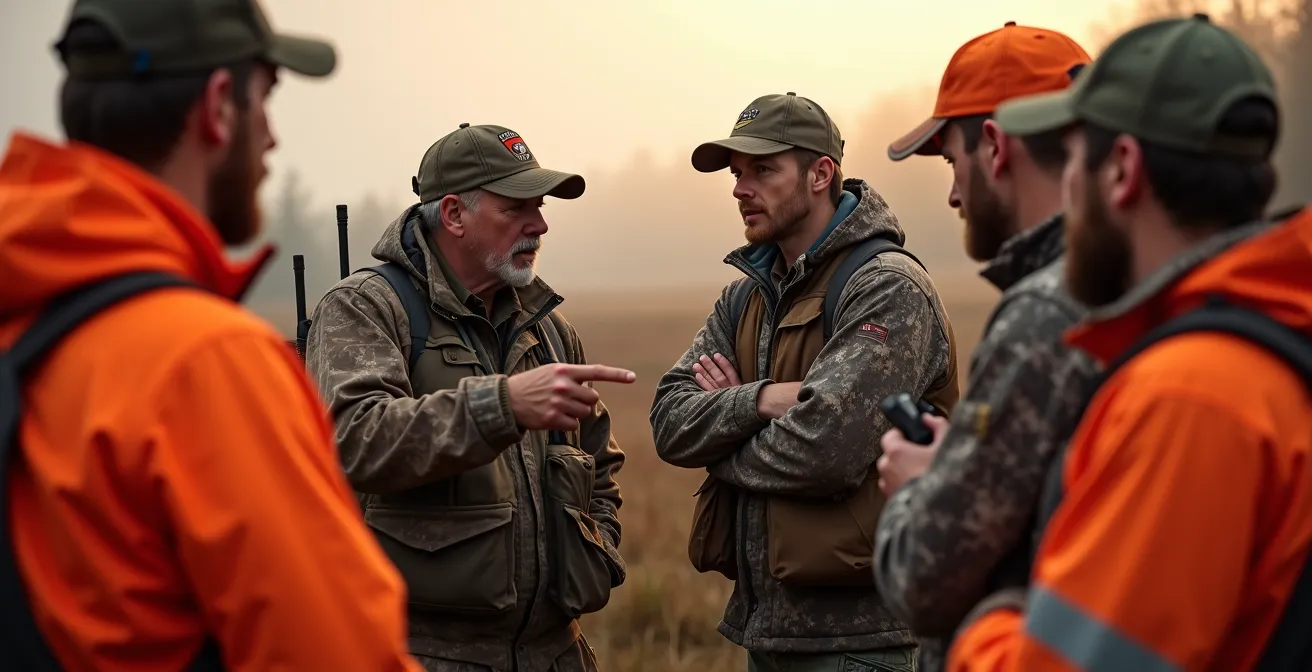
A successful group hunt is not measured by the harvest, but by the fact that every hunter returns home safely, a result achieved only through rigid protocol.
- Safety relies on an enforced system of protocols, not on individual suggestions or assumptions.
- The hunt captain’s role is to implement and enforce these non-negotiable rules for communication, lanes of fire, and go/no-go decisions without exception.
Recommendation: Treat every pre-hunt briefing as a life-or-death contract where each participant actively commits to the established plan.
As the hunt captain, the weight of every member’s safety rests on your shoulders. It’s a responsibility that extends far beyond knowing the terrain or where the game might be. The common advice—wear orange, have a plan—is dangerously insufficient. It treats safety as a checklist of suggestions. This is a fundamental error. In a dynamic environment with multiple hunters, firearms, and the unpredictable rush of “buck fever,” safety cannot be a suggestion. It must be a system, a set of non-negotiable protocols that every single person understands and adheres to, without deviation.
Many hunts fail before the first step is taken because they are built on a foundation of assumptions. We assume our cell phones will work. We assume everyone knows their safe shooting zone. We assume everyone will make the right call under pressure. As a leader, you cannot afford assumptions. Your job is to replace assumptions with absolutes. The true key to group safety isn’t memorizing a few rules; it’s about architecting and enforcing a system of shared responsibility where protocol overrides instinct and individual judgment every single time.
This guide provides that system. We will move beyond the platitudes to build a framework for command and control. We will detail the mandatory communication redundancies, define the geometry of safe fire, outline the critical pre-hunt briefing, and establish objective triggers for calling off a hunt. This is not just a collection of tips; it is a mandate for leadership, designed to ensure that the only stories you tell at the end of the day are about the hunt, not about a preventable tragedy.
This article provides a structured approach to implementing a robust safety system for your hunting group. The following sections break down the essential protocols every hunt captain must establish and enforce.
Summary: A System for Group Hunting Safety
- Why Relying on Cell Phones Is a Liability in Backcountry Groups?
- How to establish “lanes of fire” for a moving line of hunters?
- Briefing vs. Assumption: What Must Be Said Before Stepping Off the Truck?
- The Peer Pressure Risk That Forces New Hunters to Take Bad Shots
- When to Call Off the Hunt Due to Weather or Injury?
- When to Use High-Vis Markers to Signal Your Position to Partners?
- The Safety Myth That Stops Communities from Approving Urban Archery
- How to Cultivate a “Safety-First” Mindset That Overrides Buck Fever?
Why Relying on Cell Phones Is a Liability in Backcountry Groups?
The first protocol to enforce is a total distrust of consumer-grade communication. Your smartphone is a tool for the front country, not the backcountry. Relying on it as a primary or even secondary means of contact is not just optimistic; it is negligent. The reality is that cell service is unavailable in over 70% of backcountry hunting areas, creating a dangerous illusion of connectivity. When a hunter is separated, injured, or needs to relay critical information, a “no service” icon is a catastrophic failure point. As hunt captain, you must mandate a robust and redundant communication system that functions independently of cellular networks.
This is not about having a single backup; it’s about implementing a three-tier communication protocol. The first tier is line-of-sight: simple, loud whistle blasts (e.g., three for an emergency) and clear hand signals. The second tier is local area communication, built around dedicated two-way radios. GMRS/FRS radios programmed to a specific channel and privacy code are non-negotiable. Their range must be tested at the trailhead before the group spreads out. The third tier is global coverage. At least one, and preferably two, members of the party must carry a satellite messenger like a Garmin inReach or SPOT device. This provides an SOS lifeline and the ability to send pre-set “I’m okay” messages at designated times.
Furthermore, you must enforce a strict battery management protocol. All electronic devices, including radios and satellite messengers, must be kept in warm, internal pockets to preserve battery life in cold conditions. Every hunter should carry a backup power bank. The rule is simple: each hunter must have at least two functional communication methods from different tiers before they leave the vehicle. There are no exceptions.
How to establish “lanes of fire” for a moving line of hunters?
Once communication is established, the next absolute protocol is spatial discipline. When a line of hunters is moving through terrain, the most critical risk is a cross-fire incident. The concept of a “safe zone of fire” cannot be a vague understanding; it must be a clearly defined, universally understood, and rigorously enforced geometric rule. Your job as hunt captain is to make this abstract concept a physical reality for every member of the team. Each hunter is responsible for a specific slice of the world in front of them, and shooting outside that zone is a cardinal sin.
The most effective and widely adopted protocol is the 45-degree safe zone. Imagine each hunter at the center of a clock face. Their zone of fire extends from roughly 10 o’clock to 2 o’clock directly in front of them. They must never swing their firearm to shoot at game that appears outside this cone, especially not behind the line or between two other hunters. Hunters on the flanks of the line have a wider arc on their outside edge, but their inside limit remains absolute. This mental model must be drilled into every hunter during the pre-hunt brief until it is second nature.
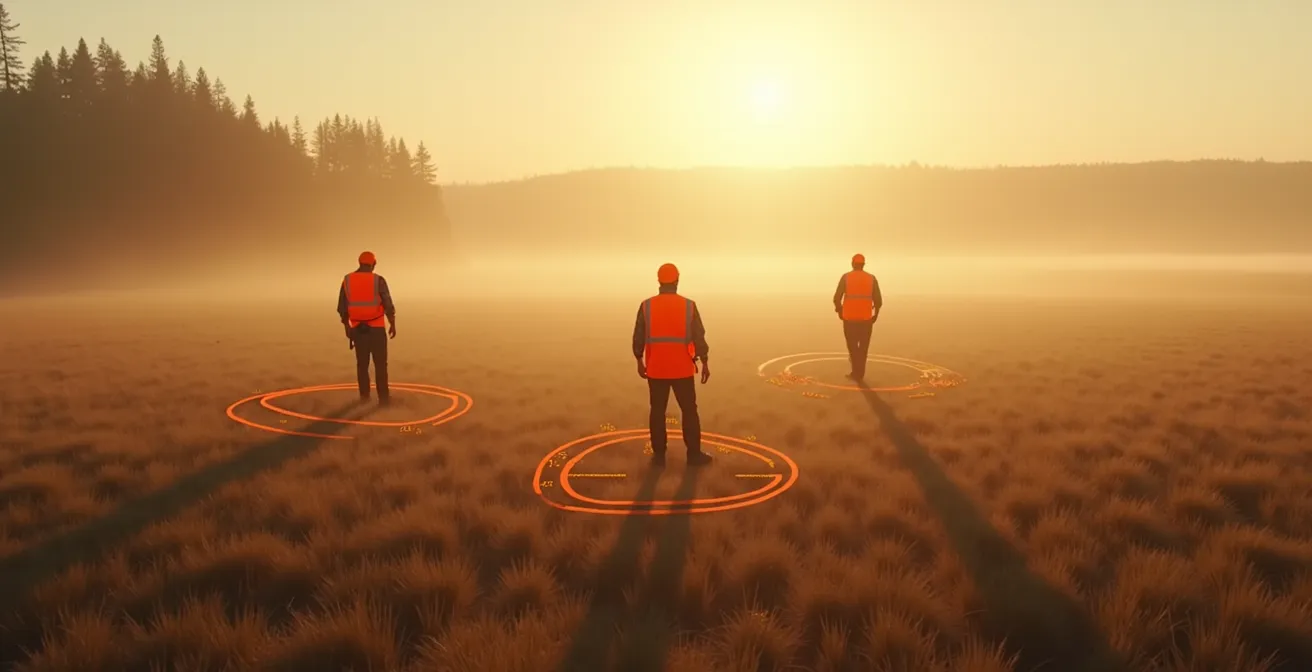
As the illustration demonstrates, maintaining proper spacing of 25 to 40 yards between hunters is essential for this system to work. Too close, and the zones overlap dangerously. Too far, and communication breaks down. When game flushes, the decision to shoot or not to shoot is instantaneous. The only thing that prevents a tragedy is the pre-programmed discipline to respect the zone. If a deer runs from right to left across the front of the line, it will pass through each hunter’s lane of fire. Each hunter has their opportunity in their zone only. Once it leaves, they must lower their firearm and let the next hunter engage. This requires immense trust and discipline, which is why it must be an enforced protocol, not a friendly suggestion.
Briefing vs. Assumption: What Must Be Said Before Stepping Off the Truck?
The single most important safety event of any group hunt happens before anyone loads a round or takes a step. It’s the pre-hunt briefing. This is not a casual chat; it is the moment where the hunt captain establishes command, sets the protocols, and secures a verbal contract from every participant. Assumptions are the enemy of safety. You must assume nothing and state everything. Every detail, from the communication plan to the rendezvous points, must be explicitly articulated and acknowledged by all.
A designated leader is crucial for this process. As safety expert Mark Fike explains in the NRA Family Hunting Safety Guide:
A huntmaster should be in charge of the hunt to run things. Generally this is either the most senior hunter on site, or the hunter most familiar with the land being hunted. The huntmaster draws heavily on his or her experience to review possible accidents that could occur.
– Mark Fike, NRA Family Hunting Safety Guide
This “huntmaster” or captain is responsible for running a comprehensive briefing that covers all contingencies. The plan must be clear, concise, and leave no room for interpretation. A proven framework for this is a four-part communication plan that ensures everyone knows how to signal and what to do if contact is lost. The plan must be tested before the group separates. A structured approach removes ambiguity and ensures every member is operating from the same playbook.
Action Plan: The P.A.C.E. Communication Briefing
- Primary: Announce the GMRS Radio channel (e.g., Channel 5) and privacy code. Conduct a radio check with every member.
- Alternate: Review whistle signals. Define what one blast means (attention/location check), three blasts (emergency/injury), and a continuous blast (lost and need help).
- Contingency: Establish visual signals for line-of-sight communication. A blaze orange flag or a powerful flashlight can be used to signal position or distress.
- Emergency: Designate a physical rendezvous point (e.g., the truck) and a hard “panic” time. If all communication fails, everyone must return to the emergency point by that time, no exceptions.
The Peer Pressure Risk That Forces New Hunters to Take Bad Shots
One of the most insidious risks in a group setting is not a failure of equipment, but a failure of nerve. The psychological pressure to perform, to contribute to the group’s success, or to simply not “miss out” can compel a hunter, especially a novice, to take a shot that is unsafe, unethical, or uncertain. This “buck fever” is amplified by the presence of peers. A hunter might see others taking shots and feel an implicit pressure to do the same, even if their own target isn’t clear, their backstop is questionable, or the shot is at the edge of their effective range. This is where leadership is critical.
As hunt captain, you must verbally and explicitly remove this pressure before the hunt begins. During the briefing, you must state clearly: “No deer is worth a bad shot. Passing on a shot is a sign of an expert hunter, not a failed one. We measure success by safety, not by filled tags.” This gives every hunter, especially the least experienced, the “permission” to be cautious. It reframes a “pass” not as a failure, but as a successful execution of safety protocol. This is vital, because the data is unforgiving. A staggering number of incidents are mislabeled as “accidents” when they are, in fact, preventable. An analysis by hunter education experts confirms that nearly 100% of hunting incidents are due to preventable negligence—a failure to follow established safety rules.
A bad shot is an act of negligence. It’s a failure to positively identify the target, a failure to confirm a safe backstop, or a failure to respect the established lane of fire. By fostering a culture that celebrates caution over kills, you directly counteract the peer pressure that leads to these negligent acts. The group’s ethos, set by you, must be that the safest hunter is the best hunter. This cultural enforcement is just as important as any technical protocol.
When to Call Off the Hunt Due to Weather or Injury?
A hunt captain’s toughest decisions are often not about where to go, but when to stop. Pride, investment, and the desire to push through can lead a group into a dangerous situation. The decision to pause or completely abort a hunt due to deteriorating weather or an injury cannot be a subjective debate. It must be a pre-agreed, objective decision based on hard triggers. Your role is to define these “red lines” before the hunt and have the discipline to enforce them, even when faced with resistance from the group.
You must establish clear, measurable thresholds. For weather, this includes conditions like a sudden temperature drop of 20°F in an hour, sustained winds over 30 mph, or visibility dropping below 100 yards. For lightning, the rule is absolute: if you can hear thunder within 30 seconds of seeing a lightning flash, the hunt is over, and you return to the vehicles immediately. For injuries, the threshold is any incident that cannot be fully managed with a basic first-aid kit. A deep laceration, a suspected sprain or fracture, or signs of hypothermia all trigger an immediate abort protocol. Emotion and ego have no place in this decision; only the data matters.
The following matrix, based on data from safety experts, outlines the difference between a temporary “pause” and a full “abort.” This should be discussed in the pre-hunt brief so everyone understands the protocol.
| Condition | Pause Protocol | Abort Protocol |
|---|---|---|
| Weather Issue | Wait in safe position, radio check every 15 min | Return to vehicles immediately via safest route |
| Minor Injury | Treat on-site, reassess in 30 min | Evacuate injured party with buddy |
| Communication Failure | Move to high ground, attempt contact | Return to last known position, then vehicles |
| Equipment Failure | Share equipment if safe | End hunt if safety equipment is compromised |
As a thorough safety analysis shows, having these protocols in place removes ambiguity in a crisis. When a red line is crossed, the “Abort” protocol is not a suggestion to be debated; it is an order to be followed immediately. The captain’s authority here is absolute and serves to protect the entire group from a cascading failure.
When to Use High-Vis Markers to Signal Your Position to Partners?
While active communication via radio is essential, a robust safety system also includes passive, silent communication. High-visibility markers like flagging tape and blaze orange clothing are not just accessories; they are critical components of your group’s spatial awareness and safety network. As hunt captain, you must enforce not only the wearing of blaze orange but also the systematic use of markers to signal positions, trails, and hazards.
The law often dictates a minimum amount of blaze orange, but your protocol should be based on maximum safety. The fact is, wearing a blaze orange vest or hat increases hunter visibility by up to 300%, drastically reducing the risk of being mistaken for game. This is a non-negotiable part of the group’s uniform. Beyond personal attire, a color-coded system of flagging tape provides a silent language that every member of the party can read. This system must be established during the pre-hunt brief.
A simple, effective marker system could be:
- Blaze Orange Tape: Used to mark a hunter’s path or current stand location. This lets others know where you are or where you have been, preventing them from accidentally moving into your line of fire.
- Pink/Red Tape: Used exclusively to mark a blood trail. Mark the point of impact and the first sign of blood, then subsequent markers to show the direction of travel for tracking.
- Blue Tape: Used to flag hazards. This could be an unstable bank, a patch of thin ice, or a steep, unseen drop-off. A blue flag is a universal “danger, proceed with caution” sign for the group.
- White/Reflective Tape: Used to mark the safe path back to camp or the vehicles, especially valuable for navigating in low-light conditions at the end of the day.
This system turns the environment itself into a communication tool. It allows a hunter to “speak” to others who may come through the area later, long after radio contact is lost. It’s a simple, cheap, and incredibly effective layer of the safety system.
The Safety Myth That Stops Communities from Approving Urban Archery
Understanding and dispelling safety myths is a mark of true expertise and leadership. A common example is the widespread public fear surrounding urban archery programs. Many communities block these highly effective deer management tools based on a fundamental misunderstanding of an arrow’s ballistics compared to a firearm’s. As a hunt captain, your knowledge must be grounded in physics and data, not emotion. Being able to articulate these facts builds credibility and demonstrates a deep commitment to genuine, not perceived, safety.
The core myth is that an arrow is as dangerous as a bullet in a suburban environment. This is demonstrably false. The primary safety feature of modern urban archery is the mandatory use of elevated stands. By shooting downwards from a treestand, the ground within 20-30 yards becomes the natural, unavoidable backstop. This virtually eliminates the possibility of a stray shot traveling an unsafe distance. In contrast, a rifle shot taken on level ground can travel for miles if it misses its target or a proper backstop is not present.
The safety differential between a bow and a firearm in a populated setting is not a matter of opinion, but of objective data. A detailed comparison of their ballistic properties makes this clear.
| Factor | Arrow from Compound Bow | Rifle Bullet |
|---|---|---|
| Maximum Range | 400-500 yards | 3-5 miles |
| Lethal Range | 60-80 yards | 500+ yards |
| Ricochet Risk | Minimal | Significant |
| Backstop Required | Ground within 30 yards | Hillside or miles of clear space |
Modern urban archery programs add further layers of safety, including mandatory proficiency tests, background checks for hunters, and property-specific inspections that define clear buffer zones from structures. Understanding and being able to explain these protocols is part of a holistic approach to hunting safety.
Key Takeaways
- Safety is a system of non-negotiable protocols, not a list of suggestions.
- Redundant communication (Radio, Satellite, Visual) is mandatory; cell phones are unreliable.
- Enforce rigid 45-degree lanes of fire and proper spacing to prevent cross-fire incidents.
- Establish objective “red line” triggers (weather, injury) to make go/no-go decisions emotionless.
How to Cultivate a “Safety-First” Mindset That Overrides Buck Fever?
The final and most challenging piece of the safety system is internal. You can have the best protocols, gear, and plans, but they are all useless if a hunter’s mind is hijacked by “buck fever”—the overwhelming rush of adrenaline that short-circuits rational thought. As hunt captain, your ultimate responsibility is to train your team’s minds to default to safety. This isn’t about hope; it’s about building a cognitive interrupt, a mental firewall that forces a safety check before the trigger is pulled.
This requires consistent, deliberate practice that builds a new neural pathway. The goal is to make the safety check sequence as automatic as breathing. This can be achieved through a simple training protocol that should be practiced long before the season begins. The core of this is creating a personal safety mantra—a short, three-part check that is repeated until it is inseparable from the act of aiming.
A highly effective protocol involves these steps:
- Create a Personal Mantra: Each hunter develops a simple, three-word safety check. A classic example is: “Target. Backstop. Clear.”
- Dry-Fire Practice: At home, with an unloaded firearm, the hunter rehearses shouldering the firearm, acquiring a target, and verbally stating their mantra (“Target. Backstop. Clear.”) before dry-firing. This should be repeated dozens of times.
- Visualization Drills: The hunter mentally walks through various hunting scenarios, seeing the game, and deliberately forcing themselves to complete the mantra before simulating the shot.
- Stress Inoculation: To better simulate buck fever, practice the mantra after physical exercise when the heart rate is elevated. This trains the brain to perform the check under physiological stress.
By making this mantra an ingrained, automatic habit, you are programming a response that can override the cognitive overload of an exciting moment. The mantra acts as a circuit breaker, forcing a moment of conscious thought before an irreversible action. It is the final line of defense, the personal embodiment of the group’s commitment to a safety-first system.
Ultimately, your mandate as hunt captain is to be the chief risk manager. By implementing and enforcing a rigid system of protocols—from communication and positioning to briefings and mental discipline—you transform a group of individuals into a safe, cohesive unit. This is the only way to guarantee that everyone returns home.