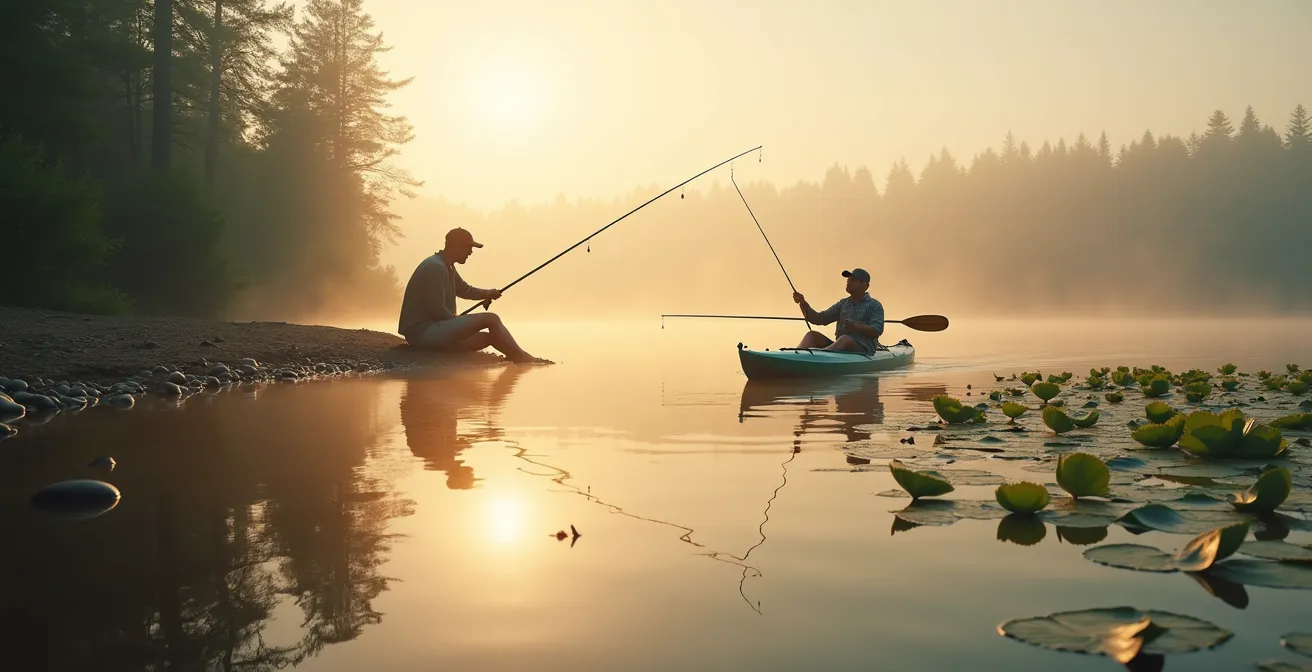
The secret to enjoying fishing isn’t developing more patience, but understanding and embracing the type of patience you already possess.
- Active patience thrives on constant adjustment and movement, making kayak fishing or using trolling motors highly rewarding.
- Passive patience finds peace in observation and waiting, aligning perfectly with bank fishing or using live bait with forgiving line.
- Novice confidence is built faster with high-action panfish than with elusive trophy bass, creating a positive feedback loop.
Recommendation: Diagnose your personal patience archetype first, then choose your gear, location, and target species to ensure a fulfilling and stress-reducing experience.
Staring at a wall of fishing gear can be more intimidating than landing a trophy fish. Rods, reels, lures, and lines all scream for attention, and the conventional wisdom isn’t much help. You’re told to choose based on the species you want to catch or the budget you have. While not wrong, this advice misses the most crucial variable in the equation: you. As a recreational therapist, I’ve seen countless people abandon hobbies not because they were too difficult, but because they were a poor psychological fit. Fishing is no exception.
The common refrain is that fishing requires “patience.” But this is a misleading oversimplification. Patience isn’t a single, monolithic trait. It’s a spectrum of temperaments. What if the key to unlocking a lifelong passion for angling wasn’t about forcing yourself to be more patient, but about selecting a style that harmonizes with the patience you naturally have? What if we treated this choice less like a gear problem and more like a personality assessment?
This guide reframes the selection process. We will move beyond gear and species to explore the different “patience archetypes” that define an angler’s temperament. By diagnosing your own style—whether you thrive on active problem-solving or find peace in quiet observation—you can choose a discipline that feels less like a challenge and more like a natural extension of who you are. This is how you find your flow on the water and guarantee your recreational return on investment.
To help you navigate this self-discovery process, we will explore various angling scenarios and the psychological profiles they suit best. This structured approach will provide a clear roadmap to a more enjoyable and sustainable fishing experience.
Summary: A Guide to Matching Angling Style With Your Temperament
- Bank Fishing vs. Kayak: Which Offers the Best ROI for Weekend Warriors?
- Why Solitary Wading Reduces Cortisol Levels Faster Than Group Fishing?
- The Bobber Mistake That Bores Kids Within 15 Minutes
- Ice Fishing or Open Water: Which Season Offers Higher Catch Rates for Beginners?
- Panfish vs. Bass: Which Species Builds Confidence Faster for Novices?
- How to Read River Seams to Locate Feeding Fish Instantly?
- Trolling Motor or Drift Sock: Which Tool Controls Boat Speed Better?
- Why Monofilament Line Is Still the Best Choice for Live Bait Fishing?
Bank Fishing vs. Kayak: Which Offers the Best ROI for Weekend Warriors?
The first decision every new angler faces is where to stand: on the shore or in a boat. This choice is a perfect litmus test for your core patience archetype. It pits the Passive-Patient Angler against the Active-Patient Angler. Bank fishing is the domain of the former. It represents a low initial investment and minimal setup time, but it demands a high degree of waiting patience. You are committed to your spot, finding peace in the observation and anticipation. While 48% of anglers fish from the shoreline, it’s a style that rewards those who can happily wait for the fish to come to them.
Kayak fishing, conversely, is for the tinkerer, the explorer—the active-patient angler. The initial investment and setup time are significantly higher, demanding a different kind of upfront patience. But once on the water, the waiting game changes. You are no longer stationary. You are actively seeking, paddling to new spots, and constantly adjusting your position. This mobility transforms waiting into searching. While a smaller segment, kayak fishing is growing rapidly because it appeals to those whose patience is fueled by action and exploration, not stillness.
To determine your recreational “Return on Investment” (ROI), you must honestly assess which type of effort feels more rewarding to you. Is it the zen-like calm of waiting, or the engaged problem-solving of a constant search? The following comparison helps clarify this psychological trade-off.
| Factor | Bank Fishing | Kayak Fishing |
|---|---|---|
| Initial Investment | $50-200 | $600-2000 |
| Setup Patience Required | Low (5-10 minutes) | High (30-60 minutes) |
| Waiting Patience Required | High | Low (mobile) |
| Access to Prime Spots | Limited | Extensive |
| Physical Effort | Minimal | Moderate to High |
This data, highlighted in a general comparison of fishing methods, shows that the best choice has less to do with money and more to do with managing your psychological energy. The image below visualizes the difference in complexity and commitment between these two fundamental approaches.
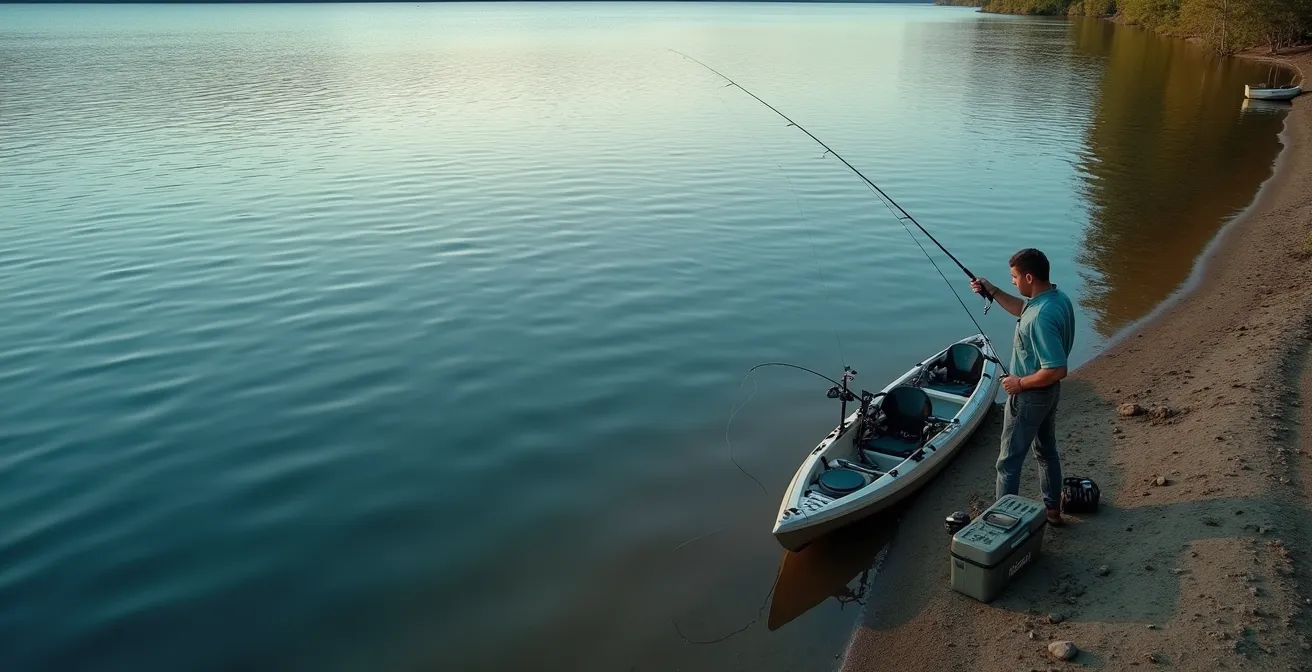
As you can see, the simplicity of bank fishing contrasts sharply with the involved nature of a fully-equipped kayak. One prioritizes ease of entry and passive waiting, the other rewards active effort with greater access. Choosing the right path is the first step in building a sustainable hobby.
Why Solitary Wading Reduces Cortisol Levels Faster Than Group Fishing?
From a therapeutic standpoint, one of fishing’s greatest benefits is stress reduction. However, the context of your fishing experience dramatically alters its effectiveness. This brings us to a fascinating paradox between human psychology and animal biology. For many species, being in a group is a primary defense mechanism. For instance, research published in Scientific Reports shows that cortisol levels (the primary stress hormone) were significantly lower in fish tested in groups compared to solitary individuals. This “social buffering” provides a sense of security against predators.
For modern humans, the equation is often reversed. Our “predators” are deadlines, notifications, and social obligations. A group setting, even with friends, can carry an undercurrent of social performance and conversation, preventing a full mental disconnect. Solitary wading, however, offers a powerful form of sensory immersion. Standing alone in a river, with the water flowing around you and your focus narrowed to the current, you engage in a form of active meditation. This environment strips away external pressures, allowing your cortisol levels from a stressful work week to decline more rapidly than they might in a socially engaged group outing.
This concept of social buffering is deeply ingrained. A comprehensive study on cyprinid fish confirmed that the presence of others provides a calming effect, a mechanism conserved across vertebrates. Yet, for us, the “stress” is often the group itself. The angler seeking true mental quietude must recognize this distinction. If your goal is a deep, therapeutic reset, the solitude of wading or fishing from a lone kayak offers a more direct path than a bustling boat or crowded pier. It’s about trading the biological security of the group for the psychological freedom of solitude.
The Bobber Mistake That Bores Kids Within 15 Minutes
Introducing a child to fishing is a delicate balancing act. The goal isn’t just to catch a fish; it’s to create a positive feedback loop that builds enthusiasm. The single biggest mistake is choosing equipment that sub-optimizes for action. Many adults hand a child a rod with a large, round bobber, cast it out, and say “watch the bobber.” This is a recipe for boredom. That large bobber requires a significant bite to go under, and a child’s patience is measured in seconds, not minutes. Their recreational ROI is based on engagement, not a single trophy.
The key is to create a high-action environment. This means shifting focus from “big fish” to “any fish.” As the Indiana DNR wisely notes, a beginner’s joy is found in quantity over quality. According to their fishing tips, “Most beginners would rather pull in 25 minnow-sized bluegill than wait for one trophy catch.” This philosophy should guide every choice you make. Use a small, pencil-style bobber that dances with the slightest nibble. Target areas where small panfish are visible. The goal is constant feedback—a twitching line, a dipping float—that keeps their mind engaged.
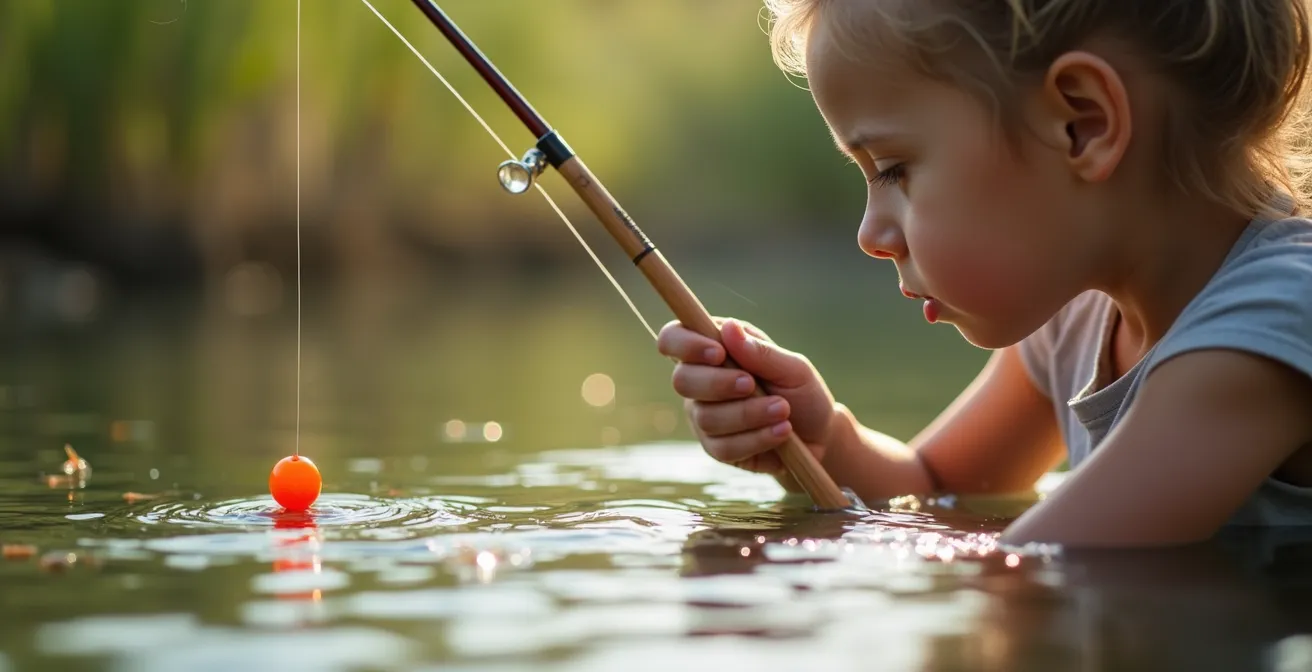
This active engagement is what builds the confidence loop. Each small success—even just a bite—reinforces the fun and possibility of the activity. A static bobber in empty water teaches them that fishing is about boring, passive waiting. A sensitive, dancing bobber surrounded by small fish teaches them that it’s an interactive game of anticipation and reaction. By setting them up for frequent, small wins, you’re not just teaching them to fish; you’re cultivating a lifelong passion.
Action Plan: Keeping Kids Engaged in Bobber Fishing
- Bobber Selection: Ditch large, round bobbers. Switch to small, pencil-style or slip bobbers that are sensitive enough to react to the slightest nibble from small fish.
- Location Targeting: Don’t cast into the deep. Find spots with visible structure like docks or weed beds where small panfish congregate, ensuring constant visual feedback.
- Bait and Hook Sizing: Use small hooks (size 6-10) with tiny pieces of bait like wax worms or nightcrawlers. This ensures more frequent bites and successful hookups.
- Engagement Strategy: Create micro-rewards and interactive tasks. Challenge them to “make the bobber dance” by twitching the line or see who can spot a fish first.
- Patience Management: Set a timer for 15-20 minutes. If there’s no action, move to a new spot. This teaches them that proactive searching is part of the sport, not just passive waiting.
Ice Fishing or Open Water: Which Season Offers Higher Catch Rates for Beginners?
For the aspiring angler who isn’t a year-round fanatic, the choice of season is a crucial one. With nearly 7 in 10 participants fishing less than once a month, maximizing success on these infrequent outings is paramount. The debate between ice fishing and open-water fishing often comes down to this: which offers a better chance for a beginner to actually catch something? The answer is surprisingly nuanced and depends, once again, on your patience archetype.
Open water fishing in spring and summer feels more intuitive. The environment is welcoming, and fish are often actively feeding in predictable shoreline areas. A beginner can walk a bank, casting and retrieving, and cover a lot of ground. This suits an active-patience angler who enjoys the physical movement and visual exploration of the sport. The feedback is constant, even if it’s just seeing a lure move through the water.
Ice fishing, on the other hand, appears to be the ultimate test of passive patience. You drill a hole and wait. However, modern technology has completely inverted this dynamic. It has become a sport for the analytical-patient angler. As professional angler John Peterson’s experience illustrates, the old method of sitting on one hole for hours is highly inefficient. Today’s successful ice angler uses a depth-finder (flasher) to actively search for fish. If no fish appear on the screen within minutes, they drill a new hole. This “run and gun” approach is a high-tech, data-driven hunt. The patience required is not in waiting, but in the analytical process of drilling, checking, and moving until fish are located. For a tech-savvy beginner, this can lead to much higher catch rates than aimlessly casting in open water, as you are fishing only where fish are confirmed to be present.
Panfish vs. Bass: Which Species Builds Confidence Faster for Novices?
Once you’re on the water, the target species is the next major decision, and for a novice, this choice is all about building a confidence loop. The sport of fishing is growing, with female fishing participation growing from 16 million in 2012 to 19.8 million in 2022, bringing in new perspectives and goals. For many of these new anglers, the primary goal is simply to feel the tug on the line. This is where the humble panfish (like bluegill, crappie, and perch) outshines the prestigious bass.
Panfish are typically numerous, aggressive, and can be caught with simple techniques. They provide the frequent, positive reinforcement that is essential for a beginner. Every catch, no matter how small, is a deposit in the confidence bank. It proves the technique works and keeps the angler engaged. This rapid feedback cycle is the fastest way to build foundational skills and, more importantly, a sense of accomplishment and fun.
Bass fishing, while immensely popular, presents a steeper learning curve. Bass can be finicky and require more advanced techniques and a deeper understanding of habitat. While it’s true that great catches are possible, as professional angler Joseph Raines notes, “I have caught all of my 7lb+ bass from the bank,” this is the voice of experience. A novice angler spending hours trying to fool a wary bass with no success is likely to get discouraged. The confidence loop is broken. The optimal path for a beginner is to start with panfish to build that initial momentum and enjoyment, then graduate to the more complex challenge of bass fishing once the fundamentals are firmly in place.
How to Read River Seams to Locate Feeding Fish Instantly?
For the angler who chooses to wade a river, success shifts from passive waiting to active observation. This is the domain of the analytical-patient angler, one who finds satisfaction in solving the puzzle of the water. Fish in a river, particularly trout, won’t be found just anywhere. They hold in specific locations that offer both shelter from the current and easy access to food. The key to finding them is learning to read current seams.
A current seam is the visible line where fast-moving water meets slower water. As the experts at Anchored Outdoors explain, “Fish love a fast-moving current seam because it acts like a conveyor belt, transporting insects and food to them as it moves.” The fish will sit just inside the slower water, darting out into the “conveyor belt” to grab a meal before returning to their resting spot. Learning to identify these seams is the single most important skill for a river angler. It transforms a wide, intimidating river into a map of high-probability targets.
This skill requires a shift in mindset. You are no longer just “fishing,” you are hunting. Your patience is channeled into a focused, analytical process. You are not casting randomly; you are identifying a specific target, planning your approach to avoid spooking the fish, and making a deliberate cast. Here are the key features to look for:
- Current Edges: The most obvious feature, where fast and slow water run parallel.
- Eddies: Areas behind rocks or logs where the current swirls back on itself. Foam and bubbles often collect here, trapping food.
- Pocket Water: Small areas of calm water amidst a stretch of rapids, often created by clusters of rocks.
- Mid-River Structures: Submerged boulders or shelves that create current breaks you can only identify by reading the surface patterns.
By focusing your efforts on these conveyor belts, you stop wasting time on empty water. This is active, engaged patience at its finest, a skill that provides a deep sense of satisfaction as you begin to unlock the river’s secrets and locate fish with consistent precision. This active problem-solving is a rewarding pursuit that pays dividends with every trip.
Trolling Motor or Drift Sock: Which Tool Controls Boat Speed Better?
For the boat angler, controlling speed is everything. Presenting a lure at the right pace is often the difference between success and failure. The tools used to achieve this control—a high-tech trolling motor or a simple drift sock—are a perfect reflection of two opposing patience philosophies: Active Control vs. Passive Strategy. The choice between them reveals whether you are an angler who wants to impose your will on the environment or one who prefers to work in harmony with it.
The trolling motor is the ultimate tool for the Active Control tinkerer. It allows for precise, constant micro-adjustments to speed and direction, independent of the wind. An angler with a trolling motor is always doing something: adjusting speed, changing direction, or using features like “Spot-Lock” to hold a position. As exemplified by high-end kayaks like the Hobie Mirage Pro Angler 12 360, this technology appeals to those whose patience thrives on constant input and immediate response. The high cost reflects the high degree of control it offers.
The drift sock, in contrast, is the epitome of a Passive Strategy. It is a large, underwater parachute that uses the wind to slow your drift to a natural, fish-attracting pace. It requires you to trust your setup and work with nature. You position your boat upwind of your target area, deploy the sock, and let the elements do the work. This approach appeals to the angler who finds calm in letting a system work, observing the results without constant interference. The table below starkly contrasts these two mindsets.
| Aspect | Trolling Motor | Drift Sock |
|---|---|---|
| Control Philosophy | Active Control | Passive Strategy |
| Best For | Tinkerers who need constant adjustment | Those who prefer working with nature |
| Patience Type | Active patience with micro-management | Passive patience with trust in setup |
| Wind Dependency | Independent | Wind-dependent |
| Cost | $500-3000+ | $30-100 |
Ultimately, both tools can achieve perfect speed control. The “better” tool is the one that aligns with your mental state. Do you find satisfaction in fine-tuning a machine, or in setting a course and trusting the process? Answering this question will lead you to the right gear and a more enjoyable day on the water.
Key Takeaways
- Patience is not monolithic; identify if you are an active (tinkerer), passive (observer), or analytical (problem-solver) angler.
- Match your gear (kayak vs. bank chair) and technique (trolling vs. drifting) to your patience style, not the other way around.
- For beginners and kids, prioritize high-action (panfish, sensitive bobbers) to build a “confidence loop” and prevent boredom.
Why Monofilament Line Is Still the Best Choice for Live Bait Fishing?
In a world of high-tech braided and fluorocarbon lines, humble monofilament can seem outdated. Yet, for certain applications, its perceived weaknesses are its greatest strengths. This is especially true for live bait fishing, a technique that perfectly suits the Passive-Patient Angler. Monofilament’s unique properties force a patient approach, acting as a built-in guard against an angler’s own impatience.
The defining characteristic of monofilament is its stretch. Unlike braid, which has zero stretch and transmits every bump and nibble instantly, monofilament has a significant amount of give. When a fish picks up a live bait, this stretch acts as a shock absorber. It allows the fish to fully take the bait without feeling unnatural resistance, which might cause it to drop it. For the angler, this creates a delayed sensory feedback. You don’t feel the instant “tick” of a bite; instead, you feel the line slowly loading up as the fish swims away. This delay forces you to wait for a committed bite, preventing premature hook sets that pull the bait away from the fish.
This mechanical forgiveness is a perfect match for the passive-patient mindset. It complements a style of fishing that is about observation and trust in the setup, rather than aggressive, reaction-based tactics. Here are the core advantages:
- Shock Absorption: The line’s stretch prevents pulling the hook out during a sudden headshake.
- Delayed Feedback: Forces the angler to wait for a definitive bite, reducing failed hooksets from impatience.
- Natural Presentation: The softer feel is less likely to spook a fish that is cautiously mouthing a bait.
- Low Cost: Allows for frequent line replacement, ensuring optimal performance without a large financial investment.
In a sport where many innovations are geared toward speed and instant feedback, monofilament remains the champion of the slow, deliberate approach. It reminds us of the counter-intuitive wisdom shared by Bob Jensen of The American Outdoorsman: “The most successful anglers are not patient: In fact, they’re usually quite impatient.” They are impatient to find fish, but once they do, the right gear, like monofilament, can help enforce the patience needed to close the deal.
Now that you have the tools to diagnose your angling personality, the next logical step is to confidently select a starting point. Choose a style, embrace the process, and experience the profound therapeutic benefits of a hobby that is truly, and perfectly, yours.