The common frustration of freezing in a treestand and sweating during the walk-in stems from a misunderstanding of apparel science. Effective thermal regulation is not about the number of layers, but about engineering a system that actively manages moisture and trapped air based on your body’s heat production. This guide moves beyond generic advice to explain the thermodynamics of material choice, enabling you to build a system that performs predictably from static cold to high-output activity.
For any late-season hunter, the scenario is painfully familiar: you shiver uncontrollably during the cold, pre-dawn sit, only to find yourself drenched in sweat an hour later after a short stalk or drag. This cycle of being too cold and too hot is not just uncomfortable; it’s a critical failure of your clothing system. Most advice centers on the simplistic mantra of “layering,” but fails to address the underlying physics of heat and moisture management. The truth is, your body is a furnace, and your clothing is the thermostat, flue, and insulation all in one. A failure in any one component compromises the entire system.
The common approach is to buy more gear, often focusing on camouflage patterns or brand names while overlooking the scientific properties of the materials themselves. We’ll touch on concepts like softshells, hardshells, and even the controversial world of scent control, but our core focus is more fundamental. This isn’t about collecting a closet full of disparate garments. It’s about understanding the principles of thermodynamics and material science to build a cohesive, predictable system.
The key shift in thinking is moving from dressing for the outside temperature to dressing for your metabolic output. Your heat production can vary by a factor of ten between sitting still and climbing a steep ridge. An effective clothing system must be able to adapt to this dynamic range. It must wick moisture away from your skin (phase one), transport it through your insulation (phase two), and allow it to escape to the environment (phase three). A breakdown at any stage leads to the cold, clammy feeling that can ruin a hunt and, in extreme cases, become dangerous.
This article will deconstruct the science of a high-performance apparel system. We will analyze why certain materials are fundamentally flawed, how to evaluate components beyond marketing claims, and how to select insulation based on activity, not just a thermometer. By understanding the “why” behind the “what,” you can stop fighting your clothes and start engineering a personal microclimate that keeps you comfortable, focused, and effective in the field.
In the following sections, we will dissect each critical component of a modern hunting apparel system, from the foundational fabrics to the often-overlooked failure points. This detailed exploration will provide the scientific basis for making smarter gear choices.
Summary: How to Build a Dynamic Clothing System for Hunting
- Why Cotton Is the Enemy of the Late-Season Hunter?
- How to Test Fabric Silence Before Buying It Online?
- Softshell vs. Hardshell: Which Layer Handles Briars and Rain Best?
- The Scent-Lok Myth: Can Clothing Really Block Human Odor Completely?
- When to Sacrifice Warmth for Trigger Sensitivity in Winter Gloves?
- How to Select Grams of Insulation Based on Activity Level, Not Just Temperature?
- Why Cheap Zippers Fail Faster Than Cheap Fabric in the Field?
- How to survive an Unexpected Blizzard While Miles from the Truck?
Why Cotton Is the Enemy of the Late-Season Hunter?
From a textile science perspective, the phrase “cotton kills” is not hyperbole; it is a statement of physical fact. The danger lies in cotton’s molecular structure, which makes it hydrophilic, or “water-loving.” Its fibers actively attract and hold onto water molecules, both from external sources like rain and, more critically, from your own perspiration. In fact, research shows that cotton garments can absorb up to 27 times their weight in water. When this happens, two catastrophic failures occur in your thermal regulation system.
First, the absorbed water displaces the trapped air within the fabric’s structure. This trapped “dead air” is what provides insulation; the material itself does very little. When saturated, cotton’s insulating value, or R-value, plummets to near zero. Second, this moisture held against your skin creates a powerful engine for evaporative and conductive heat loss. Water conducts heat away from your body 25 times faster than air. A damp cotton t-shirt becomes a thermal siphon, actively pulling warmth from your core. This was tragically demonstrated when an exhausted hiker in the Adirondacks, clad in waterlogged cotton gear, succumbed to hypothermia despite otherwise appropriate equipment.
To avoid this fundamental system failure, you must be vigilant in eliminating cotton and similar fabrics from your hunting apparel. Hydrophobic alternatives like merino wool and modern synthetics are essential. They don’t absorb water; they wick it, moving moisture from the skin to the fabric’s outer surface where it can evaporate without catastrophic heat loss. Identifying and avoiding cotton-based materials is the first and most crucial step in building a safe and effective system.
- Check garment labels: Avoid items labeled as corduroy, denim, flannel, or duck, as these are all cotton-based.
- Steer clear of cotton-polyester blends: Even a 50/50 blend retains the dangerous water-absorbing properties of cotton.
- Avoid modal, rayon, viscose, tencel, and lyocell: These cellulosic fibers can absorb water even faster than cotton.
- Be wary of bamboo fabrics: Many are a form of rayon and share cotton’s dangerous performance pitfalls in wet conditions.
- Immediately replace any cotton base layers with quality merino wool or synthetic alternatives.
Choosing the right material is a non-negotiable foundation of your system’s performance and your personal safety.
How to Test Fabric Silence Before Buying It Online?
In the world of hunting, especially for bowhunters, silence is a non-negotiable performance metric of your outer layers. A deer’s hearing is exponentially more sensitive than a human’s, and the rasp of a noisy fabric when drawing a bow or pushing through brush can end a hunt instantly. The challenge is evaluating this acoustic signature when purchasing gear online. While you can’t hear the fabric through a screen, you can learn to “see” the properties that contribute to noise.
Noise in textiles is primarily generated by two factors: surface friction and material stiffness. Stiff, smooth-faced fabrics, like many nylon ripstops found in mountaineering shells, create high-frequency sounds as their fibers rub against each other or external objects. Quieter fabrics disrupt this process. They typically feature a brushed or napped surface, often described as a “peach-face” finish. This texture consists of millions of tiny, soft fibers that cushion movement and prevent the harsh sound of fiber-on-fiber scraping. Materials like fleece, high-quality wool, and certain softshells are engineered with this principle in mind.
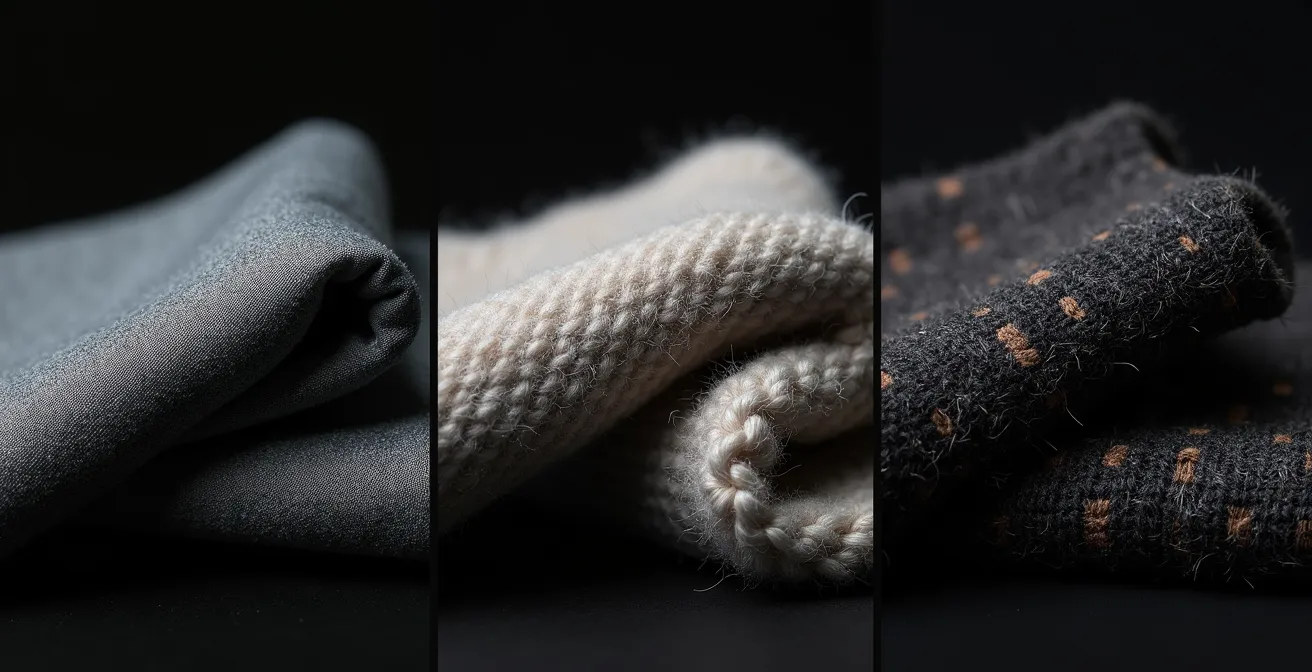
When shopping online, become a visual detective. Zoom in on high-resolution product photos. Look for a matte, non-reflective surface, which often indicates a brushed texture. Compare it to a fabric you know is noisy, like a rain jacket; the visual difference between a shiny, smooth surface and a soft, textured one will be apparent. Read reviews specifically searching for keywords like “quiet,” “silent,” “noisy,” or “swishy.” Finally, when the garment arrives, perform a simple field test: rub the fabric against itself near your ear and brush it against various surfaces. The ultimate test is to wear it and draw your bow in a quiet room. Your ears will tell you what the product photo could only suggest.
Softshell vs. Hardshell: Which Layer Handles Briars and Rain Best?
The choice between a softshell and a hardshell for your outer layer is one of the most critical decisions in engineering your clothing system. It represents a fundamental trade-off between absolute weather protection and all-day comfort and breathability. From a material science standpoint, these two categories serve distinct purposes and are optimized for different conditions. A hardshell is your emergency armor, while a softshell is your versatile, everyday shield.
A hardshell is defined by its waterproof/breathable membrane (e.g., Gore-Tex, eVent). Its primary function is to provide an impermeable barrier to wind and water. This makes it essential for hunts in sustained, heavy rain or wet snow. However, this protection comes at a cost. Even the best membranes have limited breathability (measured by Moisture Vapor Transfer Rate, or MVTR). During high-output activity, you can produce sweat vapor faster than the membrane can transport it, leading to moisture buildup inside the jacket. Furthermore, the face fabrics required to protect these membranes are often stiffer and noisier.
A softshell, in contrast, prioritizes breathability and mobility. These garments are typically made from durable, stretch-woven fabrics treated with a Durable Water Repellent (DWR) finish. They are not fully waterproof but are highly water-resistant, shedding light rain and snow with ease. Their key advantage is air permeability. They actively breathe, allowing moisture vapor to escape far more efficiently than a hardshell, which makes them vastly more comfortable during active periods. Many are also inherently quieter and more durable against the abrasion of thick brush and briars.
For the vast majority of hunting scenarios, a high-quality softshell is the more logical and comfortable choice. A hardshell should be viewed as a specialized piece of safety equipment, carried in your pack for when extreme weather rolls in. The following table breaks down their core performance characteristics.
| Feature | Softshell | Hardshell |
|---|---|---|
| Best Use Scenario | 80% of hunting conditions | 20% extreme weather |
| Breathability | High (air permeable) | Limited (membrane-based) |
| Durability vs Briars | Excellent (high denier fabrics) | Good (but can puncture) |
| Water Resistance | Light rain/snow only | Full waterproof protection |
| Noise Level | Quiet | Often noisy |
| Weight | Moderate | Light (packable options) |
The Scent-Lok Myth: Can Clothing Really Block Human Odor Completely?
The concept of scent-control clothing, particularly gear impregnated with activated carbon, has been a multi-million dollar industry for decades. The marketing promise is powerful: a garment that makes you olfactorily invisible to game. However, from a scientific and regulatory standpoint, the claim of complete odor elimination is a myth. The goal should not be elimination, which is physically impossible, but rather diligent minimization through a systematic approach.
The core technology relies on activated carbon, a material with an incredibly porous surface area that can adsorb odor molecules. While the principle is sound in a lab setting, a hunting garment is not a sealed system. A significant amount of scent escapes through inevitable gaps: the collar, cuffs, and every zipper and seam. More importantly, the single largest source of human odor in the field is respiration. You are constantly exhaling a plume of scent-rich vapor that no garment can contain. In fact, due to misleading advertising, the Federal Trade Commission has taken action against companies for making unsubstantiated claims about total odor elimination.
This does not mean that all efforts are futile. It simply means shifting your strategy from a magical belief in one product to a holistic, evidence-based system of scent minimization. This system acknowledges that the single most effective tool is understanding and using the wind to your advantage. Beyond that, a multi-pronged approach can significantly reduce your scent profile and delay the moment a downwind animal detects you.
- Play the wind: This remains the #1 most effective scent management strategy and is entirely free.
- Maintain hygiene: Shower with scent-free soap and shampoo before each hunt to reduce the initial bacterial load on your skin.
- Choose smart fabrics: Naturally antimicrobial materials like merino wool slow the growth of odor-causing bacteria, keeping your base layers fresher for longer.
- Isolate your gear: Store your hunting clothes in airtight bags or containers, ideally with a natural cover scent like earth or pine wafers, to prevent them from absorbing foreign odors.
- Accept the goal: Understand that minimization, not elimination, is the only realistic objective.
By focusing on these proven, practical steps, you invest your time and money into a strategy that works, rather than chasing the impossible promise of complete invisibility.
When to Sacrifice Warmth for Trigger Sensitivity in Winter Gloves?
For the cold-weather hunter, gloves present a unique and frustrating paradox. The insulation required to keep hands warm during long, static periods of sitting or glassing is often the very thing that robs you of the dexterity and sensitivity needed to safely operate a trigger or release. Bulky gloves can lead to a fumbled shot, a dangerously misplaced finger, or a complete inability to feel the trigger break. Sacrificing warmth for sensitivity isn’t a single decision, but a dynamic process managed through a smart, two-part glove system.
The solution is not to find one “perfect” glove, but to layer your handwear just as you layer your body. This system consists of a thin, form-fitting liner glove and a heavy, well-insulated outer mitten or glove. The liner is your “action” layer, while the outer is your “idle” layer.
- Wear thin merino wool or synthetic liner gloves as your base layer. These should be dexterous enough to allow you to feel and operate your trigger, smartphone, or GPS.
- Add heavy insulated mittens over the liners during long, static sits. Mittens are thermally superior to gloves as they allow your fingers to share warmth in a single compartment.
- Practice the silent removal of the outer mitten. This is a critical skill. You must be able to shed the bulky layer quietly and efficiently when a shot opportunity presents itself.
- Consider mittens with flip-back finger or thumb sections. These hybrid designs offer a quick transition from maximum warmth to full dexterity without fully removing the mitten.
- Always carry a spare, dry pair of liner gloves in an internal pocket. Your primary liners can easily become wet from sweat or field dressing, compromising their effectiveness.
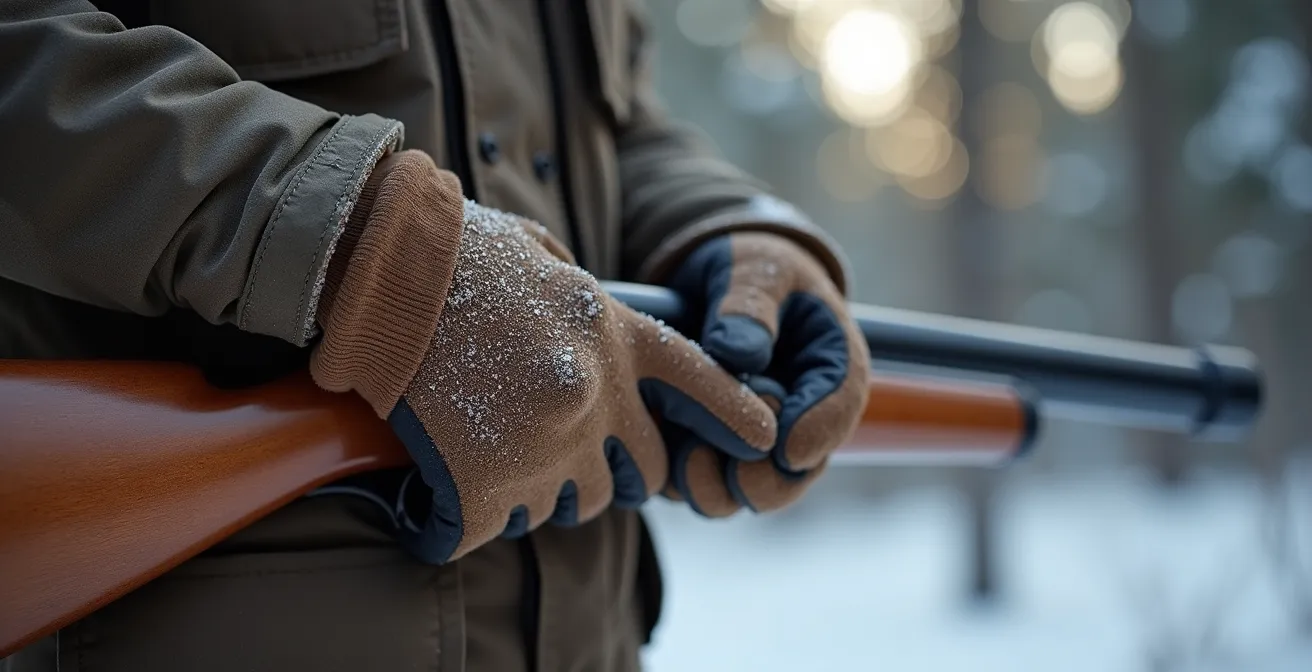
This two-glove system allows you to have the best of both worlds. You get maximum warmth when your metabolic output is low (sitting) and instant dexterity when the critical moment arrives. You are no longer forced to choose between frozen fingers and a fumbled shot. Instead, you are managing your hand insulation as a dynamic part of your overall thermal regulation system.
How to Select Grams of Insulation Based on Activity Level, Not Just Temperature?
One of the most common mistakes in choosing insulated apparel is focusing solely on the outside temperature. A 20°F day can feel drastically different depending on whether you are sitting motionless in a treestand or hiking up a steep incline. The key to selecting the right insulation is to match it not to the weather, but to your anticipated metabolic output. As a textile scientist, I can tell you that insulation doesn’t create warmth; it simply slows the rate at which your body’s heat escapes. The more heat you’re generating, the less insulation you need.
Insulation in hunting gear is often measured in grams per square meter (e.g., 100g Primaloft). This number indicates the weight and, by extension, the thickness or “loft” of the insulating material. More loft means more trapped air, and trapped air is what provides the thermal barrier. The critical insight is that you need different amounts of loft for different phases of your hunt. A thick, heavily insulated jacket that’s perfect for a static sit will cause rapid and dangerous overheating during an active stalk.
This is why a modern clothing system relies on modular insulation. You might wear a non-insulated softshell for the walk in, then add a lightweight, packable insulated “puffy” jacket over your base layers once you get to your glassing spot. This approach allows you to precisely match your insulation level to your real-time heat production. Furthermore, it’s vital to understand that insulation loses its effectiveness when compressed. Field data shows that compressed insulation under pack straps can experience up to a 60% R-value loss. This creates cold spots and is another reason why layering insulation, rather than relying on one bulky piece, is superior. The following table provides a scientific framework for choosing insulation based on activity.
| Activity Level | Metabolic Output | Recommended Insulation | Example Scenario |
|---|---|---|---|
| Static | Minimal heat generation | 100-200g synthetic | Tree stand sitting |
| Low Output | Light heat generation | 60-100g synthetic | Slow stalking |
| Moderate Output | Moderate heat generation | 40-60g synthetic | Steady hiking |
| High Output | Maximum heat generation | 0-40g or none | Steep climbing |
By adopting this activity-based model, you move from guessing to scientifically engineering your warmth, ensuring you have just enough insulation for every phase of the hunt.
Why Cheap Zippers Fail Faster Than Cheap Fabric in the Field?
In a high-performance apparel system, we often focus on the marquee features: the waterproof membrane, the camouflage pattern, or the insulation type. However, the most common point of catastrophic failure is often the most overlooked: the zipper. A blown-out main zipper on an outer shell during a backcountry storm is not an inconvenience; it’s a serious safety failure that compromises the integrity of your entire system. From a materials engineering perspective, a cheap zipper is a liability that will fail exponentially faster than even mediocre fabric.
The durability difference lies in the fundamental design and materials. Budget gear often uses coil zippers, where the “teeth” are simply a continuous plastic spiral sewn onto fabric tape. Under repeated stress, load, and exposure to grit, these coils can deform, separate from the tape, or the slider can wear and fail to engage them. In contrast, premium gear almost exclusively uses molded tooth zippers (like the ubiquitous YKK Vislon). Here, each tooth is an individual, robust piece of plastic molded directly onto the tape. They are more resistant to torque, grit, and thousands more cycles of use. Field testing analysis shows that while coil zippers can fail after an average of 500 cycles under load, quality tooth zippers can last beyond 5,000 cycles.
A zipper is a mechanical device with multiple moving parts, operating in a dirty, high-stress environment. It is a classic “weakest link” scenario. Paying a premium for a garment with a top-tier zipper from a manufacturer like YKK or Riri is an investment in system reliability. When a cheap zipper fails miles from the truck, the multi-hundred-dollar jacket it’s attached to becomes effectively useless. Therefore, inspecting the zipper should be one of your primary evaluation criteria when purchasing new gear.
Your Action Plan: Field Zipper Maintenance and Repair Protocol
- Inspect Before Purchase: Look for brand names like YKK, Riri, or other reputable manufacturers on the zipper pull. This is a primary indicator of quality.
- Check for Features: Look for “zipper garages” or fabric shrouds at the top of the zipper track. These prevent the slider from snagging beard hair or base layers.
- Clean Regularly: Use a soft brush and water to remove dirt, grit, and debris from the zipper teeth, which cause premature wear.
- Lubricate for Performance: Before a trip, apply a specialized zipper lubricant or even just paraffin wax/chapstick to the teeth to prevent icing and reduce friction.
- Carry an Emergency Tool: A small pair of pliers or a multi-tool in your pack can be used to gently re-crimp a slider that has started to separate, potentially saving a hunt.
Key Takeaways
- Effective thermal regulation is about managing moisture and metabolic heat, not just layering for the outside temperature.
- Material science is paramount: Hydrophobic materials (wool, synthetics) are essential, while hydrophilic materials (cotton) are a critical safety liability.
- A clothing “system” is only as strong as its weakest link; overlooked components like zippers and compression zones can cause catastrophic failure.
How to survive an Unexpected Blizzard While Miles from the Truck?
All the principles of building a clothing system—moisture management, modular insulation, and reliable components—are put to the ultimate test in a survival scenario. Getting caught in an unexpected blizzard or whiteout miles from safety is one of a hunter’s greatest fears. In this situation, panic is the primary enemy, and a calm, systematic response, guided by your gear and knowledge, is your only true asset. The key is to shift from “travel mode” to “survival mode” immediately, before your core temperature begins to drop.
The onset of hypothermia is insidious and can begin in surprisingly mild conditions. It is clinically defined as the body’s core temperature dropping below 95°F, and as research on hypothermia confirms, this can occur in ambient temperatures well above 35°F, especially when factors like wind and moisture are present. A tragic case of a youth soccer player requiring emergency transport for hypothermia at 60°F on a windy day illustrates this danger. The moment you realize you are lost or stranded, you must act decisively to preserve heat and energy. The most proven mental framework for this is the S.T.O.P. protocol.
This is where your well-engineered clothing system becomes your lifeline. Before you even begin to feel cold, you must put on every insulating layer you have, especially your hardshell to block the wind. Wind-driven convective heat loss is a primary killer. Your pack should always contain a lightweight emergency bivy or space blanket. This single item can be a literal lifesaver, reflecting your radiant body heat and providing a crucial barrier against wind and moisture. The goal is to create a static, insulated, and windproof micro-environment where you can wait for the storm to pass or for rescue.
- Sit: The moment you’re in trouble, stop moving. This conserves precious energy and prevents panic-driven decisions that could worsen your situation.
- Think: Calmly assess your situation. What gear do you have? Where is the best natural shelter? How much daylight is left?
- Observe: Study your immediate surroundings. Identify natural windbreaks like rock outcroppings, dense pines, or ditches. Look for resources.
- Plan: Create a logical sequence of actions. Your priorities are: 1) Shelter from wind, 2) Insulation, 3) Signaling (if possible). Put on all insulation layers *before* you get cold.
In a survival situation, your clothing is no longer about comfort; it’s a life-support system. Every decision, from avoiding cotton to packing a reliable hardshell, culminates in your ability to survive this ultimate test.
By applying these scientific principles to every gear choice, you transform your apparel from a simple collection of clothes into a high-performance system. The next step is to audit your current gear against these standards and strategically upgrade the weakest links.