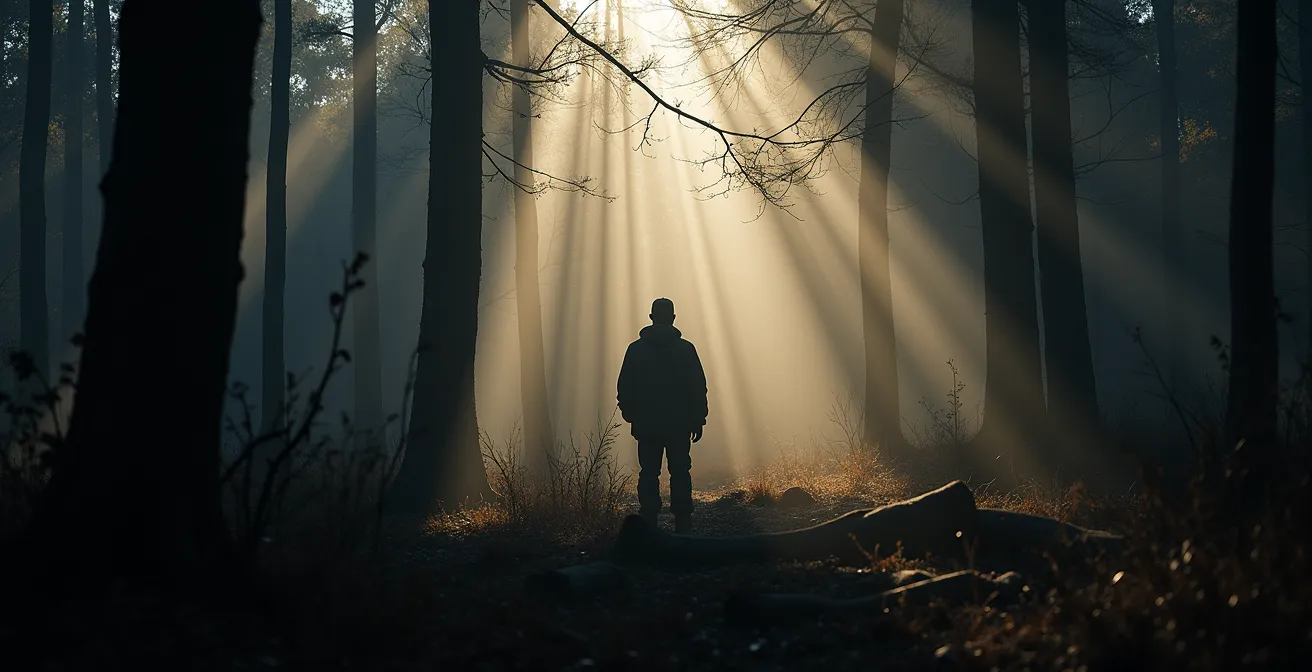
True invisibility in the field is not something you can buy; it is a discipline you must earn by exploiting the sensory gaps of your prey.
- Your upright human shape is the primary threat signal that alerts game, long before they notice your camo pattern.
- Unnatural shine from skin or gear and jerky, inefficient movements betray your position faster than any color.
Recommendation: Master silhouette discipline, light management, and your noise signature to systematically defeat an animal’s senses and hunt undetected.
You’ve spent a small fortune on the latest, most advanced camouflage pattern. It has a dozen different earth tones, a micro-pattern for close range, and a macro-pattern for long range. You feel like the Predator. Yet, you step into the woods, and a doe pegs you from 200 yards away, flags her tail, and blows out the entire valley. Sound familiar? The hunting industry has sold you a bill of goods, focusing your attention on the least important part of the concealment equation: the pattern.
As a sniper instructor, I don’t teach my students to rely on gear. I teach them to rely on discipline. The principles of military stealth are not about looking like a tree; they are about understanding physics, psychology, and the sensory limitations of the target. Game animals do not see the world as you do. They perceive it as a series of threat profiles. They are masters at detecting anomalies—unnatural shapes, movements, and reflections that scream ‘danger’. Your expensive camo is useless if you are still projecting the threat profile of a human.
The problem isn’t your pattern; it’s your silhouette, your shine, and your signature. You have been trying to hide in plain sight when you should have been learning how to not exist in the first place, from the animal’s perspective. Forget everything you think you know about camouflage. We are going back to the fundamentals.
This guide will break down the core disciplines of true invisibility. We will dissect how to manage your silhouette, master silent movement, exploit the tactical advantages of sun and shade, and understand what an animal’s eye truly sees. This is the science of not being seen. Pay attention.
Summary: The Fieldcraft Disciplines for True Invisibility
- Why Silhouette Discipline Matters More Than Your Camo Pattern?
- How to Stalk Through Dry Leaves Without Alerting Every Deer in the County?
- Sun vs. Shade: Which Position Hides Movement Better?
- The Skin Shine Mistake That Gives Away Your Position at 100 Yards
- When to Switch from Green to Brown Patterns During the Transition?
- Why Deer Cannot See Blaze Orange Spectrum Like Humans Do?
- How to Spot Coues Deer in a Landscape That Looks Completely Flat?
- How to Develop a Mental “Go/No-Go” Protocol for Every Shot Opportunity?
Why Silhouette Discipline Matters More Than Your Camo Pattern?
Your first and most critical failure in the field is your shape. An animal’s brain is hardwired over millennia to recognize one specific shape as a primary threat: the upright, symmetrical form of a bipedal predator. Your head on top of two shoulders is a dead giveaway. No amount of fancy digital camouflage can erase this fundamental geometry. Before an animal even processes color or pattern, it processes shape. Your mission is to destroy that shape.
This is what we call silhouette discipline. It is the conscious, constant practice of breaking up your human outline against any background. A hunter standing in the open is a vertical rectangle in a horizontal world. You might as well be a lighthouse. The goal is to blend your form into the natural “noise” of the environment, making your outline jagged, asymmetrical, and unrecognizable. As seasoned hunters know, this is the fundamental skill.
Hunting experts note that the key lies in breaking up your human outline, a skill that separates the seasoned hunter from the novice. Animals are wired to spot unnatural shapes—especially the upright, rigid silhouette of a human. This makes disrupting that form essential if you want to stay off their radar.
– Treetop Hunter, Hunting Camo Patterns: An In-Depth Guide
Achieving this requires you to think in three dimensions. Use natural cover not just to hide behind, but to merge with. Position yourself so that a bush breaks up the line of your shoulder or a low-hanging branch obscures the top of your head. Incorporate natural elements by tucking branches and grasses into your pack or gear. The goal is to create a “dazzle” effect with disruptive coloration and shapes, using patterns with mixed light and dark shades that mimic the natural contrasts of light and shadow found everywhere in nature.
Stop thinking about what pattern to wear and start thinking about what shape you are presenting. A hunter with perfect silhouette discipline in solid brown clothing will be far more invisible than a hunter in top-tier camo standing in the open.
How to Stalk Through Dry Leaves Without Alerting Every Deer in the County?
Now that you are managing your visual profile, you must manage your auditory signature. A forest in late autumn is a minefield of dry leaves and brittle twigs. The crunch of a single footstep can travel hundreds of yards on a still day, alerting every animal in the vicinity. Most hunters move with a clumsy, rhythmic “thump-crunch, thump-crunch” that is utterly unnatural. The sound of a human walking is distinct from the sound of a deer or squirrel moving through the same environment.
Your objective is to mimic the natural cadence and sound of the woods. This means slow, deliberate, and irregular movement. Practice the “fox walk,” placing your foot down with a rolling motion from the outside edge of your sole to the inside, feeling the ground before committing your full weight. This allows you to detect a twig that’s about to snap and adjust your footing. In critical moments when you are closing the distance, do not hesitate to remove your boots and proceed in thick wool socks. The enhanced tactile feedback is a game-changer.
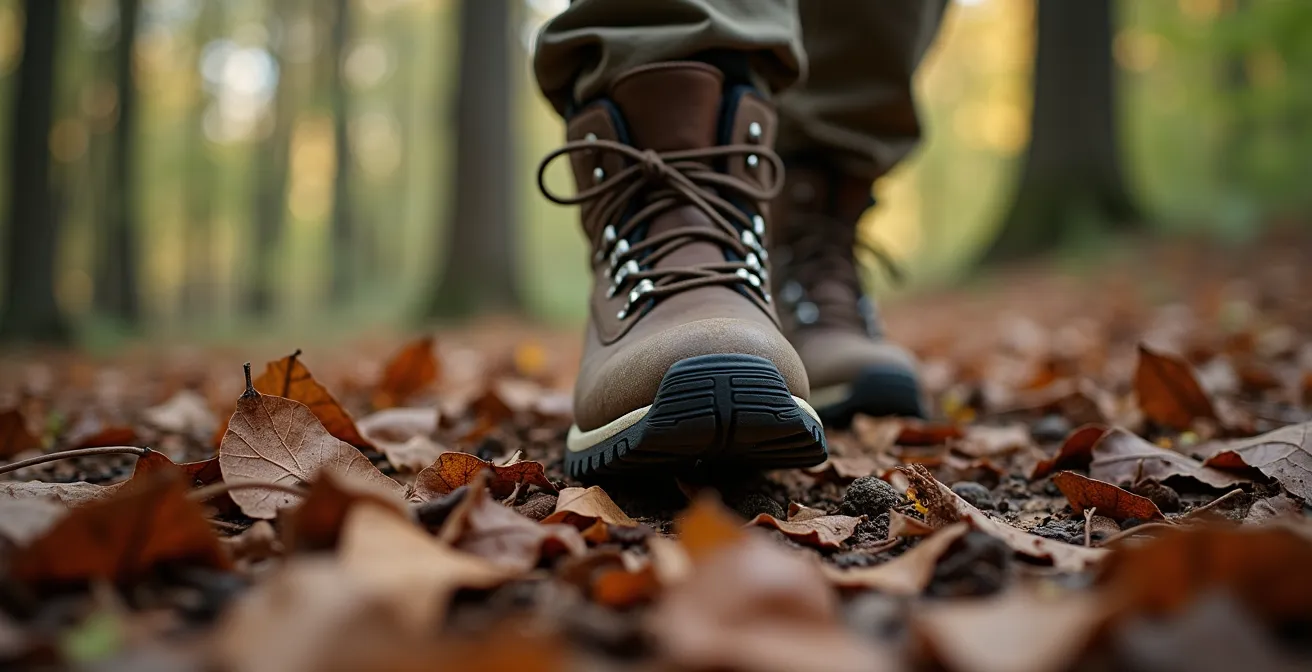
As the image demonstrates, precise foot placement is everything. You must feel the ground through your sole. Furthermore, use the environment’s sounds to your advantage. Time your steps with gusts of wind, the sound of another animal moving, or a deer itself as it feeds or scrapes. This is called sound masking. Always choose the quietest path available—step on bare soil, moss, or damp ground rather than directly on the leaf litter. It may not be the most direct route, but stealth is about the path of least resistance, not the path of least distance.
Patience is your greatest weapon here. Take one step, then pause for a full minute. Scan, listen, and then take another. Your movement should be so slow and intermittent that you become part of the forest’s ambient noise, not an intruder.
Sun vs. Shade: Which Position Hides Movement Better?
Light is a tangible element in the field, and you must learn to manipulate it. Your position relative to the sun is as critical as your camouflage or wind direction. The common mistake is to think of light only in terms of visibility. The sniper thinks of it in terms of tactical advantage. The rule is simple: shade is your ally, and direct sun is your enemy.
Movement is detected through contrast. When you move in direct sunlight, your form creates hard-edged, moving shadows and highlights that are incredibly easy for an animal’s eye to pick up. Even the best camouflage pattern will “flash” or appear unnaturally bright when hit with direct light. Conversely, positioning yourself in the shadows makes your entire form a low-contrast blob. Movement within a shadow is far less jarring and more likely to be dismissed as foliage rustling in the wind.
This is amplified by the structure of a deer’s eye. Research on deer vision reveals that deer see 20X better in low light conditions, which means the deep, blue-toned light of a shadow is their natural element. A hunter in the shade is hiding within the very light spectrum a deer is most comfortable with. One hunter demonstrated this by remaining undetected by a mature buck at just 60 yards simply by staying in the shadows. When an animal is looking from a bright area into a dark one, the shadows can appear as nearly impenetrable black voids, rendering you effectively invisible.
The ultimate tactical position is to place yourself in the shade with the sun at your back. This accomplishes two things: it keeps your form concealed in low contrast, and it forces the animal to look into the sun to see you, dazzling its vision and giving you a supreme advantage. Always be conscious of where your shadow is falling and how the light is interacting with your gear.
Before you take a position, analyze the light. Ask yourself: “Where is the sun? Where are the shadows? How will this change in the next hour?” Your ability to answer these questions will determine whether you remain a ghost or become a beacon.
The Skin Shine Mistake That Gives Away Your Position at 100 Yards
You can have perfect silhouette discipline, move like a ghost, and master the shadows, but one small detail can betray you instantly: shine. The reflection of light off an unnatural surface is one of the most powerful alert signals in nature. And the most common reflective surface you bring into the woods is your own skin.
The oils on your face, neck, and hands create a subtle sheen that can catch the sun and flash like a signal mirror. At 100 yards, a deer won’t see a face; it will see a momentary, unnatural glint of light where there should be none. This is an immediate, high-priority threat signal. Covering exposed skin is not optional; it is a mandatory part of your concealment system. A face mask or face paint is non-negotiable. Gloves are essential.
But skin is only the beginning. You must conduct a systematic audit of every single piece of gear you carry. Binocular lenses, rifle scopes, watch faces, eyeglasses frames, zippers, and even the metal on your wedding ring can cause a catastrophic reflection. Experienced operators go to great lengths to “de-shine” their equipment, swapping out metal zippers for paracord pulls and covering logos with tape. Even your breath can be a problem. In cold weather, the vapor from your mouth can create a visible plume. A wool gaiter can help disperse it, or you can learn to direct your breath downward into your clothing.
Your Pre-Hunt Reflection Audit
- Cover all exposed skin: Use gloves and face paint or a mask to completely hide your face and hands, which reflect light and contrast sharply with camouflage.
- Neutralize gear reflections: Methodically check and cover or dull eyeglass frames, binocular lenses, watch faces, and metallic zipper pulls before entering the field.
- Manage skin oils: Apply non-scented charcoal, mud, or commercial face paint to absorb oils and eliminate the natural reflectivity of your skin.
- Control breath visibility: In cold conditions, use a wool gaiter or consciously direct your breath downward into your jacket to prevent a visible vapor cloud.
- Conduct regular gear inspections: Before every hunt, perform a systematic check of all your equipment under various light conditions to identify and eliminate any new or missed reflective surfaces.
Think of yourself as a collection of surfaces. Your job is to ensure every one of those surfaces is dull, non-reflective, and absorbs light rather than bouncing it. A tiny flicker of light is all it takes to undo hours of patient stalking.
Discipline is about controlling the small details. Take this audit seriously. One flash can mean the end of your hunt, and you will likely never even know what gave you away.
When to Switch from Green to Brown Patterns During the Transition?
Only after you have mastered silhouette, movement, light, and reflection can you begin to consider the nuances of pattern. The most common question is when to switch from green-based camo in the early season to brown-based camo as the foliage dies off. The answer, however, lies in understanding how your prey sees color—or rather, how it doesn’t.
Scientific research on whitetail vision shows that deer operate in a dichromatic spectrum. Unlike humans, who have three color receptors (trichromatic), deer have only two, making them sensitive to blues and yellows but effectively red-green colorblind. They don’t see the rich greens of summer or the deep browns of fall. They see a world of muted yellows, grays, and blues. This means the specific color of your camo is far less important than its contrast and value (its overall brightness or darkness).
The key to selecting a pattern is not to match the exact colors of the environment but to match the overall brightness and the level of contrast. A dark, high-contrast pattern will stick out in a light, low-contrast environment like a dry grass field, regardless of whether it’s green or brown.
This table breaks down the strategy. Focus on the features, not just the colors. The goal is to match the texture and light-scattering properties of your surroundings.
| Season/Environment | Recommended Pattern | Key Features |
|---|---|---|
| Early Season Forest | Green-heavy patterns with shades of green, brown, and gray. In early seasons, green patterns work best, transitioning to more browns and grays as foliage changes | Matches dense, leafy vegetation |
| Open Fields/Prairie | Lighter browns, tans, and yellows with grass and stalk patterns featuring vertical lines | Disappears in tall grass and stubble |
| Wetlands/Marsh | Shades of brown, tan, and muted greens with grass-like or water-edge designs | Matches the texture of reeds and cattails |
| Late Season/Winter | Gray and brown dominant patterns | Matches the high contrast of bare trees and ground |
So, when do you switch? You switch when the overall “value” of the forest floor and canopy shifts from dark and green to light and brown. More importantly, you choose a pattern with a macro-design that effectively breaks up your silhouette at a distance. Pattern is the final 10% of concealment; don’t let it distract you from the 90% that is discipline.
Why Deer Cannot See Blaze Orange Spectrum Like Humans Do?
The concept of blaze orange is the ultimate proof that an animal’s sensory world is alien to our own. To a human, a blaze orange vest is the most conspicuous color imaginable. To a deer, it’s just another shade of dull gray or yellow. This paradox is rooted in the fundamental differences in our visual systems.
As we’ve established, deer have dichromatic vision. Wildlife vision research confirms that many animals have vision tuned to the blue-yellow spectrum, leaving them largely insensitive to colors in the long-wavelength, red-orange-green part of the spectrum. When a deer looks at your blaze orange vest, it doesn’t see a brilliant, fluorescent orange. It sees a muted, grayish-yellow shape. It blends in with the yellows and browns of the autumn foliage surprisingly well.
However, there is a critical exception to this rule: UV brighteners. While deer cannot see orange well, they are extremely sensitive to the blue and ultraviolet (UV) end of the spectrum. Many standard laundry detergents contain UV brightening agents designed to make clothes appear “whiter and brighter” to the human eye. When you wash your hunting clothes—including your blaze orange—in these detergents, you are coating them in a dye that glows intensely in the UV light that deer see so well. To a deer, your “invisible” orange vest now shines like a brilliant blue beacon.
To maximize safety without compromising stealth, you must wash all hunting gear in specialized, UV-free detergents. Furthermore, while the color itself is not a problem, a large, solid block of any color can still present a recognizable silhouette. Break up your solid orange vest with a camouflage backpack or by positioning yourself so vegetation partially obscures the solid block. And remember, even if the color is invisible, movement is not. A moving block of gray-yellow is still a moving block, and that’s what will get you busted.
Wear your orange for safety; it’s a non-negotiable requirement for being seen by other hunters. But manage it with the same discipline as the rest of your kit. Keep it UV-free and keep it still.
How to Spot Coues Deer in a Landscape That Looks Completely Flat?
Now, we flip the script. Understanding the principles of camouflage is not just about hiding; it’s also about seeing. The same rules that make you invisible can be used to detect a masterfully camouflaged animal like the Coues deer, often called the “gray ghost” for its ability to vanish in plain sight.
Spotting these animals in vast, seemingly featureless terrain is not about looking for a deer. It is about looking for anomalies. You will not see a whole deer standing out in the open. You will see a part of a deer—a horizontal line where there should be none (a deer’s back), the flicker of an ear, the twitch of a tail, or the V-shape of its legs against the brush. Your brain must be trained to ignore the “whole” and hunt for the “piece.” The most effective method is systematic glassing with high-quality binoculars on a tripod.
Adopt a mental grid system. Divide the landscape in front of you into a series of imaginary squares. Start at the top left and slowly, methodically scan each square, moving left to right, then dropping down a level and scanning right to left. Do not sweep your binoculars around randomly. This disciplined approach prevents you from subconsciously skipping over “uninteresting” areas, which is often exactly where an animal is hiding. As you scan, remember what you’ve learned about animal vision: they are masters of detecting movement. This means you must be absolutely motionless while you are glassing. Any fidgeting or shifting will give you away to the very animal you are trying to find.
Another advanced technique is to use shadows. In the low light of early morning and late evening, an animal’s shadow is often longer, darker, and more distinct than the animal itself. Glass for these moving shadows. Finally, use the “mental snapshot” technique: stare at one section for 30 seconds without moving your eyes, then close them. Analyze the afterimage in your mind. Often, a shape that didn’t register consciously will pop out as an anomaly in your memory.
Stop looking for deer. Start looking for horizontal lines, unnatural shapes, and subtle movements that don’t belong. That is how you will find what does not want to be found.
Key Takeaways
- Silhouette Over Pattern: Your upright human shape is the primary threat. Breaking it up with natural cover is more critical than any camouflage pattern.
- Manage Your Signature: Invisibility is a multi-sensory discipline. You must eliminate unnatural shine, master silent movement, and use light and shadow to your advantage.
- Think Like Your Prey: Exploit the gaps in animal senses. Understand that they see a world of shapes, movement, and UV light, not the rich colors that humans perceive.
How to Develop a Mental “Go/No-Go” Protocol for Every Shot Opportunity?
All the fieldcraft in the world is useless if you cannot execute when the moment of truth arrives. The final element of sniper-level discipline is developing a cold, logical, and repeatable pre-shot protocol. This mental checklist is what separates an ethical, effective hunter from someone who relies on luck. It is your “Go/No-Go” decision framework.
This protocol must be practiced until it is automatic, overriding the adrenaline and “buck fever” that can cloud judgment. Before your hand even moves to your bow or rifle, you must run through the checklist. Is the animal in a shootable position (broadside or quartering away)? Is it within my proven effective range? Is the shooting lane completely clear of any branches, even tiny ones? What is beyond my target? Is my own emotional and physical state stable enough to make a clean shot?
One of the most overlooked factors is the movement required to take the shot. You may have remained invisible for hours, but the act of drawing a bow or raising a rifle is the single most significant movement you will make. You must honestly evaluate if you can perform this motion slowly, smoothly, and without detection. If you struggle to draw your bow, for example, it’s a “No-Go.” It’s better to pass on an animal than to spook it with a jerky movement and risk a bad shot.
This decision matrix helps to codify the process, removing emotion and replacing it with objective criteria. Logical thinking must prevail over excitement.
| Factor | GO Indicators | NO-GO Indicators |
|---|---|---|
| Animal Position | Broadside or quartering away, relaxed posture | Facing directly, alert stance, behind obstacles |
| Distance | Within proven effective range | Beyond comfort zone, uncertain measurement |
| Environmental | Clear shooting lane, good visibility | Wind gusting, branches in path, poor light |
| Hunter State | Calm, steady breathing, confident | Rushed, shaking, uncertain, fatigued |
| Safety | Clear backdrop, no other animals or hunters nearby | Unknown beyond target, other animals present |
Now, take this framework and apply it. The next step is not to buy more gear, but to practice these disciplines until they become second nature. Analyze your every move, every position, and every shot opportunity with this protocol. That is how you earn invisibility and ensure an ethical, successful hunt.