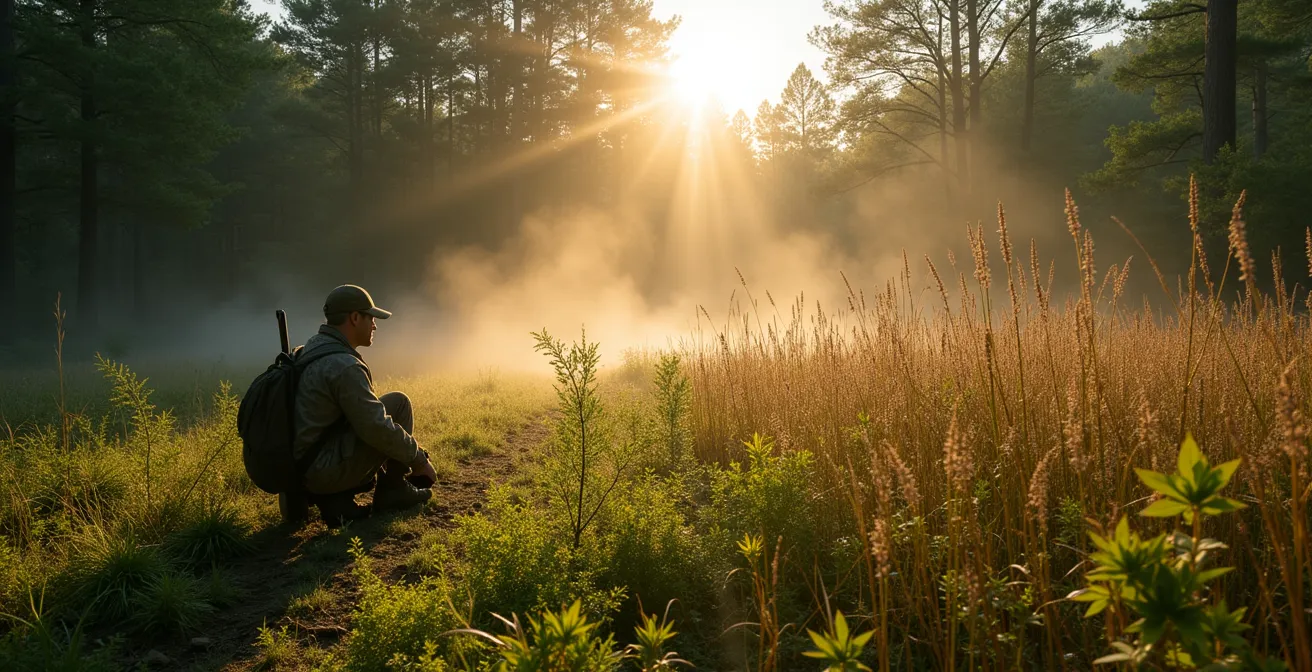
Hunters are more than just participants in an ecosystem; they are critical ecological engineers in the fight against invasive species and habitat degradation.
- Targeted removal of invasive species creates physical space and resources for native plants and wildlife to recover.
- Active land management, such as creating corridors and conducting prescribed burns, revitalizes entire habitats and restores complex food webs.
- Adopting low-impact practices ensures that hunting activities contribute positively to conservation without causing unintended harm.
Recommendation: Adopt a “restoration mindset” on every outing. Use your scouting time to gather ecological data and your actions to deliberately improve the health of the habitat you cherish.
The role of the hunter is often simplified to a single act: the harvest. This view, common in mainstream discussions, frames hunting as a tool for population control, a necessary but blunt instrument to manage species like white-tailed deer. While managing numbers is a valid outcome, this perspective completely misses the deeper, more intricate function that an ecologically-minded hunter serves. It overlooks the quiet, deliberate actions taken before and after the hunt—the hours spent analyzing the landscape, the manual labor of removing invasive flora, and the conscious choice to minimize one’s own footprint.
The truth is, modern conservation hunting is less about simple subtraction and more about sophisticated ecological engineering. In ecosystems where natural apex predators have been extirpated, the informed hunter can act as a proxy, not just by culling numbers, but by applying pressure that alters herbivore behavior and allows vegetation to regenerate. This role extends far beyond the animal itself. It involves becoming a student of the land, capable of reading the subtle signs of a biome’s health or distress—from the diversity of the dawn chorus to the fungal networks beneath your boots.
This article moves beyond the platitude of “hunters as conservationists.” It provides a framework for understanding and acting upon your role as a restorative force. We will explore the specific mechanisms by which your actions—or inactions—can trigger a positive trophic cascade, restoring the complex web of life that defines a healthy native biome. We will detail how to identify critical habitat zones, compare land management strategies, and implement low-impact practices that turn every hunting trip into a net-positive for the environment. It’s time to see the hunt not just as a harvest, but as an act of healing.
This guide breaks down the essential strategies and knowledge an ecological hunter can use to actively restore native environments. Explore the sections below to understand your critical role in a deeper, more actionable way.
Summary: The Hunter’s Guide to Ecological Restoration
- Why an Overpopulation of Deer Destroys Forest Regeneration?
- How to Identify Indicators of a Healthy Biome While Scouting?
- Food Plots vs. Native Vegetation: Which Supports More Biodiversity?
- The Land Management Error That Isolates Wildlife Populations
- When to Conduct Prescribed Burns to Enhance Nesting Grounds?
- How to Map Your Hunting Ground to Identify Critical Habitat Zones?
- Tent vs. Trailer: Which Base Camp Setup Minimizes Soil Compaction?
- How to Make Your Hunting Trips Carbon Neutral and Low Impact?
Why an Overpopulation of Deer Destroys Forest Regeneration?
In many ecosystems, the absence of apex predators like wolves and cougars has allowed deer populations to explode beyond historical norms. This isn’t just a matter of numbers; it’s a fundamental disruption of the ecological balance. Without the constant pressure of predation, deer behavior changes. They become bolder, browsing with impunity in open areas and systematically targeting the most palatable young trees and shrubs. This creates a distinct and visible “browse line” in the forest, typically about five feet from the ground, below which very little vegetation survives. The forest floor, once a nursery for future canopy trees like oaks and maples, becomes a barren landscape of ferns and grasses that deer avoid.
This intense browsing pressure directly halts forest regeneration. When saplings are continuously eaten, they never have the chance to grow into mature trees. The diverse understory—a critical habitat for ground-nesting birds, small mammals, and a host of insects—vanishes. The forest becomes a collection of old, mature trees with no next generation to replace them. Over time, this leads to a simplified, less resilient ecosystem that supports far less biodiversity. It’s a slow-motion collapse of the entire food web, starting from the ground up.
Here, the hunter’s role transcends simple culling. By selectively harvesting deer, a hunter can mimic the ecological function of a keystone predator. This not only reduces the overall number of herbivores but also restores a “landscape of fear.” The presence of hunters makes deer more cautious, forcing them to spend less time in open areas and vary their feeding patterns. This subtle behavioral shift gives the forest understory a crucial respite, allowing young trees and a diversity of native plants to finally take root and thrive, restarting the engine of ecological succession.
How to Identify Indicators of a Healthy Biome While Scouting?
An effective ecological hunter is also a skilled naturalist, using scouting time not just to find game, but to assess the overall health of the environment. Instead of looking only for tracks and rubs, you can train your senses to pick up on key bio-indicators—species or signs that provide a snapshot of ecosystem integrity. A truly vibrant biome is a symphony of interconnected life, and learning to hear the music is a powerful skill. This “citizen science” approach can provide invaluable on-the-ground intelligence that even remote surveys might miss.
This begins with expanding your awareness. Listen for the complexity of the dawn chorus; a healthy forest is loud with the calls of numerous bird species, not just the dominant few. Look for evidence of a thriving soil community, such as abundant earthworm castings and the presence of various dung beetles breaking down waste. A forest floor teeming with different types of mushrooms is another excellent sign, indicating a robust mycorrhizal fungi network that connects the entire plant community beneath the surface. These fungi are the hidden foundation of a resilient forest.

As this image illustrates, the health of an ecosystem is often found in the details. These intricate fungal threads are essential for nutrient transfer between trees and plants. To build your assessment skills, use a multi-sensory checklist during your scouts:
- Acoustic Clues: At dawn, count the distinct bird species you can identify by ear. Near water sources at dusk, listen for a variety of frog and toad calls, as amphibians are highly sensitive to pollution.
- Visual Soil Clues: Search for mushroom fruiting bodies. Check for earthworm castings and dung beetle activity on and around animal droppings.
- Pollinator Activity: During midday, note the diversity of bees, butterflies, and other pollinators. A variety of pollinators indicates a variety of flowering native plants.
By documenting these observations, perhaps in a dedicated journal or app, hunters collaborate with wildlife managers to track long-term trends, identify emerging threats from invasive species, and confirm the success of restoration efforts.
Food Plots vs. Native Vegetation: Which Supports More Biodiversity?
The practice of planting food plots is a cornerstone of modern deer management for many hunters. However, not all food plots are created equal. The traditional approach often involves planting a single species (a monoculture), such as clover or brassicas. While effective at attracting deer, these plots function as ecological deserts for most other wildlife. They offer a single food source for a short period and lack the structural diversity needed for nesting, cover, and foraging by a wide array of species. This approach can also increase disease transmission risk by concentrating animals in a small area.
In contrast, preserving and restoring native vegetation provides a complex, year-round habitat that supports the entire food web. Native warm-season grasses, forbs, and shrubs offer seeds, nectar, and nutritious browse for countless species, from pollinators and songbirds to small mammals and the game you pursue. They have deep root systems that improve soil health, prevent erosion, and require no artificial fertilizers or pesticides. A hunter managing for native vegetation is managing for a complete, resilient ecosystem.
A more advanced and ecologically beneficial approach is the polyculture food plot, which mimics the diversity of native habitats. By planting a strategic mix of native grasses, legumes, and forbs, land managers can create a habitat that offers multiple benefits. According to conservation groups working with hunters, polyculture designs can result in 30% higher biodiversity compared to traditional monoculture plots. These plots provide nesting cover for ground birds like quail and turkey, nectar for pollinators, and high-quality forage for game, all while enriching the soil through nitrogen fixation. The following table breaks down the key differences.
| Habitat Type | Species Diversity | Disease Risk | Pollinator Support | Soil Health Impact |
|---|---|---|---|---|
| Monoculture Food Plot | Low (5-10 species) | High concentration risk | Minimal | Depleting |
| Polyculture Food Plot | Medium (20-30 species) | Moderate, dispersed | Good seasonal support | Maintaining |
| Native Vegetation | High (50+ species) | Low, natural dispersal | Excellent year-round | Enriching |
The Land Management Error That Isolates Wildlife Populations
One of the most significant threats to wildlife today is not direct habitat destruction, but habitat fragmentation. This occurs when large, contiguous blocks of forest or grassland are broken up into smaller, isolated patches by roads, agriculture, or development. While these patches may still appear green and lush, their isolation creates invisible barriers that many species cannot cross. This prevents genetic exchange between populations, leading to inbreeding and a reduced ability to adapt to environmental changes. It also limits access to critical resources like food, water, and cover, which may be scattered across the fragmented landscape.
This fragmentation has cascading negative effects. It can concentrate animals in smaller areas, making them more vulnerable to disease and predation. Furthermore, fragmented landscapes often favor generalist and invasive species that thrive along “edges.” For instance, habitat fragmentation is a major factor that allows invasive species like feral hogs to expand their range and cause immense ecological and economic harm. In Texas alone, it is estimated that habitat fragmentation allows invasive species like feral hogs to cause $500 million in damage annually.
For the ecologically-minded hunter and land manager, the solution is to think beyond individual property lines and focus on connectivity. Creating and maintaining wildlife corridors—strips of native habitat that link larger isolated patches—is one of the most effective conservation strategies. These corridors can be as simple as letting a fencerow grow wild or undertaking a more ambitious project of reforesting a strip of land along a creek. They act as highways for wildlife, facilitating movement, promoting genetic diversity, and ensuring the long-term health of entire populations. By actively creating these links, you are mending the tears in the ecological fabric.
Action Plan: Creating Effective Wildlife Corridors
- Map potential corridors: Use topographic maps and aerial imagery (like OnX or Gaia GPS) to identify natural travel routes, such as stream beds or saddles between ridges, that connect separate habitat blocks.
- Remove artificial and natural barriers: Identify and clear obstacles along your chosen corridor path. This primarily involves removing dense stands of invasive plants like multiflora rose or autumn olive that can choke out travel lanes.
- Create cover with hinge-cutting: Use a chainsaw to partially cut through non-mast trees along the corridor’s edge. This technique fells the tree while keeping it alive, creating a “living brush pile” that offers excellent cover for wildlife movement without removing the tree canopy entirely.
- Time your management activities: Conduct all clearing and cutting work outside of peak breeding and nesting seasons (typically late spring and early summer) to avoid disturbing wildlife during their most vulnerable period.
- Monitor corridor usage: Strategically place trail cameras along the corridor to verify that it is being used by your target species and to document the variety of wildlife benefiting from the new connection.
When to Conduct Prescribed Burns to Enhance Nesting Grounds?
Fire is one of nature’s most powerful and misunderstood tools for habitat renewal. For millennia, natural fires swept across landscapes, clearing out dead vegetation, releasing nutrients into the soil, and stimulating the growth of fire-adapted native plants. In the absence of this natural cycle, many habitats become choked with thick undergrowth, which suppresses valuable food sources and creates poor conditions for ground-nesting birds like wild turkey and quail. A prescribed burn is the deliberate application of fire by trained managers to a specific area under controlled weather conditions to restore this essential ecological process.
The key to a successful burn is timing. Burns are typically conducted during the dormant season—either in the late fall after leaves have dropped or in the late winter/early spring before green-up. This timing minimizes harm to wildlife and growing plants while effectively removing the accumulated fuel load of dead leaves and thatch. The goal is not to scorch the earth, but to run a low-intensity fire that moves quickly across the landscape. This process scarifies the seeds of native forbs and grasses, promoting their germination and creating a flush of tender, nutritious new growth that is irresistible to deer, turkey, and other wildlife.
Advanced techniques, such as the mosaic burn, create even greater habitat diversity. Instead of burning a large block at once, a mosaic burn involves burning smaller, adjacent patches on a rotational basis over several years. This creates a patchwork of habitats at different successional stages, providing everything wildlife needs in one compact area. As noted by wildlife management agencies, this technique has been particularly successful in increasing wild turkey and quail populations by providing open nesting areas, bug-rich brood-rearing cover, and thick escape cover all in close proximity. Before any burn, a thorough ecological survey is crucial:
- Identify and flag any den trees or snags used by wildlife.
- Locate and GPS-mark populations of any rare or threatened plants to create a firebreak around them.
- Map any seasonal wetlands or amphibian pools to protect them from fire.
- Document active bird nesting sites if burning near the start of the breeding season.
- Plan and create effective firebreaks to ensure the burn is safely contained.
How to Map Your Hunting Ground to Identify Critical Habitat Zones?
The modern hunter has access to powerful digital mapping tools that can transform them from a simple visitor into a sophisticated habitat analyst. Apps like OnX and Gaia GPS are more than just navigational aids; they are ecological databases. By learning to layer different types of information, you can create a dynamic map that reveals the hidden patterns of your hunting ground and identifies critical habitat zones—the areas that are disproportionately important for wildlife survival.
The process begins with the basics: overlaying topographic maps with aerial imagery and property boundaries. From there, you can start adding your own data. Mark key resources like water sources (creeks, ponds, vernal pools), food sources (oak flats, old apple orchards, native browse areas), and cover types (thick bedding areas, conifer stands for thermal cover). Use trail camera data not just to see what animals are present, but to map their movement patterns with timestamps, revealing daily travel routes between bedding and feeding zones. A particularly powerful technique is to identify and map thermal zones, such as south-facing slopes that receive more winter sun and provide crucial refuge during cold snaps.
This mapping strategy becomes a powerful tool for invasive species management. By creating polygons showing the exact boundaries of invasive plant colonies (like phragmites or Japanese stiltgrass), you can plan targeted removal efforts and track their effectiveness over time. This level of precision is exactly what’s needed for large-scale success. For example, in one region, a highly targeted approach to feral swine control, informed by coordinated mapping and bounty programs, helped remove 2,877 feral swine from the area. Your personal map becomes a living document that guides your hunting strategy and your habitat improvement projects, ensuring your efforts are focused where they will have the greatest ecological impact.
Tent vs. Trailer: Which Base Camp Setup Minimizes Soil Compaction?
A hunter’s impact doesn’t begin and end with the hunt itself. The choice of a base camp setup can have a lasting, often-overlooked effect on the habitat. The primary concern is soil compaction. Concentrated foot traffic and, more significantly, the weight of vehicles and trailers, compress the soil. This destroys its porous structure, preventing water infiltration, killing plant roots and soil microorganisms, and creating a dead zone where nothing can grow for years. An area used for a trailer camp can take 3-5 seasons to even begin showing signs of recovery after it’s vacated.
A traditional tent camp, where gear is often hiked in and dispersed over a wider area, has a significantly lower impact. Foot traffic is less concentrated, and the absence of a vehicle minimizes severe compaction. However, even tent camps can cause damage if used in the same spot year after year. Other factors to consider are light pollution from generators, the potential for greywater runoff to contaminate nearby water sources, and the risk of transporting invasive plant seeds on tire treads or boot soles.
For those committed to the lowest possible impact, a platform-based solution is ideal. Building a small, raised wooden deck to serve as the tent or kitchen floor completely eliminates soil compaction. But for most, the most practical approach is a strategic rotation of campsites. By establishing three designated campsites and rotating between them annually, you give each site a two-year recovery period. This simple strategy dramatically reduces long-term damage. Combining this with a “Leave No Trace” ethic—packing out all waste, using established paths, and minimizing fire impact—ensures your presence is as light as possible. The following table highlights the differences in impact.
This comparative data, adapted from analyses by conservation-focused land management groups, clearly shows the trade-offs. The environmental impact of different camp setups demonstrates that a trailer, while convenient, carries significant ecological costs that require careful management to mitigate.
| Impact Factor | Tent Camp | Trailer Camp | Platform Solution |
|---|---|---|---|
| Soil Compaction | Minimal, dispersed | Severe, concentrated | None (elevated) |
| Light Pollution | Low (headlamps) | High (generators) | Variable |
| Invasive Seed Transport | Low risk | High (tire treads) | Minimal |
| Recovery Time Needed | 1-2 seasons | 3-5 seasons | Immediate |
| Greywater Impact | Easily dispersed | Concentrated runoff | Manageable |
Key Takeaways
- Hunters can functionally replace apex predators, using harvest and pressure to manage herbivore populations and allow forest regeneration.
- Active habitat management, including creating wildlife corridors and conducting prescribed burns, is as crucial as animal removal for ecosystem restoration.
- A commitment to low-impact practices, from camp setup to gear choice, ensures that hunting remains a sustainable and positive force for conservation.
How to Make Your Hunting Trips Carbon Neutral and Low Impact?
The ultimate goal for an ecological hunter is to ensure their presence in the wild is a net positive. This involves moving beyond simply minimizing negative impacts and actively seeking ways to generate positive ecological returns, including offsetting the carbon footprint of your activities. While travel to a hunting area is a source of emissions, your actions on the ground can more than compensate for it. Conservation organizations have found that hunter-funded habitat projects, such as restoring wetlands and planting mast-producing trees, actively sequester measurable amounts of carbon from the atmosphere.
These projects serve the dual purpose of creating superb wildlife habitat while simultaneously combating climate change. An ecosystem recovering from invasive species removal and benefiting from active restoration stores carbon at an accelerated rate. Every invasive plant you remove and every native tree you plant contributes to this carbon sink. A powerful mindset shift is to dedicate a portion of every hunting trip to “restoration work.” Committing just two hours per trip to manually removing invasive plants in a critical area can have a significant cumulative effect over a season.
This low-impact philosophy extends to gear choices. Opting for durable materials like wool over synthetic fleece reduces microplastic pollution. Investing in gear that is repairable rather than disposable minimizes waste. Using wax-based waterproofing agents avoids introducing harmful chemicals into the ecosystem. The final piece of the puzzle is to practice a “pack it out, plus one” mentality—always leaving the woods cleaner than you found it by removing any extra trash you encounter. By combining these practices, you transform from a user of the resource to its most dedicated steward.
- Choose Natural & Durable Materials: Select wool or waxed canvas over synthetic fabrics to reduce microplastic shedding. Prioritize gear that can be repaired.
- Avoid Harmful Chemicals: Use wax-based waterproofing and biodegradable soaps to protect soil and water health.
- Dedicate Restoration Time: Commit a few hours each trip to a specific task, such as removing invasive plants or documenting species for a citizen science app like iNaturalist.
- Leave It Better: Pack out all of your own trash and make a point to pick up one extra piece of litter left by others.
By embracing these strategies, the ecologically-minded hunter completes the circle, actively participating in the restoration and long-term health of the very biomes they cherish. The next time you step into the wild, consider every action an opportunity to heal the land.