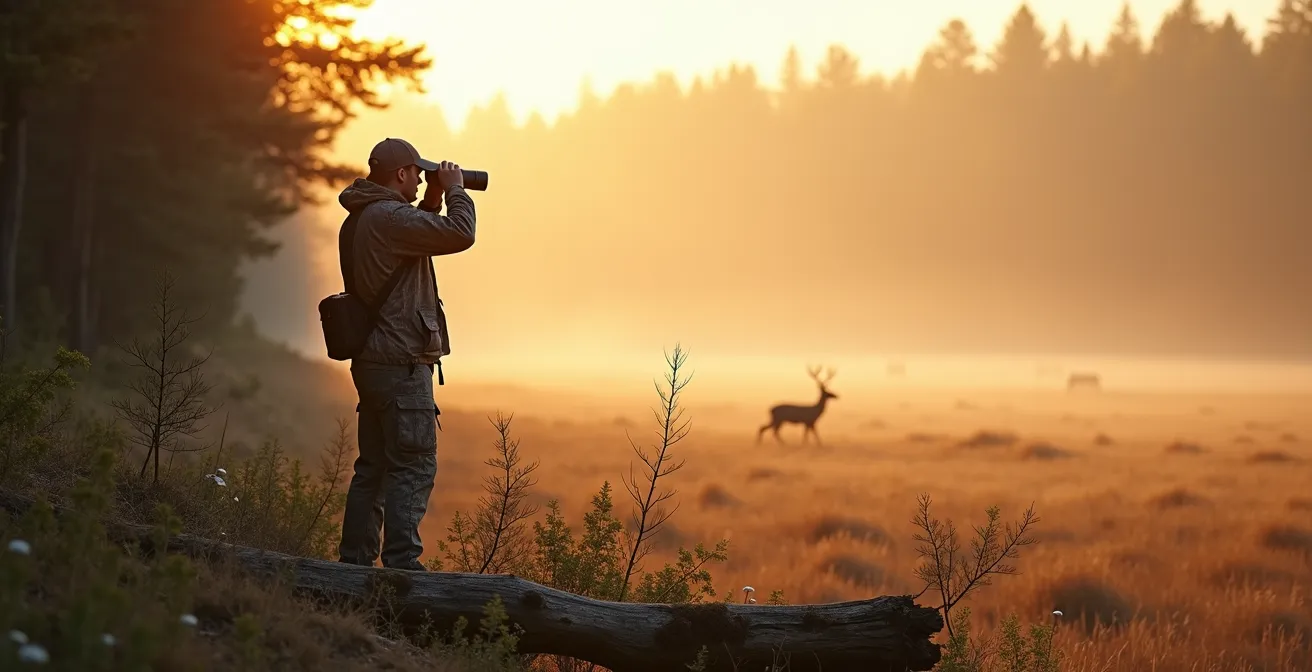
Modern hunting’s greatest contribution to conservation isn’t just funding, but its transformation into a hands-on, data-driven form of ecological stewardship.
- Hunters act as “citizen scientists,” providing critical field data that wildlife agencies use to monitor herd health and manage ecosystems.
- A “regenerative” approach prioritizes habitat improvement, biodiversity, and ethical harvesting over simple extraction, creating a net positive ecological impact.
Recommendation: The key is shifting perspective from seeing hunting as a right of extraction to a responsibility of stewardship, where success is measured by the health of the land.
The conversation around hunting is often polarized, framed as a simple conflict between animal welfare and human tradition. For many, the image of a hunter is one of pure extraction—a person who takes from nature without giving back. While it’s commonly stated that hunters fund conservation through license fees, this transactional view barely scratches the surface of a much deeper, more symbiotic relationship that is emerging. This financial contribution is not a simple payment; it is the fuel for a complex engine of scientific wildlife management.
The common understanding often misses the profound shift occurring within the hunting community itself. The dialogue is moving away from a focus on pursuit and toward a philosophy of active stewardship. This evolution redefines the hunter’s role from a passive consumer of a natural resource to an active participant in its regeneration. It demands a sophisticated understanding of ecology, a commitment to data collection, and a hands-on approach to habitat management. The true measure of a successful hunt is no longer just a filled tag, but a thriving, resilient ecosystem.
But what does this transformation from pursuer to steward actually look like in practice? It’s about developing an intimate “habitat literacy”—the ability to read a landscape, identify its needs, and work to improve its health. It’s a move from focusing solely on game species to nurturing the entire web of life, from pollinators to predators. This article explores the principles and practices that define this modern conservation ethic, demonstrating how the engaged hunter becomes one of nature’s most effective and dedicated caretakers, generating a positive ecological return on investment that goes far beyond the hunt itself.
This guide will walk you through the core tenets of this stewardship model, from the data hunters provide to the ethical considerations of the harvest itself. Explore the sections below to understand this evolving partnership between hunter and habitat.
Summary: How Hunting Becomes a Tool for Ecological Stewardship
- Why Wildlife Agencies Rely on Hunter Data to Monitor Herd Health?
- How to Map Your Hunting Ground to Identify Critical Habitat Zones?
- Stewardship vs. Extraction: What Defines a Regenerative Hunter?
- The Tracking Mistake That Disturbs Bedding Areas for Weeks
- How to Revitalize a Depleted Hunting Zone Through Active Observation?
- Food Plots vs. Native Vegetation: Which Supports More Biodiversity?
- Why Switching to Copper Ammo Is the Single Biggest Eco-Move You Can Make?
- How to Ensure a Quick Kill That Minimizes Animal Suffering?
Why Wildlife Agencies Rely on Hunter Data to Monitor Herd Health?
State and federal wildlife agencies are the architects of conservation, but they cannot operate in a vacuum. Managing vast landscapes and dynamic animal populations requires a constant flow of reliable, on-the-ground data. This is where hunters transition from being subjects of regulation to becoming indispensable partners in science. Every harvest report, jawbone submission, and field observation provides a crucial data point that feeds into sophisticated population models. These models help biologists determine herd demographics, assess the prevalence of diseases like Chronic Wasting Disease (CWD), and understand how populations are responding to environmental pressures such as drought or habitat loss.
This role as a citizen scientist is fundamental to the North American Model of Wildlife Conservation. The funding generated by hunters is significant; according to the Rocky Mountain Elk Foundation, hunters contribute over $1.6 billion annually to conservation programs. However, the true value lies in how this money empowers data-driven management. It pays for the helicopters used in aerial surveys, the labs that test for disease, and the salaries of the biologists who interpret the information hunters provide. Without this constant feedback loop, agencies would be making decisions with incomplete information, risking either unchecked population growth that degrades habitats or overly restrictive measures that are not scientifically justified.
The success of this model is evident in numerous recovery stories. The Louisiana black bear, for instance, was listed as endangered in 1992. Through habitat restoration and careful management funded by hunters, the species recovered and was de-listed in 2016. In 2024, the state approved a highly limited, science-based hunting season. This isn’t a failure of conservation; it is its ultimate success—a demonstration that a species can be restored to the point where it can be managed, in part, through regulated hunting, ensuring its long-term health and a continued source of conservation funding.
How to Map Your Hunting Ground to Identify Critical Habitat Zones?
Effective stewardship begins with deep knowledge of the land. A regenerative hunter doesn’t just see a forest; they see a complex mosaic of systems, each with a specific function. The first step in developing this “habitat literacy” is to create a comprehensive map of your hunting area. This goes far beyond simply marking stand locations. It’s an ecological audit designed to identify the key resources that wildlife depend on throughout the year. Modern tools like public GIS data, satellite imagery (Google Earth), and LiDAR elevation models can be overlaid to create a powerful analytical tool, revealing patterns of animal movement and resource availability.
This detailed mapping allows a hunter to think like a biologist. Start by identifying the three pillars of habitat: food, water, and cover. This isn’t a static exercise. A critical element is creating seasonal overlays to understand how the landscape’s value shifts. A south-facing slope that offers little in the summer becomes a vital thermal refuge after a winter storm. A stream that is a primary water source in a dry autumn may become irrelevant in a wet spring when vernal pools appear. Documenting these shifts is key to predicting animal behavior and minimizing pressure on sensitive areas.
To truly understand the land, you must visualize its components. The map below conceptualizes how different habitat features can be digitally layered over an aerial view to inform stewardship decisions.
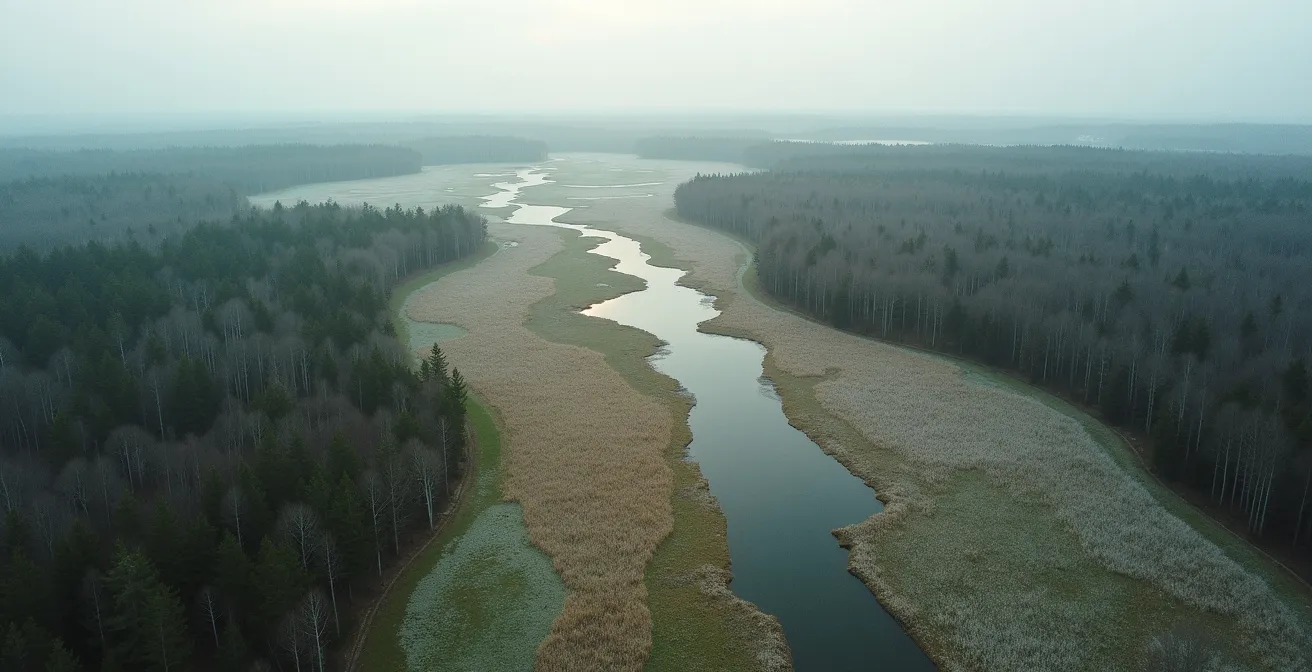
As this visualization suggests, a steward also maps the “negative spaces”—areas of poor ecological value. These might be fields overrun with invasive species or zones of significant soil erosion. By identifying these problem areas, a hunter can prioritize their conservation efforts, such as removing non-native plants or working on small-scale erosion control. This transforms the map from a simple hunting tool into a strategic plan for ecological restoration, directly improving the land’s carrying capacity for all species.
Stewardship vs. Extraction: What Defines a Regenerative Hunter?
The term “conservationist” is often applied to hunters, but it’s a label that needs clear definition in a modern context. As conservationist Bryan Bedrosian noted in an interview, “Hunters are the original conservationists. This should be something that we should all try and get behind.” To truly embody this ideal today, a hunter must consciously choose a path of stewardship over one of simple extraction. This choice represents a fundamental philosophical divide in how one interacts with the natural world. An extractive mindset views wildlife as a resource to be harvested, with success measured in filled tags or trophy size. The land is merely the backdrop for the pursuit.
In contrast, a regenerative hunter operates from a place of ethical reciprocity. They understand that taking an animal’s life incurs a debt that is repaid through dedicated work to enhance the ecosystem. For this hunter, success is measured by an increase in species diversity, the recovery of native plants, and visible improvements in soil and water health. Their engagement doesn’t end when the tag is filled; it’s a year-round commitment to observation, data collection, and hands-on habitat work. This approach seeks a positive ecological return on investment (ROI), where the hunter’s positive contributions to the habitat far outweigh the impact of their harvest.
The distinction between these two approaches becomes clear when their practices are compared side-by-side. As an analysis from hunting education resources highlights, the focus shifts from personal gain to ecosystem health. The following table breaks down these contrasting philosophies.
| Aspect | Extractive Approach | Regenerative Approach |
|---|---|---|
| Success Metrics | Filled tags, trophy size | Species diversity increase, habitat improvement, native plant recovery |
| Data Collection | Basic harvest reporting | Year-round ecosystem monitoring, non-game species documentation |
| Habitat Interaction | Minimal engagement | Active restoration, invasive species removal, habitat enhancement |
| Conservation Role | License buyer | Citizen scientist, data contributor, restoration volunteer |
| Long-term Impact | Neutral to negative | Positive ecological ROI through habitat work exceeding harvest impact |
Ultimately, becoming a regenerative hunter is a conscious decision to be a caretaker. It’s about cultivating a deep, scientific, and respectful relationship with the land, recognizing that the hunter is not separate from the ecosystem but an integral and responsible part of it. It transforms hunting from a seasonal activity into a lifelong practice of ecological stewardship.
The Tracking Mistake That Disturbs Bedding Areas for Weeks
A core principle of stewardship is minimizing negative impact. Nowhere is this more critical than in how a hunter moves through the landscape. The most common and damaging mistake made by inexperienced or extractive-minded hunters is the careless disturbance of bedding areas. These sanctuaries, often located in thick cover with strategic wind advantages, are essential for an animal’s survival. They are not merely places to rest; they are zones of security where animals like deer conserve energy, digest food, and avoid predators. Busting into a bedding area creates a significant stress event.
Wildlife management studies show that when a hunter stumbles through a core bedding zone, the impact is far greater than just spooking a single animal. It displaces entire family groups, forcing them into less optimal territory where they may be more vulnerable to predation or weather. This sudden relocation forces them to expend critical energy reserves. The psychological impact is also significant; the area is marked as unsafe, and it can take weeks for animals to feel secure enough to return. Research indicates that the recovery time for a disturbed bedding area is a minimum of two to three weeks, with some sensitive areas taking months to return to normal use patterns.
This single mistake can compromise an entire hunting season and, more importantly, places undue stress on the very wildlife the hunter purports to respect. A regenerative hunter, therefore, prioritizes an “observation-first” approach. They use binoculars and spotting scopes from a distance to locate animals in feeding or transition zones, avoiding the need to blindly push into potential security cover. They learn to read the subtle signs that indicate a bedding area is nearby—an abundance of old beds, a lack of fresh tracks, specific terrain features—and give these zones a wide berth. This respect for an animal’s sanctuary is a hallmark of ethical stewardship.
Action Plan: Preventing Bedding Area Disturbance
- Identify No-Go Signs: Before entering a thicket, look for the absence of fresh tracks, an abundance of older, matted-down beds, and terrain features that scream “security cover.” If these signs are present, back out.
- Adopt Observation-First Tracking: Use binoculars or a spotting scope from a distance to confirm an animal’s location before ever taking a step in its direction. Track with your eyes, not just your feet.
- Implement a Disturbance Protocol: If you accidentally disturb a bedding area, mark its location on your map and implement a strict policy of complete avoidance for a minimum of three weeks. No exceptions.
- Refine Your Routes: Use your map to document any disturbance locations. Analyze this data at the end of the season to refine your future entry and exit routes to avoid these sensitive zones entirely.
- Focus on Transition Zones: Concentrate your tracking and hunting efforts on feeding areas (like food plots or oak flats) and the transition corridors animals use to travel between food and bedding, rather than their core sanctuaries.
How to Revitalize a Depleted Hunting Zone Through Active Observation?
A true steward doesn’t just take from the land; they actively work to heal it. Many hunting properties, whether private or public, contain zones that are ecologically depleted. These areas may suffer from poor soil, a lack of critical resources, or the dominance of invasive species, making them unable to support a robust wildlife population. The first step toward revitalization is not to immediately start planting or clearing. It is to engage in a full season of active observation—a process of conducting a thorough ecological audit with nothing more than a notebook, binoculars, and patience.
This process involves systematically documenting what is present and, more importantly, what is missing. The goal is to identify the single greatest “limiting factor” for wildlife. Is it a lack of thermal cover for winter? A scarcity of safe fawning habitat in the spring? Or perhaps a deficiency in year-round water sources? By observing the landscape through all four seasons, a steward can diagnose the root cause of its low productivity. This audit should include tracking not just game species but also “indicator species” like songbirds, amphibians, and insects, as their presence or absence provides a clear signal of overall ecosystem health.
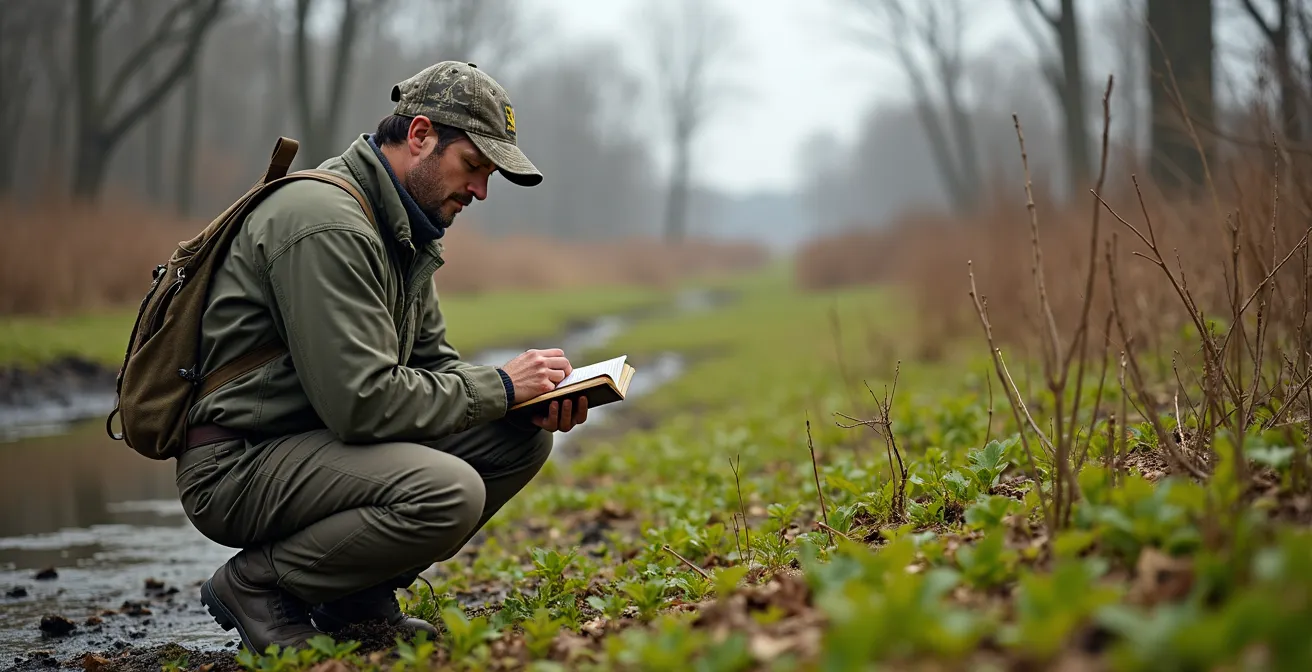
This hunter is kneeling beside a recovering wetland, embodying the hands-on, observational approach required for habitat revitalization. This image captures the essence of stewardship: the quiet work of watching, learning, and helping nature heal itself.
Once the limiting factor is identified, targeted, small-scale interventions can begin. This is often more effective than large, expensive projects. For example, simply felling a few non-valuable trees can create “soft edges”—gradual transitions from field to forest that benefit a huge range of species by providing both food and cover in close proximity. Another effective strategy is hinge-cutting trees to create immediate ground-level cover. The key is to document the baseline conditions *before* taking any action, allowing the steward to accurately measure the positive impact of their work over time and prove a positive ecological ROI.
Food Plots vs. Native Vegetation: Which Supports More Biodiversity?
A common practice in modern wildlife management is the planting of food plots—agricultural plantings of species like clover, brassicas, or corn designed to attract and nourish game animals, primarily deer. While they can be effective for this narrow purpose, a regenerative hunter must ask a deeper question: do they support overall biodiversity? From an ecological perspective, a typical food plot is a monoculture. It provides a high-quality food source for a few select species for a limited part of the year. However, it often fails to provide the complex structure, diverse food sources, and year-round cover that a wide array of wildlife requires.
In contrast, restoring and managing native vegetation creates a resilient, self-sustaining ecosystem. A field of native warm-season grasses and wildflowers offers far more than just food. It provides nesting habitat for ground-nesting birds like quail and turkey, cover for fawns, and a crucial food source for a vast community of pollinators. These native ecosystems are adapted to local climate and soil conditions, making them highly drought-resistant and requiring minimal maintenance once established. Recent research from Working Lands for Wildlife shows that grazed native pastures supported 2-3 times more pollinators than un-grazed or cultivated plots, demonstrating the immense value of native habitats.
The choice between a food plot and native vegetation highlights the difference between managing for game and stewarding an ecosystem. While food plots have their place as a supplemental tool, an over-reliance on them can create an artificial system dependent on annual tilling and fertilizing. A steward recognizes that the most powerful and sustainable way to improve a property is to restore the native plant communities that co-evolved with its wildlife. The following table illustrates the dramatic difference in ecological impact between these two approaches.
| Factor | Food Plots (Monoculture) | Native Vegetation |
|---|---|---|
| Species Supported | 3-5 game species seasonally | 50+ species year-round including pollinators, birds, small mammals |
| Maintenance Required | Annual tilling, seeding, fertilizing | Self-sustaining once established |
| Annual Cost | $200-500 per acre | $50-100 per acre after establishment |
| Drought Resistance | Low – requires irrigation in dry years | High – adapted to local conditions |
| Ecosystem Services | Limited – primarily food | Multiple – food, cover, nesting, pollination, soil health |
Why Switching to Copper Ammo Is the Single Biggest Eco-Move You Can Make?
A steward’s responsibility does not end with the boundaries of their property or the life of the animal they harvest. It extends to the entire ecological web, including the scavengers that play a vital role in cleaning the landscape. For over a century, the vast majority of hunting ammunition has been made with lead. While effective, lead is a potent neurotoxin that has a devastating, unintended consequence. When a lead bullet strikes an animal, it fragments into hundreds of tiny pieces, contaminating the meat. If a gut pile or an unrecovered animal is left in the field, this lead enters the food chain.
Scavenging birds like eagles, condors, and hawks are particularly vulnerable. A single lead fragment the size of a grain of rice is enough to kill a bald eagle. The scale of the problem is staggering; wildlife rehabilitation data reveals that up to 75% of eagles brought to centers suffer from lead poisoning. This is not a hypothetical risk; it is a documented crisis that hunters have the power to solve. The classic case is that of the California condor, a species brought to the brink of extinction largely due to lead poisoning from consuming lead-shot carcasses.
The solution is simple and readily available: switching to non-toxic ammunition, primarily copper. Modern monolithic copper bullets are engineered for exceptional performance, offering deep penetration and high weight retention without fragmenting like lead. By making this switch, a hunter completely eliminates the risk of poisoning scavengers that consume the remains of their harvest. It is a decision that has an immediate and direct positive impact on wildlife conservation, protecting vulnerable species and ensuring the health of the entire ecosystem. Choosing copper is not an anti-hunting stance; it is the ultimate pro-hunting act of a modern steward, aligning a hunter’s actions with their conservation ethic.
Key Takeaways
- True stewardship extends beyond game species to the entire ecosystem, including scavengers.
- Lead ammunition fragments upon impact, creating hundreds of toxic particles that poison wildlife, especially birds of prey like eagles and condors.
- Switching to non-toxic copper ammunition is a simple, highly effective action that completely eliminates this risk and demonstrates a profound commitment to ecological integrity.
How to Ensure a Quick Kill That Minimizes Animal Suffering?
The final, and most profound, act of a hunting steward is the harvest itself. This moment is the culmination of all the observation, preparation, and respect that defines the regenerative approach. The primary ethical obligation at this stage is to ensure a quick, humane kill that minimizes animal suffering. This is not a matter of luck; it is a matter of discipline, knowledge, and rigorous self-assessment. An ethical shot is the result of a calculated decision-making process, not a hopeful prayer. A responsible hunter lives by a strict personal framework for when to shoot and, more importantly, when not to.
This framework, often called the “Ethical Shot Equation,” requires a hunter to honestly evaluate several factors in a split second. These include: their own marksmanship skills under pressure, a precise knowledge of the animal’s anatomy to target the vital organs, and confirmation that their equipment is appropriate for the game and distance. These factors must always outweigh the challenges presented by the situation, such as the range to the animal and its current state (Is it calm and broadside, or alert and moving?). A steward prioritizes the animal’s welfare above the desire to fill a tag and will always pass on a marginal shot.
Furthermore, this discipline is not just developed in the field. It is honed through consistent, realistic practice. This includes “stress inoculation”—practicing shooting under an elevated heart rate, from awkward field positions, and under time pressure to simulate real-world conditions. By establishing a maximum effective range based on consistent accuracy in practice, a hunter removes ego and guesswork from the equation. The harvest, when it comes, is an act of profound respect, a quiet and somber moment that honors the life of the animal and solidifies the hunter’s role as a responsible, integral part of the ecosystem.
By embracing this holistic philosophy—from data collection and habitat work to the final, ethical harvest—the modern hunter completes the transformation from pursuer to true ecological steward, ensuring that the traditions of hunting contribute directly to a wilder, healthier future for all species.