Stopping the spread of invasive species requires anglers to evolve from passive users to active ecosystem guardians.
- Simple prevention like “Clean, Drain, Dry” is the baseline, but its true power is unlocked when combined with vigilant observation and data reporting.
- Your actions on and off the water—from how you walk on a riverbank to how you dispose of fishing line—have a direct impact on habitat health and biodiversity.
Recommendation: Adopt a “sentinel mindset” on every trip. Treat your boat as a potential vector, your observations as critical data, and your fishing license as a direct investment in conservation.
For any angler who has returned to a favorite spot only to find it choked with unfamiliar, dense weeds, the feeling is one of profound loss. The familiar clear water is gone, the native fish are harder to find, and the character of the place is fundamentally altered. The common advice to combat this is the well-known mantra: “Clean, Drain, Dry.” This protocol is the bedrock of invasive species prevention, and its importance cannot be overstated. However, focusing solely on this defensive action misses a greater opportunity and a more profound responsibility.
The fight against invasive aquatic species is not just about preventing their spread; it’s also about active surveillance, habitat protection, and data collection. This is where the role of the angler transforms. You are not merely a potential vector of contamination; you are the first line of defense, an on-the-ground observer with an intimate knowledge of your local waters. Your vigilance is a resource that professional biologists, often stretched thin, cannot replicate. What if the key to protecting our waters wasn’t just cleaning your boat, but turning every fishing trip into an act of ecosystem stewardship?
This guide moves beyond the basics. We will explore how specific actions, from meticulous hull inspections to conscious choices on the riverbank, contribute to a larger conservation effort. We will delve into why certain disposal methods are harmful, how your license fees fuel restoration, and most importantly, how your personal catch data can become a powerful tool for scientific research and habitat recovery. It’s time to transition from simply using the resource to actively guarding it.
This article details the practical, high-impact strategies that empower every angler to become a crucial partner in aquatic conservation. The following sections break down these key areas of responsibility and action.
Summary: Your Guide to Becoming an Angler-Conservationist
- The Hull Inspection Step That Prevents Zebra Mussel Transfer
- How to Walk Along Riverbanks Without Causing Massive Erosion?
- Who to Call When You Spot a Chemical Sheen on the Water?
- Why Burning Fishing Line Is Worse Than throwing It in the Trash?
- How Buying a Fishing License Directly Funds Wetland Restoration?
- Food Plots vs. Native Vegetation: Which Supports More Biodiversity?
- How to Test Water Clarity and pH for Local Conservation Groups?
- Citizen Science: How Your Catch Data Helps Restore Native Populations?
The Hull Inspection Step That Prevents Zebra Mussel Transfer
The “Clean, Drain, Dry” mantra is most critically applied to preventing the spread of biofouling organisms like zebra and quagga mussels. These small, sharp-shelled mollusks can survive out of water for days, hitchhiking on boat hulls, in engine cooling systems, or in residual bilge water. Their impact is not just ecological; an analysis of their presence in North American waterways shows that zebra mussels cause economic harm of over $1 billion per year, primarily by clogging water intake pipes for power plants and municipal water supplies. This makes a thorough hull inspection not just an environmental duty, but an act of protecting critical infrastructure.
The state of Minnesota provides a sobering case study. In 2024, it became the state with the most zebra mussel-infested lakes in the USA. In response, the Department of Natural Resources ramped up its prevention program, inspecting over 450,000 watercraft and performing over 4,100 decontaminations for boats leaving infested waters. This aggressive, data-driven approach highlights the severity of the threat and the necessity of every boater’s participation. Your personal inspection is the first and most effective checkpoint in this widespread battle.
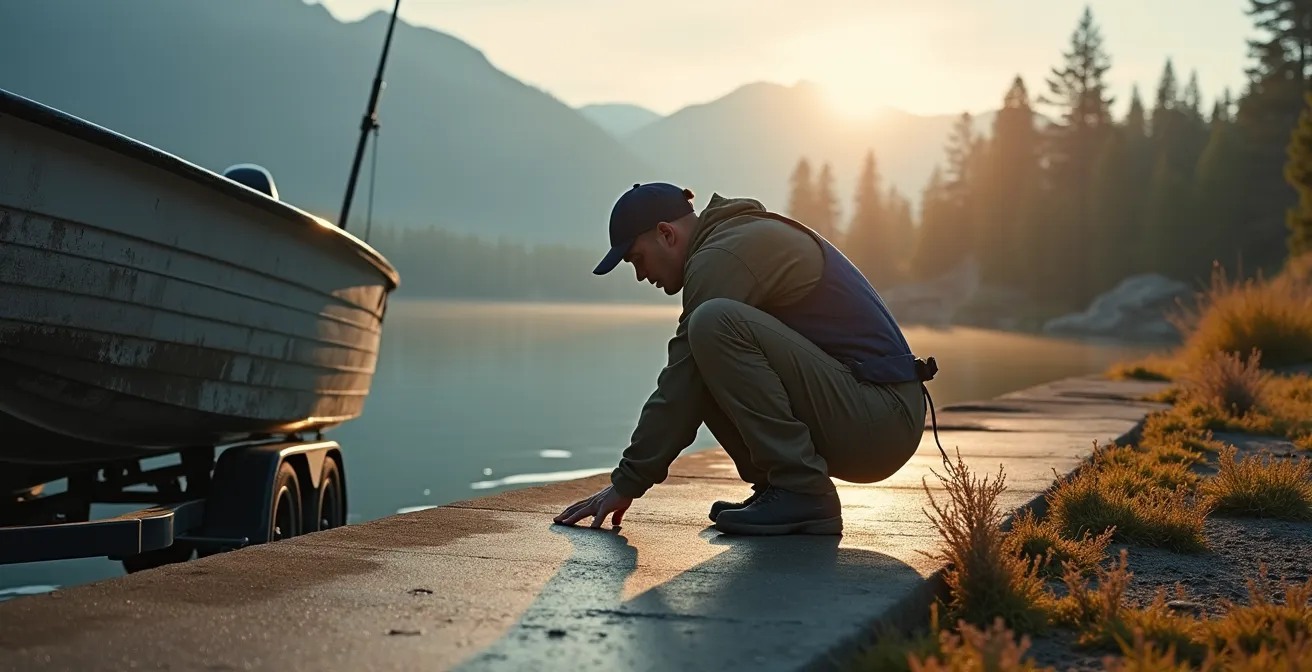
While a visual check is good, a hands-on approach is better. Run your hand over the hull, especially near the trailer bunks, transducers, and engine mounts. Zebra mussels feel like sandpaper when small. Pay special attention to any water-holding compartments. The key is to be methodical and assume that if you’ve been in infested water, you are carrying something until you’ve proven otherwise through a rigorous cleaning process.
How to Walk Along Riverbanks Without Causing Massive Erosion?
An angler’s impact isn’t limited to what they carry between water bodies; it also includes their physical footprint on the surrounding habitat. Riverbanks and shorelines are fragile ecosystems. The vegetation that grows there, from willows and sedges to native grasses, forms a critical root mat that holds the soil together. When this vegetation is repeatedly trampled, it creates bare patches of soil that are highly susceptible to erosion from rain and high water. This sediment runoff clouds the water, smothers fish spawning beds, and can carry pollutants into the river.
The principle of “Leave No Trace” is paramount for bank anglers. The goal is to move through the environment without creating new paths or compacting sensitive areas. Instead of walking on soft soil or through delicate plants, actively look for more durable surfaces. Natural rock formations, gravel bars, and the exposed roots of large, mature trees provide solid footing that can withstand traffic without degrading. When fishing with a group, walking in a single file line minimizes the width of any disturbance.
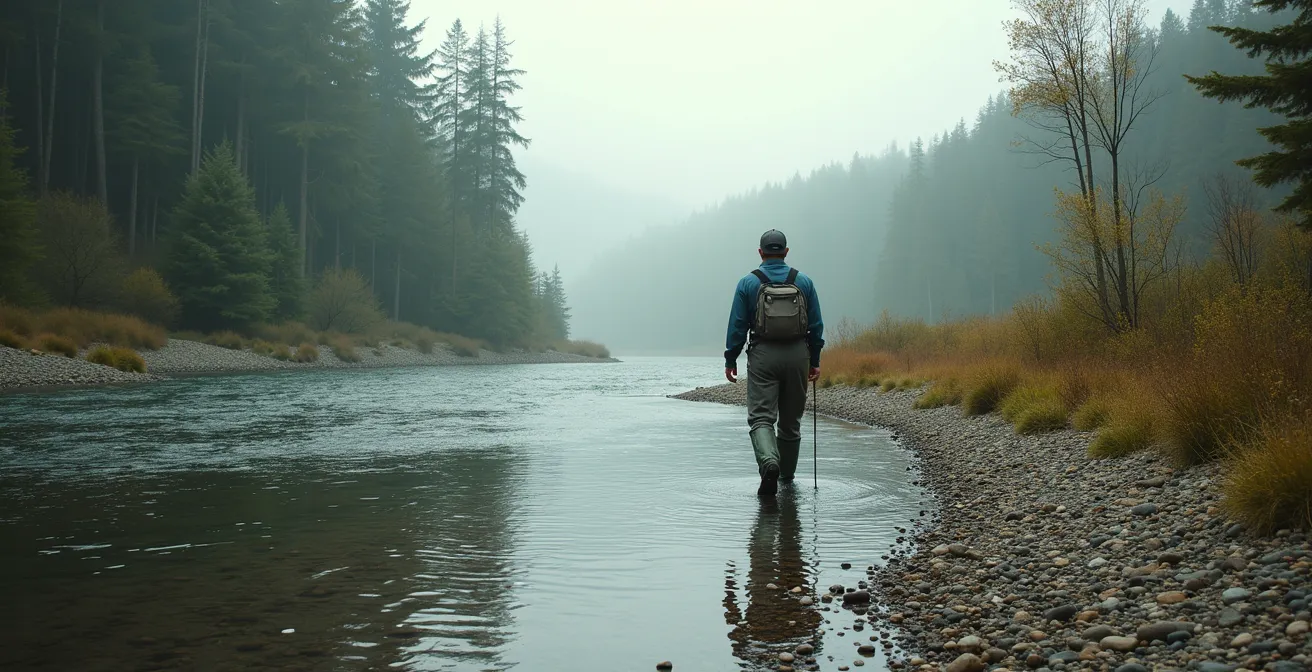
As the image above illustrates, a conscious angler uses the natural landscape to their advantage, protecting the fragile bank. In many cases, the most responsible path is in the water itself. Wading parallel to the bank is often a far less impactful option than walking on it. If you do accidentally dislodge a clump of soil, take a moment to pat it back into place. Resisting the urge to cut a new “social trail” down a steep bank and instead using an existing, stable access point is a small choice that collectively preserves the integrity of the entire watershed.
Who to Call When You Spot a Chemical Sheen on the Water?
As an angler, your time on the water makes you a frontline observer of water quality. You are more likely than anyone to notice subtle changes, including the ominous, rainbow-colored sheen of a chemical or oil spill, or the sudden, explosive growth of algae. These are not just aesthetic issues; they are direct indicators of pollution that can have devastating effects on a fishery. When you spot such a problem, you have a critical responsibility to report it. The first and most important contact should be your state’s environmental protection agency or department of natural resources. Most states have a dedicated 24/7 pollution hotline for this exact purpose. Have this number saved in your phone before you even leave the dock.
Beyond dramatic spills, be vigilant for signs of nutrient pollution. This type of pollution, often from agricultural or residential runoff, is invisible but fuels the growth of both algae and invasive aquatic plants. As the Theodore Roosevelt Conservation Partnership notes, this pollution is a major driver of invasive species dominance.
Nutrient pollution (nitrogen, phosphorus) acts as a steroid for many invasive aquatic plants, allowing them to outcompete and smother native species.
– Theodore Roosevelt Conservation Partnership, Every Angler Can Help Control Aquatic Invasive Species
When reporting, be prepared to provide as much detail as possible: the exact location (GPS coordinates are best), the time you noticed the issue, the color and extent of the sheen or bloom, and any noticeable odor. Your detailed, timely report can trigger a rapid response from authorities, potentially containing a spill before it causes widespread damage or identifying a chronic pollution source that needs to be addressed upstream.
Why Burning Fishing Line Is Worse Than throwing It in the Trash?
Dealing with used or tangled fishing line is a universal challenge for anglers. While leaving it in the environment is clearly the worst option due to the severe entanglement risk for wildlife, the common camp-side “solution” of tossing it into a fire is deceptively harmful. Monofilament, fluorocarbon, and braided lines are all forms of plastic. Burning them doesn’t make them disappear; it transforms them into a more insidious form of pollution.
Research on plastic combustion shows that burning fishing line releases carcinogenic chemicals, including dioxins, directly into the air you and others are breathing. Furthermore, the process doesn’t fully destroy the plastic. Instead, it creates vast quantities of microscopic plastic fragments. These microplastics are then carried by the wind and fall back into the ecosystem, settling on soil and water. Because of their tiny size, they are far more easily ingested by fish, birds, and invertebrates than a single, large piece of discarded line, entering the food web at its very foundation.
The only responsible way to handle used fishing line is through proper disposal and recycling. Follow these best practices:
- Cut It Up: Before throwing line in the trash, always cut it into small pieces, preferably 1 inch or less. This dramatically reduces the risk of it entangling wildlife if the trash is ever exposed.
- Carry a Snipper: Keep a small line-cutting tool in your tackle box or on a zinger for convenience.
- Find a Receptacle: Many boat ramps, piers, and tackle shops have dedicated monofilament recycling bins. Make it a habit to locate and use them.
- Start a Program: If your local area lacks recycling options, contact a fishing club or conservation organization to help start a monofilament recycling program.
How Buying a Fishing License Directly Funds Wetland Restoration?
For some, purchasing a fishing license can feel like a simple tax or a gatekeeping fee. In reality, it is one of the most direct and powerful ways an angler can contribute to conservation. The revenue generated from license sales is the financial engine behind most state-level fisheries management and habitat restoration projects. This funding is legally earmarked for conservation activities, meaning the money you spend to fish is put back into the resource you love.
This system, often known as the American System of Conservation Funding, creates a cycle where users of the resource are the primary funders of its preservation. The impact of your license fee is often magnified even further. State wildlife agencies frequently use license revenue as matching funds to unlock larger federal grants, such as those from the Dingell-Johnson Act (Sport Fish Restoration Act). This means that for every dollar you spend, the state can secure several more in federal funding. As the Northwest Power and Conservation Council highlights, license fees are often used as matching funds to unlock larger federal grants, meaning every dollar spent on a license can effectively become three or four dollars for conservation.
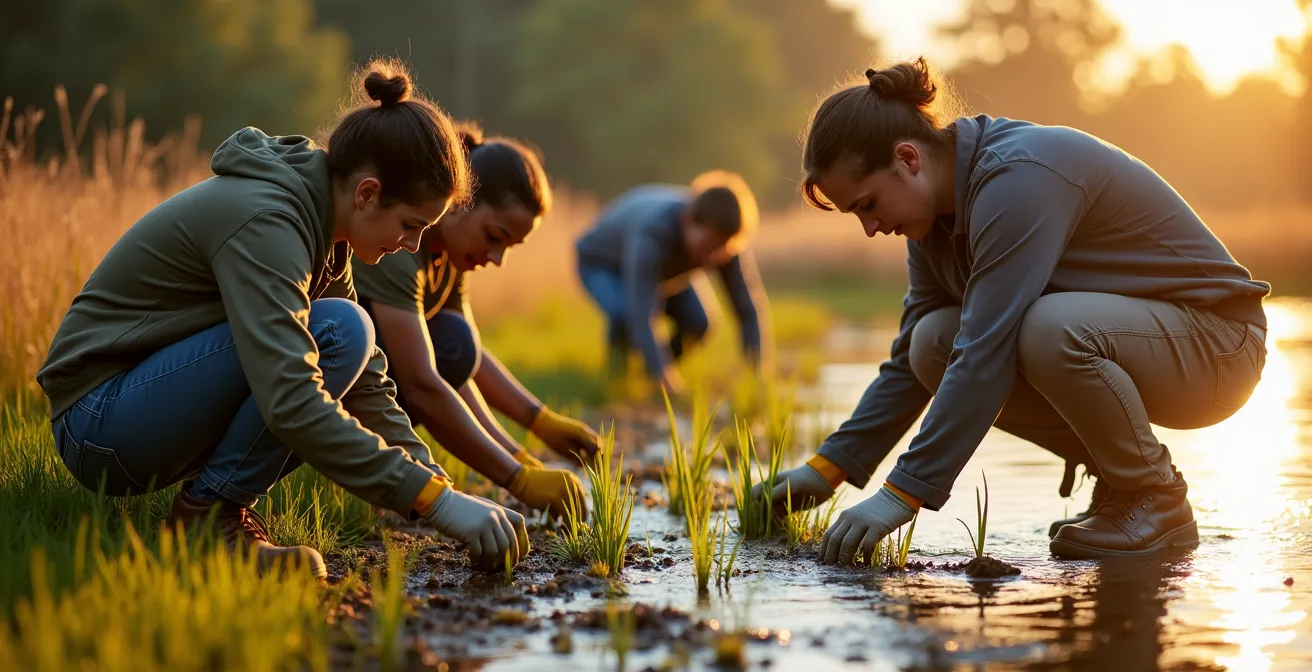
This multiplied funding is what pays for the projects you see on the ground: building boat ramps for access, stocking native fish, conducting population surveys, and, critically, restoring damaged habitats like wetlands. The scene above, with volunteers restoring a shoreline, is a direct result of this funding model. When you buy your license, you aren’t just buying the right to fish; you are making a direct, tangible investment in the health and future of the entire aquatic ecosystem.
Food Plots vs. Native Vegetation: Which Supports More Biodiversity?
The concept of managing habitat to attract game is common in hunting, but a similar logic can be misapplied to fisheries. It might seem intuitive that planting a dense, fast-growing aquatic plant would create cover and attract fish. However, this approach often leads to a monoculture—a single species dominating an area—which severely limits overall biodiversity. While a dense patch of an invasive like hydrilla might hold a large number of bass, it creates an ecological desert for the broader community of organisms.
Native vegetation, in contrast, supports a far more complex and resilient ecosystem. A healthy shoreline or littoral zone with a diverse mix of native plants provides a variety of food sources and habitat structures. This supports not only a wider range of fish species (from top predators to smaller forage fish) but also the insects, amphibians, and invertebrates they depend on. The U.S. Forest Service emphasizes this critical distinction.
While a food plot or monoculture of invasive aquatic plants can support a large quantity of a few species, native vegetation supports a vastly wider variety of insects, birds, and fish, creating a more resilient ecosystem.
– U.S. Forest Service, Gone Fishing? Biologists Share How Anglers Can Support Healthy Native Fish Populations
An excellent example of promoting biodiversity is the establishment of native riparian buffers. Planting native shrubs, grasses, and trees along waterways creates shade that cools the water, which is vital for species like trout. These buffers also act as natural filters, trapping sediment and nutrient runoff from adjacent land. Studies on these buffers show they can reduce water temperatures by up to 5°C and filter as much as 80% of nitrogen and phosphorus. This fosters a healthier environment that supports the entire food web, from the terrestrial insects that fall in the water to the predator fish that eat them.
How to Test Water Clarity and pH for Local Conservation Groups?
Moving into the realm of active data collection, one of the easiest and most valuable contributions an angler can make is monitoring water clarity and pH. These two metrics are fundamental indicators of an aquatic ecosystem’s health. Water clarity, for example, can indicate sediment runoff after a storm, an algae bloom in progress, or changes in phytoplankton populations. A simple, DIY tool called a Secchi disk is all that’s needed to gather scientifically valid data.
You can make a Secchi disk from a coffee can lid or a small bucket lid, painted in alternating black and white quadrants. By lowering it into the water on a measuring tape and recording the depth at which it disappears and reappears, you can get a consistent measure of water transparency. Similarly, simple and inexpensive pH testing strips or portable digital meters allow you to measure the water’s acidity. This is crucial because invasive plants can significantly impact water chemistry. Through photosynthesis, dense mats of invasive plants can alter daily pH levels by up to 2.0 units, creating stressful conditions for native fish and other organisms.
When you collect this data, be sure to record it systematically. Note the date, time, GPS location, and prevailing weather conditions alongside your measurements for clarity and pH. This contextual information is vital. Many local conservation groups, university extension programs, and citizen science apps (like WaterRangers) have platforms where you can submit this data. Your regular observations from your favorite fishing spots can help build a long-term dataset that reveals trends in water quality that might otherwise go unnoticed.
Key Takeaways
- Decontaminate Rigorously: Your boat is the primary vector. A hands-on hull inspection and a full “Clean, Drain, Dry” protocol after every trip is non-negotiable.
- Document Everything: Your catch data—and even zero-catch days—is invaluable scientific information. Log location, species, size, and water conditions.
- Fund the Fight: Your fishing license is a direct investment. It funds the very habitat restoration and species management programs that protect the waters you fish.
Citizen Science: How Your Catch Data Helps Restore Native Populations?
The ultimate evolution of the angler-conservationist is the role of the citizen scientist. Your fishing log is more than a personal record of success; it’s a potentially rich dataset that can inform professional fisheries management in ways that formal surveys cannot. You are on the water more frequently, in more varied conditions, and across more locations than most biologists could ever cover. Your observations provide a real-time, high-resolution picture of a lake or river’s health.
A powerful example of this comes from Canadian lakes, where angler catch data was instrumental in tracking the impact of invasive Eurasian watermilfoil. Anglers began reporting a complete absence of fish in once-productive coves that had become choked with the invasive weed. This anecdotal data, when aggregated, showed a clear behavioral shift: native fish were actively avoiding these areas. This provided a real-time impact assessment that led to targeted removal efforts, years before traditional scientific surveys might have identified the problem.
To make your data scientifically useful, however, it needs to be recorded with a degree of precision and consistency. A simple “caught 5 bass” is not enough. The most valuable data points create a complete snapshot of the encounter. This is where a detailed logbook or a dedicated fishing app becomes an essential conservation tool.
Your Action Plan: Creating a Scientific Fish Log
- Location & Structure: Record exact GPS coordinates and the type of structure where a fish was caught (e.g., weed line, rock pile, dock piling).
- Fish Vitals: Note the species, length, weight (if possible), and any visible abnormalities like lesions, parasites, or tumors.
- Diet Analysis: If you keep a fish, document its stomach contents. This provides direct evidence of food web interactions and potential shifts in diet.
- Environmental Conditions: Log the water temperature, clarity (e.g., Secchi depth), and weather conditions (e.g., sunny, overcast, windy).
- Report Zeros: Critically, always log your “zero-catch” days. Knowing where fish *aren’t* is just as important as knowing where they are. Be sure to include location and conditions.
By adopting this meticulous approach and sharing your data with state fisheries biologists or university research programs, you directly contribute to the science that underpins effective conservation. Your passion for fishing becomes a powerful force for protecting and restoring the very populations you seek to catch.