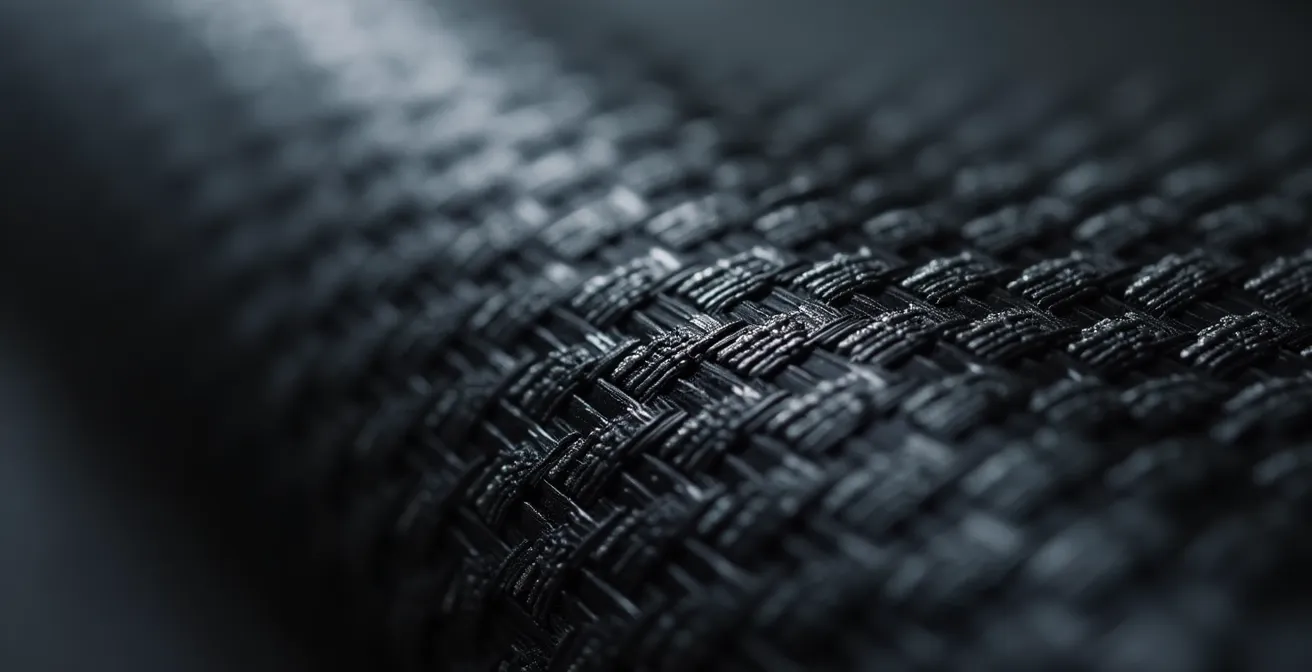
The superior sensitivity of a carbon fiber (graphite) rod is not marketing; it’s a direct result of its material physics, specifically a higher modulus of elasticity which transmits vibration with minimal energy loss.
- Fiberglass inherently dampens vibrations, masking subtle takes, while carbon’s stiffness acts like a tuning fork, telegraphing every nuance from the lure to your hand.
- Fast-action tapers, common in carbon rods, offer near-instant recovery speed, enabling quicker, more powerful hook sets crucial for single-hook soft plastic techniques.
Recommendation: To maximize bite detection, technical anglers should invest in a high-modulus carbon rod and master the grip and fish-fighting techniques that leverage its unique properties.
Every serious angler knows the frustration. You feel a faint “tick” or see a subtle line jump, and by the time you react, it’s too late. The fish is gone. Was it a snag, a piece of weed, or the trophy fish of a lifetime? For years, the debate has raged: the forgiving nature of fiberglass versus the praised sensitivity of graphite (carbon fiber). Many articles simply state that carbon is “more sensitive,” but this explanation barely scratches the surface and fails to empower the technical angler.
The common wisdom suggests choosing a rod based on lure type, which is a valid starting point. We often hear that fiberglass is for crankbaits and graphite is for jigs. But this oversimplification ignores the fundamental science at play. The true difference lies not just in what you fish, but in how information travels from the lure, through the line, up the blank, and into your nervous system. The choice between these materials is a choice between clarity and muddle, between detecting a whisper and hearing a shout.
This is where we move beyond platitudes. The key isn’t that graphite is simply “better”; it’s that its physical properties—its modulus of elasticity and recovery speed—create a direct, high-fidelity channel of communication. Fiberglass, by its very nature, is a dampener. It absorbs energy and masks the subtle vibrations that signal a tentative bite. Understanding this distinction is the first step in transforming from an angler who hopes to feel a bite into one who expects to detect an inquiry.
This guide will deconstruct the science behind rod sensitivity. We will explore what “high modulus” truly means for performance and durability, how rod action dictates hook-setting efficiency, and the critical handling errors that can destroy these high-performance tools. We will also dissect casting mechanics, sonar interpretation, and even the mental fortitude required when the technology is perfect but the fish aren’t cooperating. Prepare to learn why you’re missing strikes and how to fix it.
To navigate this in-depth analysis, the following summary outlines the key technical points we will dissect, providing a clear roadmap from material science to on-the-water application.
Summary: The Technical Angler’s Guide to Carbon Rods
- What Does “High Modulus” Actually Mean for Rod Durability?
- Fast Action vs. Medium: Which Taper Sets the Hook Faster on Soft Plastics?
- The “High-Sticking” Error That Snaps Carbon Rods Instantly
- How to Hold the Rod Grip to Maximize Sensitivity Transmission?
- Multi-Piece vs. One-Piece: Does the Ferrule Kill the Vibration?
- How to Fix the “Tailing Loop” That Knots Your Leader Every Time?
- How to Distinguish Between Bait Balls and Predator Arches on 2D Sonar?
- Tournament Fishing: How to Manage Mental Stress When the Bite Dies?
What Does “High Modulus” Actually Mean for Rod Durability?
The term “high modulus” is one of the most used and least understood specifications in the fishing industry. It does not mean “stronger.” It refers to the Modulus of Elasticity, which is a measure of a material’s stiffness or resistance to being deformed elastically. A higher modulus means the material is stiffer. For an angler, this translates directly to sensitivity. A stiff carbon fiber blank transmits vibrations—like a bass inhaling a soft plastic—far more efficiently than a flexible fiberglass blank, which tends to absorb and “dampen” that same energy.
Carbon fiber is graded by its modulus, often measured in millions of pounds per square inch (MSI) or tons (T). These grades directly impact performance:
- 24T (IM6): With a modulus around 36 MSI, this is a common entry-point for high-performance rods, offering a good blend of sensitivity and durability for all-around use.
- 30T (IM7): At approximately 40 MSI, this mid-range material provides a noticeable increase in sensitivity and is a workhorse for many technique-specific applications.
- 36T (IM8): Reaching 44 MSI, this grade delivers high-end performance, creating exceptionally light and sensitive rods for anglers who need maximum feedback.
- 40-60T (IM12): This is the realm of ultra-high modulus graphite, used in premium rods where peak sensitivity is the absolute priority, often for subtle finesse techniques.
However, stiffness comes with a trade-off. As the modulus increases, the material becomes more brittle and has a lower strain rate (the ability to stretch before breaking). For example, standardized testing confirms that a 36 million modulus carbon fiber also possesses a high strain rate of 750,000, which offers a balance. But as you climb to 50 or 60T, that strain rate decreases, making the rod less tolerant of impacts and sharp-angle stress. Durability, therefore, is not about raw strength but about the rod’s ability to withstand abuse. A high-modulus rod is not inherently weak; it is simply less forgiving of improper handling.
Fast Action vs. Medium: Which Taper Sets the Hook Faster on Soft Plastics?
While material determines sensitivity, the rod’s “action” or taper dictates how it flexes and transfers energy. This is critical for hook-setting. A fast-action rod, typical of high-modulus graphite, bends primarily in the top third of its blank. A medium-action rod has a more parabolic curve, bending deeper into its mid-section. For soft plastics fished with a single, exposed hook (like a Texas or Ned rig), a fast-action taper is unequivocally superior for setting the hook.
The reason is recovery speed. When you snap your wrist to set the hook, a fast-action rod transfers that energy almost instantly to the line and recovers to a straight position with minimal oscillation. This drives the hook home with authority before a fish can spit the lure. A medium-action rod, with its slower recovery, absorbs some of that initial power into its bend, resulting in a softer, less efficient hookset. This is why they are preferred for treble-hooked lures, as the delayed power prevents the hooks from being ripped out.
The real-world advantage is significant. As a case study, professional angler Mark Davis credited his victory at the 2024 Lake Guntersville Classic to his choice of fast-action carbon rods for his Texas-rigged plastics. In a post-tournament interview, he noted that during practice he was missing subtle bites with his backup fiberglass rods, but switching to a St. Croix Avid 7-foot medium-heavy allowed him to detect and capitalize on what he estimated were 23% more bites than during practice rounds, a testament to the synergy of a sensitive material and a powerful taper.
This table breaks down the key performance differences, making the choice clearer for technical applications.
| Characteristic | Fast Action (Graphite) | Medium Action (Fiberglass/Composite) |
|---|---|---|
| Flex Zone | Tip to first-third only | Parabolic curve throughout |
| Recovery Speed | Near-instant snap back | Slower, dampened recovery |
| Sensitivity | Maximum vibration transmission | Moderate, some dampening |
| Hook-Set Power Transfer | 95-100% with braid | 70-85% with stretch lines |
| Best Line Match | Non-stretch braided lines | Fluorocarbon/monofilament |
The “High-Sticking” Error That Snaps Carbon Rods Instantly
The single most common reason a high-performance carbon rod shatters is not a manufacturing defect, but a user error known as “high-sticking.” This occurs when an angler raises the rod to a vertical or near-vertical position while fighting a powerful fish, especially close to the boat. Instead of distributing the load along the parabolic curve of the blank, this action concentrates all the pressure on the rod’s tip section, which is the thinnest and most vulnerable part.
A carbon rod is designed to be a spring, a shock absorber that bends to tire the fish. It is not a crane designed to lift dead weight. When the rod angle exceeds the critical 90-110 degrees relative to the line, the compressive and tensile forces surpass the material’s strain limit. The result is a sharp, explosive failure. Fiberglass rods are more forgiving of this abuse due to their lower modulus and higher flexibility, but they pay for it with reduced performance.
The correct technique is to keep the rod at a 45-degree angle or lower during the fight. Use low, smooth “pumping” motions to gain line, lowering the rod to reel and raising it to pull. If a fish dives under the boat, do not lift the rod straight up. Instead, “bow to the fish”—plunge the rod tip into the water and point it directly at the fish to relieve the acute angle and pressure on the blank. Mastering this discipline is the price of admission for using elite-level equipment.
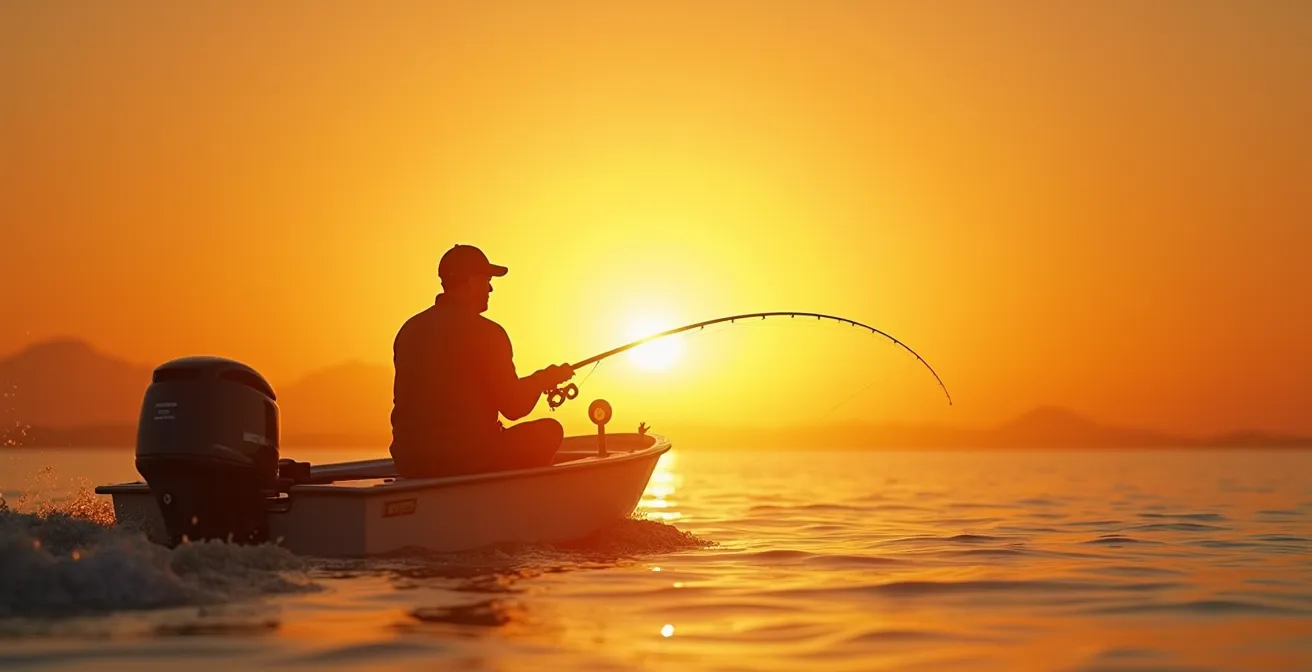
As this image demonstrates, maintaining a lower rod angle allows the entire blank to participate in the fight, distributing stress and protecting the sensitive tip. This technique leverages the rod’s design, rather than fighting against it.
Action Plan: Preventing High-Sticking and Other Carbon Rod Breaks
- Pressure Management: When a fish runs under the boat, point the rod directly at the fish to release all pressure and avoid an acute line angle. This is the “bow to the fish” technique.
- Lifting Motion: Use low, sweeping pump-and-reel motions, always keeping the rod angle below 45 degrees. Never use the rod as a crane to lift a fish into the boat.
- Shock Absorption: Think of the rod as a spring, not a lever. Use its flex to absorb head shakes and sudden runs, protecting your line and the rod itself.
- Boat Organization: Store rods in designated holders where they cannot be stepped on or crushed by gear. Most “mystery” breaks happen from impact, not fishing.
- Line Spooling: Never spool new line by running it through the guides under heavy tension. This creates micro-fractures in the blank that lead to future failure.
How to Hold the Rod Grip to Maximize Sensitivity Transmission?
Owning a sensitive carbon rod is only half the battle; you must create an efficient neural interface to receive the information it transmits. How you hold the rod is not a matter of comfort, but of physics. Your hand, nerves, and bone are the final components in the sensitivity chain. To maximize vibration transmission, you must prioritize direct contact with the rod blank.
The most common mistake is a “full-fisted” grip, where the entire hand wraps around the thickest part of the cork or EVA foam handle. These materials, while comfortable, are also insulators that dampen vibration. The optimal grip technique involves placing one or more fingers directly on the exposed portion of the rod blank, typically just ahead of the reel seat or on a split-grip handle design. The index finger is particularly effective. Extending it to rest on the blank creates a direct conduit for high-frequency vibrations to travel from the blank to the bones in your finger, which are far better conductors than soft tissue.
Modern rod designs facilitate this. Exposed-blank reel seats and split-grip handles are not just aesthetic choices; they are engineered to provide a dedicated contact point. When fishing finesse techniques where bites are exceptionally light, some pros will even “palm” the reel and wrap their fingers completely around the blank forward of the reel. This provides the absolute maximum surface area for contact, turning your entire hand into a sensory organ. Experiment with different holds—index finger out, two fingers split above and below the reel stem, or a full palm grip—to find what gives you the clearest picture of what’s happening at the end of your line. Don’t just hold your rod; connect with it.
Multi-Piece vs. One-Piece: Does the Ferrule Kill the Vibration?
A persistent myth among anglers is that multi-piece travel rods are inherently less sensitive than their one-piece counterparts. The logic seems sound: any joint, or “ferrule,” must interrupt the seamless flow of vibrations up the blank. While this was true of older, clunky metal or fiberglass ferrules, modern carbon rod engineering has rendered this concern largely obsolete. The key is the design of the connection, most notably the spigot ferrule.
A spigot ferrule consists of a solid graphite peg extending from the lower section that fits snugly inside the hollow upper section. This creates a solid, internal bridge that maintains the blank’s continuity. High-end manufacturers machine these spigots to incredibly tight tolerances, ensuring there are no gaps that could dampen or reflect vibrational waves. The energy travels across this seamless junction with negligible loss, making the rod behave and feel like a single piece.
As the technical team at a leading rod manufacturer points out, the evolution of this component has been a game-changer. In a technical deep-dive, the experts at Epic Fly Rods state:
Modern spigot ferrules create a seamless internal bridge that allows vibrational waves to travel across the joint with negligible loss, making the difference undetectable for most anglers.
– Epic Fly Rods Technical Team, Epic Fly Rods Technical Blog
While a laboratory instrument might detect a microscopic difference, for the human nervous system, a well-made multi-piece carbon rod is indistinguishable from a one-piece in terms of sensitivity. The convenience of portability no longer requires a compromise in performance, provided you invest in a rod from a manufacturer that prioritizes precision engineering.
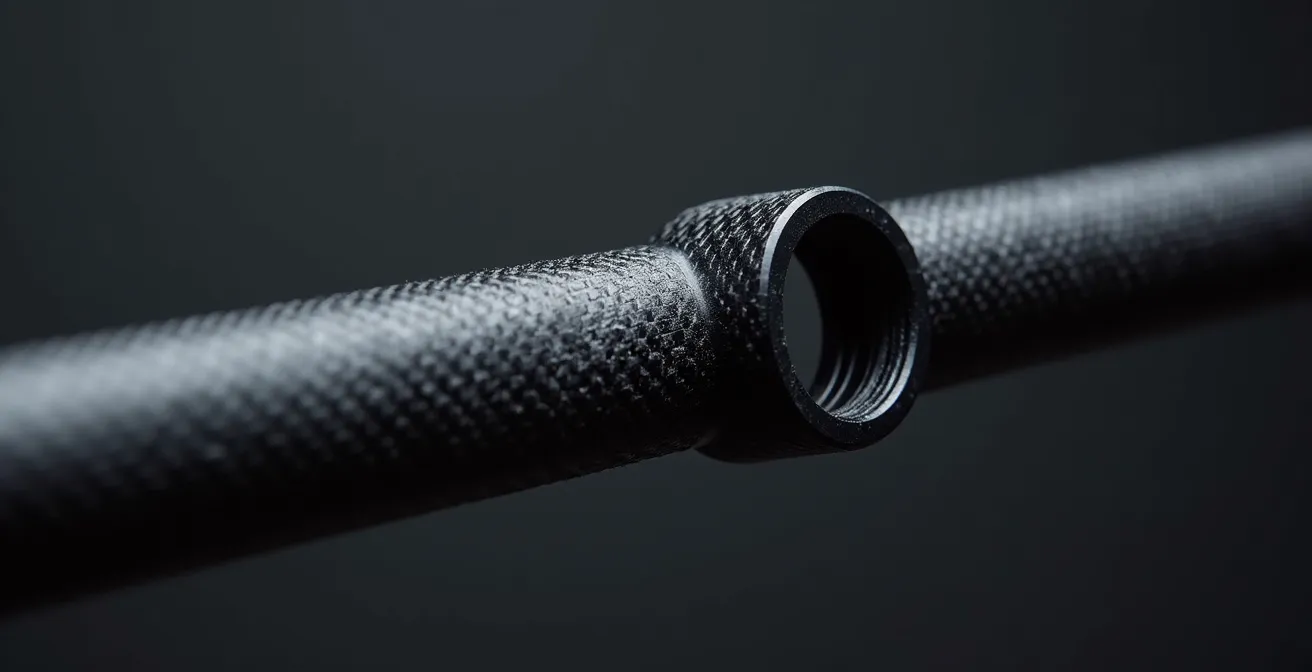
The precision seen in this modern ferrule demonstrates how the junction is no longer a weak point but an integral part of the rod’s high-performance design, ensuring uninterrupted energy transfer.
How to Fix the “Tailing Loop” That Knots Your Leader Every Time?
Even the most advanced rod is useless without a proper cast. A common and frustrating casting flaw is the “tailing loop,” where the fly line or leader crosses over itself mid-air, often resulting in a “wind knot.” This is caused by a jerky, abrupt application of power, effectively “breaking” the smooth, progressive bend of the rod. Instead of the line flowing in a tight, open loop, the rod tip dips and then snaps upward, causing the line to collide with itself.
This is not a rod problem; it’s a caster problem. It’s the fly-casting equivalent of trying to “crack a whip” instead of “throwing paint from a brush.” The fix lies in smoothing out your power application and improving your timing. The goal is to allow the rod to load (bend) fully on the backcast before initiating the forward stroke. A fast-action graphite rod, with its quick recovery, is less forgiving of this timing error than a slower fiberglass rod, which naturally dampens jerky movements.
To correct a tailing loop, focus on these mechanical adjustments:
- Practice with a wrist lock: Use your non-casting hand to grab your casting wrist. This forces you to use your forearm and shoulder for a smoother, longer casting stroke and eliminates the abrupt wrist snap that causes the issue.
- Focus on gradual acceleration: Your casting stroke should be a smooth, accelerating movement that stops abruptly. This allows the rod to unload its energy progressively, forming a clean loop.
- Feel the backcast load: Pause slightly longer on your backcast. Wait until you feel the full weight of the line bend the rod before you start your forward motion. Rushing the forward cast is a primary cause of tailing loops.
- Reduce false casting: Every extra false cast is an opportunity to introduce a timing error. Aim for one backcast and one forward cast to deliver the lure. Efficiency is smoothness.
By focusing on smooth power application and proper timing, you let the rod do the work it was designed for, leading to effortless, knot-free casts.
How to Distinguish Between Bait Balls and Predator Arches on 2D Sonar?
Your high-tech rod is a tool for interacting with fish, but your sonar is your eye beneath the surface. Misinterpreting what you see leads to wasted time fishing empty water. On a traditional 2D sonar display, the two most important signals are bait balls and predator fish, and they have distinct signatures. Learning to differentiate them instantly is a critical skill.
A bait ball will appear as a dense, amorphous cloud or a tightly packed mass of individual pixels. Its shape can be irregular, and it often looks “fuzzy” or “static-y” depending on your sonar’s sensitivity settings. The color will typically be solid, indicating a large number of small, weak returns packed closely together. These are your targets’ food source.
A predator fish (like a bass, walleye, or pike) paints a much different picture. As the fish moves through the sonar cone, it creates a distinct “arch.” This happens because the fish is closest to the transducer (and thus appears shallowest on the screen) when it’s directly under the boat, and further away (appearing deeper) as it enters and exits the cone. The result is an inverted “U” shape. The thicker and more defined the arch, and the stronger the color (often yellow or red on most color palettes), the larger the fish. The most promising signal is seeing distinct predator arches positioned on the edges of, or directly below, a bait ball. This indicates predators that are actively feeding or staging to feed.
To optimize your display for this distinction, slightly increase your sensitivity or “ping speed” until the screen has a light amount of “clutter,” then back it off just until it clears up. This ensures you’re seeing weaker returns from baitfish without overwhelming the stronger returns from predators. Learning to read these digital tea leaves turns your electronics from a depth finder into a true fish finder.
Key Takeaways
- A rod’s sensitivity is determined by its modulus of elasticity; higher modulus (stiffer) carbon transmits vibrations more efficiently than flexible, dampening fiberglass.
- Fast-action tapers provide the instant recovery speed needed for powerful, single-hook sets, while medium actions absorb energy, making them better for treble hooks.
- “High-sticking”—raising the rod past 90 degrees while fighting a fish—is the number one cause of carbon rod failure and must be avoided by maintaining a low rod angle.
Tournament Fishing: How to Manage Mental Stress When the Bite Dies?
You can have the most technologically advanced rod, a perfectly tuned reel, and sonar that sees every fish in the lake, but if your mental game collapses, your day is over. In tournament fishing, or any high-pressure situation, the period when the bite dies is the ultimate test of an angler’s mettle. Stress leads to poor decisions: running-and-gunning randomly, re-tying proven lures, or second-guessing your game plan. Managing this mental pressure is as critical as any piece of equipment.
The first step is to trust your process. You developed a game plan based on practice, seasonal patterns, and conditions. When the action slows, it’s not a sign that your plan is wrong, but that you need to make systematic adjustments. Instead of abandoning a productive area, try a subtle change: switch from a 5-inch worm to a 4-inch, slow your retrieve, or present the lure from a different angle. These are controlled variables, not panicked reactions.
Secondly, practice mental resets. When you feel frustration mounting, stop fishing for 60 seconds. Take a drink of water, re-organize your tackle, and look at the landscape. This brief pause breaks the negative feedback loop and allows your prefrontal cortex to regain control from the emotional, reactive part of your brain. Finally, focus on what you can control. You cannot control whether a fish bites. You can control the precision of your cast, the depth of your retrieve, and your attention to the line. Execute the process perfectly, and the results will eventually follow. The best anglers are not those who never feel stress, but those who have a system to manage it and stay effective under pressure.
Now that you understand the physics behind rod sensitivity and the techniques to maximize its potential, the next logical step is to critically evaluate your own arsenal. Apply this knowledge to select the right tool for the job and elevate your on-the-water performance.