In summary:
- Your fishing trips are a goldmine of data that wildlife agencies desperately need for conservation.
- By adopting simple, precise data collection methods, you can elevate your hobby into a direct contribution to science.
- This guide provides practical, step-by-step instructions on how to become a valued angler-scientist, from tagging fish to restoring habitats.
- Active participation goes beyond following rules; it means becoming a field partner in the active restoration of our fisheries.
Every angler feels it: that deep connection to the water and the desire to protect it for future generations. We meticulously follow regulations, practice catch-and-release, and pick up stray line. But what if that desire to give back could be channeled into something more powerful? What if every cast, every catch, and every observation could become a vital piece of a larger scientific puzzle?
Most advice for conservation-minded anglers stops at the basics. The common wisdom is to buy a license and respect the limits. While essential, this is a passive form of conservation. The truth is, wildlife agencies and research groups are facing immense challenges in monitoring our vast aquatic ecosystems, and they cannot be everywhere at once. They are increasingly turning to a new class of dedicated partner: the angler-scientist.
This is where the real opportunity lies. The key isn’t just to be a good steward, but to become an active data-gatherer. It’s about transforming the act of fishing from a simple pastime into a precise data ritual. By learning how to properly tag a fish, measure water quality, or identify critical habitats, you contribute scientifically valid information that directly empowers wildlife managers to make better decisions, protect vulnerable species, and actively restore the fisheries we all love.
This guide moves beyond the basics. It will show you exactly how your passion can fuel real science. We’ll explore the specific techniques you can use on your next trip to provide data that matters, from tracking fish movements to stopping the spread of invasive species. It’s time to pick up your rod and your field notebook—your journey to becoming an angler-scientist starts now.
To help you navigate this path from angler to active conservationist, this article details the practical methods and scientific principles that make your time on the water invaluable. Discover how you can contribute in meaningful ways.
Summary: From Angler to Scientist: A Practical Guide to Using Your Catches for Conservation
- How to Correctly Tag a Shark/Fish for Research Tracking?
- Christmas Trees vs. PVC: Which Artificial Habitat Lasts Longer?
- How to Test Water Clarity and pH for Local Conservation Groups?
- How Buying Duck Stamps Helps Fish Populations Too?
- How to Teach a New Angler to Care About the Resource, Not Just the Catch?
- Why Wildlife Agencies Rely on Hunter Data to Monitor Herd Health?
- How to Map Your Hunting Ground to Identify Critical Habitat Zones?
- How Anglers Can Stop the Spread of Invasive Aquatic Plants?
How to Correctly Tag a Shark/Fish for Research Tracking?
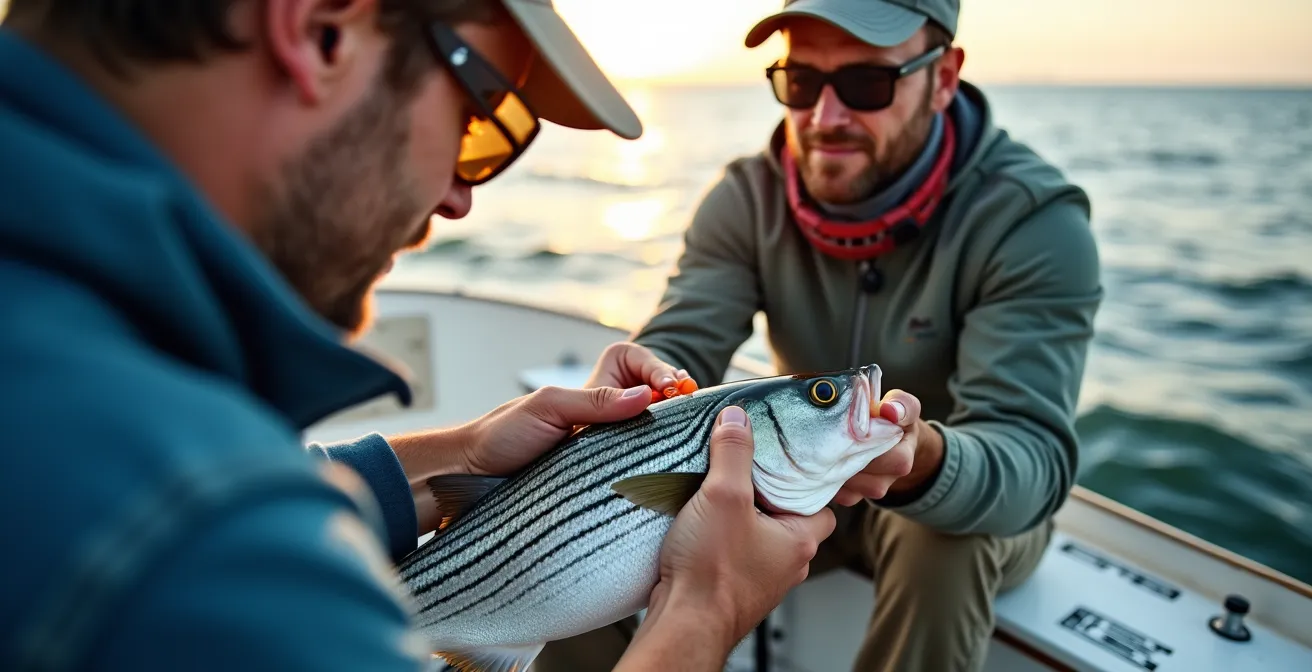
One of the most direct ways an angler can contribute to science is by participating in fish tagging programs. This isn’t just about sticking a tag in a fish; it’s a precise data ritual that provides invaluable information on migration patterns, growth rates, and population dynamics. For decades, these programs have been the backbone of fisheries management. In fact, since 1954, volunteer anglers working with programs like the NOAA Cooperative Tagging Program have deployed over 270,000 tags on more than 70 species, creating a massive historical dataset that is simply irreplaceable.
To ensure your contribution is scientifically valid, technique is everything. A poorly tagged fish can lead to infection or tag loss, rendering the effort useless. The key is to handle the fish with extreme care, keeping it in the water as much as possible. Before you even touch the fish, have your tag and report card ready. Once the fish is secured, the process involves a few critical steps: careful measurement, precise recording of GPS coordinates, and the secure insertion of the tag into the dorsal musculature. Advanced programs like the one run by Gray FishTag Research go even further, using sophisticated satellite tags on species like striped bass and billfish. These devices track large-scale movements for months, providing a level of detail that transforms our understanding of a species’ life cycle.
The final, crucial step is revival. Ensuring the fish swims away strong is paramount. Pulling it gently alongside the boat to pass water over its gills can make all the difference. By following these steps, the angler-scientist ensures that each tagged fish is a successful data point, a swimming sensor returning critical information to the scientific community.
Christmas Trees vs. PVC: Which Artificial Habitat Lasts Longer?
Beyond tracking individual fish, angler-scientists can play a massive role in active restoration by creating new habitats. Artificial reefs and fish attractors provide crucial structure in areas that are otherwise barren, offering shelter for juvenile fish and ambush points for predators. However, not all habitat materials are created equal. The debate often centers on natural, biodegradable materials versus long-lasting synthetic ones. Understanding the trade-offs is key to making an environmentally sound decision.
The choice of material has significant long-term consequences. A common approach involves sinking Christmas trees, which provide excellent short-term structure for fry and a surface for algae growth. However, they typically decompose within 2-5 years. In contrast, structures made from PVC or concrete can last for 50 years or more, providing stable, long-term habitat. But this longevity comes with a risk: PVC can shed microplastics over its lifespan, potentially harming the very ecosystem it’s meant to help. This complex decision requires a careful balance between durability and environmental impact.
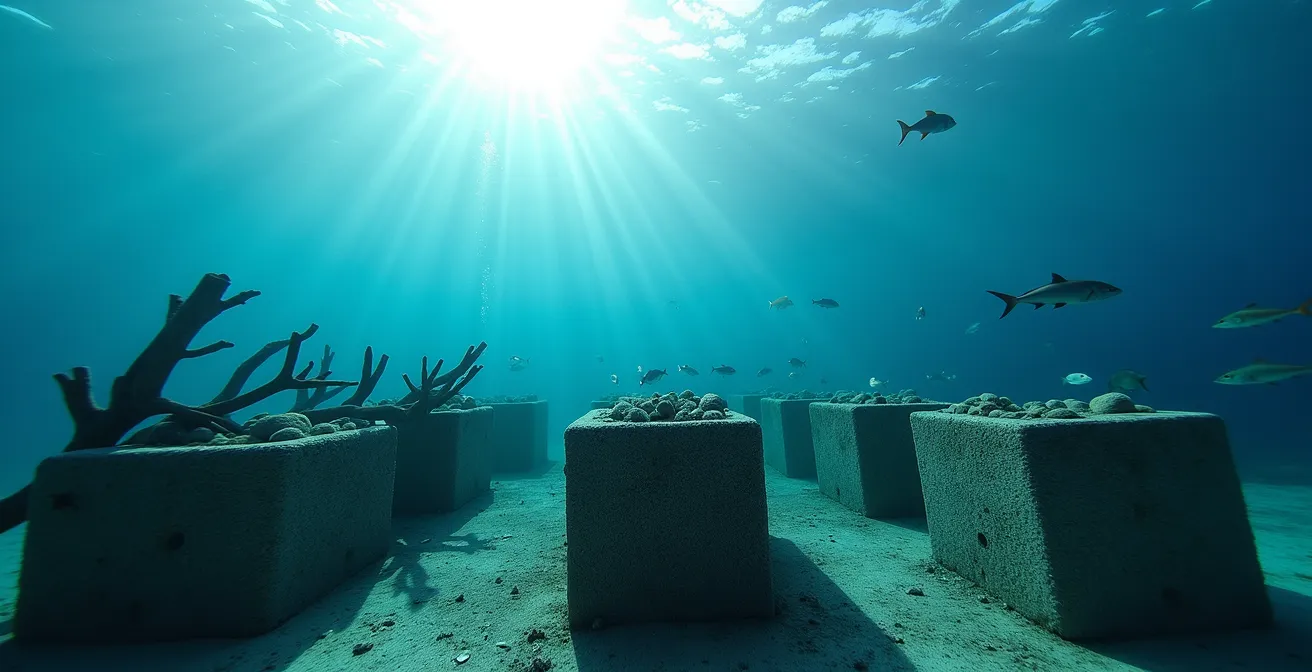
This dilemma is at the heart of modern habitat restoration. The following table breaks down the pros and cons of common materials, based on data from scientific comparisons. It highlights the role of the angler-scientist in not just building habitats, but in choosing the right materials for sustainable, long-term success.
This table, based on findings from a comparative analysis of reef materials, can help conservation groups make informed decisions.
| Material Type | Longevity | Environmental Impact | Fish Habitat Value |
|---|---|---|---|
| Christmas Trees | 2-5 years | Biodegradable, adds nutrients | Good short-term structure for fry |
| PVC Structures | 50+ years | Microplastic shedding risk | Long-term stable structure |
| Natural Wood/Bamboo | 5-10 years | Carbon neutral, no toxins | Moderate durability, good surface for growth |
How to Test Water Clarity and pH for Local Conservation Groups?
Water is the lifeblood of any fishery, and its quality dictates the health of fish populations. As an angler, you possess invaluable ecological intelligence, noticing subtle changes in water clarity, temperature, and flow that others might miss. By formalizing these observations, you can provide local conservation groups and agencies with a powerful stream of data. Testing key water parameters like pH, dissolved oxygen (DO), and turbidity (clarity) provides a direct snapshot of ecosystem health.
For data to be useful, it must be collected with scientific rigor. This means establishing a consistent sampling protocol. You must test at the same locations, at the same time of day, and use properly calibrated equipment. Abrupt changes in these parameters can indicate a serious problem. For instance, NOAA Fisheries indicates that dissolved oxygen below 5 mg/L and high temperatures can cause extreme stress to fish, leading to fish kills. Your on-the-ground measurements can provide the crucial early warning that allows managers to investigate pollution sources or other environmental stressors before a catastrophe occurs.
Submitting this data promptly and in a standardized format is just as important as collecting it accurately. Many conservation groups have online platforms or apps for data submission. Your detailed records—including GPS coordinates, weather conditions, and photos—transform your personal observations into a scientifically valid dataset that can be used to track long-term trends, assess the impact of restoration projects, and protect your home waters.
Action Plan: Create a Scientifically Valid Water Quality Dataset
- Establish Consistent Sampling Protocol: Define your testing spots and commit to measuring at the same time of day and same depth for all measurements to ensure comparability.
- Use Calibrated Testing Equipment: Invest in and learn to calibrate pH meters, dissolved oxygen probes, turbidity tubes, and thermometers for accurate readings.
- Record Environmental Conditions: Go beyond the numbers. Note the weather, recent rainfall, water level, and any unusual observations like algae blooms or strange odors.
- Create Standardized Data Sheets: Use a consistent format (digital or paper) to log the date, time, GPS coordinates, all measurements, and accompanying photos.
- Submit Data Promptly: Upload your findings to your conservation group’s preferred platform or database within 48 hours to ensure the information is timely.
How to Buy Duck Stamps Helps Fish Populations Too?
Many anglers might be surprised to learn that one of the most effective ways to support fish habitat is by purchasing a Federal Duck Stamp. While the name suggests its benefits are limited to waterfowl, the reality is far more interconnected. The Duck Stamp program is a powerful conservation engine funded primarily by hunters. Since 1934, sales have raised over $1.2 billion, which has been used to protect more than 6 million acres of wetland habitat.
And what’s good for ducks is fantastic for fish. These protected wetlands—from prairie potholes to marshy river deltas—are the vital spawning and nursery grounds for countless fish species. They provide clean water, abundant food, and shelter from predators. The vegetation filters out pollutants, the shallow waters warm up quickly in the spring to trigger spawning, and the complex structure protects juvenile fish as they grow. When you buy a Duck Stamp, you are directly funding the acquisition and restoration of these critical fish factories.
The impact is substantial. A case study from the Department of the Interior shows how funding from programs like this benefits fish and wildlife on national refuges, expanding public opportunities for fishing and outdoor recreation. The program demonstrates a core principle of ecosystem management: you cannot protect one species in isolation. By preserving the entire wetland ecosystem, the Duck Stamp program creates a positive cascade effect that benefits waterfowl, shorebirds, amphibians, and, crucially, the fish that every angler cherishes. It’s a prime example of how the hunting and fishing communities work together for conservation.
How to Teach a New Angler to Care About the Resource, Not Just the Catch?
The future of our fisheries depends on the next generation of anglers becoming dedicated stewards. The challenge is to instill a conservation ethic that goes deeper than just the thrill of the catch. The most effective way to do this is to immediately involve a new angler in the process of active restoration. By framing their first fishing experiences as scientific missions, you can cultivate a sense of purpose and responsibility from day one. Instead of just teaching them how to cast, teach them how to measure a fish, identify an aquatic insect, or log a catch on a citizen science app.
A structured approach like a “First Year Angler Stewardship Challenge” can be incredibly effective. This turns conservation into a game, with achievable goals spread throughout the year. In the first few months, the focus is on the basics: logging catches and measurements. As they gain confidence, the challenges become more advanced: documenting aquatic insects, participating in a habitat cleanup, or even tagging their first fish for a research program. This progressive framework builds skills and a deep appreciation for the complexity of the aquatic ecosystem.
This approach is backed by research and supported by agencies that recognize the immense value of volunteer data. The role of the individual angler is no longer just a hobby; it is a critical part of the scientific process. As NOAA Fisheries notes, this partnership is vital for effective management.
New research from NOAA Fisheries indicates potential to expand the use of citizen science data in stock assessments. Volunteer anglers like Keri C. play an important role in this citizen science program, and the data they collect helps inform fisheries management strategies.
– NOAA Fisheries, Citizen Science Programs Update
By mentoring a new angler through this journey, you are not just creating a fishing buddy; you are training a future angler-scientist who understands that caring for the resource is the most rewarding catch of all.
Why Wildlife Agencies Rely on Hunter Data to Monitor Herd Health?
The partnership between sportsmen and wildlife agencies is a cornerstone of North American conservation, and it extends far beyond the water’s edge. For decades, hunters have served as the eyes and ears for state biologists, providing essential data on herd health, population density, and disease outbreaks. From mandatory check stations where biologists collect tissue samples to monitor for Chronic Wasting Disease (CWD) to voluntary jawbone submissions that help determine the age structure of a deer herd, hunter-supplied data is indispensable. The sheer scale of this data collection, funded by license sales and supported by millions of enthusiasts, is something agencies could never achieve on their own.
But the connection between hunting and fishing conservation is more direct than many realize. The health of a forest and its wildlife has a direct, measurable impact on the health of a river and its fish. A powerful example is the relationship between deer populations and trout streams. As a Ducks Unlimited report on watershed health illustrates, when deer herds are overpopulated, they can decimate the vegetation along riverbanks. This over-browsing leads to increased erosion, which smothers trout spawning gravel with silt. It also removes the shade-providing trees and bushes that keep water temperatures cool and provide habitat for terrestrial insects—a key food source for fish.
In this way, the data a hunter provides to help manage deer populations is, indirectly, a contribution to fish conservation. This holistic view is what modern conservation is all about. Programs funded by sportsmen, such as the Duck Stamp, which sees over 1.5 million stamps sold annually, protect entire watersheds that benefit all species. It demonstrates that the ecological intelligence gathered from the field—whether from a treestand or a drift boat—is part of the same crucial effort to preserve our wild places.
How to Map Your Hunting Ground to Identify Critical Habitat Zones?
The modern outdoorsman has access to powerful digital mapping tools that can revolutionize how they interact with the landscape. Apps originally designed for hunters to map deer trails, food plots, and stand locations can be repurposed as sophisticated tools for fisheries conservation. By using these apps to create detailed maps of a local river or lake, an angler-scientist can identify and monitor critical fish habitat zones with incredible precision. This goes far beyond simply marking a good fishing spot; it’s about documenting the underlying structure that makes it a productive habitat.
The process involves creating different data layers. The first layer might mark all water sources, including perennial streams, seasonal seeps, and cold-water springs that provide thermal refuge in the summer. A second layer could identify key structural elements like undercut banks, deep overwintering holes, and logjams that provide cover. A third layer could document spawning areas, such as gravel beds for trout or shallow flats for bass, noting their condition during low-water periods. Finally, you can even map terrestrial inputs, like overhanging trees that drop insects into the water, creating reliable feeding zones.
This detailed mapping creates a powerful baseline. If a future development project is proposed or a pollution event occurs, your data can provide a crucial “before” picture of the habitat’s value. It transforms your anecdotal knowledge into hard, geolocated evidence. The global community of anglers represents a massive, untapped resource for this kind of work.
Sea fishing is a globally popular activity so recreational anglers are a substantial group of highly motivated and engaged potential citizen scientists. One aspect of the CAST project is using a newly established annual sea angling competition located in the Solent to collect relevant data, then test and optimise the citizen science method.
– University of Essex Research Team, CAST Project Report
By leveraging technology, you can create a detailed, data-rich portrait of your home waters that can be used to protect them for years to come.
Key takeaways
- Becoming an angler-scientist means transforming your hobby into a precise, data-driven contribution to conservation.
- Your on-the-water observations, when collected systematically, provide invaluable data that wildlife agencies cannot gather on their own.
- From tagging fish and building habitats to monitoring water quality and stopping invasive species, your actions can lead to active, measurable restoration of our fisheries.
How Anglers Can Stop the Spread of Invasive Aquatic Plants?
One of the most insidious threats to our fisheries is the spread of invasive aquatic plants. Species like hydrilla, Eurasian watermilfoil, and giant salvinia can form dense, impenetrable mats that choke out native vegetation, deplete oxygen levels, and make boating and fishing impossible. As an angler who moves between different bodies of water, you are on the front lines of this battle—both as a potential vector of spread and as the first line of defense.
The “Clean, Drain, Dry” protocol is the absolute minimum standard of care. Every angler must be diligent about inspecting their boat, trailer, and gear for plant fragments before leaving a launch. However, the role of the angler-scientist goes further. It involves active surveillance and rapid response. Learning to identify the most threatening invasive species in your region allows you to spot a new infestation before it gets out of control. Reporting it immediately through a state wildlife agency app or hotline can trigger a management response that saves a lake. Research consistently shows the immense value of early action; a study published in Reviews in Fish Biology and Fisheries found a 90% reduction in control costs when an invasive species is detected and managed within its first year of establishment.
For those willing to take the next step, organizing a community “weed pull” can be a powerful form of active restoration. This requires careful planning, including securing permits, training volunteers in proper species identification to avoid removing native plants, and following strict disposal regulations to prevent re-infestation. It’s hard work, but it directly improves habitat and builds a strong sense of community stewardship. By being vigilant and proactive, anglers can become the most effective force in protecting their home waters from the devastating impact of invasive species.
The journey from a passionate angler to an effective angler-scientist is a rewarding one. It imbues every moment on the water with a deeper sense of purpose. By embracing these data rituals and committing to scientifically sound practices, you are no longer just a user of the resource; you are its most dedicated guardian and a vital partner in its restoration. Start today by choosing one of these actions to incorporate into your next fishing trip.