Equipment & Innovation
The evolution of hunting and fishing equipment has fundamentally transformed how outdoor enthusiasts engage with their pursuits. Modern gear represents the convergence of material science, ergonomic design, and field-tested practicality. Whether you’re pursuing game in mountain terrain or casting for trophy fish in remote waters, understanding equipment innovation empowers you to make informed decisions that enhance both safety and success.
This comprehensive resource explores the critical equipment categories every hunter and angler should master: from visibility systems that balance concealment with human safety, to optical technology that clarifies distant targets, to the maintenance protocols that prevent dangerous malfunctions. We’ll examine how contemporary materials are reshaping performance expectations, why certain design choices matter more than marketing claims suggest, and which innovations deliver genuine field advantages versus those that merely add weight to your pack.
Safety First: Visibility and Protection in the Field
The fundamental challenge facing every hunter is simultaneously remaining concealed from game while being unmistakably visible to other humans. This paradox has driven significant innovation in safety equipment design, particularly as we’ve learned more about how different species perceive color and movement.
Understanding Animal Vision Versus Human Detection
Most game animals lack the photoreceptors necessary to distinguish blaze orange from surrounding foliage, yet this color screams “human” to other hunters at distances exceeding several hundred yards. Deer, for instance, perceive the world primarily in blues and yellows—their dichromatic vision makes fluorescent orange appear as a neutral gray or brown tone that blends with autumn landscapes. This biological reality underpins why high-visibility clothing works: it protects you from the greatest threat in the field (other humans with firearms) without compromising your concealment from quarry.
Legal Requirements and Practical Sense
Regulations typically mandate minimum square inches of blaze orange or pink on outer garments, but relying solely on legal minimums represents a dangerous miscalculation. Consider that visibility requirements were often established decades ago, before modern rifle optics extended effective shooting ranges. Exceeding minimum requirements—particularly on headwear and upper torso—provides a crucial margin of safety. Group signaling systems, including coordinated check-ins and designated rally points, add another layer of protection that no amount of orange fabric alone can provide.
When Visibility Systems Fail
Accident investigations consistently reveal that visibility failures stem from predictable causes: garments stored in direct sunlight lose their fluorescent properties, camouflage worn over required orange obscures visibility, and complacency in familiar terrain creates false security. The solution involves treating safety gear with the same rigor you apply to ammunition selection—regular inspection, timely replacement, and zero tolerance for degraded equipment.
Apparel Technology: From Thermal Regulation to Scent Control
Modern hunting and fishing apparel represents sophisticated engineering rather than simple clothing. The science of thermal regulation combines multiple fabric technologies working in concert to manage the complex challenge of human thermoregulation during varying activity levels.
Advanced Layering Systems
Effective layering follows a three-tier principle: base layers manage moisture, mid layers provide insulation, and outer shells block wind and precipitation. The innovation lies in how contemporary fabrics achieve these functions without the bulk that restricted movement in previous generations. Merino wool base layers, for example, can absorb up to 30% of their weight in moisture before feeling damp, while synthetic alternatives dry faster but retain odors more readily. Understanding this trade-off allows you to select materials matching your specific needs.
Moisture Management and Temperature Control
The human body produces remarkable amounts of perspiration during exertion—often a liter or more during strenuous hiking. This moisture becomes your enemy during rest periods, conducting heat away from your core up to 25 times faster than dry fabric. Modern moisture-wicking materials use capillary action to move perspiration away from skin to outer fabric surfaces where evaporation occurs. The key metric is the fabric’s moisture vapor transmission rate, which should exceed 10,000 grams per square meter over 24 hours for serious backcountry use.
Specialized Features: Noise, Scent, and Dexterity
Fabric noise elimination involves brushing, fleece construction, or specialized knits that prevent the rustling that alerts game. Similarly, scent control technology uses activated carbon, antimicrobial treatments, or silver ion integration to reduce human odor signature. For extremity protection, modern glove design balances insulation with tactile sensitivity—critical when you need to disengage a safety or tie a fishing knot in cold conditions. The best designs use differential insulation, protecting backs of hands while maintaining thin, dexterous palm materials.
Optical Equipment: Seeing Clearly Without the Weight
Quality optics represent arguably the most important investment for hunters and anglers who operate at distance. The ability to clearly identify targets, assess trophy quality, and verify legal compliance before committing to a shot or stalk determines both success rates and ethical outcomes.
The Magnification and Objective Lens Relationship
Binocular specifications like “10×42” reveal the magnification power (10x) and objective lens diameter (42mm). These numbers exist in critical relationship: higher magnification demands larger objectives to gather sufficient light, creating a heavier package. For general hunting use, 8×42 or 10×42 configurations balance field of view with light-gathering ability. The exit pupil—calculated by dividing objective diameter by magnification—should match or exceed your eye’s pupil dilation in low light (typically 5-7mm) for optimal performance during dawn and dusk activity periods.
Glass Quality Tiers and Performance Differences
Optical glass quality determines resolution, color fidelity, and light transmission. Premium glass (often designated ED or HD) uses extra-low dispersion elements that minimize chromatic aberration—the color fringing visible at high-contrast edges. The performance difference becomes obvious when glassing distant timber or trying to distinguish antler points at 800 yards. While premium optics command higher prices, their functional advantage in critical moments justifies the investment for serious practitioners.
Mounting and Stability Systems
Even exceptional optics deliver mediocre results without proper stabilization. Chest harness systems distribute weight across shoulders while keeping binoculars instantly accessible and preventing the swinging that occurs with neck straps. For extended glassing sessions or high-magnification spotting scopes (15x and above), tripod mounting becomes essential—no human can hand-hold above 12x magnification without visible shake degrading image quality. Understanding when to transition from handheld to mounted optics marks the difference between amateur and experienced glassmen.
Tools and Blades: The Foundation of Field Processing
Efficient field processing depends entirely on blade selection, edge geometry, and maintenance practices. A properly designed and maintained knife makes the difference between clean, hygienic work and contaminated meat or preventable injury.
Blade Geometry for Specific Tasks
Different processing stages demand different blade profiles. Initial field dressing benefits from a drop-point or trailing-point design with a sweeping belly that prevents puncturing intestines during abdominal opening. Skinning requires thinner, more flexible blades that follow the membrane between hide and muscle. Butchering and deboning use narrow, stiff blades with acute edge angles (15-20 degrees per side) that slice through connective tissue without wedging. Carrying multiple blade geometries in a compact package makes more sense than expecting a single knife to excel at every task.
Steel Selection: Hardness Versus Toughness
Knife steel properties exist on a continuum between hardness (edge retention) and toughness (resistance to chipping). Steels above 60 HRC (Rockwell hardness) hold edges admirably but may chip when encountering bone. Softer steels around 56-58 HRC dull faster but tolerate abuse better and sharpen more easily in field conditions. Stainless formulations resist corrosion during wet processing but generally sacrifice some edge performance compared to high-carbon alternatives. Matching steel properties to your processing environment and maintenance capabilities ensures optimal performance.
Edge Maintenance and Field Sharpening
A dull blade requires excessive pressure, increasing slip risk and creating ragged cuts that promote bacterial growth. Field sharpening skills using compact diamond stones or ceramic rods keep working edges functional between formal sharpening sessions. The technique involves maintaining consistent angle (use a sharpie to mark the bevel edge as a guide), working from coarse to fine grits, and finishing with stropping to remove the wire edge. Regular light maintenance proves far more effective than infrequent heavy grinding that removes excessive material and shortens blade life.
Fishing Gear: Material Science Meets Performance
Contemporary fishing equipment leverages advanced composite materials that deliver sensitivity and performance impossible with previous-generation fiberglass or traditional graphite construction.
Rod Materials and Modulus Ratings
Carbon fiber modulus ratings—typically ranging from 30 to 55 million—indicate material stiffness. Higher modulus carbons create lighter, more sensitive rods that transmit bottom composition and subtle strikes directly to your hand. However, this sensitivity comes with increased brittleness; ultra-high-modulus rods demand careful handling during transport and storage. Understanding the modulus-to-durability relationship helps you select materials matching your fishing style and care capabilities.
Action Versus Power: Critical Distinctions
Rod “action” describes where the blank bends (fast action bends primarily at the tip, slow action throughout the blank), while “power” indicates the force required to flex the rod. These independent characteristics determine casting performance and fish-fighting capability. Fast-action rods excel at setting hooks and casting accuracy but may rip hooks from soft-mouthed species. Moderate actions forgive aggressive hook sets and cushion light tippets during fish runs. Matching action and power to target species and techniques prevents the frustration of fighting your equipment instead of your quarry.
Protecting Fragile Equipment
Modern high-modulus rods represent significant investments requiring protective measures during transport. Rod tubes with individual sleeves prevent blank-to-blank contact that creates stress fractures. During travel, distributing equipment across multiple bags ensures that lost luggage doesn’t eliminate your entire fishing capability. For extreme environments, building redundancy into your gear selection—carrying backup rods in different modulus ranges—provides insurance against catastrophic failure far from tackle shops.
Equipment Maintenance: Preventing Failure Before It Happens
Systematic maintenance protocols identify developing problems before they create dangerous or expensive failures. Treating maintenance as an ongoing discipline rather than an annual chore dramatically extends equipment life while ensuring reliability.
Routine Inspection Schedules
Establishing regular inspection intervals creates accountability. Monthly checks during active seasons should verify that firearm actions cycle smoothly, optics remain fog-free and aligned, and fabric integrity shows no degradation. Pre-season inspections go deeper: scope mounting torque verification (typically 15-25 inch-pounds for base screws, 15-20 for ring screws), detailed cleaning of trigger assemblies, and function testing of all safety mechanisms under various conditions.
Identifying Corrosion and Wear Patterns
Corrosion begins invisibly, often under finishes where moisture becomes trapped. Learn to recognize the early signs: slight surface roughness, discoloration at metal junctions, or resistance during action cycling. Common failure points include scope tube-to-ring interfaces where dissimilar metals promote galvanic corrosion, and trigger assemblies where powder residue attracts moisture. Proactive replacement of suspect components costs far less than catastrophic failure or injury from neglected safety mechanisms.
Cleaning Protocols That Actually Work
Effective cleaning balances thoroughness with avoiding damage from excessive disassembly or aggressive solvents. For firearms, bore cleaning should continue until patches emerge clean, but excessive cleaning wears barrels prematurely—accuracy-focused shooters often limit cleaning to every 100-200 rounds for modern stainless barrels. Optical equipment requires only soft brushes and appropriate lens cleaners; never use clothing or paper products that scratch coatings. Fishing reels benefit from quarterly disassembly and re-greasing of gears, with drag washers receiving specific lubrication per manufacturer specifications.
Extreme Conditions: Specialized Gear for Challenging Environments
Hunting and fishing in extreme environments—high altitude, extended expeditions, or severe weather—demands equipment selections that prioritize reliability and emergency capability over weight savings or convenience features.
Layering and Shelter Systems for Extremes
Alpine and winter environments require redundant insulation systems where wetness equals danger. Synthetic insulation layers maintain loft when damp, making them essential for outer insulation layers even though down provides superior warmth-to-weight ratios in dry conditions. Emergency shelter capability should always exceed your planned needs—carrying materials for unexpected overnight stays provides critical safety margin when weather deteriorates or injuries prevent planned returns.
Navigation and Communication Redundancy
GPS technology provides remarkable capability until batteries fail or units break. Serious backcountry travel demands backup navigation via map and compass skills, plus the judgment to use them before becoming disoriented. Similarly, satellite communication devices provide emergency contact when cellular service disappears, but only if you carry them on your person rather than in camp. The weight penalty of communication redundancy becomes irrelevant during actual emergencies.
Hydration Logistics and Water Management
Dehydration degrades decision-making before you recognize thirst. Multi-day expeditions require carrying capacity for 3-4 liters plus purification capability for resupply. Hydration bladder systems encourage regular drinking but freeze in cold weather and prove difficult to monitor for remaining volume. Wide-mouth bottles resist freezing, allow easy monitoring, and simplify water treatment addition. Smart practitioners carry both systems, using bladders during moderate conditions and bottles as backup and for overnight freeze prevention by sleeping with bottles in sleeping bags.
Equipment innovation continues reshaping hunting and fishing capabilities, but fundamental principles remain constant: safety equipment requires no compromise, maintenance prevents failures, and understanding the science behind design choices empowers better decisions than marketing claims ever will. The most successful practitioners view their equipment as integrated systems rather than collections of individual items, where each component’s selection considers its relationship to every other piece you carry. This systematic approach, combined with realistic assessment of your actual needs versus wants, creates equipment packages that enhance rather than complicate your time afield.
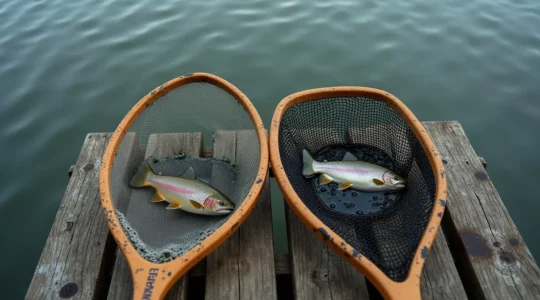
Rubber vs. Nylon Mesh: A Fish Health Specialist’s Guide to Choosing the Right Net
The choice between a rubber and nylon net is more than a preference; it’s a decision that directly impacts a fish’s immune system and its long-term survival. Smooth rubber mesh minimizes the removal of the critical slime coat, which acts…
Read more
Graphite vs. Fiberglass: Why Carbon Rods Detect Strikes You Are Missing?
The superior sensitivity of a carbon fiber (graphite) rod is not marketing; it’s a direct result of its material physics, specifically a higher modulus of elasticity which transmits vibration with minimal energy loss. Fiberglass inherently dampens vibrations, masking subtle takes,…
Read more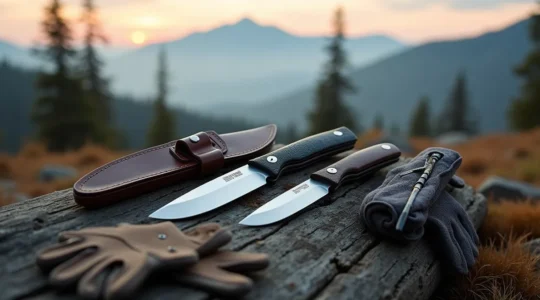
Fixed Blade or Replaceable Edge: Which Is Safer for Deep Backcountry Processing?
In summary: True field dressing safety is a system, not just a tool. It’s about controlling variables to prevent catastrophic failure. Mastering in-field sharpening is non-negotiable and more critical than the initial sharpness of any blade. Blade geometry (like a…
Read more
Spotting Scope vs. Binoculars: When Is the Extra Weight Worth the Effort?
The true value of a spotting scope isn’t its magnification, but your ability to overcome the environmental and physical limitations that high power creates. Heat mirage, not the optic itself, is often the limiting factor for clarity, rendering extreme magnification…
Read more
Binoculars or Spotting Scope: Which Optic Matches Your Terrain?
The best optic isn’t the most powerful; it’s the one whose optical properties are perfectly matched to the physical realities of your specific hunting environment. Higher magnification is often defeated by atmospheric mirage and hand-shake, making it less effective than…
Read more
How to Choose a Clothing System That Regulates Body Temp from Idle to Active?
The common frustration of freezing in a treestand and sweating during the walk-in stems from a misunderstanding of apparel science. Effective thermal regulation is not about the number of layers, but about engineering a system that actively manages moisture and…
Read more
What Technical Gear Do You Really Need for a High-Altitude Sheep Hunt?
True expedition preparedness isn’t about a gear list; it’s about mastering systems designed to anticipate and mitigate catastrophic failure. Your clothing and shelter are not just items, but an integrated system for managing moisture, energy, and morale under environmental hostility….
Read more
The 15-Minute Firearm Inspection That Prevents Misfires in the Field
The difference between a successful hunt and a catastrophic failure is not luck; it’s a diagnostic mindset that identifies problems before they occur. Internal corrosion, not external scratches, is the primary silent threat to accuracy and safety. Optic stability depends…
Read more
Blaze Orange vs. Camouflage: How to Stay Safe Without Spooking Game?
The fear that blaze orange compromises your hunt is based on a misunderstanding of animal vision; the real threat to your stealth is the invisible UV glow from your laundry detergent. Game animals like deer have dichromatic vision, meaning they…
Read more