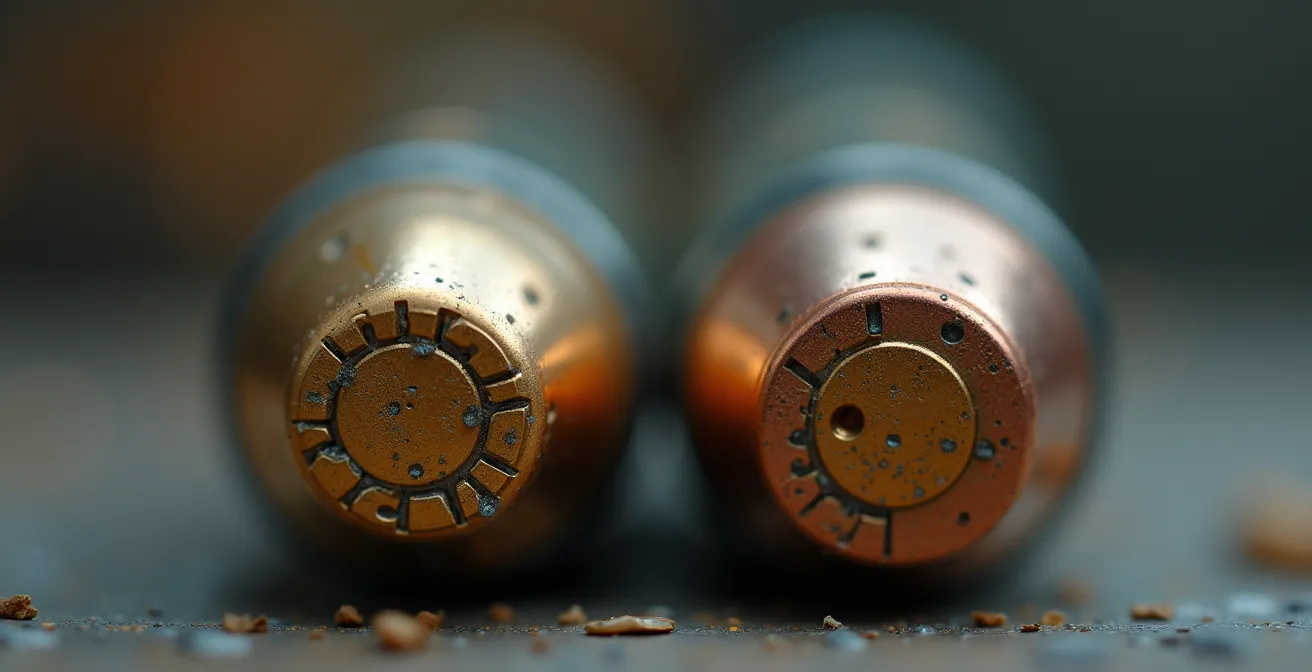
Switching to non-lead ammunition is not a performance downgrade; it is a shift in physics that, once understood, leads to greater precision and more predictable terminal results.
- Monolithic bullets, being less dense but harder than lead, require higher impact velocities to expand reliably and behave differently in flight and on game.
- Success depends on a complete “System Adjustment”—matching bullet weight to your rifle’s twist rate, meticulously re-zeroing your scope, and selecting the right shot material and size for the specific quarry and range.
Recommendation: Instead of fighting the change, focus on mastering the new ballistic variables to become a more effective and ethical hunter.
The letter arrives in the mail, or the new regulations appear online, and the message is clear: the lead-core ammunition you’ve trusted for decades is now restricted. For any serious hunter, this news brings a wave of concern. You’ve spent years perfecting your craft with a system you know inside and out, and the prospect of switching to copper or steel feels like a step backward—a forced compromise that could risk a clean harvest. The common refrains are that non-lead is “better for the environment” but “just doesn’t perform the same.” This leaves you with a critical question: are you now at a disadvantage in the field?
Most discussions on this topic fall into two camps: those who dismiss ballistic concerns in favor of the environmental benefits, and those who lament the loss of lead’s terminal performance without offering a viable path forward. This leaves the practical hunter stranded, worried about wounded and lost game. But what if the transition away from lead wasn’t about accepting a compromise? What if it was an opportunity to deepen your understanding of ballistics and become an even more precise marksman? The truth is that monolithic bullets are not inherently worse; they simply operate under a different set of physical principles.
This guide moves beyond the surface-level debate. As a ballistics analyst, I’ll provide the data-driven insights you need to master this transition. We won’t just say non-lead bullets are “different”; we will dissect the terminal physics to explain precisely *why* they behave differently and how to leverage those characteristics to your advantage. By understanding the science, you can turn a regulatory mandate into a moment of mastery. This article will walk you through the critical adjustments, from velocity requirements and zeroing procedures to shot selection and safety considerations, giving you the confidence to hunt effectively and ethically with non-lead ammunition.
To navigate this transition successfully, it’s essential to break down the distinct challenges and advantages presented by non-lead ammunition. The following sections provide a detailed, data-driven look at each critical aspect you’ll need to master.
Summary: The Hunter’s Guide to Mastering Non-Lead Ammunition
- Why Copper Bullets Require More Velocity to Expand Reliably?
- #2 or BB: Which Steel Shot Size Reduces Crippling in Geese?
- Bismuth vs. Tungsten: Which Alternative Is Safe for Vintage Shotguns?
- The “Cheap Ammo” Mistake That Costs You the Trophy of a Lifetime
- How to Adjust Your Zero When Switching from Lead to Monolithic?
- Why Switching to Copper Ammo Is the Single Biggest Eco-Move You Can Make?
- Why a Clean Pass-Through Can Be Dangerous in Rocky Terrain?
- What Every Hunter Must Understand About Bullet Trajectory and Ricochet?
Why Copper Bullets Require More Velocity to Expand Reliably?
The single most important concept to grasp when switching to monolithic copper bullets is their relationship with velocity. Unlike soft lead, which deforms easily upon impact, copper is a much harder, more ductile material. This means it requires significantly more force—and therefore, higher impact velocity—to initiate expansion. If a copper bullet is traveling too slowly when it hits the target, it may fail to expand, behaving like a full metal jacket (FMJ) round. This results in a narrow wound channel, poor energy transfer, and a high risk of losing the animal.
This isn’t theoretical; it’s a matter of physics proven in testing. For example, recent ballistic testing demonstrates that while traditional cup-and-core lead bullets still expanded effectively at 500 yards, some copper bullets of the same caliber merely blunted their noses. This critical difference is the primary source of anxiety for hunters forced to switch. However, manufacturers have engineered solutions. Designs like the Barnes TTSX use a polymer tip to initiate hydraulic expansion and pre-scored petals to ensure the bullet mushrooms reliably, while Hornady’s CX bullets are also designed for broad, swift expansion. This shows that performance isn’t just about the material but the engineering behind the bullet.

Ultimately, as a hunter, you must ensure your setup delivers the necessary speed at your expected engagement distances. This might mean choosing a lighter-for-caliber bullet, which can be driven faster, or being mindful of how factors like barrel length affect muzzle velocity. A shorter barrel will produce lower velocities, potentially reducing the effective expansion range of your chosen copper ammunition. Understanding this velocity threshold is the first step toward confidence with non-lead rounds.
#2 or BB: Which Steel Shot Size Reduces Crippling in Geese?
When waterfowl hunters switch from lead to steel, the most pressing question becomes shot size. The core dilemma is a trade-off between pattern density and per-pellet energy. Steel is about 30% less dense than lead, meaning a steel pellet of the same size is lighter and loses velocity and energy more quickly. To compensate, hunters must use larger steel shot (e.g., #2 steel instead of #4 lead) to achieve similar downrange energy. However, for large birds like geese, the debate often centers on whether to use a dense pattern of smaller shot like #2 steel or fewer, heavier pellets like BBs.
The answer depends entirely on your expected shooting distance. For closer shots over decoys (20-30 yards), a dense cloud of #2 steel shot provides more hits on the bird’s vital head and neck area, leading to cleaner kills. The numbers are clear: Federal Premium’s data shows that a standard 1.25-ounce payload of #2 steel contains 156 pellets, a 73% increase in pellet count over the 90 BB pellets in the same payload. This superior pattern density is a decisive advantage at close range.
However, as the range increases, those smaller #2 pellets lose energy rapidly. For pass-shooting or shots beyond 40 yards, the greater mass and retained energy of BB or even BBB shot become necessary to ensure sufficient penetration to break bones and reach vital organs. Using #2 shot at these extended ranges is a primary cause of crippling, where a bird is hit but not brought down ethically. A balanced approach is key to responsible hunting.
This comparative table provides a clear, at-a-glance guide for selecting the most effective steel shot size based on your hunting scenario, helping you maximize effectiveness and minimize the risk of crippling birds.
| Range | Recommended Shot Size | Key Advantage |
|---|---|---|
| Close (20-30 yards) | #2 or #1 steel | Dense pattern, high pellet count |
| Medium (30-40 yards) | BB or BBB steel | Balance of pattern and energy |
| Long (40+ yards) | BBB or T steel | Maximum knockdown power |
Bismuth vs. Tungsten: Which Alternative Is Safe for Vintage Shotguns?
For owners of fine, vintage side-by-sides or older shotguns, the non-lead mandate presents a unique and serious problem. The barrels and fixed chokes on these classic firearms were not designed to handle the hardness of modern steel or high-density tungsten shot (like TSS). Firing these loads can cause barrel bulging, choke damage, or catastrophic failure. This leaves hunters seeking an alternative that is both legal and safe for their cherished guns. The two primary options are bismuth and tungsten-based loads, but only one is universally safe.
Bismuth is the clear winner for safety in vintage guns. The key lies in its material properties: it is denser than steel but significantly softer. Specifically, according to Remington’s technical specifications, bismuth has a density of 9.6 g/cc, making it 23% denser than steel (7.8 g/cc) but still softer than the gun’s barrel steel. This softness allows it to deform safely as it passes through the forcing cone and choke, posing no risk to the firearm. It offers near-lead performance without the danger of steel.
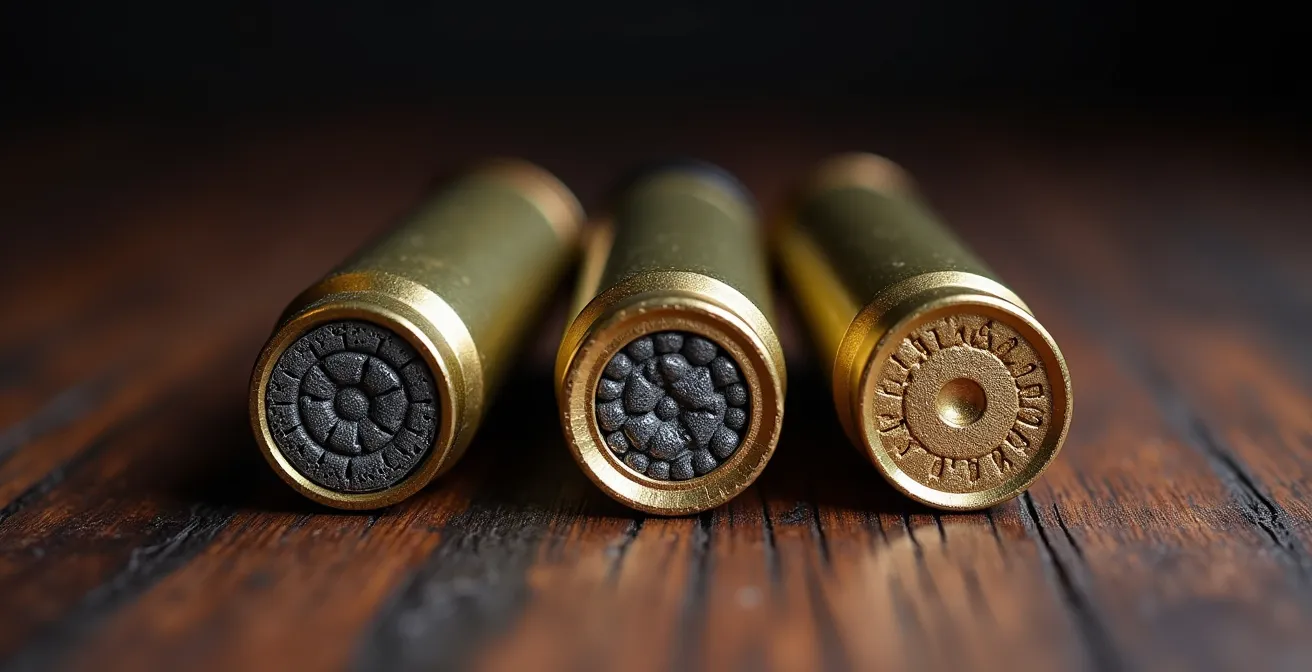
Tungsten, on the other hand, is a more complex category. While extremely dense (TSS is up to 18 g/cc), pure tungsten shot is harder than barrel steel and will absolutely damage a vintage gun. However, manufacturers offer “tungsten-matrix” or “tungsten-polymer” loads, where tungsten powder is mixed with a softer material like polymer or nylon. These are generally considered safe for modern guns but should still be approached with caution in older firearms. For a true vintage piece, bismuth remains the safest non-toxic alternative to lead. Before using any modern load, a thorough safety check is not just recommended—it’s essential.
Your Action Plan: Vintage Shotgun Safety Check Protocol
- Locate proof marks on your vintage shotgun’s barrel or receiver to identify its pressure rating.
- Compare the gun’s proof pressure ratings to the modern ammunition’s SAAMI/CIP specifications printed on the box.
- Choose bismuth or specific tungsten-matrix loads rated well below your gun’s maximum proof pressure.
- Avoid pure tungsten (TSS) and standard steel loads, as they can damage older fixed chokes and thin barrels.
- Always start with the lightest available loads (e.g., 2¾-inch shells) to test for function and safety before considering heavier options.
The “Cheap Ammo” Mistake That Costs You the Trophy of a Lifetime
A hunt for a trophy animal is an enormous investment. It’s an investment of time spent scouting, money on tags, gear, and travel, and emotional energy dedicated to a single moment of opportunity. After pouring thousands of dollars and hundreds of hours into a hunt, many hunters make a critical error at the last moment: they try to save $20 on a box of ammunition. This “cheap ammo” mistake, especially when dealing with the nuanced performance of non-lead bullets, is one of the most common reasons for a heartbreaking failure in the field.
Premium non-lead ammunition is engineered for one thing: predictable and devastating terminal performance. The cost reflects the complex design, high-quality materials, and extensive R&D required to make a copper bullet expand reliably across a wide range of velocities. Bargain-brand monolithic bullets may not have the same level of engineering, leading to inconsistent expansion, poor accuracy, or failure to perform when it matters most. When you consider the total cost of a hunt, the price difference for premium ammunition becomes negligible. In fact, industry analysis reveals that premium ammunition often represents less than 2% of a hunter’s total hunt-related expenses.
Skimping on this final, critical link in the chain is a risk that simply isn’t worth taking. The difference between a premium, well-designed copper bullet and a cheap one is the difference between a clean, ethical kill and a wounded, lost animal. It’s the difference between a memory of a lifetime and a lifetime of regret. The investment in quality ammunition is an insurance policy on your entire hunting effort.
The pain of paying the extra cost of a high-tech bullet will fade much faster than the agony of failure that can result from using an inadequate bullet.
– Bryce Towsley, American Hunter Magazine
How to Adjust Your Zero When Switching from Lead to Monolithic?
A common and dangerous assumption hunters make is that two bullets of the same weight, one lead-core and one copper, will shoot to the same point of impact (POI). This is fundamentally incorrect and failing to re-zero your rifle is a recipe for a miss or, worse, an unethical shot. Copper is less dense than lead, so for two bullets to have the same weight, the copper bullet must be significantly longer. This change in length and bearing surface dramatically alters the bullet’s interaction with the barrel’s rifling and its resulting flight path.
This difference in length is also why your rifle’s twist rate becomes critically important. A longer bullet requires a faster twist rate to properly stabilize in flight. If your rifle’s twist rate is too slow for the long, lightweight copper bullet you’ve chosen, you will never achieve acceptable accuracy. Often, the solution is to drop down in bullet weight (e.g., from a 180-grain lead bullet to a 150-grain copper bullet in a .30-06). The lighter copper bullet will be shorter, closer in length to the original lead bullet, and more likely to stabilize in a standard factory barrel, all while delivering higher velocity.
Once you’ve selected an appropriate bullet for your rifle’s twist rate, a systematic re-zeroing process is mandatory. You cannot skip this step. The POI shift can be several inches at 100 yards, a difference that translates to a complete miss at typical hunting distances. Following a strict protocol ensures your first shot in the field is as accurate and confident as it was with your old lead loads.
The following protocol outlines the essential steps for transitioning your rifle from lead to monolithic ammunition:
- Thoroughly clean your barrel to remove all previous copper and lead fouling using appropriate solvents, as mixed fouling can degrade accuracy.
- Fire a 3-shot group with your old lead ammunition to confirm your baseline zero at 100 yards.
- Without changing your scope, fire a 3-shot group with the new copper ammunition to measure the exact point of impact shift.
- Calculate the necessary scope adjustments in MOA or Mils based on the measured POI shift.
- Make the precise adjustments to your scope’s windage and elevation turrets.
- Confirm your new zero with another 3-shot group and, if possible, verify your trajectory at your maximum expected hunting distance.
Why Switching to Copper Ammo Is the Single Biggest Eco-Move You Can Make?
While hunters rightly focus on terminal ballistics, it’s impossible to ignore the profound environmental reason behind the push for non-lead ammunition: lead toxicity. For over a century, hunters have been the primary drivers of wildlife conservation in North America. Embracing non-lead ammunition is the modern continuation of that legacy. A single lead-core bullet can fragment into hundreds of tiny pieces upon impact, contaminating the gut pile and any surrounding tissue left in the field. This is not a minor issue; scientific research has documented that lead fragments from a high-velocity rifle bullet can travel up to 14 inches from the entry point, peppering a huge area of the carcass.
These fragments are then consumed by scavengers, from eagles and condors to coyotes and bears, leading to lead poisoning, which causes a slow, agonizing death. It’s a form of unintended secondary kill that runs counter to the ethics of hunting. When you dress an animal in the field and leave the gut pile behind, you are providing a food source for the ecosystem. Using lead ammunition turns that offering into a poison delivery system. By switching to copper, you eliminate this threat entirely. Monolithic bullets typically retain over 95% of their weight, meaning they do not shatter into toxic fragments.
The positive impact of this switch is not theoretical; it is proven. In California, after a ban on lead ammunition was implemented within the range of the endangered California Condor, documented cases of lead poisoning in these magnificent birds dropped significantly. This provides a direct link between a hunter’s choice of ammunition and the survival of an iconic species. By choosing copper, you are actively participating in the North American Model of Wildlife Conservation, ensuring that both game and non-game species can thrive for generations to come. It’s the single most impactful decision a hunter can make to reduce their environmental footprint.
Why a Clean Pass-Through Can Be Dangerous in Rocky Terrain?
In many hunting situations, a complete pass-through is considered the gold standard. It creates both an entrance and an exit wound, leading to a better blood trail and a faster, more humane kill. However, with hard, monolithic copper bullets, this desirable terminal performance can create a significant and often overlooked safety hazard: ricochet. Because a copper bullet is designed to retain its weight and shape, a bullet that passes completely through an animal can exit with substantial remaining energy. In open fields with soft soil, this isn’t a concern. But in rocky, mountainous terrain, that exiting bullet becomes an unpredictable projectile.
A lead-core bullet that passes through an animal is often deformed, fragmented, and has lost a significant portion of its mass and velocity, reducing its ricochet potential. A monolithic copper bullet, by contrast, is far more likely to retain its shape and a large percentage of its velocity. If it strikes a hard surface like a rock or frozen ground, it can ricochet at a high angle with enough energy to be lethal for hundreds of yards. This poses a danger not only to other hunters, livestock, or property in the distance but also potentially to the shooter or their party if the bullet deflects off a nearby rock face.
This risk requires a shift in mindset. A hunter using copper bullets in hard terrain must be as aware of the environment behind the target as they are of the target itself. Shot placement and angle become safety considerations as much as they are ethical ones. Fortunately, you can actively mitigate this risk by adopting specific field tactics:
- Strive for higher shot angles whenever possible, directing the bullet’s path into soft ground on the far side of the animal.
- Always use natural backstops like earthen banks, hillsides, or thick timber to catch an exiting bullet.
- Consider using rapid-expansion monolithic bullets designed to dump their energy quickly within the animal, reducing exit velocity.
- Avoid taking broadside shots when you can see rocks, frozen ground, or other hard surfaces directly behind your target.
Key Takeaways
- Non-lead bullet performance is not a matter of “better” or “worse,” but a different application of physics that requires understanding velocity thresholds and material hardness.
- Success with non-lead ammo demands a “System Adjustment”: matching your bullet to your rifle’s twist rate and meticulously re-zeroing are non-negotiable steps.
- A hunter’s ammunition choice has a direct impact on the ecosystem; switching to copper eliminates the risk of lead poisoning in scavenger species, upholding the principles of conservation.
What Every Hunter Must Understand About Bullet Trajectory and Ricochet?
The final piece of the non-lead puzzle is understanding how these bullets behave in flight and upon contact with incidental objects. Because monolithic copper bullets are longer and lighter for their caliber, their ballistic coefficient and stability can differ from the lead-core bullets you’re used to. One of the most critical and least-discussed issues is bullet deflection. Testing and field reports have shown that lightweight copper bullets can be more easily deflected off course by small obstacles like twigs, branches, or even thick grass that a heavier lead bullet might have plowed through.
This “hidden trajectory” effect can cause a perfectly aimed shot to result in a clean miss or, far worse, a non-lethal wound. It requires hunters, especially those in dense woods or brushy country, to be absolutely certain of a clear flight path to the target. What might have been an acceptable shooting lane with a heavy 180-grain lead bullet may not be clear enough for a lighter 150-grain copper projectile. This places a higher premium on patience and selecting the right moment to shoot.
Furthermore, the nature of the wound channel created by a non-fragmenting monolithic bullet affects tracking. A copper bullet that expands perfectly creates a clean, consistent wound channel, often resulting in a complete pass-through and a good blood trail. However, unlike a lead bullet that can shed fragments and create a wider area of trauma, the copper bullet’s damage is more localized. If the shot placement is marginal, the resulting blood trail from the cleaner wound channel may be less pronounced, making the tracking job more difficult. This reality reinforces the absolute necessity of precision shot placement when using monolithic ammunition. Your margin for error is reduced, demanding a higher level of marksmanship.
By embracing these new ballistic realities not as compromises but as variables to be mastered, you can adapt your system and skills. The next logical step is to apply this knowledge on the range and in the field, turning theory into confident, ethical, and successful hunts.