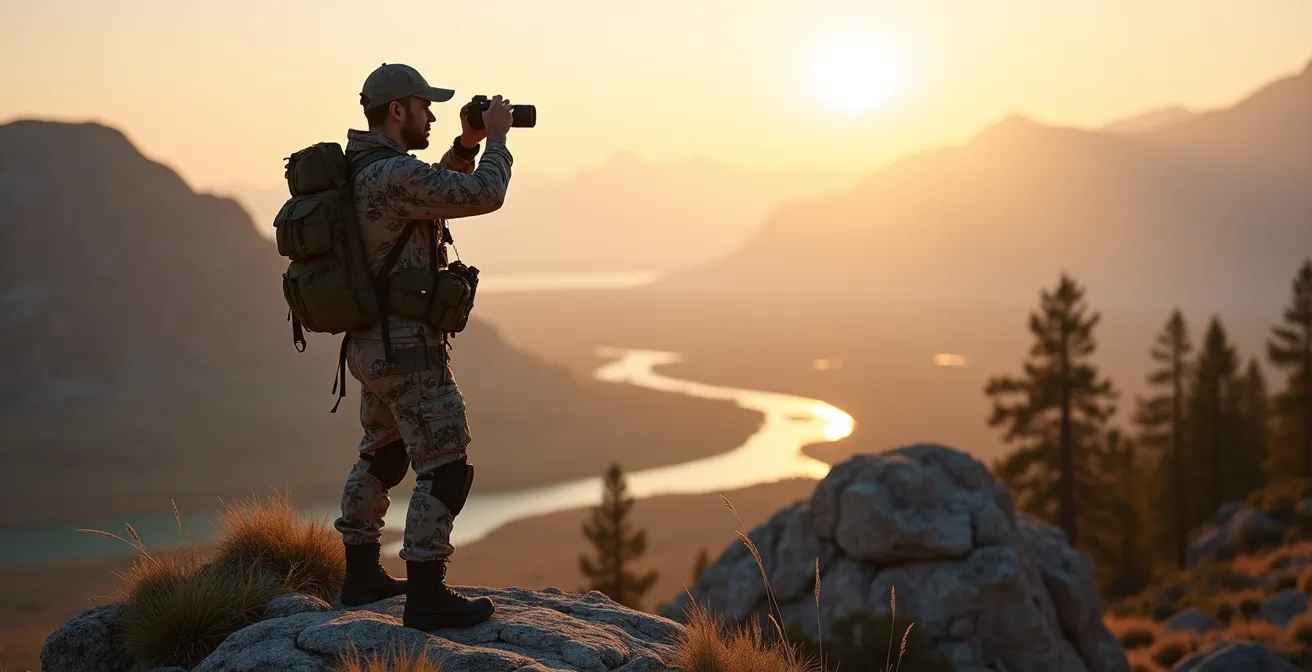
Success in a new hunting biome isn’t about having the most gear, but about recalibrating your senses to read the environment’s unique language.
- True concealment goes beyond camouflage; it involves mastering movement, scent, and silhouette.
- Every environment, from mountains to swamps, has invisible signatures (thermals, ground compression) that reveal game presence.
Recommendation: Stop planning your hunt around your gear and start planning it around the specific environmental signals you need to detect.
For any hunter, stepping into an unfamiliar biome is a primal challenge. The vast, sun-baked desert, the steep and unpredictable mountains, the disorienting cypress swamps—each presents a landscape that can feel alien and unforgiving. The common response is to over-prepare with gear, packing for every contingency. We’re told to buy the right camouflage, carry a GPS, and layer our clothing. While sound advice, this approach often misses the most critical element of adaptation.
The fundamental truth is that the most successful hunters are not those with the most equipment, but those with the most finely tuned senses. They have learned to shift their perception, to stop just looking and start *seeing*, to stop just feeling the wind and start understanding its complex choreography. But what if the key to unlocking a new environment wasn’t in your pack, but in your ability to decipher a new set of rules? What if success lies in learning the specific language of that biome?
This guide moves beyond generic checklists. We will dissect the unique challenges of disparate environments and reveal the specific tactics needed to overcome them. We will explore how to spot game that seems invisible, predict scent trails in vertical terrain, navigate by nature’s subtle compass, and become a ghost in the landscape by mastering more than just your camo pattern. It’s time to learn how to hold a dialogue with the environment itself.
For those who prefer a visual journey, the following video offers an inspiring immersion into the diverse public lands and game that await an adaptive hunter, perfectly complementing the tactical advice in this guide.
To master these environments, you must first understand their unique challenges. This article is structured to guide you through specific, high-stakes scenarios in different biomes, providing the advanced tactics needed to turn the tables in your favor.
Summary: A Hunter’s Guide to Biome Adaptation
- How to Spot Coues Deer in a Landscape That Looks Completely Flat?
- Updraft or Downdraft: How to Predict Scent Control in Steep Terrain?
- How to Navigate a Cypress Swamp When Every Tree Looks the Same?
- What to Do When There Is No Wood for a Fire on the Tundra?
- Tracking on Pine Needles: How to See Sign Where the Ground Is Soft?
- Why Cotton Is the Enemy of the Late-Season Hunter?
- Gore-Tex vs. Rubber: Which Keeps Feet Drier in High Activity?
- How to Become Invisible to Game Without relying Solely on Camo Patterns?
How to Spot Coues Deer in a Landscape That Looks Completely Flat?
The desert is an exercise in optical illusion. The ‘Grey Ghost,’ or Coues deer, is a master of this environment, capable of vanishing in sparse cover. The mistake most hunters make is actively looking for a deer. The secret is to instead look for what is ‘wrong’ with the landscape. This is a game of patience and sensory calibration, where your eyes must be trained to detect subtle anomalies rather than whole animals. Success here is not about walking more, but seeing more.
In the Sky Island terrain of Southern Arizona, seasoned hunters know this is primarily a glassing game. They will spend 80% of their time behind high-power binoculars (15x or stronger) and spotting scopes, meticulously picking apart distant hillsides. The goal is to let your optics do the walking. Instead of scanning for a deer’s body, you must train your brain to register the flicker of an ear, the twitch of a tail, or the horizontal line of a back that contrasts with the vertical vegetation.
To do this effectively, you need a system. The “Flicker Detection Method” is not about direct searching but about using your peripheral vision and understanding how light interacts with the environment. It requires a tripod-mounted optic for stability and a methodical approach, especially during the “magic hours” of dawn and dusk when backlighting can create a subtle glow on a deer’s coat, making it pop from the background. This is the language of the desert: a language of light, shadow, and minute movements.
Ultimately, spotting the unspottable is about transforming your observation from a passive act into an active interrogation of the environment. Every patch of cover must be mentally dissected until the single, out-of-place element reveals itself.
Updraft or Downdraft: How to Predict Scent Control in Steep Terrain?
In mountain hunting, the wind is not a simple line; it’s a three-dimensional, chaotic river of air. A steady breeze at your back on a ridge can be swirling in a dozen different directions in the basin below. Ignoring this fact is the single most common reason for failure in steep terrain. With research showing that over 70% of mature bucks approach from downwind during the rut, mastering scent control is not optional—it’s paramount. The key isn’t just knowing the wind’s direction, but predicting its behavior.
This behavior is governed by thermals. As the sun heats the slopes, warm air rises (an updraft), carrying your scent uphill. In the evening or on shaded slopes, cool air sinks (a downdraft), pulling your scent into the basins. These are the general rules, but every gully, cliff band, and saddle creates its own micro-current. Your job is to read these invisible signatures of airflow. Relying on a single wind check at your location is a fool’s errand. You must constantly validate what the wind is doing between you and your target zone.
This requires a proactive approach, using tools like a powder puffer or milkweed fluff to visualize these currents at various points. This is your way of having a conversation with the mountain, asking it where your scent is going. Understanding this dynamic allows for advanced setups, such as positioning yourself where a strong crosswind acts as a “scent vacuum,” pulling your odor away from the game’s likely approach trails. It’s a chess match where you must think several moves ahead of the air itself.
Your Checklist for Wind Validation in the Mountains
- Micro-Currents: Use a powder puffer or milkweed seeds every 100 yards of movement to verify local air currents, not just the prevailing wind.
- Positional Offsets: When using e-calls for predators, set them up 30-50 yards crosswind from your position to draw attention away from your scent cone.
- Thermal Transitions: Actively hunt the transition zones between sun-exposed (updraft) and shaded (downdraft) slopes during midday to intercept game moving between feeding and bedding areas.
- Scent Funnels: Position yourself where strong crosswinds push your scent safely behind and away from the primary game trails you are watching.
By learning to predict and verify these complex wind patterns, you move from being a victim of the wind to using it as a tactical tool, effectively becoming invisible to the one sense you can’t fool: an animal’s nose.
How to Navigate a Cypress Swamp When Every Tree Looks the Same?
A cypress swamp is a master of monotony. With water mirroring the sky and every tree looking like its neighbor, it’s one of the easiest places on earth to become disoriented. GPS is a valuable tool, but technology fails. The true survivalist understands how to read the biome-specific language of the swamp, using natural indicators that are far more reliable than any battery-powered device.
One of the most dependable, yet often overlooked, natural compasses is moss. In the Northern Hemisphere, moss generally grows more thickly on the north side of a tree, as it receives the least direct sunlight and stays damper. This isn’t a perfect rule, but by observing the pattern on multiple trees, you can establish a reliable directional trend. You are looking for a gradient, a subtle difference in texture and color that tells a story about the sun’s path.
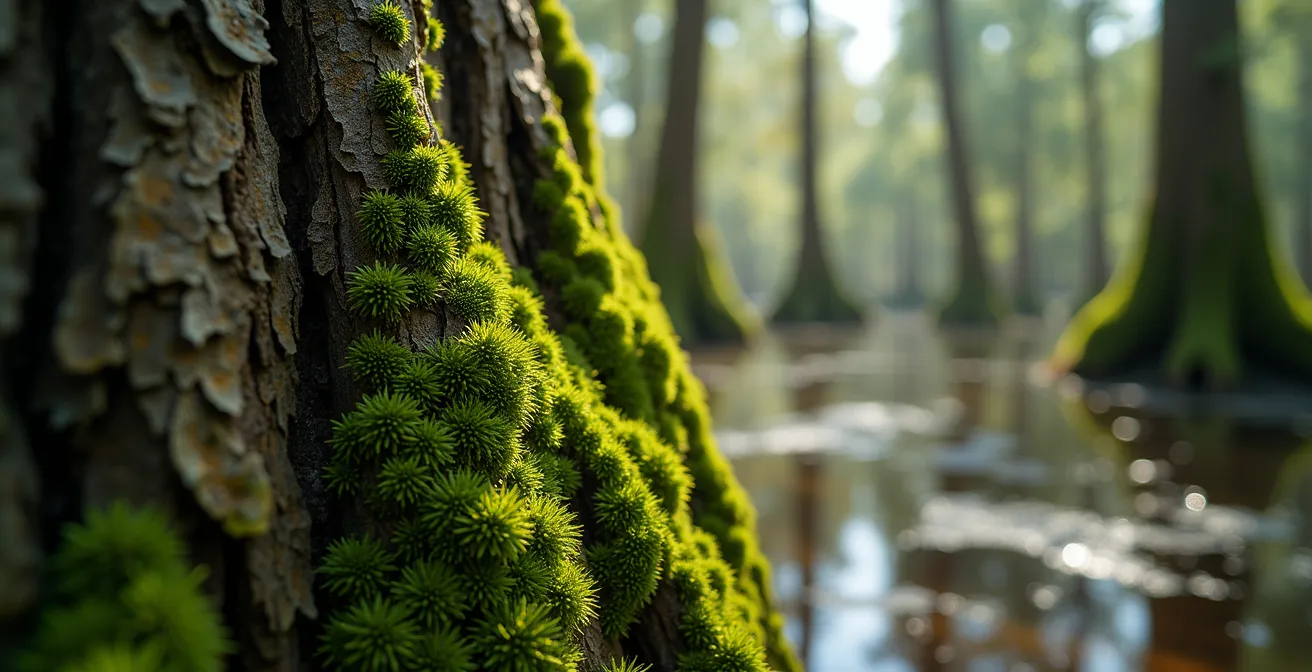
As the image demonstrates, this isn’t a giant green arrow, but a subtle pattern that requires careful observation. However, navigation should never rely on a single sense. An expert hunter in this environment engages in multi-sensory navigation. A Florida hunter, for instance, reported successfully navigating out of a swamp after his GPS failed by using auditory landmarks. He could hear the faint sound of airboats on the Gulf miles away. By putting that sound to his back, he was able to walk in a consistent direction until he reached safety. This is about listening to the swamp’s heartbeat—the flow of water, the direction of bird calls, and even the distant hum of civilization.
In a visually repetitive world, you must broaden your definition of a landmark. It may not be a unique tree, but the consistent sound of a distant highway, the feel of a prevailing breeze, or the subtle patterns of life that have aligned themselves with the cardinal directions.
What to Do When There Is No Wood for a Fire on the Tundra?
On the barren, windswept tundra, the concept of a “forest” disappears. Here, fire is life, but its fuel is not obvious. In extreme cold, where survival research indicates hunters require 5,000-6,000 calories per day just to maintain body temperature, the ability to make a fire without traditional wood is a non-negotiable skill. This environment demands a radical shift in what you define as “fuel.”
The tundra provides, but you must know what to look for. The landscape that appears barren to the untrained eye is actually littered with resources. The first and most valuable is dried animal dung, particularly from herbivores like caribou or muskox. When completely dry, it burns surprisingly hot and long. This is the tundra’s version of seasoned hardwood. You must learn to see it not as waste, but as a life-saving cache of BTUs.
Beyond this, you must look down, not up. The fuel is at your feet. Dwarf willow and arctic heather, though small, grow in dense clumps. When harvested and bundled tightly, they create a concentrated fuel source that can sustain a small, efficient fire. For tinder and kindling, look for oil-rich mosses and dried grasses, often found in sheltered pockets out of the wind. The final, critical step before even attempting a fire is building a windbreak. Using blocks of snow or a rock outcropping to create a calm space is essential; without it, the relentless wind will steal your heat and extinguish your flame before it can catch.
Adapting to the tundra is a lesson in humility and ingenuity. It forces you to abandon preconceived notions and find value in the overlooked, proving that even the most desolate landscapes offer the means for survival to those who know how to look.
Tracking on Pine Needles: How to See Sign Where the Ground Is Soft?
A forest floor blanketed in pine needles, or “duff,” is like a soundproof room for tracks. The soft, springy surface absorbs impact, erasing the clear-cut prints a hunter relies on. Trying to find a perfect track here is a recipe for frustration. The key is to stop looking for prints and start looking for compression and disturbance. You are not a detective looking for a single clue, but a physicist reading the transfer of energy.
This skill is borrowed from the master trackers of the big woods, who apply similar principles in snow. They are less concerned with the perfect outline of a hoof and more with its depth and displacement. On pine needles, this translates to looking for subtle depressions, crushed needles, and scuff marks that indicate the direction of travel. This is where light becomes your greatest ally. Low-angle sunlight, early in the morning or late in the afternoon, casts long shadows that reveal these faint compressions, which are completely invisible under the flat light of midday.
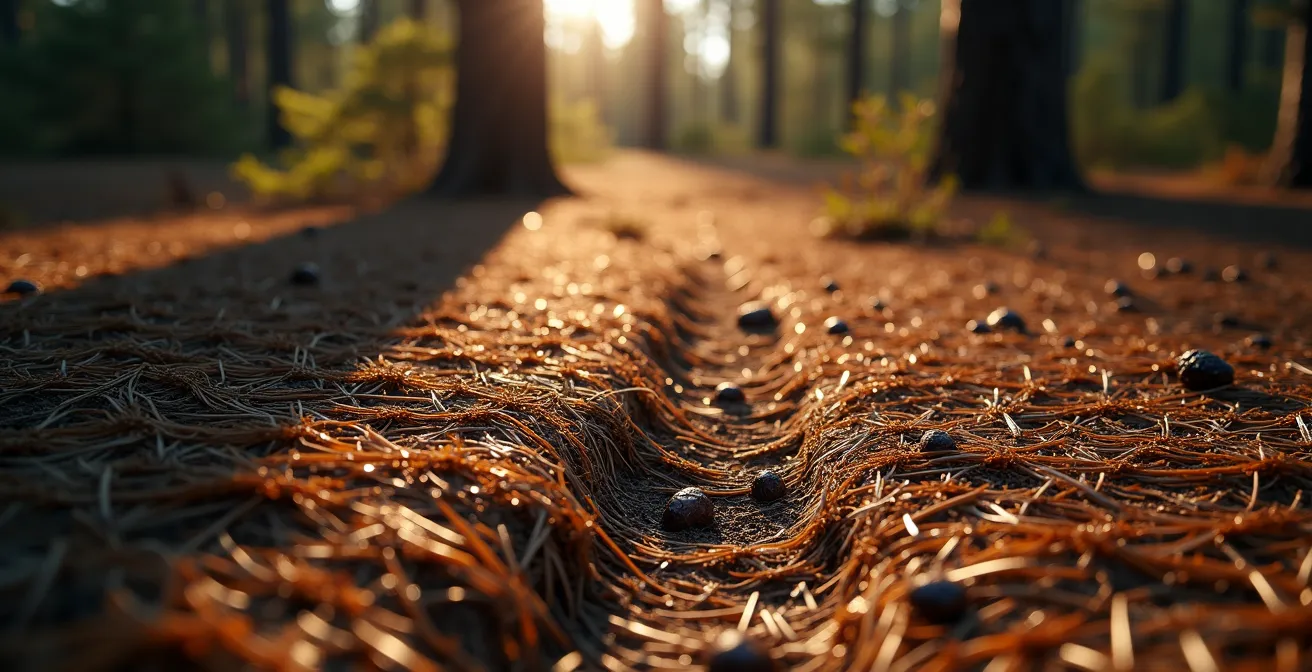
As this image illustrates, the tracks are not prints but subtle indentations, visible only because of the dramatic side-lighting. To find them, you must get low to the ground and scan the surface horizontally, letting the shadows define the sign. Experienced trackers in Maine who hunt massive, 200-plus-pound bucks rely on this ability to read pressure, as a heavier animal will create deeper, more noticeable compressions. You’re looking for a trail of flattened needles, a tiny broken twig, or a pinecone kicked out of place. It’s a chain of subtle evidence, not a single smoking gun.
Tracking on a soft forest floor is the ultimate test of a hunter’s observational powers. It forces you to see the forest floor not as a surface, but as a living record of passage, written in a language of pressure and shadow.
Why Cotton Is the Enemy of the Late-Season Hunter?
There’s an old saying among outdoorsmen: “cotton kills.” This isn’t hyperbole; it’s a statement of thermal dynamics. For the late-season hunter facing cold, and potentially wet, conditions, wearing cotton is one of the most dangerous mistakes you can make. The reason is simple: when cotton gets wet, from sweat or precipitation, it loses all of its insulating properties. In fact, thermal studies demonstrate that up to 25 times faster heat loss occurs when cotton is wet versus dry. Your body is forced to burn precious calories simply to fight the cold seeping through your clothes.
Cotton fibers are hydrophilic, meaning they absorb and hold water like a sponge. A wet cotton t-shirt becomes a cold, clammy sheet plastered against your skin, actively pulling heat away from your core. This can lead to discomfort, a loss of focus, and in a worst-case scenario, hypothermia. The solution is to choose fabrics that are hydrophobic (they repel water) or that retain their insulating ability even when damp.
Modern synthetics and natural merino wool are the late-season hunter’s best friends. They work by wicking moisture away from your skin and allowing it to evaporate, keeping you dry from the inside out. Even when saturated, they retain a significant portion of their insulating loft, creating a buffer of warm air that protects you. Understanding this fundamental difference in fabric performance is not just about comfort; it’s a critical component of your survival system.
This table clearly illustrates the stark performance differences. The choice of material is a direct investment in your safety and effectiveness in the field.
| Fabric Type | Wet Insulation | Drying Time | Weight |
|---|---|---|---|
| Cotton | 0% retention | 8-12 hours | Heavy when wet |
| Merino Wool | 80% retention | 2-4 hours | Moderate |
| Synthetic | 70% retention | 1-2 hours | Lightweight |
Choosing the right layering system is a deliberate act of environmental adaptation. By ditching cotton, you are removing a significant variable of risk and freeing your body to focus on the hunt, not just on survival.
Gore-Tex vs. Rubber: Which Keeps Feet Drier in High Activity?
The question of Gore-Tex versus rubber boots seems simple, but the answer is complex and situational. The goal is dry feet, but “dry” has two enemies: external water (rain, creek crossings) and internal water (sweat). Choosing the right boot means understanding which enemy you’re more likely to face. There is no single “best” boot, only the best boot for a specific application.
Rubber boots offer 100% waterproof protection from the outside. They are unbeatable for crossing swamps, sitting in a wet duck blind, or any situation involving standing water. However, they have zero breathability. During high-exertion activities like hiking in the mountains, your feet will sweat, and that moisture has nowhere to go. You can end up with feet just as wet from your own perspiration as you would from a leaky boot, leading to blisters and cold.
Gore-Tex (and similar waterproof-breathable membranes) are designed to solve this problem. They allow sweat vapor to escape while blocking larger water molecules from entering. This makes them ideal for high-exertion hunting where you are constantly moving. However, their effectiveness can be compromised by dirt and oils clogging the membrane, and they can eventually “wet out” under sustained downpour. The choice is a trade-off between absolute external protection and internal moisture management.
This choice is highly dependent on your activity level and the specific conditions you’ll face, as a comparative analysis of boot materials reveals.
| Boot Type | Best For | Breathability | Waterproofing | Failure Point |
|---|---|---|---|---|
| Gore-Tex | High exertion/hiking | Excellent | Good until saturated | Dirt contamination of membrane |
| Rubber | Standing water/swamps | None | 100% waterproof | Punctures and tears |
| Hybrid (rubber bottom/breathable top) | Mixed conditions | Moderate | Good | Seam separation |
Ultimately, the boot is only half the equation. The real secret to dry feet is a proactive sock system that manages moisture regardless of your footwear. A thin wool liner wicks sweat, while a thicker outer sock provides cushioning. For high-activity hunts, packing a dry pair of socks and changing them midday is the single best thing you can do to keep your feet dry and healthy.
Thinking of your footwear as a system—boots, socks, and maintenance—rather than a single product is the mark of an experienced and adaptive hunter.
Key Takeaways
- See Anomalies, Not Animals: Train your eyes to detect what’s ‘wrong’ in the landscape—a horizontal line, an unnatural flicker—rather than searching for a complete silhouette.
- Master Micro-Environments: The wind on the ridgetop is not the wind in the basin. Use thermals, funnels, and constant verification to understand where your scent truly travels.
- Break the Human Pattern: Game animals key in on the steady rhythm and upright silhouette of a human. To become invisible, you must mimic the broken, stop-and-go movements of nature.
How to Become Invisible to Game Without relying Solely on Camo Patterns?
The modern hunting market is saturated with camouflage patterns, each promising to make you disappear. While camo helps break up your outline, true invisibility is achieved by deceiving an animal’s other senses and, most importantly, its expectations. Animals don’t just see patterns; they recognize shape, movement, and sound. The most effective concealment is not about what you wear, but how you move and the form you present.
This concept of behavioral exploitation is not new. In the early 1800s, as documented by artist George Catlin, Native American hunters would disguise themselves as wolves to hunt bison. They understood that bison would stand their ground against a wolf (which only attacked running animals) but would flee from the upright form of a human. They weren’t just hiding; they were manipulating the bison’s behavioral programming. Modern hunters apply this same principle by using cow decoys to approach antelope, breaking the bipedal human silhouette and replacing it with a non-threatening shape.
Movement is the other critical factor. Humans walk with a steady, predatory rhythm. Browsing animals, like deer, move with a “hunt-and-peck” pattern: a few steps, then a long pause to scan their surroundings. By mimicking this behavior—taking two or three slow steps, then freezing for up to a minute—you blend into the natural rhythm of the woods. During these pauses, you use terrain features like trees or brush to break up your outline. You move only when the wind, rain, or other natural sounds can mask the noise of your steps. This tactical fluidity makes you part of the landscape, not an intruder in it.
Action Plan: The Hunt-and-Peck Movement Pattern
- Initiate Contact: Take two to three slow, deliberate steps, minimizing ground impact.
- Collect Data: Freeze completely for 30-60 seconds, using this pause to scan your entire environment with your eyes and ears, not just your head.
- Ensure Coherence: Your movement should mimic the natural, relaxed browsing behavior of a non-predatory animal. Never maintain a steady, rhythmic walk.
- Assess Emotional Impact: At every pause, ensure your silhouette is broken by a tree, bush, or terrain feature. Avoid standing in the open.
- Integrate & Advance: Plan your next short movement only when a gust of wind, a passing airplane, or another ambient sound can cover the noise of your steps.
By focusing on shape and movement, you engage in a deeper level of stealth. You are no longer just a hunter in a camo suit; you are an active participant in the environmental dialogue, speaking a language of non-threatening forms and natural rhythms that allows you to disappear in plain sight.