The core confusion between daily and possession limits stems from not understanding the legal “harvest timeline.” It’s not just about the numbers; it’s about knowing the precise moment a caught fish or game animal transitions from a potential take to being part of your legally defined possession. Mastering this timeline, especially on multi-day trips, is the only way to avoid accidental violations and costly fines. This guide provides the clarity needed to ensure every harvest is compliant from field to freezer.
Imagine this scenario: you’re on the second day of a three-day fishing trip. The cooler at your campsite holds yesterday’s daily limit of walleye, perfectly legal. Today, you land the trophy of a lifetime. Can you keep it? Answering this question incorrectly can turn a dream trip into a legal nightmare involving fines and license suspension. This is where the critical, and often misunderstood, distinction between a “daily limit” and a “possession limit” becomes paramount.
Many anglers believe that simply knowing the numbers in the regulation book is enough. They check the daily bag limit and assume the slate is wiped clean every 24 hours. But the law is more complex. It operates on a concept I call the harvest timeline—a sequence of events and states that determines when an animal is officially in your possession. This includes everything from how you measure it and correctly identify its species to where it’s stored. True compliance isn’t just about what you catch; it’s about what you possess, where you possess it, and for how long.
But if the real key isn’t just memorizing numbers, what is it? It’s about understanding the legal and biological principles that underpin these rules. This isn’t bureaucratic red tape; it’s the framework that ensures sustainable populations for future generations. Forgetting this can lead to unintentional poaching.
This article will break down the crucial components of the harvest timeline. We will dissect the non-negotiable rules of measurement, explain the biological necessity of slot limits, clarify species identification, define the legal boundaries of culling in tournaments, and explore the wider ecological impact of your harvest. Your responsibility as a sportsperson goes beyond the catch—it begins with a mastery of these regulations.
To navigate these complex but essential regulations, this guide breaks down the key areas where hunters and anglers most often make mistakes. The following sections provide the clarity needed to ensure every trip remains compliant and ethical.
Contents: Understanding Harvest Regulations
- Fork Length vs. Total Length: Which Measurement Keeps You Legal?
- Why You Must Release Fish Between 15 and 20 Inches?
- Sauger or Walleye: The Spotting Detail That Prevents a Fine
- When Is “Culling” Considered Illegal Poaching in Tournaments?
- How to Report a Poacher Without Confronting Them Directly?
- How to Calculate Your Personal Harvest Impact on Local Herds?
- The Population Crash Caused by Harvesting the Wrong Doe Ratio
- Why Removing Small Predators Can Actually Produce Bigger Trophies?
Fork Length vs. Total Length: Which Measurement Keeps You Legal?
The first point of failure in the harvest timeline is often the most basic: the measurement. Assuming “length” is a universal term is a rookie mistake that can lead to an illegal catch. The method required is dictated by the species and the jurisdiction, and ignorance is not a defense. The history of these regulations shows just how variable they can be; for instance, the Florida Fish and Wildlife Conservation Commission documented that between 1925 and 1973, four different measurement methods were used simultaneously for marine fish. This complexity persists today.
To stay compliant, you must understand the primary methods and when to use them. Louisiana, for example, employs a comprehensive system: Total Length for most species, Fork Length for deeply forked fish like amberjack, and even Lower Jaw Fork Length for billfish. The difference is not trivial. Total Length (TL) is measured from the tip of the snout to the tip of the tail, often requiring the tail to be squeezed together. Fork Length (FL), by contrast, is measured from the snout to the fork in the tail. Using the wrong method on a fish that is close to the legal size can be the difference between a legal harvest and a citation.
The following table outlines the most common measurement types. It is your responsibility to know which one applies before you head out on the water.
| Measurement Type | Definition | Primary Use |
|---|---|---|
| Total Length (TL) | Tip of snout to tip of tail | Most freshwater species |
| Fork Length (FL) | Tip of snout to fork of tail | Pelagic species with forked tails |
| Curved Fork Length (CFL) | Following body contour to fork | Highly migratory species |
Ultimately, a legal measurement is not a suggestion; it is a strict requirement. Before measuring any fish for regulatory purposes, you must know your local regulations for that specific species, understand whether to squeeze the tail, and use the correct method. This is the first regulatory bright-line you must not cross.
Why You Must Release Fish Between 15 and 20 Inches?
The question isn’t just a hypothetical; it refers to a specific type of regulation known as a “slot limit.” A protected slot limit—where fish within a certain size range must be released—is one of the most powerful tools in a biologist’s arsenal. It may seem counterintuitive to release healthy, medium-sized fish, but there is a profound biological imperative behind this rule. These fish are often the prime breeding stock of a population. They are mature enough to spawn prolifically but have not yet reached the larger, older sizes where reproductive output can decline. Protecting this specific age class ensures the maximum number of healthy offspring for future seasons.
Harvesting these “teenage” fish is akin to cutting down a fruit tree just as it begins to bear its best fruit. By releasing them, anglers act as conservation partners, safeguarding the engine of the entire fishery. These regulations are not static; they are adjusted based on scientific data to respond to environmental pressures or population declines. For example, recent emergency regulations in California reduced the white sturgeon slot limit to 42-48 inches to protect the species after a significant die-off. This demonstrates how agencies use slot limits as a surgical tool to manage populations in real-time.
There are also “harvestable” slot limits, where you can only keep fish within a certain range. This is often used to thin out an overabundant year class of smaller fish to allow others to grow larger, or to protect the largest trophy fish as unique genetic assets. In either case, adherence is mandatory. Measuring a fish and releasing it if it falls within a protected slot is not a courtesy; it is a legal requirement essential for the health of the ecosystem.
Sauger or Walleye: The Spotting Detail That Prevents a Fine
In many waterways, sauger and walleye coexist, and they often have different size limits, daily limits, or even open seasons. Mistaking one for the other is a common and costly error. The law does not accept “I thought it was a walleye” as an excuse. As a responsible angler, it is your duty to know the definitive features that separate these two closely related species. Relying on general body color is a recipe for failure, as it can vary widely based on water clarity and diet.
The most reliable indicators are found on the fins. The walleye has a large, single dark blotch at the rear base of its spiny dorsal fin, while the rest of that fin is generally unmarked. The sauger, in contrast, lacks this large blotch. Instead, its spiny dorsal fin is covered in distinct, separate dark spots arranged in rows, giving it a polka-dotted appearance. This is a non-negotiable identifying feature.
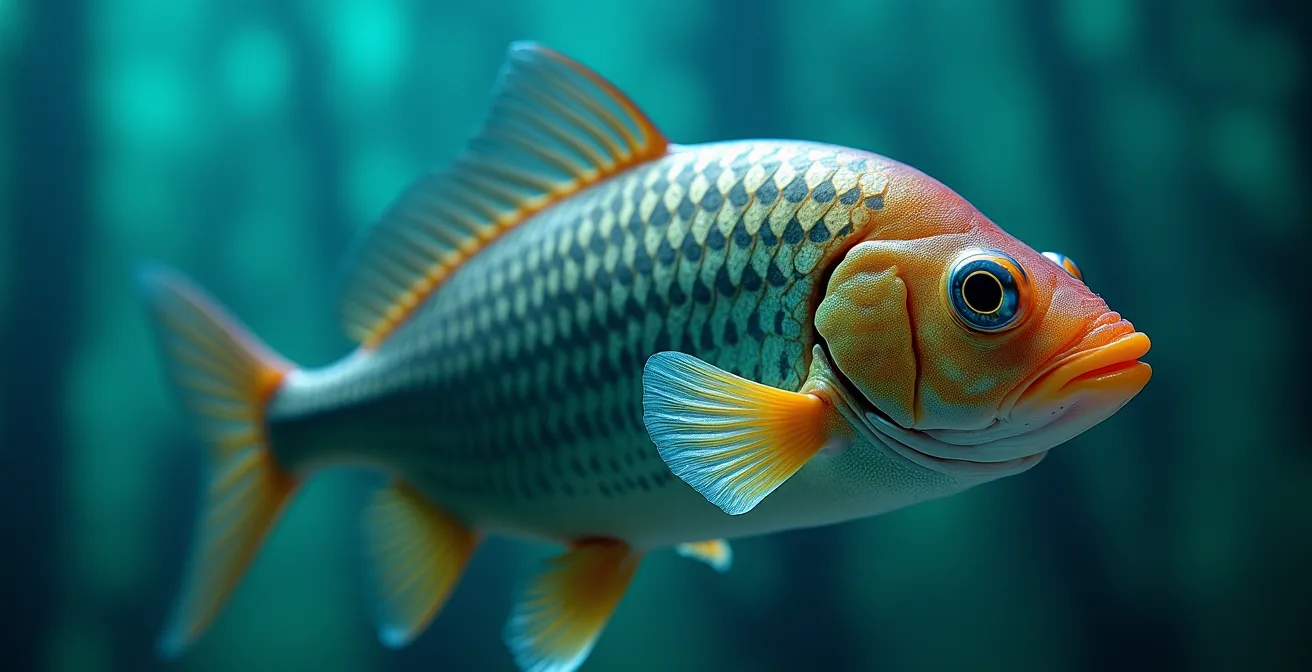
Another key difference is on the tail. A walleye has a prominent white tip on the lower lobe of its caudal (tail) fin. A sauger lacks this distinct white tip. While both may have some light coloration, the walleye’s marking is a clear, opaque white patch. Finally, the body of a sauger is typically covered in dark, saddle-like blotches, whereas a walleye’s body is more uniform in color. When in doubt, examine the dorsal fin first—it is the most conclusive piece of evidence you have.
When Is “Culling” Considered Illegal Poaching in Tournaments?
The practice of “culling”—releasing a smaller fish from your livewell to replace it with a larger one you just caught—is a major point of confusion. For the average recreational angler, the rule is simple and absolute: once a fish is reduced to your possession and not immediately released, it counts towards your daily bag limit. If you have your limit of five bass in a livewell and catch a sixth, bigger one, you cannot legally release one of the five to keep the sixth. This would constitute exceeding your daily limit, even if only for a moment. That fifth fish became part of your limit the instant it was placed in the livewell.
However, a specific exemption often exists for organized, sanctioned fishing tournaments. This is not a loophole for casual anglers; it is a specific provision for competitive events. As the fishing resource Fish Untamed clarifies regarding Alabama’s rules:
If you’re in a bonafide fishing tournament and keep fish alive in a livewell, you can have more fish than the daily creel limit as long as you release them unharmed after the tournament in the same day.
– Fish Untamed, Alabama Tournament Fishing Regulations
This special rule is designed to allow competitors to assemble their heaviest possible legal limit for weigh-in. It is critical to understand that this only applies to “bonafide” tournaments and usually requires all fish to be released alive. Outside of this specific context, culling is illegal. The regulatory bright-line is clear: a fish becomes part of your daily limit as soon as it is not immediately returned to the water. In many states, once you reach your limit for a species, you must stop fishing for that species altogether.
How to Report a Poacher Without Confronting Them Directly?
Witnessing a poaching violation puts ethical sportspersons in a difficult position. Confrontation can be dangerous and is never recommended. However, turning a blind eye allows thieves to steal a resource that belongs to every citizen. The correct and safest course of action is to act as a good witness: observe, document, and report. Your goal is to provide conservation officers with the actionable intelligence needed to investigate and apprehend violators, and you can do this anonymously and safely.
Every state has a designated poaching hotline, often called “Turn In Poachers,” “Operation Game Thief,” or a similar name. These lines are typically staffed 24/7 and allow for confidential reporting. To make your report effective, you must collect specific, factual information. Vague reports like “someone is over-fishing the lake” are not actionable. Officers need details to build a case. The more precise your information, the higher the likelihood of a successful enforcement action. Your cell phone is your most powerful tool: use it to take photos or videos (if safe), drop a GPS pin, and record notes.
Before making a call, ensure you have gathered as much of the critical information as possible. A complete and accurate report is the most valuable contribution you can make to protecting wildlife resources.
Your Checklist for an Effective Poaching Report
- Document Location: Record precise GPS coordinates or specific, immovable landmarks (e.g., “100 yards east of the Route 5 bridge”).
- Note Date and Time: Log the exact date and time the violation was observed. This is crucial for establishing a legal timeline.
- Record Descriptions: Note descriptions of individuals involved and any vehicles, including make, model, color, and license plate number if possible.
- Detail the Violation: Describe the specific illegal activity (e.g., “kept three undersized redfish,” “shot a deer from the road”) and the type of wildlife involved.
- Verify Regulations: If possible and safe, use a mobile app like FishRules to quickly verify the current regulation you believe is being violated before you report.
By following these steps, you fulfill your duty as a steward of the environment without putting yourself at risk. You become the eyes and ears for conservation law enforcement, helping to ensure the resource remains for all to enjoy.
How to Calculate Your Personal Harvest Impact on Local Herds?
This is where we return to the core question of possession limits, especially on multi-day trips. A possession limit is the total number of a species you can have in your control at any one time. This includes fish in your cooler at camp, birds in your truck, and even game in your freezer at home. This is the legal doctrine of “constructive possession.” The law sees no difference between a fish on your stringer and one you harvested two days ago that is now at your house. Both count towards your possession limit.
A common rule of thumb, as MeatEater’s conservation analysis shows, is that a possession limit is often two or three times the daily bag limit. So, if the daily limit for pheasants is two, the possession limit might be four or six. This system is designed to allow for multi-day hunting or fishing trips without forcing you to go home after the first day. However, it is not an invitation to stockpile.
Case Study: Colorado’s Progressive Possession System for Blue Grouse
Colorado’s regulation for blue grouse provides a perfect illustration of how possession limits work over time. The daily bag limit is three birds. The possession limit is nine birds. However, a hunter cannot go out on day one and shoot nine birds. They can legally take three birds on day one. On day two, they can take another three, bringing their total possession to six. Only after a third day of hunting can they harvest another three birds to reach the maximum possession limit of nine. This system explicitly ties the possession limit to the number of hunting days, preventing a single outing from depleting the local resource while still accommodating extended trips.
Understanding this concept is critical. Your personal harvest impact is not just what you take in a single day. It is the cumulative total of game you have that has not yet been consumed or gifted. On a multi-day trip, you must constantly be aware of your total count to ensure you do not exceed your possession limit when you take another animal.
The Population Crash Caused by Harvesting the Wrong Doe Ratio
Game management is not simply about limiting numbers; it’s about managing demographics. Within a deer herd, not all animals have the same biological value to the population’s future. While hunters often prioritize harvesting bucks for their antlers, the true engine of the herd is the doe population. Each doe is a potential factory for future deer. Harvesting a buck removes one animal. Harvesting a doe removes that animal plus all of its potential future offspring.

This is why wildlife agencies spend so much effort on calculating the correct antlerless harvest quotas. If too many does are removed from a population, the herd’s reproductive capacity can be crippled, leading to a population crash that can take years, or even decades, to recover. In a healthy system, a certain number of does must be harvested to keep the population in balance with what the habitat can support, preventing over-browsing and mass starvation. But exceeding that number is a catastrophic failure of management.
As a hunter, you are a direct instrument of this management strategy. Choosing to fill an antlerless tag is not a lesser hunt; it is a direct contribution to the health and stability of the entire herd. It is a recognition that your harvest is part of a much larger ecological equation. Ignoring doe tags or exclusively targeting bucks in an area that requires a higher doe harvest can contribute to long-term population instability and reduce hunting opportunities for everyone in the future.
Key Takeaways
- The law operates on a “harvest timeline”; you must know when a caught animal is legally considered in your possession.
- Your responsibility is absolute: you must know the correct measurement methods, species identification, and slot limits for your target and location.
- Possession is not just what’s on your stringer. It includes game at your camp, in your vehicle, or in your freezer at home (“constructive possession”).
Why Removing Small Predators Can Actually Produce Bigger Trophies?
The logic seems simple: fewer predators should mean more game. This often leads well-intentioned land managers and hunters to target smaller predators like coyotes and foxes, believing it will directly result in more deer, turkey, or quail. However, ecology is rarely that simple. A healthy ecosystem is a complex web of interactions, and disrupting one part can have unexpected and often negative consequences elsewhere—a phenomenon known as a trophic cascade.
While large predators like wolves or mountain lions can certainly impact game populations, the more ubiquitous smaller predators play a different role. When you aggressively remove a “peak” small predator like the coyote, you can inadvertently cause an explosion in the population of “mesopredators”—animals like raccoons, skunks, and opossums. Coyotes actively hunt and suppress these smaller animals. Without that pressure, their numbers can skyrocket.
This is where the problem for trophy game arises. A raccoon or a skunk isn’t going to take down an adult deer, but they are devastatingly efficient nest raiders and fawn predators. An explosion in the mesopredator population can lead to a massive decline in the survival rate of turkey poults, quail chicks, and newborn fawns. So, while you may have fewer coyotes, you have far more mouths devouring the next generation of game before they ever have a chance to grow. The end result of your predator removal effort can be fewer, not more, mature trophy animals in the long run.
Your next step is not to memorize every rule, but to adopt the mindset of a steward. Before every trip, review the specific regulations for your target species and location. It is your duty, and it is the only way to protect the future of the sport.