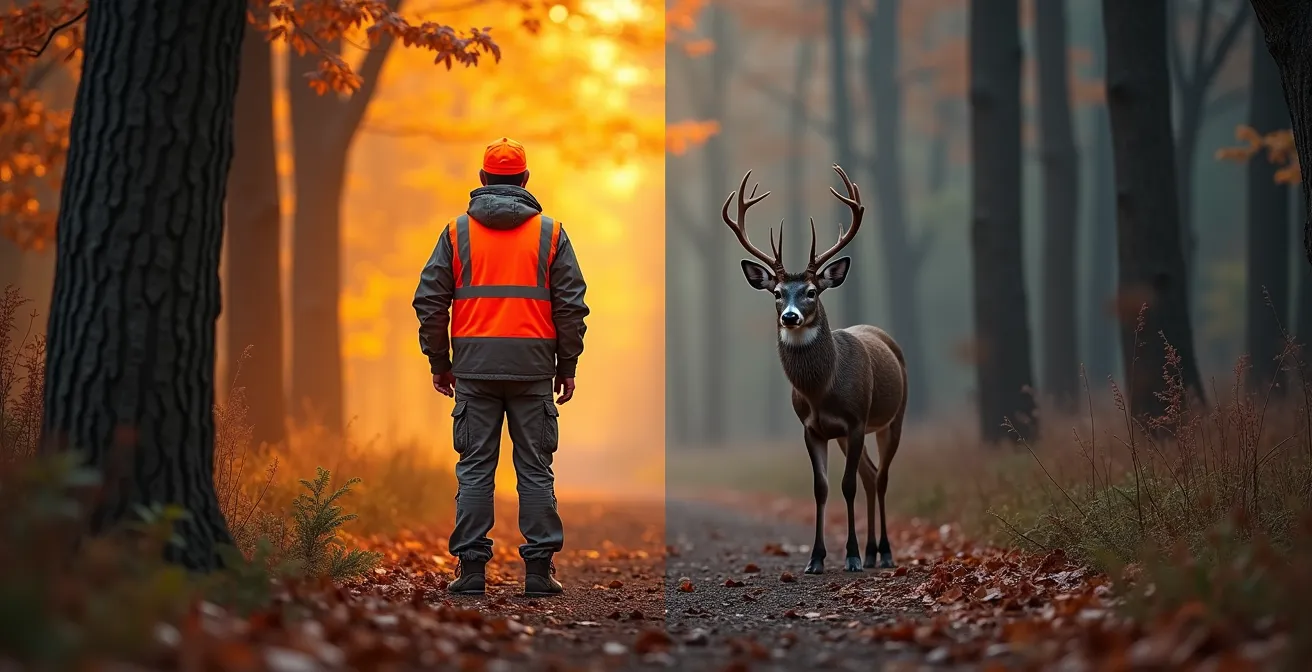
The fear that blaze orange compromises your hunt is based on a misunderstanding of animal vision; the real threat to your stealth is the invisible UV glow from your laundry detergent.
- Game animals like deer have dichromatic vision, meaning they can’t distinguish the long-wavelength colors of red and orange from greens and browns.
- However, their eyes are highly sensitive to the blue and UV light spectrum, causing fabrics treated with UV brighteners to appear as a brilliant, unnatural glow.
Recommendation: Prioritize washing your gear with UV-free detergents and focus on controlling movement and silhouette, as these are far more critical for concealment than arguing over color.
For any hunter, the dilemma is as old as the fluorescent vest itself. On one shoulder sits the absolute, non-negotiable need for safety—to be seen by other humans. On the other sits the primal drive for stealth—to melt into the environment and go completely unnoticed by your quarry. This conflict gives rise to a persistent question: does wearing blaze orange, the very color designed to make you conspicuous, effectively broadcast your presence to the entire forest, ruining your chances of success? The common wisdom is a frustrating paradox, leaving hunters to wonder if they must choose between a safe hunt and a successful one.
Many articles simply state that deer are “colorblind” and to “wear a vest.” This oversimplifies a complex reality. The truth of concealment goes far beyond simple color matching. It involves understanding the fundamental differences between how human eyes and animal eyes process the world. As a visual perception expert, I can tell you that the key to unlocking true stealth isn’t about the colors you wear, but about the light your gear reflects and the movements you make.
The crucial insight is this: your blaze orange vest is practically invisible to a deer in the way you fear, but your clean, freshly washed camouflage jacket might be shining like a beacon. This guide will dismantle the myths around hunting visibility. We will explore the science of animal vision, address the practicalities of layering safety gear, and redefine what it truly means to be invisible to game. By shifting focus from pattern to perception, you can achieve the ultimate goal: being an unmistakable human to other hunters while remaining a mere shadow to the wildlife you pursue.
This comprehensive guide breaks down every aspect of the safety-versus-stealth debate. Below, you will find detailed sections exploring the science, the gear, and the field tactics necessary to master both visibility and concealment.
Summary: Blaze Orange vs. Camouflage: A Hunter’s Guide to Visual Perception
- Why Deer Cannot See Blaze Orange Spectrum Like Humans Do?
- How to Layer High-Vis Gear Over Cold Weather Clothing?
- Vest or Hat: Which Safety Item Offers Better Visibility in Dense Brush?
- The Low-Light Mistake That Renders Your Orange Vest Useless
- When to Use High-Vis Markers to Signal Your Position to Partners?
- Why Experienced Hunters Are Just as Prone to Accidents as Beginners?
- How to establish “lanes of fire” for a moving line of hunters?
- How to Become Invisible to Game Without relying Solely on Camo Patterns?
Why Deer Cannot See Blaze Orange Spectrum Like Humans Do?
The core of the blaze orange debate rests on a fundamental difference in biology. Human eyes possess trichromatic vision, with three types of cone cells that allow us to perceive red, green, and blue light, and all their combinations. This is why blaze orange appears so vibrant and distinct to us against a green and brown forest background. Deer and other ungulates, however, have dichromatic vision. They lack the red-sensitive cone, meaning their world is perceived in shades of blue, yellow, and gray. To a deer, the long-wavelength light of hunter orange is indistinguishable from the greens and browns of the foliage. It simply blends into a muted, yellowish-gray tone.
So, if they can’t see the orange, why do hunters sometimes get busted while wearing it? The answer lies not in the color, but in the ultraviolet (UV) spectrum. A deer’s eye is highly sensitive to short-wavelength light, including UV light, which helps them see better in low-light conditions at dawn and dusk. The problem arises from laundry detergents and fabric treatments that contain UV brighteners. These chemicals are designed to make clothes look “brighter” to the human eye by absorbing UV light and re-emitting it as visible blue light. To a deer, this effect is dramatic. Clothing washed with these brighteners—even camouflage patterns—can appear to glow with an intense, unnatural white or blue light, instantly signaling danger.
This is why some hunters wearing drab camouflage get spotted easily, while others in blaze orange go unnoticed. The true visual enemy is not the color orange, but the invisible UV glow. Success depends on managing this aspect of your visual profile. Many hunters find that even their blue jeans will appear to glow brightly to deer because of the dyes and detergents used.
Action Plan: Avoiding UV Detection by Deer
- Wash all hunting gear, from base layers to outer shells, exclusively with UV-free detergents or specialized hunting soaps to eliminate fluorescent glow.
- Consider treating your clothing and equipment with a UV-blocking spray, which can neutralize any existing brighteners and prevent UV reflection.
- Before the season, use a handheld UV or black light in a dark room to inspect your gear. You will be surprised what glows.
- Choose camouflage patterns and blaze orange gear from reputable hunting brands that specifically avoid using UV brighteners in their manufacturing process.
- Remember that your silhouette and movement are primary detection triggers; even with perfect UV control, remaining still is paramount.
Ultimately, by focusing on UV control, you are addressing what the animal actually sees, making the color of your safety gear a non-issue for stealth.
How to Layer High-Vis Gear Over Cold Weather Clothing?
Wearing blaze orange is simple in mild weather, but it becomes a logistical challenge when the temperature drops. Bulky insulated jackets and multiple layers can make a standard, ill-fitting vest a cumbersome and even unsafe addition. An improperly layered vest can restrict movement, snag on branches, and bunch up, reducing both its visibility and your ability to properly shoulder a firearm or draw a bow. The key is to select high-visibility gear that is designed for integration, not just as an afterthought.
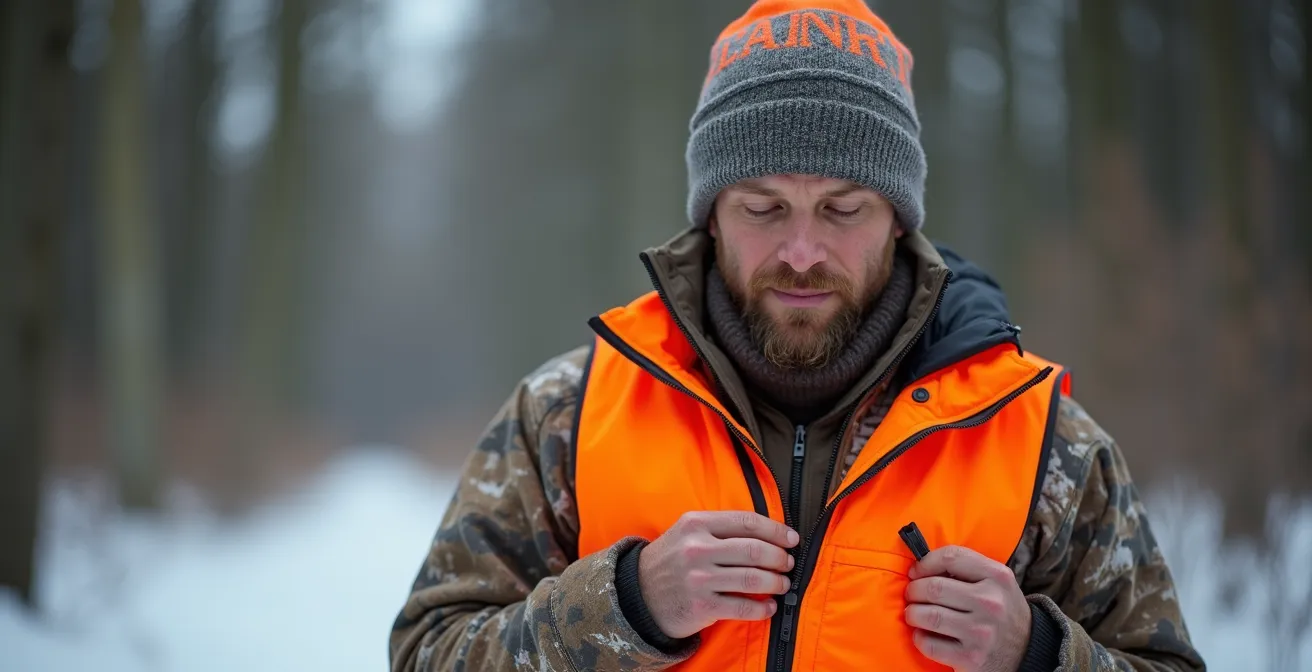
Modern blaze orange vests come in various styles, each suited to different conditions and layering systems. A lightweight mesh vest is perfect for slipping over a warm-weather shirt or a light jacket. For colder hunts, look for vests with adjustable side straps or buckles. These allow you to expand the vest to fit comfortably over a thick parka without compressing the insulation, which would reduce its thermal efficiency. Strap-style “vests,” which are essentially a harness of blaze orange webbing, offer maximum adjustability and breathability, and they ensure that pockets and access zippers on your primary jacket remain unobstructed.
This image demonstrates how a well-designed vest with adjustable sides fits securely over a heavy winter jacket, maintaining full visibility without impeding the hunter’s movement or access to their gear.
When selecting a vest, considering its material and design is as important as its color. The goal is a seamless fit that you can forget you’re wearing, ensuring your focus remains on the hunt, not on your gear.
This comparative analysis shows how different vest types perform in various cold-weather layering scenarios. Choosing the right one ensures you don’t have to sacrifice warmth for safety.
| Vest Type | Weight (GSM) | Temperature Range | Layering Capability |
|---|---|---|---|
| Lightweight Mesh | 200-300 | 5-15°C | Excellent over bulky jackets |
| Standard Fabric | 300-400 | 0-10°C | Good with adjustable straps |
| Insulated Heavy | 400-500 | -5-5°C | Limited, works as outer layer |
| Strap Style | 150-250 | Any | Superior – maintains gear access |
By choosing the right type of high-visibility gear for your system, you ensure that safety and comfort coexist, allowing you to perform at your best even in harsh conditions.
Vest or Hat: Which Safety Item Offers Better Visibility in Dense Brush?
When navigating thick undergrowth, ravines, or rolling terrain, a hunter’s body can be partially or completely obscured. This raises a critical question: if you had to prioritize one piece of safety gear, which provides more reliable visibility—a vest or a hat? The answer is not always straightforward and depends on the environment and hunting scenario. A hat sits at the highest point of your body, making it the first thing to appear over a ridge or out of a dip in the terrain. In dense brush, it can often be seen bobbing above the foliage when your torso is completely hidden.
However, a vest provides a much larger surface area of continuous color. Its 360-degree visibility is its greatest asset. While a hat is a single, small point of color, a vest presents a large, unmistakable block of orange from the front, back, and sides. This is crucial for preventing tragic mistaken-for-game accidents. In fact, a statistical analysis reveals that victims wearing Hunter Orange are seven times less likely to be involved in such incidents. The larger the visible block of color, the less likely a human brain is to misinterpret a shape or movement as an animal.
Most state regulations recognize the superior coverage of a vest, often mandating a minimum number of square inches of blaze orange to be worn on the torso. For example, a common requirement is 400 square inches visible above the waist. While a hat contributes to this total, it is rarely sufficient on its own. The ideal solution, and the one that provides the most robust safety profile, is to wear both. The hat provides high-point visibility in undulating terrain, while the vest ensures your torso is clearly identifiable as human, even when partially obscured. Combining the two creates layers of visibility that cover more potential scenarios than either piece alone.
Ultimately, treating the hat and vest as a complementary system, rather than an either/or choice, offers the most comprehensive protection against being misidentified in the field.
The Low-Light Mistake That Renders Your Orange Vest Useless
The protective power of blaze orange is entirely dependent on light. Its fluorescent properties are designed to react with the sun’s ultraviolet rays, making it “glow” with exceptional brightness during daylight hours. However, in the low-light conditions of dawn and dusk—prime time for both hunting activity and accidents—this effect diminishes significantly. As ambient light fades, the color’s vibrancy disappears, and the orange can appear as a dull, dark brown, blending in with the shadowy treeline. This is when a hunter’s reliance on color alone becomes a critical mistake.
The single most dangerous error in these conditions is assuming your gear is performing as it does in broad daylight. This false sense of security can lead to tragedy. The effectiveness of blaze orange laws is a testament to its importance; for instance, the introduction of the blaze orange law in Washington led to a 60% reduction in vision-related accidents. This demonstrates its critical role, but also highlights that its effectiveness is tied to environmental conditions. A common and dangerous mistake is wearing gear with reflective stripes, such as a construction vest. In low light, a headlamp beam might only illuminate the white stripe, which can be easily mistaken for the flash of a deer’s tail.
This scene shows how quickly a hunter can become a silhouette against a dark background as dawn breaks, making color less relevant than shape and position.
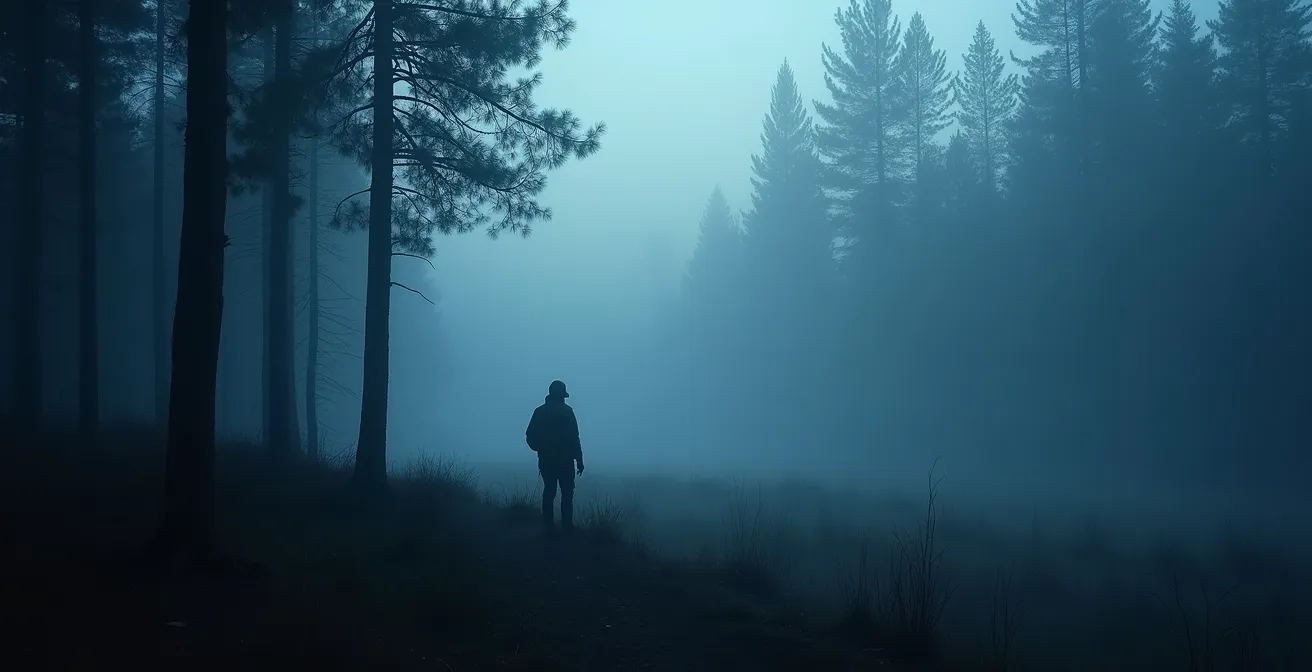
To maintain visibility in these crucial moments, several precautions are necessary. First, check your gear for UV fading annually; a worn-out, faded vest loses its fluorescent qualities and offers significantly less protection. Second, be mindful of your position. Standing in deep shadows or against a dark, light-absorbing background like a pine stand will negate your vest’s visibility. Whenever possible, position yourself against a lighter backdrop like an open sky or lighter foliage to maintain a clear silhouette. Lastly, never remove your orange gear until you are safely back at camp or in your vehicle. Most accidents occur when this vital layer of safety is momentarily forgotten.
By understanding the limitations of blaze orange and actively managing your position and gear quality, you can ensure you remain visible during the most high-risk periods of the day.
When to Use High-Vis Markers to Signal Your Position to Partners?
In a group hunt, personal blaze orange gear is only one part of the safety equation. Maintaining constant awareness of your partners’ locations is equally crucial, especially in dense woods or when conducting a drive. High-visibility markers, such as blaze orange flagging tape or reusable safety panels, are an essential tool for non-verbal communication and positional awareness. They serve as static reference points that augment the dynamic visibility provided by hats and vests.
The use of these markers should be systematic, not random. The rules for their deployment must be established during a pre-hunt safety briefing, ensuring everyone in the group understands what each marker signifies. A primary use is to mark stationary positions. For example, when hunters are setting up in treestands or ground blinds along a perimeter, each location should be marked with an eye-level piece of flagging tape. This provides a clear, fixed map of where every hunter is located before any movement begins. For hunters on the move, markers can indicate the path taken or a change in direction, helping the group stay coordinated without the need for constant verbal or radio contact.
Beyond simple position marking, high-vis markers play a vital role in the moments after a shot is taken. They are indispensable for:
- Marking a blood trail: In low light, tying a small piece of tape at the site of each blood spot makes the trail easier to follow and relocate if lost.
- Securing a downed animal: Before leaving a downed animal to get help or equipment, clearly mark its location with several pieces of tape. This prevents losing the location and alerts other hunters in the area to your activity.
- Indicating hazards: Markers can be used to signal unseen dangers to the group, such as a deep ditch, a wasp nest, or an unsafe property line.
For reusability and reduced environmental impact, consider using clamp-on or tie-on safety panels instead of disposable tape.
By integrating a clear marker system into your group’s safety protocol, you create a silent, visual language that enhances awareness and prevents dangerous confusion.
Why Experienced Hunters Are Just as Prone to Accidents as Beginners?
It’s a counter-intuitive but statistically supported fact: experience does not grant immunity from hunting accidents. In fact, complacency born from years in the field can be a more significant risk factor than a beginner’s cautious uncertainty. While novices are hyper-aware of safety rules and their own limitations, veteran hunters can fall into the trap of habit and overconfidence. They may cut corners on safety checks, become less rigorous about identifying their target and what is beyond it, or develop a subconscious belief that “it could never happen to me.”
This psychological phenomenon is known as habituation. After years of seeing deer in a certain environment, the brain creates a mental shortcut. A flash of movement, a patch of brown—the mind can leap to a conclusion before the eyes have had time to confirm the details. It is precisely in these moments that a patch of brown clothing, a hunter bending over, or someone moving through thick brush can be tragically misidentified. In fact, safety research indicates that most mistaken-for-game accidents are caused by experienced hunters, not novices. This highlights that the danger lies not in a lack of skill, but in a momentary lapse of discipline.
This point is powerfully illustrated by those who have lived through it. Henry Worsp, an outdoor safety professional and paramedic with 17 years of hunting experience, reflects on a tragic accident he was involved in:
I still realise the importance of hunters identifying their target regardless of what technology is around but I thought I had done that beyond doubt – and hadn’t. The mistake I made was just a thousand times easier to make than I figured.
– Henry Worsp, Outdoor Safety Professional and Paramedic with 17 years hunting experience
This sobering perspective underscores that the most critical safety tool is not on your belt or in your pack; it is the unwavering mental discipline to treat every single target identification as if it were your first. No amount of experience can substitute for positively identifying your target 100% of the time.
For the veteran hunter, true expertise is demonstrated not by confidence, but by a relentless commitment to the fundamental rules of safety on every single outing.
How to establish “lanes of fire” for a moving line of hunters?
Group hunts, particularly drives where a line of “walkers” pushes game towards stationary “standers,” are effective but carry a high degree of inherent risk. The most critical safety protocol in this scenario is the clear establishment and strict observance of “lanes of fire” or “safe zones of fire.” This is a pre-agreed-upon arc in which each hunter is permitted to shoot. Firing outside this zone is strictly forbidden, as it risks sending a projectile toward another member of the hunting party. The system must be simple, unambiguous, and controlled by a single designated leader.
A designated Line Captain is essential for managing the moving line. This person is the only one authorized to start, stop, and direct the movement of the drive. They are the central communication hub, ensuring the line advances evenly and that everyone maintains their spacing. Before the drive begins, the Line Captain must brief every participant on the specific system being used to define their zone of fire. A common and effective method is the “clock face” system, where each hunter’s zone is defined as, for example, “10 o’clock to 2 o’clock” directly in front of them. This means they can only shoot forward, never straight to the side or, most critically, behind them.
The protocol for establishing and maintaining these lanes is a multi-step process that demands absolute discipline. A comprehensive plan, like the one outlined by agencies such as the Texas Parks & Wildlife Department, includes these core principles:
- The Line Captain controls all movement and communication. No one moves until given the signal.
- Each hunter must know their specific zone of fire and stick to it without exception.
- Absolutely identify your target. Be equally sure of what is in front of it and, crucially, what constitutes a safe backstop behind it.
- Establish “no-shot” scenarios. These must include any target on the skyline (no backstop) or any game that breaks back through the line of hunters.
- Utilize technology like GPS tracking apps on smartphones so the Line Captain and other hunters can maintain real-time awareness of everyone’s position.
This table outlines various systems used to assign and manage zones of fire, each with benefits for different types of terrain and group sizes.
| System Type | Arc Coverage | Best For | Communication Method |
|---|---|---|---|
| Clock Face | 30-60 degrees per hunter | Open terrain drives | Verbal + hand signals |
| Fixed Lanes | Straight ahead only | Dense cover drives | Line captain calls |
| Overlapping Zones | 45 degrees with overlap | Mixed terrain | Radio + markers |
| GPS Tracked | Dynamic based on position | Large area hunts | Digital real-time |
Adherence to these lanes is not a suggestion; it is the fundamental contract of trust that allows a group to hunt together safely.
Key Takeaways
- A deer’s dichromatic vision makes it unable to distinguish blaze orange from the surrounding foliage; it sees a muted yellowish-gray.
- The real visual threat is UV brighteners from detergents, which make clothing glow unnaturally in a spectrum highly visible to deer.
- True concealment relies more on controlling movement (“kinetic camouflage”) and breaking up your silhouette than on specific camo patterns.
How to Become Invisible to Game Without relying Solely on Camo Patterns?
The hunting industry has built a multi-billion dollar market around the idea that the perfect camouflage pattern is the key to invisibility. But as we’ve established, game animals like deer perceive the world very differently. They are masters of detecting anomalies, but those anomalies are rarely about color. The two elements that will give you away faster than anything are movement and silhouette. Successful hunters understand that true concealment is an active practice, not a passive pattern you wear. This is the art of multi-sensory concealment.
First, you must master what can be called ‘kinetic camouflage.’ Deer see movement, not fine detail. Their eyes are packed with rod cells, making them exceptional at detecting even the slightest motion, especially in their wide peripheral vision. The key is to minimize your own movement and make any necessary adjustments slow and deliberate. Scan the woods by moving only your eyes, not turning your head. Time your movements for when an animal is looking away, feeding, or distracted by wind or other natural sounds. This principle of stillness is the foundation upon which all other concealment techniques are built.
Second, focus on disrupting your human silhouette. From a distance, the upright, symmetrical shape of a human is a glaring red flag in a forest of vertical but irregular trees. Use natural cover to your advantage. Always try to position yourself with a background that breaks up your outline, such as a large tree trunk, a cluster of bushes, or a shadowy rock face. Avoid skylining yourself on ridges at all costs. Some modern gear aids this by using soft, quiet fabrics like Berber-Wool or fleece hybrids, which not only suppress sound but also have a texture that diffuses light, softening the hard edges of your form. By combining stillness with silhouette disruption, you attack the two primary ways a deer’s visual system identifies threats.
By shifting your focus from matching a pattern to managing your entire visual-sensory profile—movement, silhouette, sound, and scent—you will achieve a level of invisibility that no camouflage pattern alone can ever provide.
Frequently Asked Questions About Blaze Orange vs. Camouflage: How to Stay Safe Without Spooking Game?
How much blaze orange coverage is typically required?
Most states require at least 400 square inches of blaze orange above the waist visible from all sides, which can include both a hat and vest combination. However, regulations vary significantly by state and season, so always check your local hunting laws.
Can I wear just a hat or just a vest to meet safety requirements?
Some jurisdictions may allow just a hunter orange hat during certain seasons (like bowhunting), but for most firearm seasons, a vest or jacket providing substantial torso coverage is the standard. Relying on a hat alone is often insufficient and unsafe.
Does blaze orange camouflage pattern count toward visibility requirements?
Often, no. Many states specify that the orange must be solid. The camouflage pattern, even if orange, breaks up the color block and can reduce its effectiveness in being quickly identified as human. Always default to solid blaze orange to ensure compliance and maximum safety.