In summary:
- Mastering a fishing boat requires moving beyond basic knowledge to understand the principles of precision control, environmental stewardship, and safety systems.
- Advanced techniques like dual-point anchoring and sophisticated sonar analysis are essential for fishing specific structures and pressured waters effectively.
- Proper etiquette at launch ramps and rigorous inspection of safety gear like PFDs are non-negotiable responsibilities for every serious boater.
- Success in challenging conditions, whether in a tournament or a weekend trip, depends as much on mental preparation and discipline as it does on technical skill.
Making the leap from shore fishing to owning a boat is a milestone for any angler. Suddenly, distant structures and unpressured fish are within reach. However, many new boat owners quickly discover that simply having the vessel is not enough. The internet is filled with basic advice about checking the weather and wearing a life jacket, but this barely scratches the surface. True mastery of a fishing boat—the kind that leads to consistent success and safe operation—is a different discipline entirely. It involves a deeper level of understanding that transforms the boat from a simple transport vehicle into a precision fishing tool.
The real key to unlocking your boat’s potential isn’t just knowing *what* to do, but understanding the *why* behind each action. It’s about developing true situational awareness, both above and below the water. This involves interpreting your electronics with an expert eye, controlling your boat’s position with pinpoint accuracy against wind and current, and upholding a standard of conduct and environmental responsibility that sets you apart. It’s a systemic approach where the angler, the gear, and the vessel work in perfect concert.
This guide is your captain’s brief for that next level. We will move past the generic tips and delve into eight specific, advanced skill sets. From deciphering sonar returns and executing professional anchoring techniques to managing tournament pressure and preventing the spread of invasive species, each section is designed to build your expertise and confidence on the water. By mastering these principles, you will not only catch more fish but also become a safer, more respected, and more effective boater.
For those who prefer a visual format, the following video offers an excellent look into advanced trolling techniques, a key component of boat control for many anglers.
This article is structured to guide you through the critical areas of boat mastery. The following summary outlines the key skills we will cover, providing a roadmap for your journey from boat owner to expert captain.
Summary: A Guide to Advanced Angling and Boat Mastery
- How to Distinguish Between Bait Balls and Predator Arches on 2D Sonar?
- How to Account for Wind Swing When Anchoring on a Specific Structure?
- Line Counter vs. Lead Core: Which Gets Your Lure to the Strike Zone?
- The Launch Ramp Error That Enrages Other Boaters on Saturday Morning
- Inflatable PFDs: When to Replace the CO2 Cylinder to Ensure Inflation?
- The Hull Inspection Step That Prevents Zebra Mussel Transfer
- The Safety Myth That Stops Communities from Approving Urban Archery
- Tournament Fishing: How to Manage Mental Stress When the Bite Dies?
How to Distinguish Between Bait Balls and Predator Arches on 2D Sonar?
Your fishfinder is one of the most powerful tools for developing subsurface situational awareness, but interpreting its display is an art. Many anglers see a screen full of blobs and lines, but a trained eye can distinguish between a dense, panicked school of baitfish and the larger, more distinct marks of the predators hunting them. Understanding these signatures is the first step to targeting feeding fish effectively. Baitfish, when threatened, form tightly packed schools that appear as irregularly shaped balls or dense “thumbprints” on your 2D sonar screen. When they are not being harassed, they often appear as thin, spread-out horizontal lines suspended at a comfortable depth.
Predators, on the other hand, create very different marks. As professional guides have demonstrated, fish like tuna or walleye often appear as larger, more defined shapes that are thicker at the front and taper toward the back. These marks are known as “arches.” An arch is formed as a fish moves through the cone-shaped sonar beam; pixels light up at progressively different depths, creating the characteristic arc. A long, drawn-out arch indicates a fish moving slowly through the beam, while a short, steep arch signals a faster-moving target. The key is to look for these individual, larger marks on the periphery of the bait balls, which is where the action is happening.
Professional Guide’s Sonar Interpretation Methods
As Captain Duane Mellor of Pinnacle Sportfishing demonstrates, predator fish like tuna mark distinctively on sonar displays. They appear bigger on the front and taper off in the back, and their marks elongate when swimming with the boat or streak up and down depending on how the sonar beam hits them. This highlights the importance of analyzing not just the shape, but the movement and orientation of a mark to identify a predator.
Action Plan: Differentiating Bait from Predators on Sonar
- Look for shape patterns: Identify if the marks are tightly packed, irregularly shaped balls (baitfish) or distinct, individual arches (predators).
- Check vertical distribution: Note if the marks are thin horizontal lines (unpressured bait) or if there are larger marks actively feeding near the bottom or edges of a bait mass.
- Analyze edge activity: Pay close attention to the edges of dense bait schools. This is the primary hunting ground for predator fish.
- Monitor movement patterns: Watch how the marks develop. True arches are created by fish entering and exiting the sonar beam, confirming they are individual, moving targets and not just clutter.
How to Account for Wind Swing When Anchoring on a Specific Structure?
Positioning your boat is everything. Finding a key piece of structure on your sonar is useless if you can’t hold your boat in the perfect spot to fish it. Wind is the constant enemy of precision anchoring, causing your boat to “swing” in an arc and pulling your baits away from the strike zone. The amount of swing is determined by your “scope”—the ratio of anchor line (or rode) to water depth. While a longer scope provides a more secure hold, it also creates a much larger swing radius. A common rule of thumb is to maintain a scope of at least 5:1, but many captains prefer a 7:1 scope ratio for a secure hold in breezy conditions.
However, a single anchor, even with the correct scope, is often insufficient for precision fishing over a specific spot like a wreck or a small rock pile. To eliminate wind swing, advanced anglers and professional captains employ a two-anchor system. This technique locks the boat in place and provides ultimate position control. The process involves setting your primary (bow) anchor upwind or up-current of your target. After paying out the appropriate amount of line, you set a second anchor off the bow at a 45-degree angle to the first. By adjusting the tension on both lines, you can effectively triangulate your position and hold fast directly over the structure, regardless of wind shifts.
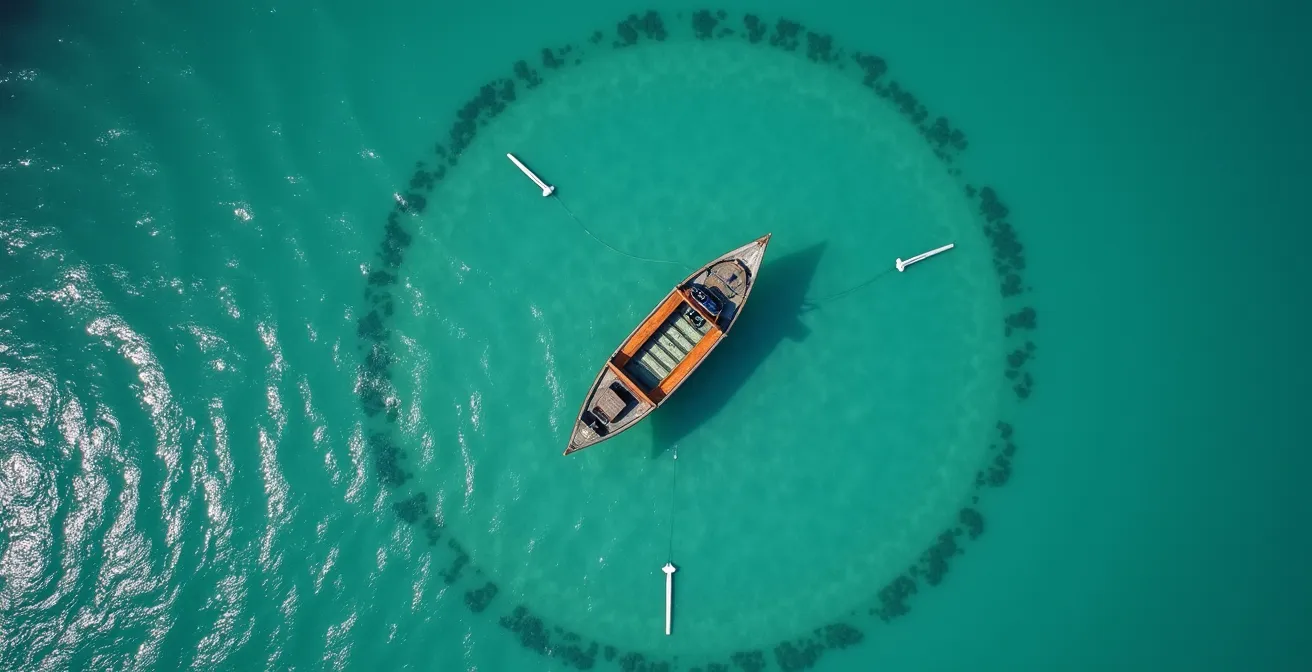
This dual-anchor setup, as shown in the diagram above, is particularly advantageous in crowded areas or tight spaces where a wide swing could be dangerous. As an added benefit, it offers significant peace of mind; if one anchor were to fail in adverse weather, the second provides a critical backup, a principle that every safety-conscious captain values. Mastering this technique is a hallmark of an expert boater and is a skill that will pay dividends for years to come.
Line Counter vs. Lead Core: Which Gets Your Lure to the Strike Zone?
For trollers, repeatable depth control is the holy grail. Getting your lure back into the strike zone after catching a fish is paramount. The two primary systems for achieving this are line-counter reels and lead-core line. Each has its own strengths and weaknesses, and the best anglers understand when to use each system—or even combine them. A line-counter reel measures the exact amount of line you’ve deployed, allowing for micro-adjustments. Paired with a standard monofilament or braided line, it offers a direct path to the lure, preserving its natural action and offering excellent stealth due to the thinner line diameter. This makes it ideal for targeting pressured fish that require a precise, delicate presentation.
Lead-core line, conversely, achieves depth by its own weight. It is a thick, color-coded line where each color segment (typically 10 yards) sinks the lure by a predetermined amount (e.g., 5 feet per color at 2 mph). This system is simple and effective for reaching deep water without extra weights, but it has drawbacks. The thick line creates a large, bowing catenary in the water, which can be less stealthy and may deaden a lure’s action at very slow speeds. It offers less precision than a line counter, as depth is controlled in fixed, color-based increments.
Many experienced trollers have found success by adopting a hybrid, systemic approach. As one case study showed, using line-counter reels spooled with short, specific segments of lead core followed by a braid backing offers the best of both worlds. This allows for the deep-diving capability of lead core but adds the repeatable deployment and micro-adjustment capability of the line counter for ultimate precision. Choosing the right system depends on the situation, but understanding the nuances of both is critical.
The following table breaks down the core differences between the two systems for precise lure presentation.
| Feature | Line Counter Setup | Lead Core |
|---|---|---|
| Precision | Micro-adjustable with backing | Fixed depth per color |
| Lure Action | Preserves natural action | Can deaden action at slow speeds |
| Stealth Factor | Thinner, more direct line path | Large underwater bow, less stealthy |
| Best Application | Pressured fish, precise depth control | Deep water, less finicky fish |
The Launch Ramp Error That Enrages Other Boaters on Saturday Morning
Nothing reveals an angler’s experience level—or lack thereof—more quickly than their conduct at the boat ramp. On busy weekends, especially as Saturday mornings see the highest traffic, the launch ramp can become a major point of congestion and frustration. The single biggest error, the one that causes the most delays and angers fellow boaters, is performing pre-launch preparations on the ramp itself. The ramp is for one thing only: launching and retrieving the boat. It is not a parking space or a staging area.
Proper ramp etiquette dictates that all preparation should be completed in the designated staging or “make-ready” area well away from the ramp. This includes loading gear, coolers, and rods into the boat, attaching lines and fenders, and—most critically—installing the drain plug. Pulling onto the ramp before you are 100% ready to launch is a cardinal sin of boating. It hogs precious real estate and forces everyone behind you to wait while you fumble with gear. Once the boat is in the water, the tow vehicle and trailer must be moved immediately to a parking spot to clear the ramp for the next person.
Proper ramp etiquette dictates that you do all of your pre-launch preparation before approaching the ramp.
– Boats.com Editorial Staff, Boat Launch: Ramp Etiquette for Loading and Unloading
Other major violations include “power loading”—using excessive engine throttle to force the boat onto the trailer, which erodes the ramp bottom—and failing to have your boat ready for retrieval before you pull your trailer down. By preparing in the staging area, you ensure a smooth, efficient process that takes only a few minutes. This demonstrates respect for your fellow boaters and marks you as a competent, conscientious captain.
Inflatable PFDs: When to Replace the CO2 Cylinder to Ensure Inflation?
As a captain, safety is your first and final responsibility. Modern inflatable Personal Flotation Devices (PFDs) are comfortable and effective, but they are not “fire and forget” equipment. Their reliability depends entirely on the integrity of their inflation mechanism, which consists of a CO2 cylinder and a water-sensitive “bobbin” or hydrostatic trigger. Assuming your PFD is fine simply because it hasn’t been used is a dangerous mistake. Regular inspection and proactive replacement are mandatory components of a systemic approach to safety.
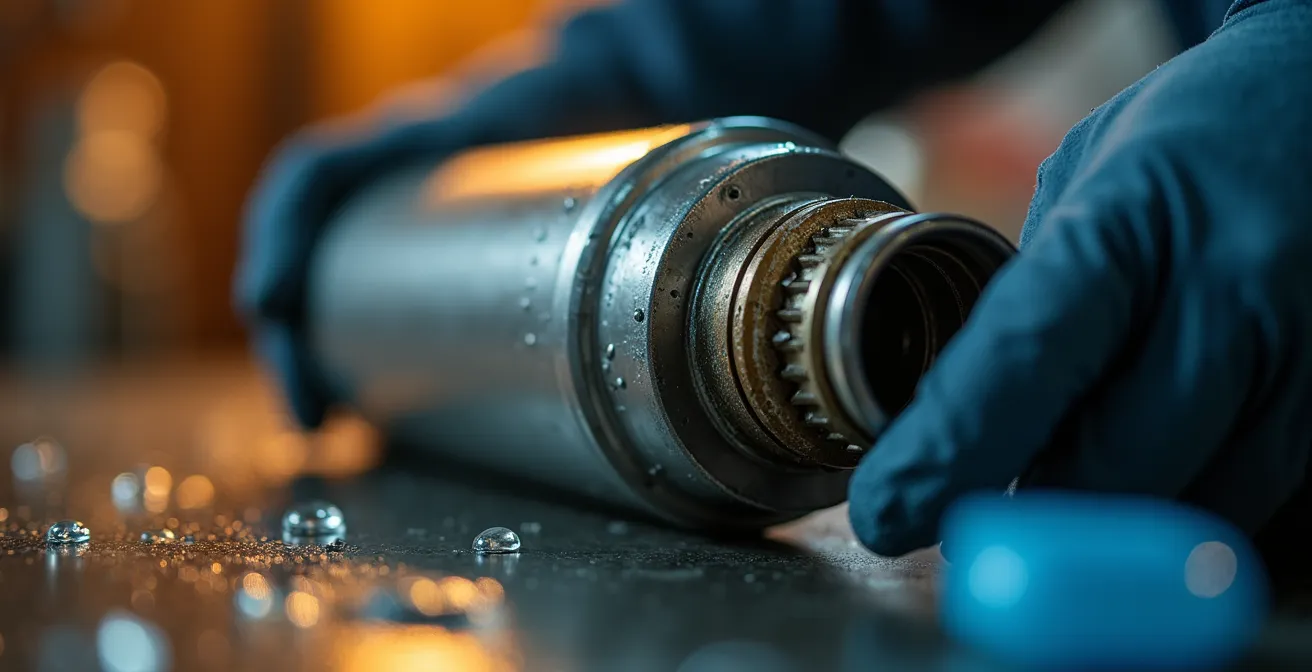
Every boater must know the protocol for CO2 cylinder maintenance. First, perform a regular visual inspection, looking for any signs of corrosion or rust around the threads and seal, especially if you operate in saltwater. Second, a cylinder can lose its charge without any visible signs. The only way to be certain is to weigh it. Use a simple kitchen or postal scale; any weight below the gross weight printed on the cylinder itself indicates a leak, and the cylinder must be replaced immediately. Heed this warning: if your PFD is ever submerged and inflates, or even if it gets soaked and doesn’t inflate, you must replace the entire re-arming kit, including both the bobbin and the CO2 cylinder.
The best practice, however, is proactive replacement. Many safety-conscious captains implement an annual replacement schedule at the beginning of each season, regardless of the cylinder’s expiration date or appearance. Considering a re-arming kit costs between $20 and $30, this small investment is negligible compared to the assurance that your life-saving device will function when you need it most. Your life, and the lives of your passengers, depend on this diligence.
The Hull Inspection Step That Prevents Zebra Mussel Transfer
A captain’s duty extends beyond their own vessel to the health of the waters we all share. One of the most significant threats to our fisheries is the spread of aquatic invasive species (AIS), particularly zebra and quagga mussels. These destructive invaders can devastate ecosystems and ruin fisheries. As boaters, we are the primary vector for their transfer between water bodies. Upholding a strict “Clean, Drain, Dry” protocol is not just a suggestion; it is a fundamental aspect of responsible boating. A visual check of the hull is not enough.
The most overlooked but critical step is a tactile inspection. Juvenile mussels, or veligers, are often invisible to the naked eye, but they feel like fine-grit sandpaper to the touch. You must physically run your hand carefully over the entire hull, paying special attention to areas near the waterline, around trim tabs, and on transducer brackets. Beyond the hull, you must inspect all hidden voids where water can be trapped: engine intake ports, livewell plumbing, and even the carpet on trailer bunks. Anything that was wet must be inspected.
After cleaning and draining all water from the boat, bilge, and livewells, the “Dry” portion of the protocol is your most effective weapon. According to research on AIS prevention, drying the boat for at least 5 days in warm, summer conditions is the most effective non-chemical method to kill any missed mussels and veligers. In cooler or more humid weather, this drying time should be extended. Some regions, like those west of the 100th Meridian, are designated as high-risk zones and may have mandatory inspection stations. Fulfilling your role in preventing the spread of AIS is a core tenet of being a responsible and ethical angler.
The Safety Myth That Stops Communities from Approving Urban Archery
As responsible members of the outdoor community, it’s important to understand wildlife management issues beyond just fishing. One such issue is the management of overabundant deer populations in suburban and urban areas, which leads to landscape damage and dangerous deer-vehicle collisions. Urban archery programs are an effective, targeted management tool, but they are often met with public resistance fueled by a persistent safety myth: the fear of wounded deer running through neighborhoods or stray arrows endangering residents. A responsible outdoorsperson should be armed with the facts to dispel this misinformation.
The data from established urban archery programs paints a very clear picture that contradicts this myth. The vast majority of deer harvested with modern archery equipment expire quickly and within a very short distance. One analysis of program safety records found that most animals travel less than 100 yards after the shot, typically expiring within the same park or greenspace where the hunt occurred. Incidents of arrows traveling outside designated hunting areas or causing property damage are virtually nonexistent in well-run programs that require proficiency testing and hunting from elevated stands.
When the risks are properly contextualized, the argument becomes even clearer. The perceived danger of urban archery pales in comparison to the very real and documented danger of unmanaged deer populations.
This risk comparison starkly illustrates that a professionally managed urban archery program is an exceptionally safe and effective public safety tool.
| Risk Factor | Urban Archery | Deer-Vehicle Collisions |
|---|---|---|
| Annual Incidents | Near zero in established programs | 1.5 million annually in US |
| Fatalities | 0 documented | 200+ per year |
| Property Damage | None | $1 billion+ annually |
| Control Measures | Elevated stands, proficiency tests, restricted hours | Limited options |
Key takeaways
- Precision Control is Paramount: True boat mastery comes from the ability to precisely control your vessel’s position and your lure’s depth using advanced anchoring, trolling, and sonar interpretation techniques.
- Safety is a System, Not a Gadget: Your responsibility as a captain is to maintain a systemic approach to safety, which includes rigorous, proactive inspection and maintenance of all life-saving equipment.
- Environmental Stewardship is Non-Negotiable: Every boater has a fundamental duty to actively prevent the spread of aquatic invasive species through strict adherence to “Clean, Drain, Dry” protocols.
Tournament Fishing: How to Manage Mental Stress When the Bite Dies?
All the technical skill in the world won’t help you when the pressure mounts and the fish stop biting. This is especially true in tournament fishing, but the lesson applies to any angler who takes their craft seriously. When the bite dies, it’s easy to fall into a spiral of panic and “junk fishing”—frantically changing lures and locations with no clear strategy. This is where mental fortitude separates the consistently successful angler from the rest. Managing this stress requires a pre-planned, systematic approach to reset your focus and get back on a productive pattern.
When faced with a dead bite, your first move shouldn’t be to panic, but to execute a pre-planned mental reset protocol. A highly effective method involves four steps. First, stay in a high-confidence area but begin a systematic downsizing of your presentation—progressively using a smaller lure, lighter line, or a slower retrieve. If that doesn’t trigger a bite, enact a hard reset: stow all your rods for 10 minutes, hydrate, eat a high-energy snack, and review your lake map away from the distracting glow of the sonar screens. This break allows you to shift your focus from the negative outcome (not catching fish) back to the process. Concentrate on executing your next ten casts perfectly, rather than on the immediate need to catch a fish.
This micro-focus on controllable actions reduces pressure and anxiety, and ironically, often leads to a bite.
– Tournament Psychology Expert, Mental Game Strategies for Competitive Fishing
Finally, a true professional always has a “bailout” strategy. This is a completely different pattern you’ve identified in practice (e.g., switching from a deep offshore ledge to a shallow weedline) that you can turn to when your primary plan fails. Having this fallback gives you the confidence to stay disciplined and avoid making panicked decisions. This mental toughness is the final piece of the puzzle, transforming good anglers into great ones.
By integrating these advanced skills—from technical boat control and environmental responsibility to mental discipline—you elevate your craft. The next logical step is to consciously apply one of these principles on every trip until it becomes an ingrained habit, building your expertise and confidence on the water.