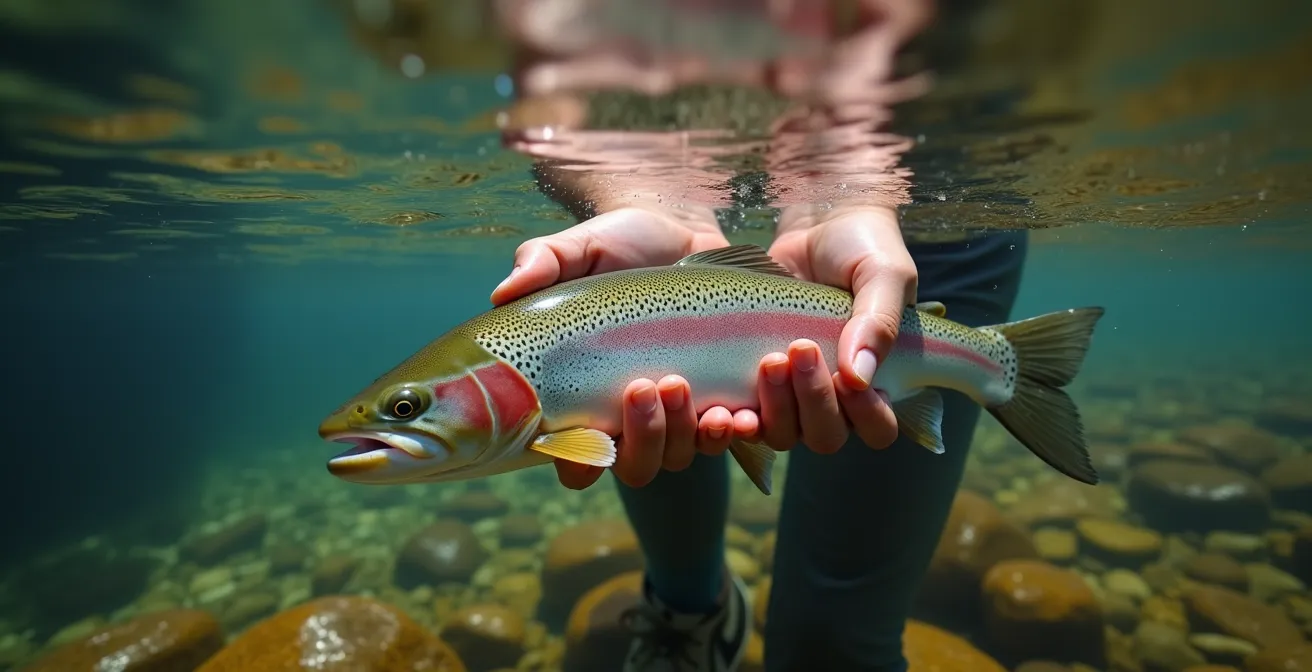
True angling conservation goes far beyond simply using barbless hooks. It requires understanding the critical science behind our actions—from the physiological stress of air exposure to the genetic importance of large fish. This guide moves past the common advice to reveal eight evidence-based practices that empower conscientious anglers to become proactive stewards of our fisheries, ensuring their health and viability for generations to come.
For any conscientious angler, the desire to protect the resource we love is instinctual. We follow the unwritten rules of catch-and-release, handle fish with care, and believe we’re doing our part. We’re often told the solution is simple: use barbless hooks, wet your hands, and release fish quickly. While these are good starting points, they are merely the surface of a much deeper and more complex ecological responsibility. Relying on this basic checklist alone can create a false sense of security, masking impacts we don’t see.
The conversation around angling ethics is often limited to gear choices, but the real impact lies in our understanding of fish physiology and ecosystem dynamics. What if the true key to minimizing mortality wasn’t just the hook, but the 15 seconds a fish spends out of water for a photo? What if the decision to keep a medium-sized bass instead of a trophy was a more powerful act of conservation than releasing a dozen small ones? This is the core of modern, science-based conservation: moving from following rules to understanding consequences.
This article adopts that forward-thinking perspective. We will deconstruct common angling habits and examine them through a scientific lens. By exploring the critical “why” behind the “how,” you will gain a deeper appreciation for your role in the ecosystem. We will cover the unseen damage of air exposure, the ethics of targeting spawning fish, the vital importance of genetic stewardship, and the hidden environmental costs of our tackle and bait choices, transforming you from a participant into a true guardian of the fishery.
text
To guide you through this deeper level of angling stewardship, this article is structured to explore the science and practical application behind each critical conservation concept. The following sections will provide actionable insights to elevate your impact on the water.
Summary: Practices of a Modern Conservation-Minded Angler
- Why Air Exposure Exceeding 10 Seconds Drastically Lowers Survival?
- The Unethical Habit of Targeting Bedding Bass That Hurts Recruitment
- Tungsten vs. Steel Weights: Which Alternative Sinks Faster?
- Why Keeping Medium Fish Is Better for the Gene Pool Than Keeping Giants?
- Why Dumping Leftover Worms Can Destroy Local Forest Ecosystems?
- Why Switching to Copper Ammo Is the Single Biggest Eco-Move You Can Make?
- How to Identify a ‘Stunted’ Bluegill Population Before It Crashes?
- How to Revive a Deeply Exhausted Trout in Fast Current?
Why Air Exposure Exceeding 10 Seconds Drastically Lowers Survival?
For a fish, being out of water is not just uncomfortable; it is a rapid progression toward suffocation and severe internal damage. While anglers may focus on hook wounds, the single greatest threat during catch-and-release is often air exposure. Any duration beyond 10 seconds begins a cascade of physiological stress from which a fish may never recover, even if it swims away seemingly unharmed.
The primary mechanism of failure is the collapse of the gill lamellae. These delicate, feather-like structures are designed to extract oxygen from water, but they rely on the water’s buoyancy to remain separated. In the air, gravity and surface tension cause them to clump together, drastically reducing the surface area available for gas exchange. This leads to immediate oxygen deprivation and a buildup of carbon dioxide and lactic acid in the bloodstream. The impact isn’t just theoretical; research on Atlantic Salmon shows the stark reality. One study found that fish not exposed to air produced twice as many offspring as those exposed for up to 10 seconds, and three times as many as those exposed for more than 10 seconds. This demonstrates that even brief air exposure can cripple a fish’s reproductive fitness, a delayed form of mortality that impacts the entire population.
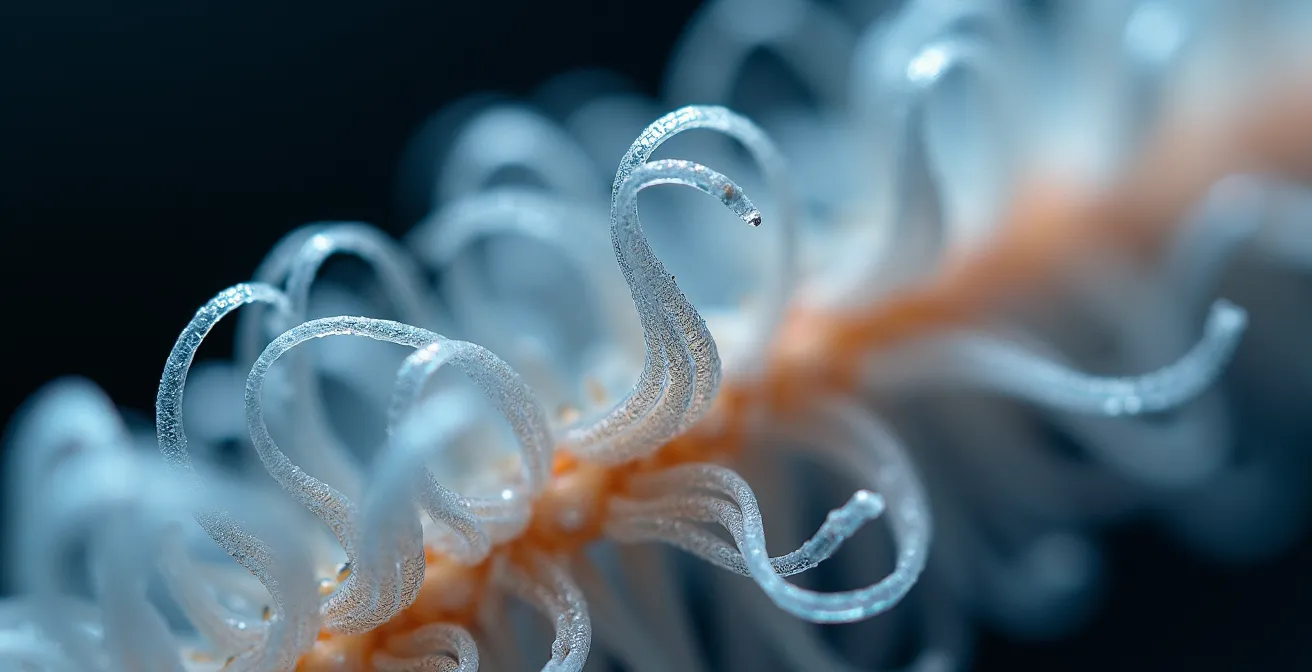
As the illustration above shows, the intricate structure of the gills is incredibly fragile. The rule for every angler should be to minimize air exposure at all costs. This means preparing your camera and release tools before lifting the fish, using rubberized nets to handle the fish in the water, and adhering to a strict “no more than 10 seconds” rule—long enough for a quick photo, but short enough to give the fish its best chance at survival and successful reproduction.
The Unethical Habit of Targeting Bedding Bass That Hurts Recruitment
The sight of a large bass locked on its nest, aggressively defending its territory, can be an irresistible target for many anglers. However, catching these “bedding” bass is one of the most detrimental and ethically questionable practices in freshwater fishing. It’s not just about disturbing one fish; it’s an act that can trigger an ecological cascade, leading to complete reproductive failure for that nest and damaging the future of the fishery.
When a male bass is hooked and pulled from its nest, even for a few minutes, the unguarded eggs or fry become immediately vulnerable. Swarms of smaller fish like bluegill and perch, which were held at bay by the protective male, rush in to feast. The impact is swift and devastating. Beyond opportunistic predation, studies have documented approximately 90% nest abandonment rates after a male bass is caught just once or twice. Once the nest is raided, the male often sees no reason to return, and the entire brood is lost.
This is not simply a matter of opinion; it is a well-documented biological phenomenon. As a leading expert in bass biology, Dr. David Philipp, explained to the Jackson Kayak Hub, the consequences are immediate:
removing the guarding male, even for a few minutes, triggers immediate predation on the eggs by smaller fish (bluegill, perch) and nest raiding by subordinate bass
– Dr. David Philipp, Jackson Kayak Hub – The Impact of Nest Fishing for Smallmouth Bass
This direct cause-and-effect relationship means that targeting bedding bass is an act of conscious destruction. True conservationists understand that the short-term thrill of a single catch is not worth compromising an entire generation of fish. The most ethical and responsible choice is to leave spawning fish undisturbed, ensuring that the crucial process of recruitment can succeed.
Tungsten vs. Steel Weights: Which Alternative Sinks Faster?
For decades, lead has been the standard material for fishing weights due to its density and low cost. However, its high toxicity is undeniable. Lost sinkers and jigs leach lead into aquatic ecosystems, poisoning waterfowl, loons, eagles, and other wildlife that ingest them. As responsible anglers, moving away from lead is a critical step in reducing our environmental footprint. The two primary alternatives are tungsten and steel, but they offer very different performance characteristics, particularly concerning sink rate.
The answer to which sinks faster is unequivocally tungsten. Density is the key factor, and tungsten is significantly denser than both steel and lead. In fact, tungsten’s superior density makes it nearly 1.7 times denser than lead, and far denser than steel. This means that a tungsten weight of the same mass will be much smaller, allowing it to cut through the water column with less resistance. This results in a faster sink rate, increased sensitivity for detecting subtle bites, and better performance in current or deep water. Steel, while an excellent non-toxic option, is less dense than lead, meaning a steel weight will be bulkier than a lead weight of the same mass, causing it to sink more slowly.
The environmental and performance trade-offs are clear. While steel is a perfectly benign and affordable alternative for many shallow-water applications, tungsten offers superior fishing performance in a non-toxic package. The choice depends on the application, but both are infinitely better than the legacy of lead poisoning.
To better understand the materials, this comparative analysis of their environmental impacts provides a clear overview.
| Material | Toxicity | Density vs Lead | Environmental Impact if Lost |
|---|---|---|---|
| Tungsten | Non-toxic | Higher | Inert, harmless |
| Steel | Non-toxic | Lower | Benign, rusts naturally |
| Lead | Highly toxic | Baseline | Persists 100-300 years, poisons wildlife |
Why Keeping Medium Fish Is Better for the Gene Pool Than Keeping Giants?
The “let the big ones go” mantra is a cornerstone of catch-and-release culture, and for good reason. However, a more sophisticated approach to genetic stewardship suggests that selectively harvesting medium-sized, “slot-limit” fish while always releasing the largest specimens is even better for the long-term health of a fishery. This practice protects the most valuable contributors to the gene pool: the giant, mature females.
These massive fish are often referred to by fisheries biologists as BOFFFFs (Big Old Fat Fecund Female Fish). They are not just big; they are genetically superior survivors that have proven their ability to thrive in their environment. More importantly, they produce exponentially more eggs—and higher quality eggs—than smaller fish. Removing these genetic powerhouses from the population is like removing the best breeding stock from a herd. Over time, this can lead to a fishery dominated by smaller, slower-growing fish, a phenomenon known as “high-grading.”
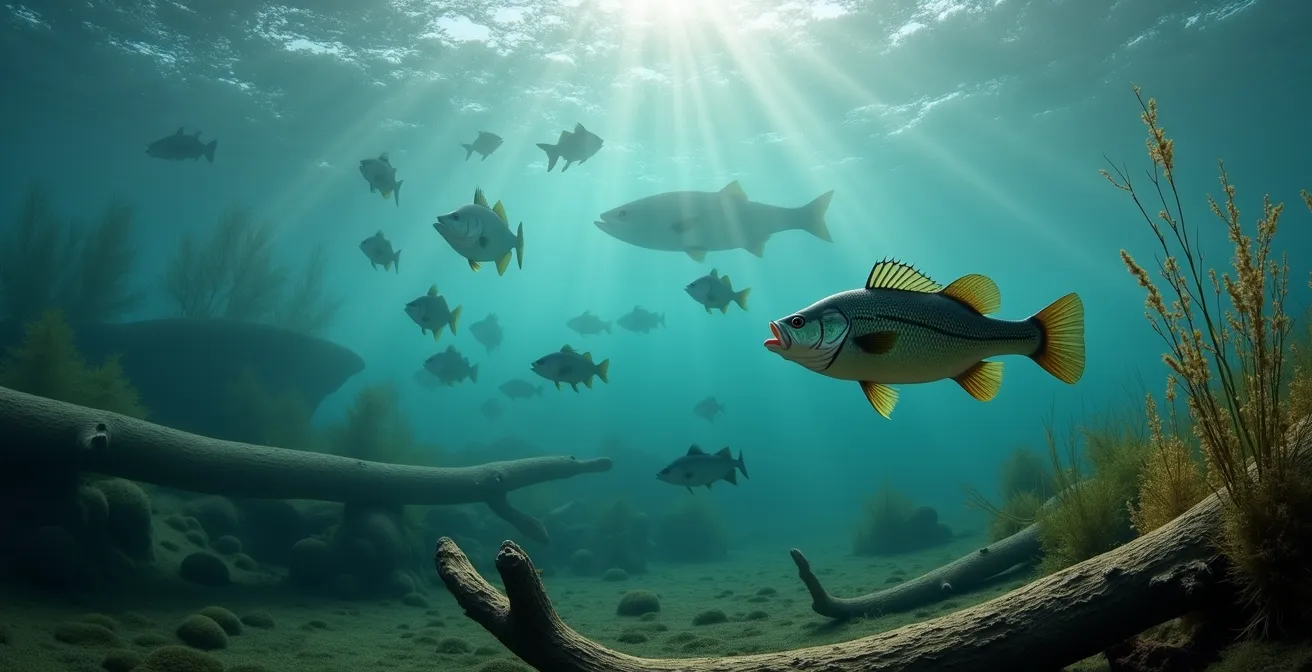
By contrast, harvesting a few medium-sized fish from the most abundant part of the population has a minimal impact on the gene pool. This practice can also improve the fishery by reducing competition for food, allowing remaining fish to grow larger and faster. A healthy population, as visualized above, has a wide base of small and medium fish supporting a smaller number of top-tier breeders. The responsible harvest of a few individuals from the middle of this pyramid ensures the apex—the crucial BOFFFFs—remains intact to propagate superior genetics for future generations.
Why Dumping Leftover Worms Can Destroy Local Forest Ecosystems?
It seems like a harmless, even generous, act: you’ve finished fishing for the day and have a few earthworms left. Tossing them into the nearby woods feels like returning them to nature. However, this common practice can have devastating consequences for local forest ecosystems, particularly in regions of North America that were once covered by glaciers, such as the Northeast and Upper Midwest.
The forests in these regions evolved for thousands of years without native earthworms. Their ecosystems are built upon a thick, slow-to-decompose layer of leaf litter on the forest floor, known as “duff.” This duff layer is a critical habitat for native wildflowers, ferns, and tree seedlings, as well as insects and salamanders. When non-native earthworms—like the common nightcrawlers sold as bait—are introduced, they act as aggressive ecosystem engineers. They rapidly consume this vital duff layer, fundamentally altering the soil structure and nutrient cycles. This process is a direct threat to ecosystem integrity.
The result is a forest floor that is bare and compacted, unable to support the native understory plants that countless other species rely on. This creates an opening for invasive plant species to take hold, further degrading the habitat. The seemingly innocent act of dumping a cup of worms is, in fact, an act of introducing an invasive species. It’s a stark reminder that our responsibility as conservationists doesn’t end at the water’s edge. Proper disposal of all bait is crucial to prevent unintended and long-lasting harm to the surrounding terrestrial environment.
Why Switching to Copper Ammo Is the Single Biggest Eco-Move You Can Make?
For the many anglers who are also hunters, the conservation mindset extends from the water to the woods. Just as we are moving away from lead tackle, the single most impactful change a hunter can make for wildlife is switching from lead to non-toxic ammunition like copper. A lead bullet fragment the size of a grain of rice is enough to kill a bald eagle, and the gut piles and unrecovered game left in the field become toxic bait for countless scavengers.
The devastating effect of lead poisoning on wildlife is not a theory; it is a documented crisis. Scavenging birds like eagles, condors, and vultures are particularly vulnerable. A compelling case study involving a California condor demonstrated that ingestion of a copper-based bullet did not result in poisoning, while a lead fragment in the same bird contributed to lead toxicity. This provides clear evidence of copper’s safety and lead’s persistent danger within the food chain. Every gut pile left behind with lead fragments is a potential death sentence for the next animal that feeds on it.
Some hunters may worry about the effectiveness of non-lead alternatives, but modern copper bullets are renowned for their terminal performance, often outperforming traditional lead-core bullets with superior weight retention and deep penetration. The switch is not a compromise on performance; it’s an upgrade in responsibility. As noted by a leading hunting publication, the effectiveness of copper is a primary feature, not a secondary benefit.
Copper bullets weren’t developed to prevent plumbism but to kill game more effectively, and they do
– American Hunter Magazine, NRA’s Official Journal – 2012 Ammunition Product of the Year Award
By making the switch to copper, hunters can eliminate a significant source of lead in the environment, protecting the same ecosystems they cherish. It is a direct and powerful action that aligns the pursuit of hunting with the core principles of wildlife conservation.
How to Identify a ‘Stunted’ Bluegill Population Before It Crashes?
Catching dozens of small, “pan-sized” bluegill might seem like a sign of a healthy, abundant fishery. However, it can often be a warning sign of a population in trouble—a “stunted” population. A stunted population is one where intense competition for limited food resources prevents fish from growing to a normal size. This is usually caused by an imbalance in the ecosystem, specifically a lack of predator fish like largemouth bass to keep the bluegill numbers in check.
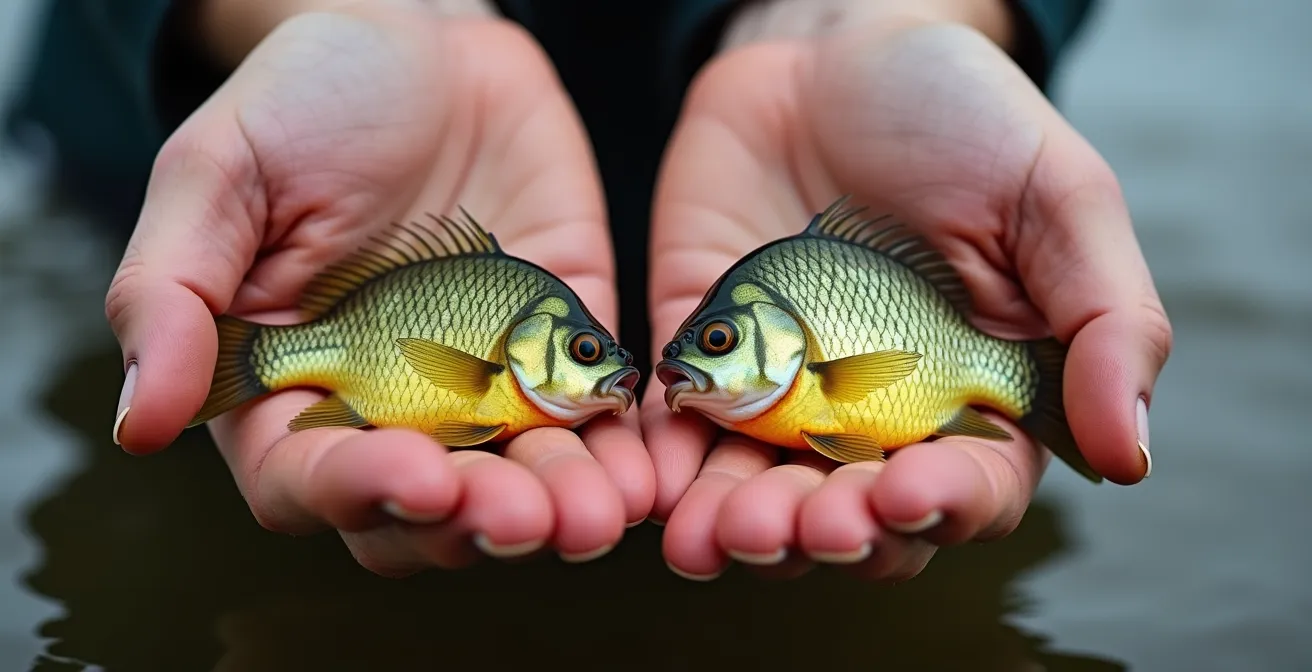
Identifying a stunted population early is crucial for any angler who wants to be a good steward of their local waters, as it indicates a system on the verge of crashing. These fish are not “babies”; they are often several years old but are chronically underfed. They typically exhibit a distinct “big-head, small-body” morphology, with disproportionately large eyes and a body that looks thin or “paper-like.” If nearly every bluegill you catch is in the 3-5 inch range, with a noticeable absence of larger specimens, you are likely dealing with a stunted population.
Recognizing these signs allows you to make more informed decisions. For example, selectively harvesting a significant number of these small bluegill (where regulations permit) can actually help the fishery by reducing competition and allowing the remaining fish to grow larger. It transforms a simple fishing trip into a meaningful act of fishery management.
Field Diagnostic Checklist: Identifying Stunted Bluegill
- Catch a sample of 10-15 bluegill from various areas of the water body.
- Examine for a big-head, small-body morphology—disproportionately large eyes and heads with thin bodies.
- Measure and record the size distribution; if nearly all are 3-5 inches with no larger specimens, suspect stunting.
- Compare body condition; stunted fish often appear ‘paper-like’ and feel thin despite being sexually mature.
- Assess predator presence; a lack of healthy largemouth bass, pike, or other predators often correlates with bluegill overpopulation.
Key Takeaways
- Physiological Reality Over Rules: Understanding the science of gill collapse and lactic acid buildup is more important than just following generic catch-and-release guidelines.
- Act as a Genetic Steward: Protecting the largest breeding fish (BOFFFFs) and selectively harvesting from abundant mid-size populations is a powerful tool for long-term fishery health.
- Your Footprint is Bigger Than Your Hook: The conservation mindset must extend to your choice of tackle (non-toxic weights) and your disposal of bait to prevent broader ecosystem harm.
How to Revive a Deeply Exhausted Trout in Fast Current?
The final, critical moment of catch-and-release is the revival. After a long fight, a fish is in a state of extreme physiological stress, its muscles flooded with lactic acid and its body depleted of oxygen. Simply tossing it back into the water is often a death sentence. A proper revival, especially for species like trout in moving water, requires patience and a specific technique to ensure the fish fully recovers and has the strength to survive.
Improper revival is a significant and often overlooked cause of post-release mortality. In fact, research shows that improper revival techniques can cause an additional 20% reduction in survival, even for fish that seem to swim away. The key is to help the fish process oxygen and regain its equilibrium. In a river or stream, this means holding the fish gently in the water, facing upstream into the current. This allows a steady flow of oxygen-rich water to pass over its gills without the fish needing to expend energy. Never “pump” the fish back and forth; this can damage the delicate gills and disrupt the natural flow of water.
The fish will tell you when it is ready. A professional guide’s firsthand experience provides the best advice on what to look and feel for during this crucial process:
If you played it for a while you may have to hold it in the water for a longer period to allow it to recover. A poorly recovering fish will have trouble keeping itself upright and will be moving its gills rapidly. Wait until you feel the momentum of the tail or the feel of the body tense before you release her. These are both signs that she’s ready to go.
– Professional Fishing Guide, Global FlyFisher
When you feel that strong tail kick or the body tensing, it’s a clear signal that its systems have recovered enough for it to navigate the current on its own. Releasing it before this point forces an exhausted fish to fight the current, often leading to it being swept away and perishing out of sight. This final act of patience is the ultimate sign of respect for the fish and a commitment to its survival.
Frequently Asked Questions About Angling and Ecosystem Impact
What should I do with leftover fishing worms?
The best options are to take them home for your next fishing trip or offer them to another angler at the fishing spot. This completely prevents any risk of introducing a non-native species.
Can I compost unused bait worms?
Yes, adding bait worms like nightcrawlers to a home compost pile is an excellent and environmentally safe way to dispose of them. They will contribute positively to the composting process without disrupting a wild ecosystem.
What if I absolutely must dispose of worms on site?
As an absolute last resort, if you cannot take them with you, the worms must be killed before being disposed of in a trash receptacle. Leaving them on hot pavement or another method to ensure they are dead prevents any chance of them becoming an invasive species in the local soil.